
Key takeaways
- The minimum wage applies according to the area where the store operates rather than where the company has its head office, so a chain with stores in several regions must check each address before applying the new rates from 1 January 2027[1].
- Part-time staff who work to a shift roster, are managed by a shift leader and are paid wages are employees, need an employment contract and may be subject to compulsory social insurance[3][4].
- A night shift should be designed as a normal working shift with additional night pay, rather than extending the day shift into overtime, because the cost and the overtime limits differ significantly.
- A business may not require cashiers to pay a deposit, may not impose fines and may only claim compensation for shortages after determining fault following the procedure in the internal labour rules[3].
After the cost of goods, labour is the largest expense of a convenience store chain, and also where violations most easily arise. A store open 24 hours needs three shifts a day, one of them running past midnight, with a workforce made up of full-time staff, students working part time, seasonal workers at Tet and sometimes even persons under 18. Cashiers handle cash and high-value goods every shift, so questions about shortages, compensation and discipline come up almost every week.
This page introduces Justeps’ service of standardising labour, wages and social insurance for convenience store chains, mini-supermarkets and specialist store chains. It focuses on the particular features of the sector, namely the regional minimum wage for each store, night shifts, part-time staff, cashiers’ material liability, safety on night work and the management of foreign employees. The number of people and positions in each store model is determined beforehand under the organisational structure design service for retail chain and convenience store businesses, while this page deals with the employment relationship with each individual.
The regional minimum wage for each store
The decree on minimum wages sets monthly and hourly rates for four regions, and a business applies the rate of the area in which it operates. Where a business has a branch or unit operating in an area of a different region, that unit applies the rate of the area in which it operates[1]. For a retail chain, this means that a store in a city centre and a store in a commune of a neighbouring province may have different floors, even though they belong to the same company and the same payroll.
The hourly minimum wage is particularly important for part-time staff paid by the hour. The chart below compares the hourly minimum wage of the four regions in 2026 and from 1 January 2027.
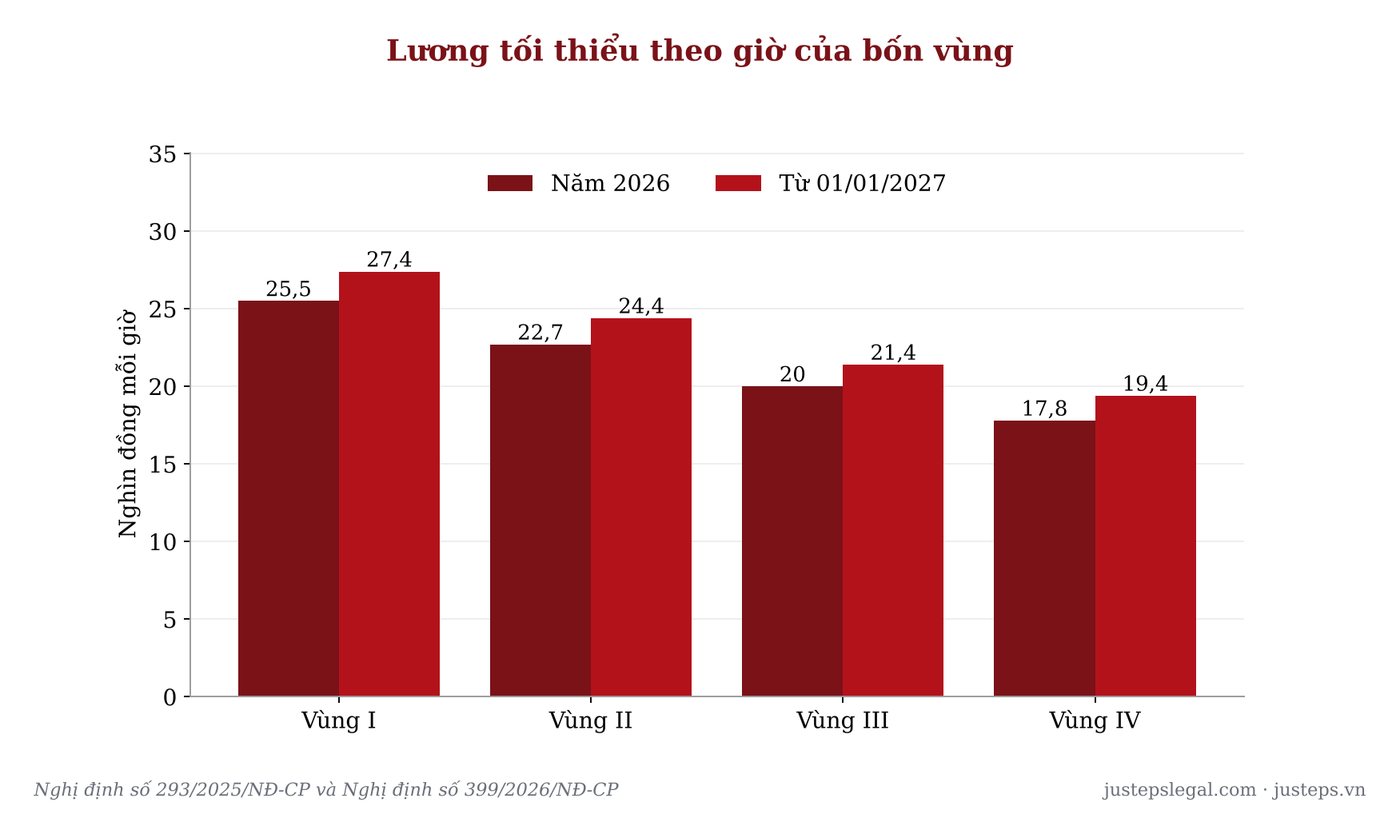
Hourly minimum wage of the four regions in 2026 and from 1 January 2027
Under Decree No. 293/2025/ND-CP, the hourly minimum wage in 2026 is VND 25,500 in Region I, VND 22,700 in Region II, VND 20,000 in Region III and VND 17,800 in Region IV[2]. From 1 January 2027, Decree No. 399/2026/ND-CP raises these rates to VND 27,400, VND 24,400, VND 21,400 and VND 19,400 respectively[1]. These are the floors for normal working hours, before additional pay for night work and overtime. Justeps prepares a table matching each store to its wage region, reviews the hourly rates of each group of staff and identifies the cases that must be adjusted before 1 January 2027.
Part-time staff, students and contracts
Many chains call shift staff collaborators or sign service contracts with them to avoid paying social insurance. Under the Labour Code, an agreement on paid work, with wages and under the management, direction and supervision of one party, is regarded as an employment contract regardless of what the parties call it[3]. A student staffing the counter on a shift roster set by the store, wearing a uniform, following the shift closing procedure and supervised by the shift leader usually satisfies all of these indicators.
As regards insurance, the 2024 Law on Social Insurance has expanded the scope of compulsory contributions to include part-time workers whose monthly wages reach the prescribed level or above[4]. Justeps reviews each group of workers to determine who is subject to social insurance, health insurance and unemployment insurance, and who is not yet subject but from whose wages the business must still withhold personal income tax. For contributions that have been underpaid, Justeps estimates the amount to be paid in arrears and draws up a roadmap so that the business can remedy the situation proactively.
Employment contracts may be concluded by electronic means, which suits chains with many staff joining and leaving each month[5]. Justeps drafts separate contract templates for full-time staff, part-time shift staff and seasonal workers for peak periods, with appendices on the shift booking window, the calculation of hourly pay and responsibility for managing cash and goods.
Night shifts, breaks and public holidays
Under the Labour Code, night-time working hours run from 10 p.m. to 6 a.m. the following morning, and a person working at night is paid at least 30% more than the wage for the same work done during the day[3]. A person working a continuous shift of six hours or more is entitled to a break, and the break on a night shift is longer than on a day shift. Stores with only one or two people on the night shift often cannot arrange a proper break, so the roster needs to specify the time of the break and who covers the counter while one person is on break.
Some chains extend the afternoon shift to midnight and count the time after 10 p.m. as overtime. This both raises costs, because both the overtime rate and the night supplement must be paid, and makes it easy to exceed the monthly and annual overtime limits. Justeps designs the night shift as a normal working shift with its own staff and a clear night allowance in the wage regulation, and uses overtime only when someone is unexpectedly absent. From 1 March 2027, employees will have additional public holidays on 27 July and 24 November[6], so chains that open on public holidays need to update their rosters and their holiday pay budgets.
Cashiers’ material liability
Cash shortages at shift close and stock shortages at stocktakes are an everyday occurrence in convenience stores, and the common response is to deduct the amount directly from wages or require staff to pay a deposit when taking on cashier duties. Both practices breach labour law, because the employer may not retain original documents or require employees to provide security in money, and may not use fines or wage cuts in place of disciplinary action[3]. Requiring an employee to pay a deposit when entering into a contract is also subject to administrative penalties[7].
A cashier is only liable to pay compensation when fault and actual loss have been established, following the procedure set out in the internal labour rules. The flowchart below describes the procedure Justeps builds for convenience store chains.
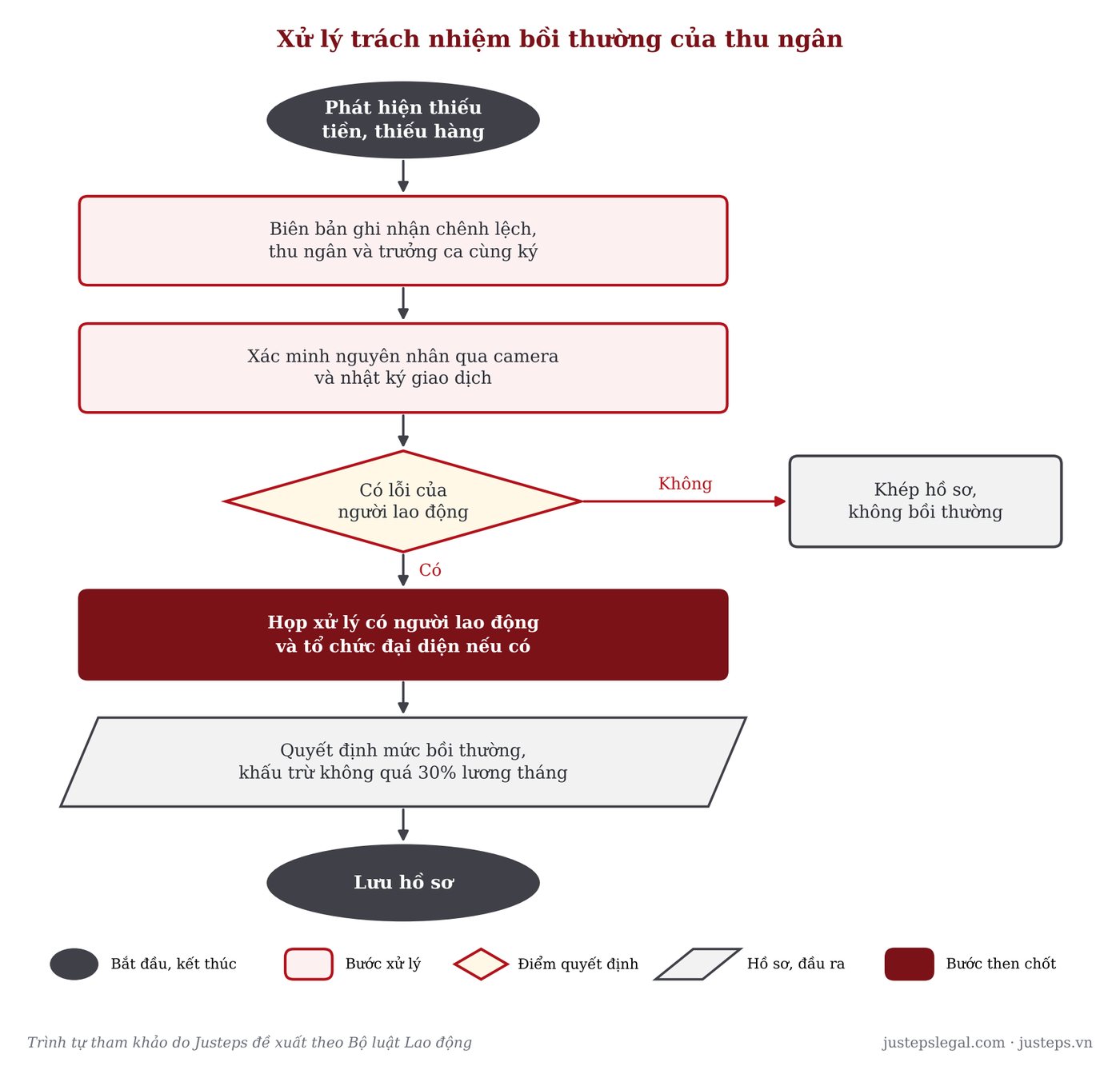
Procedure for handling liability for compensation when a cashier is short of cash or goods
The procedure begins with a report recording the discrepancy, signed by the cashier and the shift leader, after which the loss prevention unit verifies the cause through CCTV and the transaction log. If no fault on the part of the employee can be established, for example where the discrepancy is due to the scanner, a short delivery by the supplier or external theft, the case is closed without compensation. If there is fault, the business holds a meeting attended by the employee and by the employee representative organisation, if any, and decides the amount of compensation taking into account the degree of fault, the actual loss and the employee’s circumstances. The compensation is deducted from wages in instalments, but each month the deduction may not exceed 30% of the wages actually paid after deducting insurance contributions and personal income tax[3]. The shift closing and reconciliation steps that lead to the initial report are described under the internal procedures and regulations service for retail chain and convenience store businesses.
Sales bonuses and wages subject to social insurance
Retail chains usually pay a basic wage, a night-shift allowance, a responsibility allowance for shift leaders and a bonus based on the store’s sales or stocktake results. The wages on which compulsory social insurance contributions are based comprise the wage rate, wage allowances and other supplementary amounts agreed to be paid regularly and consistently in each pay period[4]. An amount called a bonus but in substance paid as a fixed monthly sum regardless of results may still be treated as subject to insurance contributions.
A common error is splitting wages into numerous allowances for fuel, telephone or housing in order to lower the contribution base, when these amounts are paid equally to everyone without supporting documents. Justeps builds a wage and bonus regulation that clearly distinguishes which amounts are tied to results and which are fixed allowances, together with pay scales and pay tables for each position according to the store’s region. A business that needs detailed pay scales and pay tables can combine this with the pay scale and wage and bonus regulation service.
Minors, night-shift safety and managing foreign employees
Pupils aged from 15 to under 18 may be employed, but the business must limit their working hours, may not assign them overtime or night work except in certain cases, and must keep a separate register[3]. The law on alcohol and beer also does not allow persons under 18 to be directly involved in selling alcohol and beer[8]. Justeps recommends not placing minors on night shifts and not assigning them to the till in stores that sell alcohol, beer or tobacco.
Night-shift staff face the risk of robbery, theft and disruptive customers. The business is obliged to ensure occupational safety and health, train employees and arrange periodic health checks[9], together with fire prevention and fire fighting training for store staff. Justeps drafts safety guidance for night shifts, covering the cash limit in the till, a rule against resisting robbers, the procedure for reporting to the police and the support available to injured staff.
Foreign-invested chains often bring in foreign regional managers or operations directors. Work permit applications submitted up to and including 4 December 2026 are governed by Decree No. 219/2025/ND-CP[10], while from 5 December 2026 Decree No. 393/2026/ND-CP applies, with redefined criteria for experts, managers and technical workers[11]. Justeps reviews each person’s file to determine when to apply and which documents to prepare.
Implementation process, deliverables and fees
A project usually takes about eight weeks. In the first two weeks Justeps reviews contracts, timesheets, payrolls and social insurance records for the last three to six months at head office and several stores, and interviews the human resources team and regional managers. In the third week Justeps sends a risk report with an estimate of any social insurance arrears, so that the leadership can confirm its shift and pay policies. From the fourth to the sixth week Justeps drafts the contracts, the wage regulation and the internal labour rules, then consults the employee representative organisation, if any, files the internal labour rules for registration where the business has 10 or more employees and trains regional managers and store managers in the final two weeks[3]. The deliverables comprise the following documents:
- A labour, wage and social insurance compliance review report, with an estimate of any arrears.
- A set of employment contracts for full-time, part-time and seasonal staff, with an agreement on responsibility for managing cash and goods.
- A regulation on wages, bonuses and night-shift allowances, and pay scales and pay tables by the region of each store.
- Internal labour rules with a procedure for handling shortages and compensation, together with the registration file.
- Forms for shift rosters, timekeeping, discrepancy reports and minutes of compensation meetings.
- A table of persons subject to social insurance and safety guidance for night shifts.
Justeps quotes a fixed project fee in writing after the initial discussion. The fee depends on the number of employees and stores, the number of wage regions, the number of contract groups, whether there are social insurance arrears or existing labour disputes, and training needs. A business concerned about the social insurance coverage of part-time staff can start with the compulsory social insurance advisory service.
How Justeps can help
Alongside labour, wages and social insurance services, retail chain and convenience store businesses can combine the following Justeps services:
- Organisational structure design for retail chain and convenience store businesses. Justeps defines the positions, the shift leader tier and staffing by time slot on which contracts and rosters are based.
- Internal procedures and regulations for retail chain and convenience store businesses. Justeps writes procedures for shift closing, stocktaking and write-offs so that discrepancy reports provide a sufficient basis for assessing liability.
- Internal labour rules and disciplinary action. Justeps drafts and registers the internal labour rules and guides store managers on the procedure for discipline and compensation.
- Pay scales and wage and bonus regulations. Justeps builds pay scales, pay tables and a sales bonus regulation according to the region of each store.
- Compulsory social insurance advisory. Justeps determines coverage, the contribution base and the roadmap for paying arrears for each group of staff.
Frequently asked questions
Do part-time staff have to pay social insurance?
They may. The 2024 Law on Social Insurance brings part-time workers whose monthly wages reach the prescribed level or above within compulsory coverage[4]. Justeps makes the determination based on each person’s actual wages and type of contract.
Which regional minimum wage applies to a store in a province other than the head office?
The rate of the area in which the store operates applies, not that of the place where the company has its head office[1]. A chain with stores in several provinces should prepare a table matching each address to its region.
May a cashier be required to pay a deposit when starting work?
No. Labour law prohibits requiring employees to provide security in money or property when entering into or performing a contract[3], and this conduct is subject to administrative penalties[7].
Are sales bonuses included in the wages subject to social insurance?
A bonus that genuinely depends on business results is usually not part of the wages subject to social insurance. If the bonus is paid as a fixed monthly amount like an allowance, it may be subject to contributions[4].
Do students working part time in a store need an employment contract?
Yes, if the student works to a shift roster, is paid wages and is managed by the store. Such an arrangement is an employment contract even if the parties call it something else[3].
Should pupils under 18 be placed on night shifts?
They should not. The law restricts night work by minors[3] and does not allow persons under 18 to sell alcohol and beer directly[8]. Justeps recommends placing this group only on day shifts in positions that do not involve restricted sales.
Related articles
- Organisational structure design for retail chain and convenience store businesses, from store and region to head office
- Internal procedures and regulations for retail chain and convenience store businesses following the life cycle of goods and cash
- Overtime limits, how overtime pay is calculated and the records a business must keep
- Labour, wages and social insurance services for restaurant, café and F&B chain businesses with part-time workers and split shifts
Notes
[1] Clause 3, Article 3 of Government Decree No. 399/2026/ND-CP dated 2 November 2026 on the minimum wage for employees working under employment contracts, applicable from 1 January 2027.
[2] Government Decree No. 293/2025/ND-CP dated 10 November 2025 on the minimum wage for employees working under employment contracts, applicable from 1 January 2026 to 31 December 2026.
[3] The Labour Code and the documents amending and supplementing it.
[4] The Law on Social Insurance and the documents amending and supplementing it.
[5] Government Decree No. 337/2025/ND-CP dated 24 December 2025 on electronic employment contracts.
[6] The Law amending and supplementing a number of articles of the Labour Code, the Law on Archives, the Law on Gender Equality, the Law on Red Cross Activities and the Law on Employment, effective from 1 March 2027.
[7] Government Decree No. 283/2026/ND-CP dated 15 July 2026 on administrative penalties for violations in the fields of labour and social insurance.
[8] The Law on Prevention and Control of Harmful Effects of Alcoholic Beverages No. 44/2019/QH14.
[9] The Law on Occupational Safety and Health and the documents amending and supplementing it.
[10] Government Decree No. 219/2025/ND-CP on foreign employees working in Vietnam, applicable until 4 December 2026.
[11] Government Decree No. 393/2026/ND-CP dated 20 October 2026 on foreign employees working in Vietnam, effective from 5 December 2026.
This article is for reference and reflects the regulations in force at the time of publication. Please consult Justeps for advice tailored to your company’s records and situation.
For further information, please contact:
📩 Email: info@justeps.vn
🌐 Website: https://justepslegal.com · https://justeps.vn
🌐 Page: Justeps
☎️ Hotline (Zalo): 096 172 2607
📍 Thanh Xuan Office: 12th Floor, Licogi 13 Tower, 164 Khuat Duy Tien Street, Thanh Xuan Ward, Hanoi, Vietnam
📍 Ha Dong Office: LK06B, No.10, Dong Dua Area, Ha Dong Ward, Hanoi, Vietnam
📍 Ho Chi Minh City Branch: 528 Le Van Sy, Ho Chi Minh City, Vietnam
📍 Hai Phong Office: Truong Thinh Village, Ha Dong Commune, Hai Phong, Vietnam
📍 Quang Ninh Office: Van Don Special Zone, Quang Ninh Province, Vietnam





