
Key takeaways
- Even where working hours are set on a weekly basis, there may be no more than 10 normal working hours a day, so a 12-hour shift always contains at least two hours of overtime, which count towards the monthly and annual overtime limits[1].
- The overtime limits of 40 hours a month and 200 hours a year make it difficult to apply 12-hour shifts to the same person all year round, even where each post has four or five staff working in rotation[2].
- A fixed monthly wage is only lawful where it is enough to cover overtime, night work and public holiday work at the statutory minimum rates; if it falls short, the business may have to make back payments to many people at once[4].
- Fines and wage deductions are not permitted when staff fall asleep or lose property, nor may the business keep diplomas or collect deposits; to retain trained staff, a training contract should be used[10].
The most common model in the security sector is two people taking turns on duty for 12 hours each, every day including public holidays and Tet, on a fixed monthly wage. This approach keeps quoted prices low and reduces recruitment, but each member of staff works around 84 hours a week, almost twice the limit on normal working hours, with no weekly rest day. When a labour inspection takes place or a group of staff leave at the same time and claim back pay for overtime, shift schedules and payrolls covering many years may all be re-examined.
This page introduces Justeps’ labour, payroll and insurance service designed specifically for security service businesses. The focus is on bringing shift models within the limits of the Labour Code, calculating pay for night work, overtime and public holiday work correctly, determining the correct basis for social insurance contributions and replacing fines with lawful disciplinary and compensation mechanisms. The main legal bases are the Labour Code No. 45/2019/QH14, the Law on Social Insurance No. 41/2024/QH15 and the decrees on regional minimum wages.
The 12-hour shift seen through the limits on working hours
Normal working hours may not exceed 08 hours a day and 48 hours a week; where the business sets hours on a weekly basis, they may not exceed 10 hours a day and still no more than 48 hours a week[1]. Therefore, in a 12-hour shift, at least the last two hours are always overtime, and where hours are set on a daily basis, the figure is four hours. Total normal hours and overtime may not exceed 12 hours a day, and overtime may not exceed 40 hours a month or 200 hours a year, except for certain sectors, occupations and jobs where up to 300 hours are permitted[2].
Security businesses are not among the sectors named in the list permitted to work up to 300 hours of overtime, so by default they must apply the 200-hour ceiling. The figure below compares the annual overtime per person at a post guarded around the clock under the common shift models, before annual leave and public holidays are taken into account.
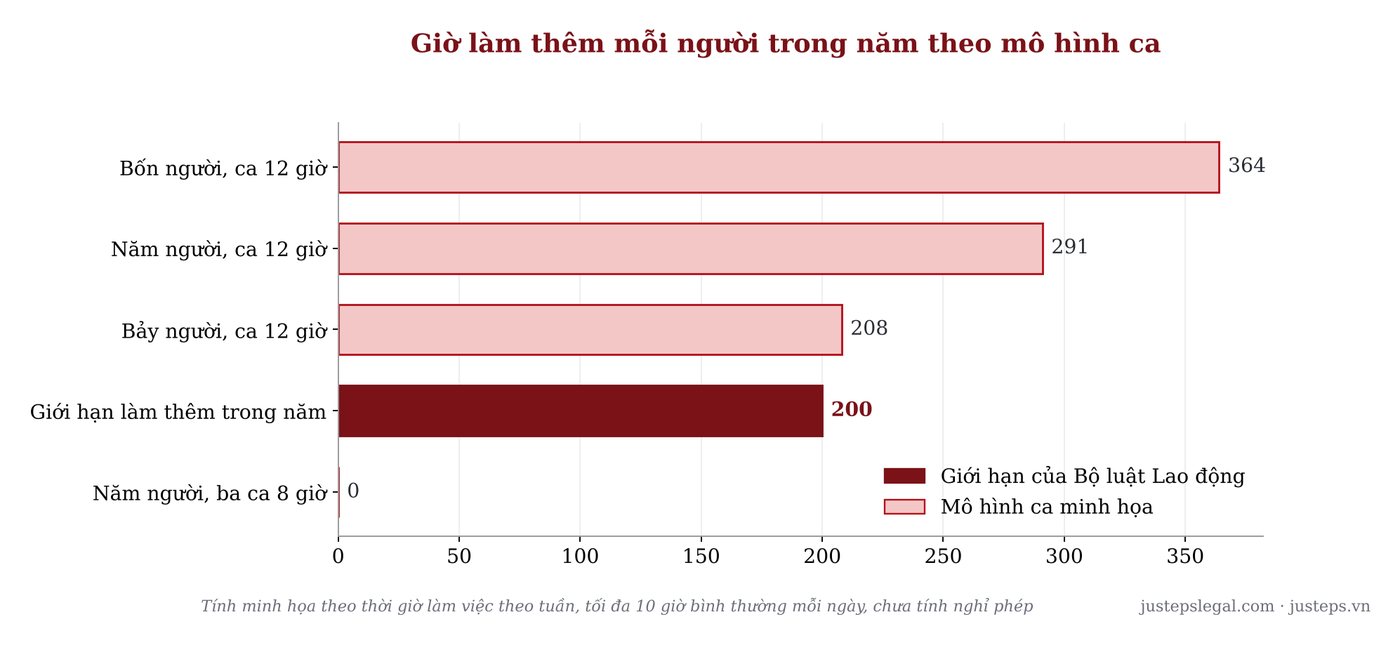
Annual overtime per person by shift model at a post guarded around the clock
With four people rotating on 12-hour shifts, each works around three and a half shifts a week, or 42 hours, below the 48-hour limit, but still accumulates around 7 hours of overtime a week and exceeds the annual ceiling from around the seventh month. Even with seven people, overtime remains slightly above 200 hours, while the model of three 8-hour shifts with five people generates almost no overtime. The model of two people alternating every day is not shown in the figure because overtime reaches almost 1,900 hours a year, exceeding the limit many times over, and cannot be legitimised by agreement.
For this reason, Justeps usually proposes a mixed model, using 8-hour shifts as the base and 12-hour shifts only on certain days or at certain posts, together with a tracker of each person’s cumulative overtime so that shifts can be changed before the ceiling is reached. Staffing for each site is recalculated according to the chosen model, and if the organisation needs to change as a result, this work continues under the organisational structure design service for security service businesses.
Pay for night work, overtime and public holidays
Night work is counted from 22:00 to 06:00 the following morning[3]. The Labour Code sets minimum rates for each situation, and the fixed wage for a shift must be enough to cover these rates[4]. The table below summarises them.
| Situation | Minimum rate of pay |
|---|---|
| Overtime on normal working days | At least 150% of the hourly wage for the work being performed. |
| Overtime on weekly rest days | At least 200% of the hourly wage for the work being performed. |
| Overtime on public holidays and Tet | At least 300%, not including the holiday pay to which the worker is entitled. |
| Night work | An additional payment of at least 30% of the wage for a normal working day. |
| Overtime at night | In addition to the above rates, an additional 20% of the wage calculated on the basis of a normal working day, rest day or public holiday. |
From 1 March 2027, the Law amending the Labour Code adds a paid public holiday, so the number of shifts falling on public holidays each year will increase and the cost of each post will rise accordingly. Before that, from 1 January 2027, regional minimum wages increase, with Region I at VND 5,700,000 a month[5], changing the floor used to check pay for normal working hours. Justeps prepares a table breaking the fixed wage down into pay for normal hours, overtime, night work and public holiday work so that the business can justify each item, and uses the same table to recalculate the unit prices quoted to clients.
Breaks during shifts, rest between shifts and weekly rest
A person working 06 hours or more a day is entitled to a break of at least 30 consecutive minutes, or at least 45 minutes when working at night, and for continuous shifts of 06 hours or more this break counts as working time[6]. A person working in shifts is entitled to at least 12 hours of rest before moving to another shift[7]. Each week, workers are entitled to at least 24 consecutive hours of rest; in special cases where weekly rest cannot be taken, an average of at least 04 days a month must be ensured[8].
At a post with only one person, a night-time break often exists only on paper. The correct procedure is to arrange cover for the post during those 45 minutes, or to use the mobile team’s roving patrols, and to record the cover in the shift log. Shift schedules changed at short notice when someone misses a shift must also be checked so that a person who has just finished a night shift is not placed on the next day shift without the full 12 hours of rest.
Social insurance for the security workforce
The monthly salary used as the basis for compulsory social insurance contributions comprises the wage for the job or position, wage allowances and other additional amounts agreed to be paid regularly and consistently in each pay period[9]. Splitting security staff income into a low wage plus numerous allowances for fuel, attendance or site assignments in order to contribute less does not change the nature of an amount if it is paid regularly. When this is discovered, the business must pay the arrears, bear late payment interest and may be penalised.
The security workforce includes many people who have retired from the army or the police. Persons receiving a retirement pension are not subject to compulsory social insurance, but they must still sign an employment contract, and the business still has obligations regarding occupational accident and occupational disease insurance for them in accordance with the law. Justeps prepares a table classifying staff by contribution group and a table classifying income items by contribution basis, so that the payroll department applies them consistently at every site.
Recruitment, training and handling breaches without fines
An employer may not keep the originals of workers’ identity documents, diplomas or certificates, nor require workers to provide security in money or property[10]. Where the business bears the cost of training so that staff can be granted the security guard professional certificate, the lawful way to secure a period of service is a training contract specifying the costs, the committed period and the obligation to reimburse if the worker leaves early[11].
Sleeping on duty, leaving a post and losing property are the most common breaches, but the business may not impose fines or deduct wages in place of labour discipline[12]. Compensation may only be sought through the procedure for material liability; where the damage results from negligence and is of limited value, compensation is capped at 03 months’ wages and monthly deductions may not exceed 30% of the wage actually paid after insurance contributions and tax[13]. A member of staff who abandons work for 05 cumulative days within 30 days without good reason may be dismissed following the proper procedure, rather than having wages withheld as a deterrent.
Implementation process and deliverables
A project usually takes around nine weeks and begins by accurately measuring the current situation before anything is redesigned. The flowchart below shows the sequence, in which the turning point is the size of the gap between what has been paid and what should have been paid under the law.
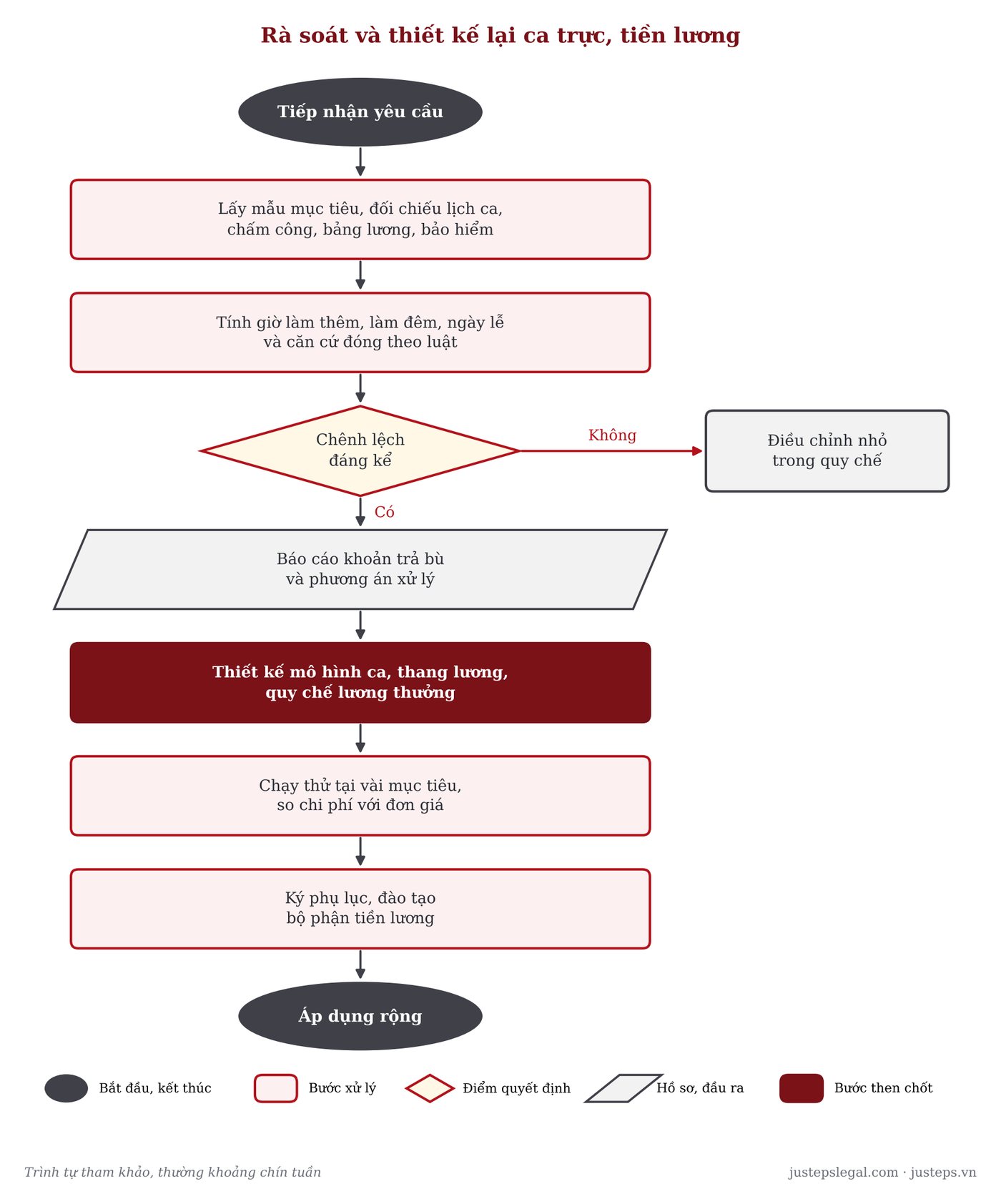
Sequence for reviewing and redesigning shifts, pay and insurance in a security business
In the first two weeks, Justeps consultants take a sample of representative sites and compare shift schedules, timesheets, payrolls, insurance data and employment contracts. If the gap is significant, the board of directors receives a report estimating the back pay and the options for dealing with it before Justeps designs the shift model, pay regulations and new pay scales. The new model is piloted at a few sites and actual costs are compared with the unit prices being quoted before it is rolled out more widely. The deliverables comprise:
- A review report on working hours, pay and insurance, with the level of risk and the cost of remedying it.
- A set of shift models for each type of site and a costing table for use in quotations.
- Pay scales for staff, group leaders, team leaders and area commanders, and regulations on pay and bonuses.
- Templates for employment contracts, training contracts and contracts for people receiving a retirement pension.
- A table classifying income by insurance contribution basis and a procedure for handling shift breaches.
Small businesses usually only need shift models, the method of calculating overtime and night work and full insurance registration; businesses with thousands of staff in several provinces also need pay scales by region and timekeeping that is independent of team leaders. The fee is quoted as a fixed fee in writing after the initial meeting, depending on the number of staff, the number of sites, the number of wage regions, the number of shift models and the extent of discrepancies in the current records. Issues arising after implementation can continue to be supported under the ongoing legal advisory service for security service businesses.
How Justeps can help
Alongside labour, payroll and insurance services, security service businesses may combine the following Justeps services:
- Organisational structure design for security service businesses. Justeps recalculates staffing and command levels when the shift model changes the number of people needed for each site.
- Ongoing legal advisory for security service businesses. Justeps tracks changes to minimum wages and public holidays and supports the adjustment of prices in client contracts.
- Building pay scales and pay and bonus regulations. Justeps builds pay scales by command level and regulations on allowances for night shifts, public holidays and site assignments.
- Compulsory social insurance advisory. Justeps determines who must contribute and the contribution basis for each group of staff, including people receiving a retirement pension.
Frequently asked questions
Are 12-hour shifts lawful?
They can be, if the business calculates the overtime correctly, does not exceed the daily, monthly and annual limits and ensures breaks during shifts, rest between shifts and weekly rest[2]. Assigning the same person to continuous 12-hour shifts all year round will almost certainly exceed the limits.
How is night shift pay for security staff calculated?
Hours worked between 22:00 and 06:00 attract an additional payment of at least 30% of the normal day’s wage; if those hours are also overtime, the overtime rate and an additional 20% are also payable as required by law[4].
Must pensioners working as security guards pay social insurance contributions?
Persons receiving a retirement pension are not subject to compulsory social insurance. The business must still sign an employment contract and meet its obligations regarding occupational accident and occupational disease insurance in accordance with the law.
Can the business require staff who leave early to reimburse training costs?
Yes, if the two parties have signed a training contract specifying the costs, the committed period of work and the obligation to reimburse[11]. The business may not keep certificates or collect deposits in place of such a contract[10].
Can wages be deducted when staff lose property at a site?
Wages may not be deducted in place of discipline. The business must follow the material liability procedure, under which the amount of compensation and the monthly deduction rate are limited[13].
When regional minimum wages rise, do unit prices in client contracts rise automatically?
No, unless the contract contains an adjustment clause or the parties renegotiate. Justeps recommends including an adjustment formula in long-term contracts before the wage increase from 1 January 2027[5].
Is an attendance allowance subject to social insurance contributions?
If the allowance is agreed and paid regularly and consistently in each pay period, it is likely to form part of the contribution basis[9]. The specific payment conditions in the pay regulations need to be examined before reaching a conclusion.
Related articles
- Organisational structure design for security service businesses with a chain of command from head office to every guarded site
- Building internal procedures and regulations for security service businesses so that staff know the limits of their actions
- Ongoing legal advisory for security service businesses from client contracts to incidents at guarded sites
- Monthly labour and payroll compliance checklist for the HR department
Notes
[1] Article 105 of the Labour Code No. 45/2019/QH14 dated 20 November 2019.
[2] Article 107 of the Labour Code No. 45/2019/QH14 dated 20 November 2019; Government Decree No. 145/2020/ND-CP dated 14 December 2020 detailing a number of articles of the Labour Code.
[3] Article 106 of the Labour Code No. 45/2019/QH14 dated 20 November 2019.
[4] Article 98 of the Labour Code No. 45/2019/QH14 dated 20 November 2019.
[5] Government Decree No. 399/2026/ND-CP on minimum wages for workers employed under employment contracts, applicable from 1 January 2027.
[6] Article 109 of the Labour Code No. 45/2019/QH14 dated 20 November 2019.
[7] Article 110 of the Labour Code No. 45/2019/QH14 dated 20 November 2019.
[8] Article 111 of the Labour Code No. 45/2019/QH14 dated 20 November 2019.
[9] The Law on Social Insurance No. 41/2024/QH15 dated 29 June 2024, effective from 1 July 2025.
[10] Clauses 1 and 2 of Article 17 of the Labour Code No. 45/2019/QH14 dated 20 November 2019.
[11] Article 62 of the Labour Code No. 45/2019/QH14 dated 20 November 2019.
[12] Clause 2 of Article 127 of the Labour Code No. 45/2019/QH14 dated 20 November 2019.
[13] Articles 102 and 129 of the Labour Code No. 45/2019/QH14 dated 20 November 2019.
This article is for reference and reflects the regulations in force at the time of publication. Please consult Justeps for advice tailored to your company’s records and situation.
For further information, please contact:
📩 Email: info@justeps.vn
🌐 Website: https://justepslegal.com · https://justeps.vn
🌐 Page: Justeps
☎️ Hotline (Zalo): 096 172 2607
📍 Thanh Xuan Office: 12th Floor, Licogi 13 Tower, 164 Khuat Duy Tien Street, Thanh Xuan Ward, Hanoi, Vietnam
📍 Ha Dong Office: LK06B, No.10, Dong Dua Area, Ha Dong Ward, Hanoi, Vietnam
📍 Ho Chi Minh City Branch: 528 Le Van Sy, Ho Chi Minh City, Vietnam
📍 Hai Phong Office: Truong Thinh Village, Ha Dong Commune, Hai Phong, Vietnam
📍 Quang Ninh Office: Van Don Special Zone, Quang Ninh Province, Vietnam





