
Key takeaways
- A General Director is a manager of the enterprise and must give at least 120 days’ notice when unilaterally resigning under an indefinite-term contract, an important tool for preserving the staffing conditions of the licence[2].
- An employee who discloses business or technology secrets may be dismissed, but only where that conduct is set out in the internal labour rules or the contract and the disciplinary procedure is followed correctly[4].
- Collaborators who recruit merchants and are given targets, have their attendance recorded and receive a fixed salary may be found to be employees, which brings the obligation to pay compulsory insurance[11].
- Recording calls, logging actions or monitoring employees’ devices is processing of personal data, so its scope and purpose must be notified to employees[7].
In a payment business, the people question does not stop at hiring good people and keeping them for a long time. Some positions are tied directly to the conditions of the licence, many employees have access to the identification data and money flows of millions of customers, the system must be staffed even on public holidays, and the team that recruits merchants is often made up of commission-based collaborators. A single template employment contract used for all these groups leaves gaps that the business only notices when someone leaves suddenly, when data is leaked or when the social insurance authority carries out an inspection.
This page introduces Justeps’ service covering contracts, internal labour rules, pay and bonuses, insurance and personal income tax for providers of e-wallets, payment gateways, collection and disbursement support services and technology companies that cooperate with banks. Identifying which positions are key and who backs up whom falls under the organisational structure design service for fintech and payment intermediary businesses, while this page deals with the contracts and terms for those people.
Labour risks differ by group of positions
Justeps starts by dividing everyone who works for the business into groups of positions and then assessing the level of risk of each group in four respects, namely licence conditions, data security, fraud and money laundering, and obligations on working hours and insurance. The matrix below is an example of the results at an e-wallet with around 200 people.
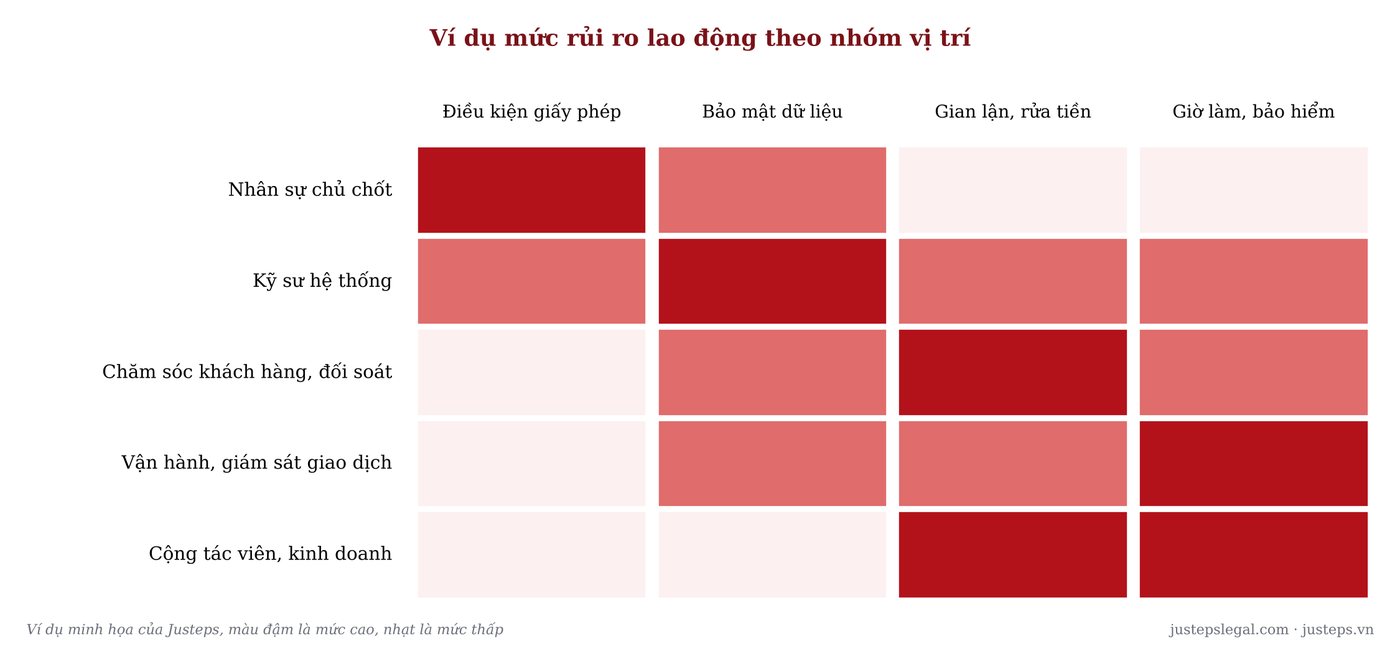
Example of labour risk levels by group of positions at an e-wallet business
In this example, key personnel carry the highest risk in terms of licence conditions, system engineers the highest risk in terms of security, while customer care staff, reconciliation staff and collaborators carry a high fraud risk because they may be bribed to hand over account information or may use forged documents to open wallets. The operations and transaction monitoring group carries a high risk in terms of working hours because it works in shifts, at night and on public holidays. Each high-risk cell corresponds to a set of documents that must be drafted separately, rather than a single policy applied to everyone.
Contracts for key personnel
The legal representative, the General Director, the Deputy General Directors and the key staff implementing the payment intermediary service provision scheme must all meet standards on qualifications and experience that form part of the licensing conditions[1]. The personnel files of these people, including degrees, confirmations of experience and appointment decisions, must be kept in full and updated as soon as someone is replaced, because inspectors will compare them with the file submitted for the licence. A common mistake is to replace the Deputy General Director in charge of technology while the file in the cabinet is still that of the previous person.
The most important contractual point is the notice period. A manager of the enterprise under the Law on Enterprises, such as the General Director, falls within the group of special jobs and must give at least 120 days’ notice when unilaterally terminating an indefinite-term contract or a fixed-term contract of 12 months or more[2], which is long enough for the business to find a replacement who meets the conditions. For key staff who are not managers of the enterprise, the general notice period is much shorter, so Justeps proposes combining a fixed-term contract of suitable length, a deferred retention bonus and a mandatory handover plan. The probation period for a manager of the enterprise may not exceed 180 days and for work requiring a college qualification or higher may not exceed 60 days[3], and the business should use the whole of this period to assess carefully the person who will be named in the licence file.
Tiered confidentiality, internal labour rules and discipline
A single confidentiality agreement for everyone is a common but weak approach, because a receptionist and a database administrator have entirely different levels of access. Justeps drafts tiered confidentiality agreements in which the highest tier is for people with access to customer data, encryption keys or the right to change system configuration, together with a list of specific prohibited acts such as downloading data to personal devices, sharing accounts or looking up customer information for non-work purposes. Engineers’ contracts also need an annex on rights in the source code and technical documents they create in the course of their work.
An employee who discloses business or technology secrets may be dismissed[4], but the business may not discipline an employee for conduct that is not set out in the internal labour rules, the employment contract or the law[5]. The internal labour rules must therefore include provisions on the protection of assets, business secrets, technology secrets and intellectual property[6], written specifically enough to be applied to a real data leak. Amending and registering the internal labour rules can be done together with the internal labour rules and disciplinary action service.
Payment businesses often record call centre calls, log actions on the administration system and monitor work devices to combat fraud. All of these are processing of employees’ personal data, so the scope, purpose and monitoring measures must be notified and have an appropriate legal basis[7]. Justeps writes these points into the internal labour rules, the contracts and the HR data processing notice so that the results of monitoring can be used in disciplinary proceedings.
Shifts, night work and public holidays
Payment systems must run continuously, and transaction volumes usually rise sharply precisely at public holidays and Tet, so the operations, transaction monitoring and incident response teams work in shifts. Night work is counted from 22:00 to 06:00 the following morning[8], employees working at night are paid at least 30% extra, and overtime on public holidays and Tet is paid at least 300%, excluding the holiday pay itself[9]. The law amending and supplementing the Labour Code, passed by the National Assembly in November 2026, adds further public holidays and takes effect from 1 March 2027[10], so the 2027 duty roster and payroll budget need to be recalculated.
Justeps proposes setting out the shift schedule for each position in the internal labour rules, together with rules on shift swaps, compensatory leave, pay calculation for shifts that run past midnight and an on-call-at-home regime for incident response engineers. On-call time at home must be clearly distinguished from actual working time, otherwise every midnight call may be counted as overtime without the business having any records to track it.
Collaborators who recruit merchants
Many e-wallets and payment gateways use networks of collaborators to open wallets for new users or find merchants, paying them by volume. If a collaborator works for pay and is subject to the business’s management, direction and supervision, the relationship is treated as an employment relationship whatever the contract is called[11], and a person working under a contract whose content reflects an employment relationship for one month or more is subject to compulsory social insurance[12]. The danger signs are mandatory targets, attendance records, fixed working schedules and monthly payments that do not depend on results.
Conversely, if management is too loose, the business finds it hard to stop collaborators using forged documents or borrowing other people’s identities to open wallets in order to earn commission, and it is the business itself that is responsible for the customer due diligence file. Justeps designs service or agency contracts that describe the results to be delivered, the standards for files, the right of inspection and a mechanism for clawing back commission when files are invalid, while keeping quality control of files separate from the management of working time. The business must also withhold personal income tax as required before paying commission to individuals.
Pay, bonuses, shares and the basis for insurance contributions
The income structure of fintech staff differs markedly between groups of positions. The chart below compares, as an illustrative example, the share of each component in the annual total income of three common groups.
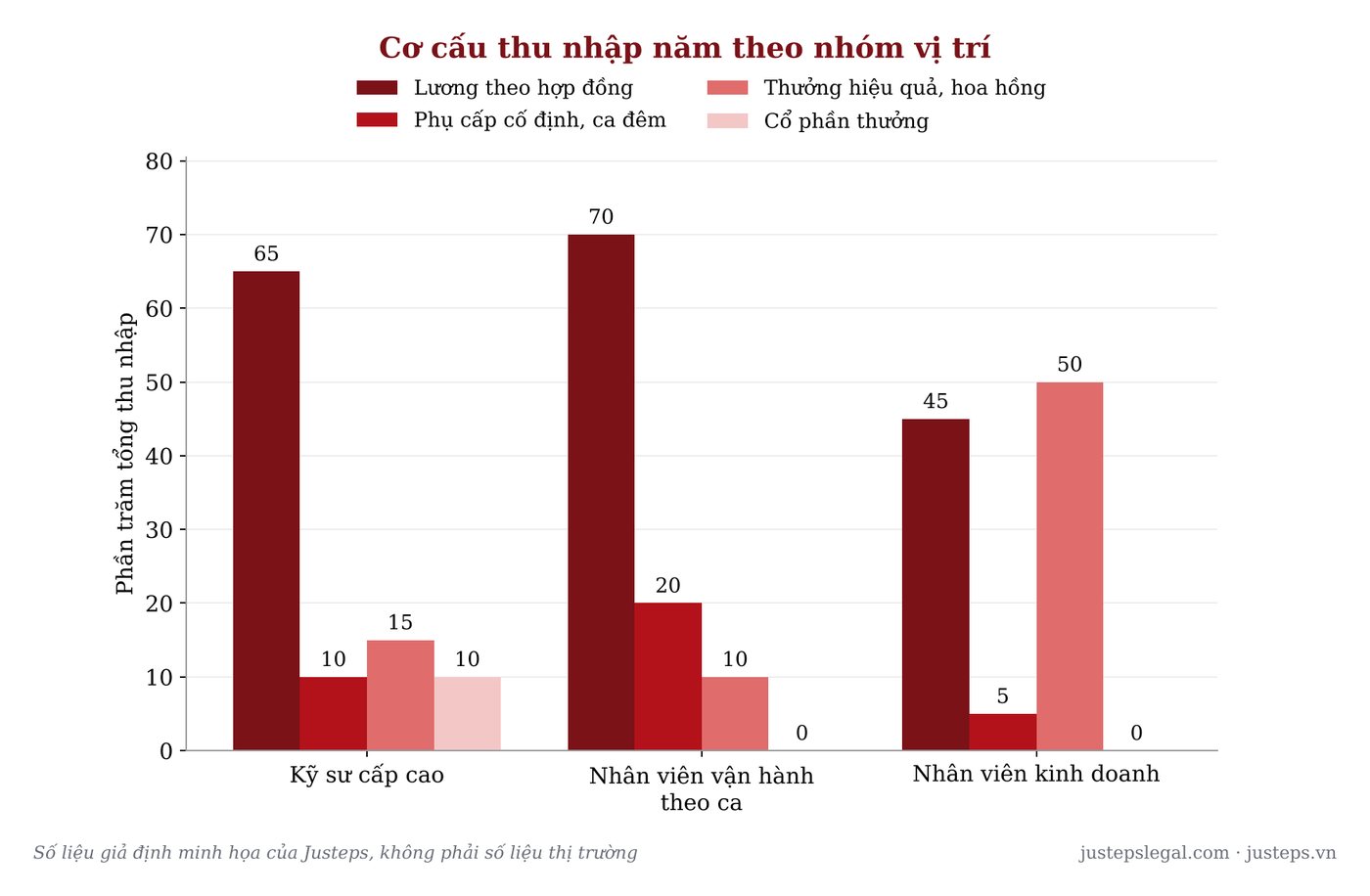
Example of the annual income structure of three groups of positions in a fintech business
In this example, contractual salary makes up about 65% of a senior engineer’s income and fixed allowances 10%, with the remainder made up of performance bonuses and bonus shares. The salary used as the basis for social insurance contributions includes the salary level, salary allowances and other supplementary amounts agreed to be paid regularly and stably, capped at 20 times the reference level[13], so an engineer’s fixed allowances must be included in the contribution base, while results-based bonuses and shares are handled under separate rules. For sales staff, commission accounts for about half of income, so the rules should state clearly that commission is calculated on the results of each period to avoid it being treated as a fixed payment, and should not reward the number of merchants brought in while ignoring the quality of due diligence.
A bonus share programme needs rules stating the conditions, the vesting period, the treatment of employees who leave, the issuance procedure under the Law on Enterprises and the personal income tax obligations, and it must take into account in advance the effect on the shareholding structure declared to the regulator. From 1 January 2027, the region I minimum wage rises to VND 5,700,000 a month[14], so the pay scales for operations and customer care staff need to be reviewed. The detailed pay scales and bonus rules can be prepared together with the service for building pay scales and salary and bonus regulations.
Anti-money laundering training and foreign experts
Internal anti-money laundering regulations must include provisions on recruitment, training and professional development of staff[15], so Justeps builds this content into the onboarding procedure for new employees, the periodic training plan and the assessment criteria for the relevant positions. Training records signed by participants are evidence that the business has fully performed its obligations when an employee abets fraud.
A business with foreign security experts, engineers or directors must obtain a work permit or a confirmation of exemption from a work permit before that person starts work. Applications filed up to and including 4 December 2026 are governed by Decree No. 219/2025/ND-CP, while from 5 December 2026 the new decree on foreign workers applies[16], so applications under preparation should be reviewed according to the filing date. The term of a foreign employee’s employment contract should not exceed the term of the work permit, and their insurance and tax obligations are calculated separately in each case.
Implementation process, deliverables and fees
The standardisation phase usually takes about eight weeks, giving priority first to key personnel files and confidentiality, and then to pay and bonuses, shifts and collaborators.
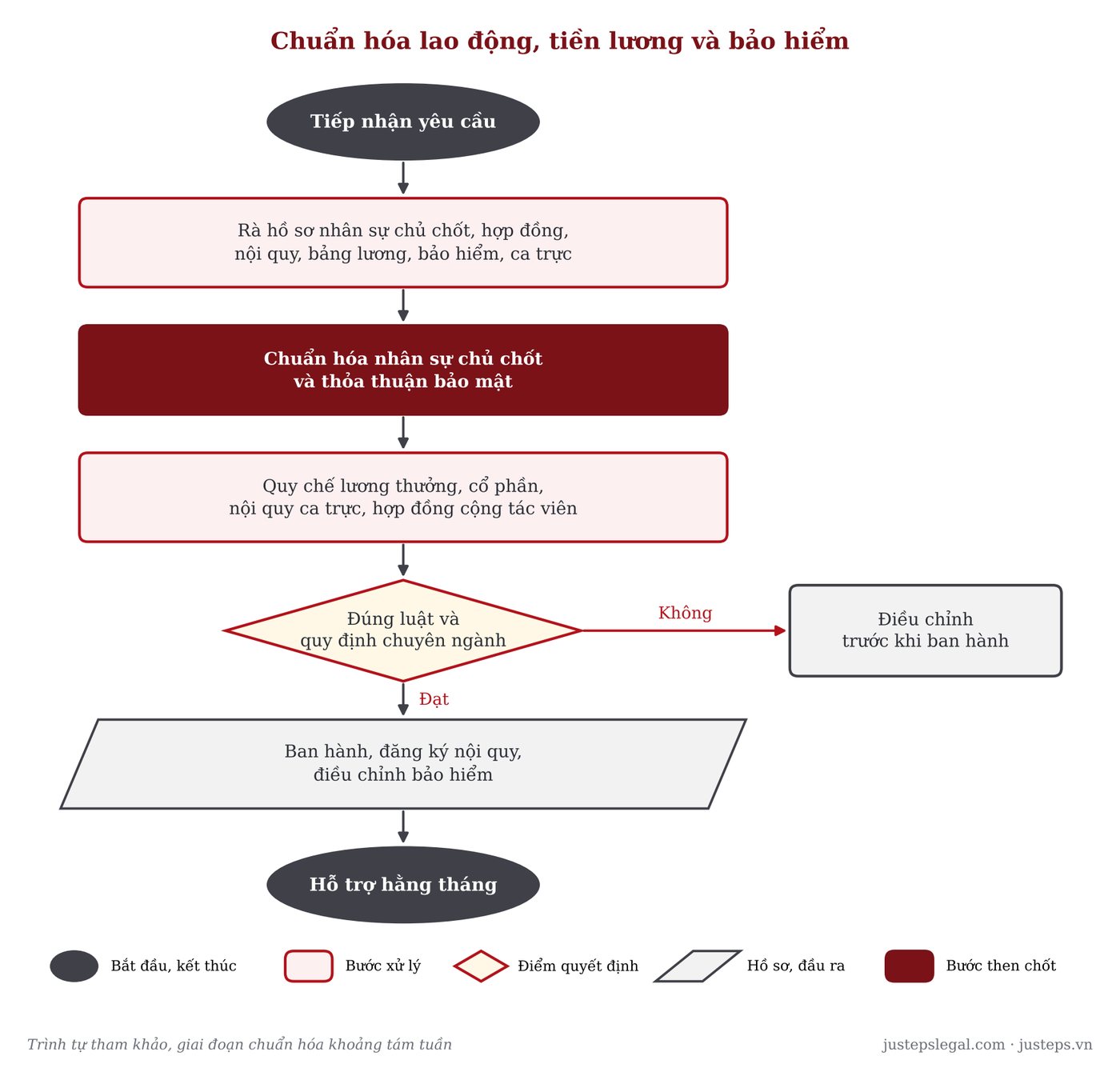
Sequence for standardising labour, wages and social insurance at a fintech business
After standardisation, the business can move to a monthly support package that includes reviewing the payroll, insurance declarations and personal income tax, and advising on situations such as replacing key personnel, disciplinary action for breaches of confidentiality or terminating the contract of a person with high-level access. Registration and adjustment of insurance can also be entrusted to the compulsory social insurance advisory service. The deliverables include the following documents:
- A review report on labour, wages and insurance, setting out discrepancies and remedies in order of priority.
- A standardised set of key personnel files and template contracts with notice and handover clauses.
- Employment contracts, tiered confidentiality agreements and an annex on rights in technology products.
- Amended internal labour rules on shifts, monitoring, confidentiality and discipline, with the registration file.
- Salary and bonus rules, bonus share rules, and contracts and management rules for collaborators.
Justeps quotes the fee in writing after the initial meeting, either as a one-off standardisation package or a monthly support package, depending on the number of staff and collaborators, the number of position groups needing separate policies, whether there is a bonus share programme, the number of foreign experts and any need for bilingual documents. A business already using the Ongoing legal advisory service for fintech and payment intermediary businesses can combine the labour work into a single package.
How Justeps can help
Alongside labour, wages and social insurance services, fintech and payment intermediary businesses may combine the following Justeps services:
- Organisational structure design for fintech and payment intermediary businesses. Justeps identifies key positions, position standards and back-up persons so that personnel contracts follow the organisation closely.
- Building pay scales and salary and bonus regulations. Justeps builds pay scales and rules on performance bonuses and commission suited to each group of positions in a payment business.
- Internal labour rules and disciplinary action. Justeps drafts internal labour rules on shifts, monitoring and confidentiality and guides the disciplinary procedure when data is leaked.
- Compulsory social insurance advisory. Justeps checks the contribution base and handles registration and adjustment of insurance for employees, reclassified collaborators and foreign workers.
Frequently asked questions
What must the business do when its head of technology leaves?
The business needs to appoint a replacement who meets the qualification standards straight away, update the personnel file and consider whether it must report to the State Bank of Vietnam if the change is one that must be reported. A contract with a notice period and a handover plan keeps the business from being caught off guard.
What is the maximum probation period for fintech staff?
No more than 180 days for the work of a manager of the enterprise and no more than 60 days for work requiring a college qualification or higher[3]. Probation may be agreed only once for a given job.
May the business record calls and monitor employees’ computers?
It may, where there is a legitimate purpose such as combating fraud or ensuring quality and employees are clearly informed of the scope, purpose and monitoring measures[7]. These points should be written into the internal labour rules and contracts.
Can an employee who leaks customer data be dismissed?
The employee may be dismissed if the disclosure of business or technology secrets has been specified and the disciplinary procedure is followed correctly[4]. Besides discipline, the person may have to pay compensation or bear liability under other laws.
Must collaborators who open wallets pay social insurance?
If collaborators control their own time and receive commission based on results, the relationship is usually a service or agency contract. If there are mandatory targets, attendance records and a fixed salary, the relationship risks being found to be an employment relationship subject to compulsory insurance[12].
How is work on public holidays and Tet paid?
Overtime on public holidays and Tet is paid at least 300%, excluding the holiday pay itself, and night work attracts additional pay as prescribed[9]. The duty roster should be announced to employees in advance.
Related articles
- Personal data protection in the HR department under the 2025 Law on Personal Data Protection
- Overtime under Vietnamese law, limits, pay calculation and the records a business must keep
- Internal labour rules, mandatory contents, registration file and effective date
- Organisational structure design for fintech and payment intermediary businesses meeting licence conditions
Notes
[1] Point d of Clause 2 of Article 22 of Government Decree No. 52/2024/ND-CP dated 15 May 2024 on non-cash payments.
[2] Article 7 of Government Decree No. 145/2020/ND-CP dated 14 December 2020 detailing and guiding the implementation of a number of articles of the Labour Code on working conditions and labour relations.
[3] Article 25 of the Labour Code No. 45/2019/QH14 dated 20 November 2019.
[4] Clause 2 of Article 125 of the Labour Code No. 45/2019/QH14 dated 20 November 2019.
[5] Clause 3 of Article 127 of the Labour Code No. 45/2019/QH14 dated 20 November 2019.
[6] Clause 2 of Article 69 of Government Decree No. 145/2020/ND-CP dated 14 December 2020 detailing and guiding the implementation of a number of articles of the Labour Code on working conditions and labour relations.
[7] Article 25 of the Law on Personal Data Protection No. 91/2025/QH15, effective from 1 January 2026.
[8] Article 106 of the Labour Code No. 45/2019/QH14 dated 20 November 2019.
[9] Article 98 of the Labour Code No. 45/2019/QH14 dated 20 November 2019.
[10] The Law amending and supplementing a number of articles of the Labour Code, passed by the National Assembly in November 2026.
[11] Clause 1 of Article 13 of the Labour Code No. 45/2019/QH14 dated 20 November 2019.
[12] Point a of Clause 1 of Article 2 of the Law on Social Insurance No. 41/2024/QH15, effective from 1 July 2025.
[13] Article 31 of the Law on Social Insurance No. 41/2024/QH15, effective from 1 July 2025.
[14] Government Decree No. 399/2026/ND-CP on the minimum wage for employees working under employment contracts, effective from 1 January 2027.
[15] Point i of Clause 1 of Article 24 of the Law on Anti-Money Laundering No. 14/2022/QH15 dated 15 November 2022.
[16] Government Decree No. 393/2026/ND-CP dated 20 October 2026 on foreign workers working in Vietnam, effective from 5 December 2026, replacing Decree No. 219/2025/ND-CP.
This article is for reference and reflects the regulations in force at the time of publication. Please consult Justeps for advice tailored to your company’s records and situation.
For further information, please contact:
📩 Email: info@justeps.vn
🌐 Website: https://justepslegal.com · https://justeps.vn
🌐 Page: Justeps
☎️ Hotline (Zalo): 096 172 2607
📍 Thanh Xuan Office: 12th Floor, Licogi 13 Tower, 164 Khuat Duy Tien Street, Thanh Xuan Ward, Hanoi, Vietnam
📍 Ha Dong Office: LK06B, No.10, Dong Dua Area, Ha Dong Ward, Hanoi, Vietnam
📍 Ho Chi Minh City Branch: 528 Le Van Sy, Ho Chi Minh City, Vietnam
📍 Hai Phong Office: Truong Thinh Village, Ha Dong Commune, Hai Phong, Vietnam
📍 Quang Ninh Office: Van Don Special Zone, Quang Ninh Province, Vietnam





