
Key takeaways
- A person who works for pay under the business’s management, direction and supervision is an employee even if the contract is called a collaboration agreement, so artists and testers working full time at the office usually need to be moved onto employment contracts[1].
- The crunch period before launch must stay within the overtime limit of 40 hours per month; the 300-hour annual cap applies only to certain cases, including work requiring highly qualified professional or technical workers whom the market cannot supply in time, and the labour authority must be notified[4].
- Launch bonuses and revenue bonuses that depend on business results and are not paid at a fixed amount differ from regular, stable payments made together with salary, which are included in the salary used for social insurance contributions, so the bonus regulations must state the conditions clearly[9].
- From 5 December 2026, the recruitment of foreign producers and experts is governed by the new decree on foreign workers, so applications in progress need to be reviewed according to their filing date[14].
A medium-sized game business may at the same time use full-time programmers, freelance artists paid per set of characters, dubbing actors who work a few recording sessions, operations staff on overnight server duty, content reviewers working from home in another province and a foreign producer. Each group needs a different type of contract, method of pay and insurance arrangement, yet many businesses still use one contract template for everyone and only discover the discrepancies when someone who has left lodges a complaint or when the insurance authority carries out an inspection.
This page introduces Justeps’ service that helps game and digital content businesses choose the right way of engaging people, design pay and bonuses around the product life cycle, meet their insurance and personal income tax obligations in full and retain rights in the output created by employees. The arrangement of the organisation and the rules for operating games are covered on the sister pages in the same sector.
Groups of workers and the appropriate arrangements
The first step Justeps takes is to list everyone working for the business, including people who are not on the payroll, and then compare how they actually work with the type of contract they have signed. The table below summarises the usual classification, while the conclusion for each person depends on the extent to which the business controls their time, place and way of working.
| Group of workers | Usually appropriate arrangement | Points to note |
|---|---|---|
| Programmers, game designers | Employment contract with an annex on copyright and confidentiality. | The creative tasks must be stated in the contract or the job description. |
| Freelance artists, musicians | Service contract or commissioning contract per deliverable. | Include a rights transfer clause and do not manage them like employees. |
| Dubbing actors | Contract per recording session, with an agreement on rights in the recordings. | State the scope of use of the voice in the game and in advertising. |
| Operations, player care | Employment contract with a shift schedule set out in the labour regulations. | Night work and holiday work must be paid extra at the statutory rates. |
| Remote content reviewers | Employment contract stating the place of work and where insurance is paid. | The minimum wage follows the area where the employee works. |
| Foreign experts | Employment contract with a work permit or confirmation of exemption. | The contract term may not exceed the term of the work permit. |
Collaborators and the risk of reclassification as employees
Labour law looks at the substance of the work rather than the name of the contract, so a person who works for pay under the business’s management, direction and supervision is still treated as an employee[1]. A person working under an employment contract of one month or more, including a contract with a different name whose content shows an employment relationship, is subject to compulsory social insurance[2]. Testers or artists who come to the office every day, clock in and receive a fixed monthly payment while signing a collaboration contract are the situation Justeps encounters most often in the sector.
When a relationship is reclassified, the business must pay insurance contributions retrospectively for the past period plus interest and may be penalised, so Justeps usually proposes a proactive conversion roadmap by group, giving priority to long-serving and full-time workers. For genuine freelancers paid per deliverable, the business withholds 10% personal income tax when the total income paid each time is VND 5 million or more, unless the individual has made a commitment in the prescribed form that their income is below the taxable threshold[3]. Contracts with this group should describe the deliverables, the acceptance criteria and the deadline rather than working hours and place of work.
The crunch period before launch
Game businesses usually have a few weeks of intense work before launching a game or releasing a major expansion, after which the workload drops sharply. Overtime may not exceed 40 hours in a month and 200 hours in a year; a business may use the maximum of 300 hours a year only in certain sectors, occupations or cases, including work requiring highly qualified professional or technical workers whom the labour market cannot supply fully and in time, and it must notify the provincial labour authority in writing[4]. The monthly limit cannot be averaged out, so a crunch month with 70 hours of overtime is still a breach even if the annual total is below 200 hours.
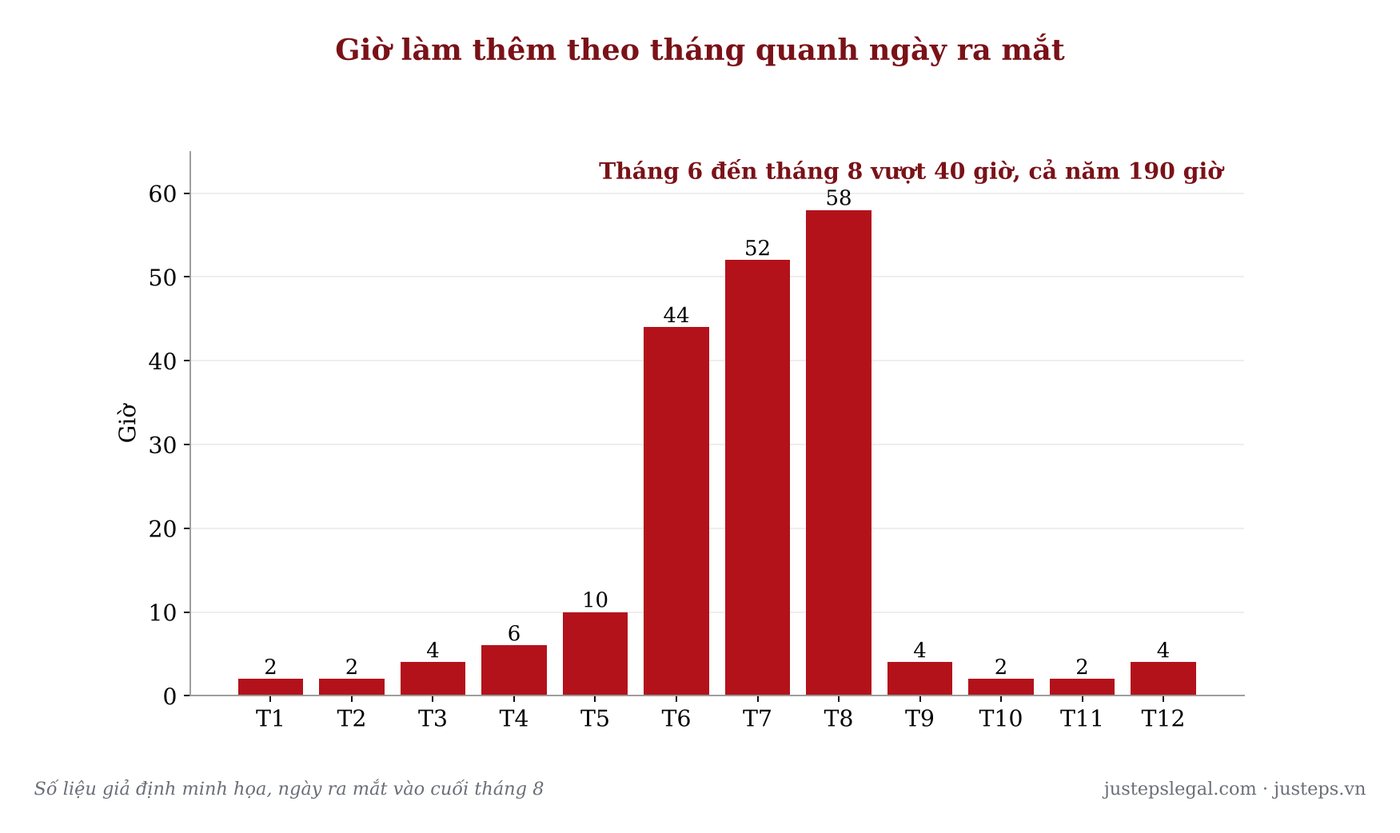
Example of monthly overtime hours of a development team around a game launch
In this example, the three months before launch exceed the limit of 40 hours of overtime per month, even though the annual total is only about 190 hours, below the 200-hour limit. The solution is not to record fewer hours on the timesheet but to plan staffing earlier, hire additional people on short-term contracts or outsource part of the art work, and for the months in which overtime is still needed, to obtain the employee’s consent and pay overtime of at least 150% on normal working days and 200% on weekly rest days[5]. Justeps drafts a project-based overtime registration form so that the human resources unit can track each person’s cumulative hours before approving.
Operating shifts, night work and public holidays
Servers, in-game events and the player care unit must run in the evenings, at weekends and on public holidays, which is exactly when the largest number of players are online. Night work is counted from 22:00 to 06:00 the following morning[6], employees working at night are paid at least 30% extra, and overtime on public holidays and Tet is paid at least 300%, not including the holiday pay itself[5]. The amended Labour Code passed by the National Assembly in November 2026 adds two further fully paid public holidays, 27 July and 24 November, from 1 March 2027[7], so the duty roster and the payroll budget for 2027 need to be recalculated.
Justeps proposes setting out shift schedules for each position in the labour regulations instead of applying office hours to the whole company, together with rules on shift swaps, compensatory leave and pay for shifts that run past midnight. A business employing 10 or more employees must have written labour regulations[8], and amending and registering the labour regulations can be done together with the labour regulations and disciplinary procedures service. For content reviewers who are regularly exposed to violent or disturbing images, the labour regulations should provide for rotation and breaks between shifts.
Launch bonuses, revenue bonuses and equity for key staff
The income of people working in games is closely tied to the product’s success and usually includes a bonus for launching on time, a bonus based on the game’s revenue and share options for key staff. The salary used as the basis for social insurance contributions includes the salary level, salary allowances and other additional payments agreed to be paid regularly and stably in each pay period[9]. Consequently, a revenue bonus paid at a fixed amount every month risks being treated as a regular additional payment, whereas a bonus with clear conditions that depends on actual results is not.
Justeps builds pay and bonus regulations with a salary scale by professional grade and formulas for launch bonuses and revenue bonuses, setting out the conditions, the assessment period and how bonuses are divided when someone leaves part way through, while also identifying which payments are subject to personal income tax and which supporting documents must be kept for them to be deductible expenses. Programmes that issue shares or share options to employees are taxed in a particular way under the regulations guiding the Law on Personal Income Tax, so they should be designed together with the finance department from the outset. The detailed salary scale can be combined with the salary scale and pay and bonus regulations service.
Rights in source code and artwork, and project confidentiality
A business that assigns a creative task to an employee is the owner of the economic rights in the resulting work, unless otherwise agreed[10]. To rely on this rule, the employment contract or the job description must clearly state the task of writing code, drawing, composing or scriptwriting, because a contract that only gives a general job title makes it hard for the business to prove that the work was created under an assigned task. Justeps drafts a copyright annex to the employment contract, including rules on work produced outside working hours using company equipment and on using the work in an individual’s personal portfolio.
The business and the employee may agree in writing on the content and duration of protection of business secrets and technology secrets, the related benefits and the compensation payable for breach[11]. For unannounced projects, Justeps recommends focusing on a confidentiality agreement with a specific scope, access controls on the source code repository and a procedure for revoking accounts on departure, rather than a clause prohibiting work for any competitor, whose validity is easily contested.
Minors, remote workers and foreign nationals
Some businesses recruit young players to work as testers or content creators. Persons aged from 15 to under 18 may work no more than 08 hours a day and 40 hours a week, while persons under 15 may work no more than 04 hours a day and 20 hours a week and may not work overtime or at night[12]. The content being tested must also be appropriate to the worker’s age, so Justeps recommends keeping a separate list and a separate approval procedure for this group.
Remote workers in another province need a contract that states the place of work, because the minimum wage applies according to the area where the employee works and is being increased in all four regions from 1 January 2027[13]. For foreign experts and producers, applications filed before 5 December 2026 are governed by Decree No. 219/2025/ND-CP, while from 5 December 2026 the new replacement decree applies[14], so the business needs to review the position criteria, the work permit term and the exemption cases before renewing or recruiting.
Implementation process, deliverables and fees
The service usually begins with a review and standardisation phase lasting about seven weeks, after which the business may choose a monthly support package for payroll calculation, insurance and tax filings and matters that arise, such as recruiting foreign nationals, disciplinary proceedings or terminating contracts.
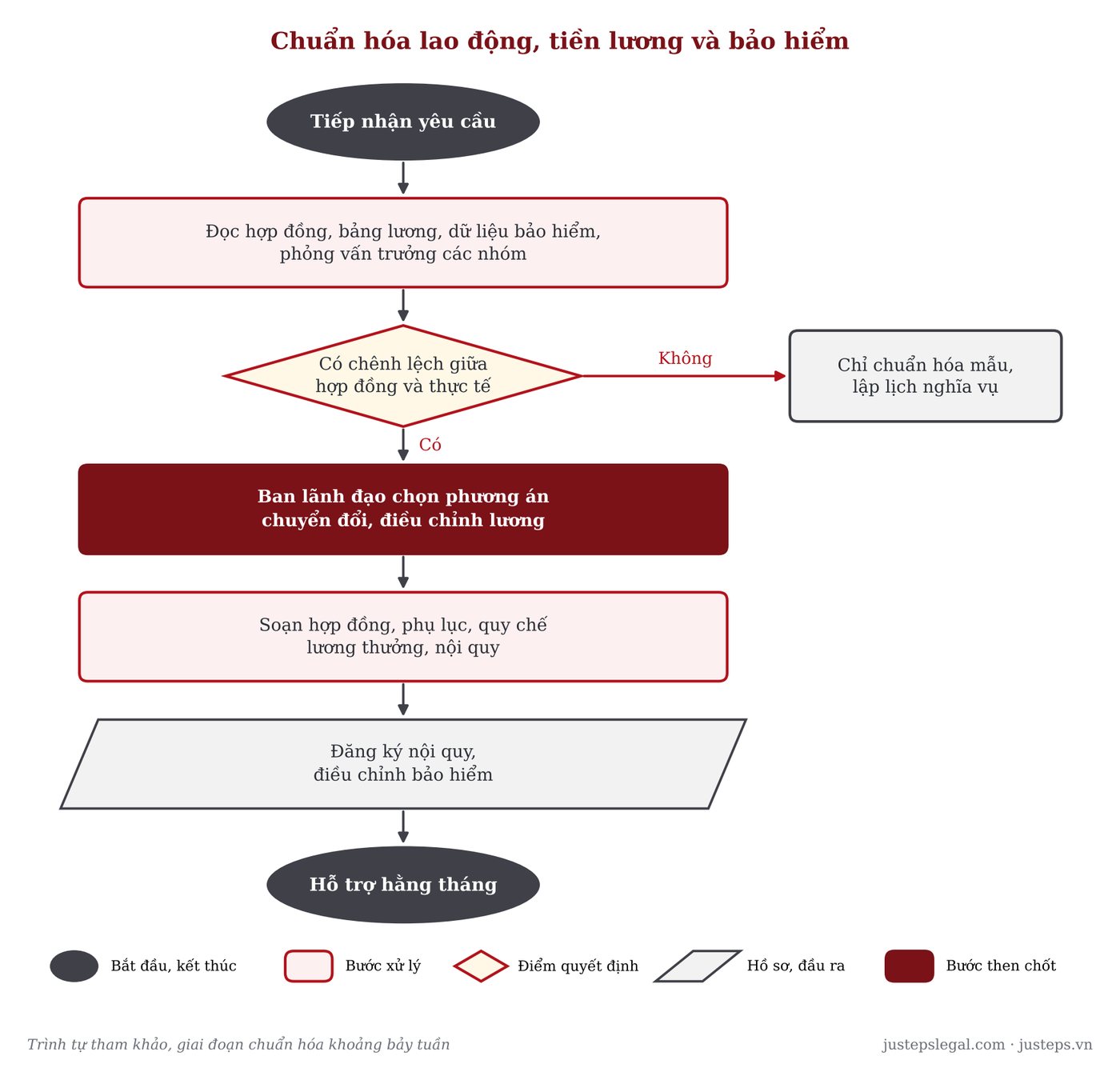
Sequence for standardising labour, payroll and insurance at a game business
In the first two weeks, Justeps consultants read the staff list, contracts, payroll, bonus regulations and insurance contribution data, and then interview team leads to learn how people actually work. The gap report ranks the issues by level of risk and proposes how to deal with them, for example converting collaborators according to a roadmap or adjusting the pay structure. Management chooses the option, and Justeps drafts the documents, guides the human resources unit through implementation and works with the business to register the labour regulations where required.
At the end of the standardisation phase, the business receives a set of documents it can edit later, together with guidance for the human resources unit and payroll accounting, including the following documents:
- A labour and insurance review report setting out the gaps and how to address them.
- A set of employment contracts with annexes on copyright and confidentiality.
- A set of service and commissioning contracts for freelancers and dubbing actors, with rights transfer clauses.
- A salary scale and pay and bonus regulations, including launch bonuses and revenue bonuses.
- Amended labour regulations with shift schedules by position and the registration file.
- A monthly and annual calendar of obligations on labour, insurance and personal income tax.
Justeps quotes its fees in writing after the initial discussion, either for a one-off standardisation package or for a monthly support package. The fee depends on the number of employees and freelancers, the number of contract types to be drafted, the extent of the gaps to be resolved, whether there are foreign nationals or an equity programme, and the volume of monthly filings. Complex files for retrospective insurance contributions or insurance adjustments can be combined with the compulsory social insurance advisory service.
How Justeps can help
Alongside labour, payroll and insurance services, game and digital content businesses may combine the following Justeps services:
- Organisational structure design for game and digital content businesses. Justeps arranges the divisions and headcount so that contract classification and the salary scale follow the organisation.
- Ongoing legal advisory for game and digital content businesses. Justeps works with the business every month on questions about contracts, copyright and labour matters as they arise.
- Salary scales and pay and bonus regulations. Justeps builds a salary scale by professional grade and formulas for launch bonuses and revenue bonuses.
- Labour regulations and disciplinary procedures. Justeps amends the labour regulations to cover operating shifts, night work and remote work, and completes the registration file.
Frequently asked questions
Must social insurance be paid for a freelance artist paid per set of characters?
If the person controls their own time, place and tools and is not managed like an employee, the relationship is usually a service contract and is not subject to compulsory social insurance. The business must still withhold personal income tax on payments as required[3].
May a game business allow 300 hours of overtime a year?
Only in the cases permitted by law, for example work requiring highly qualified professional or technical workers whom the market cannot supply in time, and the provincial labour authority must be notified. The limit of 40 hours per month still applies[4].
Are social insurance contributions payable on revenue bonuses?
A bonus that depends on business results and is not paid at a fixed amount is usually not included in the salary used for insurance contributions. A payment made regularly and stably every pay period risks being included[9], so the bonus regulations need to state the conditions clearly.
Who owns the source code written by employees?
The business that assigns the task owns the economic rights in works created under that task, unless otherwise agreed[10]. The contract or job description needs to state the creative tasks clearly to prove this.
How much extra are operations staff paid for night shifts?
Employees working at night are paid at least 30% extra; overtime worked at night attracts further additional pay at the statutory rates[5]. Shift schedules and the method of calculation should be set out in the labour regulations and the pay regulations.
Should a non-compete clause be included in employment contracts?
The business should prioritise an agreement protecting business secrets and technology secrets with a specific scope and duration[11]. A clause prohibiting work for any competitor that is too broad is often contested as to its validity in a dispute.
Related articles
- Overtime limits, how overtime pay is calculated and the records businesses must keep
- Managing seasonal workers and freelance collaborators in line with the true nature of the contract and contribution obligations
- Setting up a technology start-up, capital structure, ESOP and ownership of source code
- Labour, payroll and insurance services for communications, advertising and event agencies
Notes
[1] Clause 1 of Article 13 of the Labour Code No. 45/2019/QH14 dated 20 November 2019.
[2] Point a of Clause 1 of Article 2 of the Law on Social Insurance No. 41/2024/QH15 dated 29 June 2024, effective from 1 July 2025.
[3] Clause 2 of Article 50 of Government Decree No. 253/2026/ND-CP dated 30 June 2026 detailing the Law on Personal Income Tax No. 109/2025/QH15.
[4] Clauses 2, 3 and 4 of Article 107 of the Labour Code No. 45/2019/QH14 dated 20 November 2019.
[5] Article 98 of the Labour Code No. 45/2019/QH14 dated 20 November 2019.
[6] Article 106 of the Labour Code No. 45/2019/QH14 dated 20 November 2019.
[7] The Law amending and supplementing a number of articles of the Labour Code, the Law on Archives, the Law on Gender Equality, the Law on Red Cross Activities and the Law on Employment, passed by the National Assembly on 21 November 2026, effective from 1 March 2027.
[8] Clause 1 of Article 118 of the Labour Code No. 45/2019/QH14 dated 20 November 2019.
[9] Clause 1 of Article 31 of the Law on Social Insurance No. 41/2024/QH15 dated 29 June 2024, effective from 1 July 2025.
[10] Clause 1 of Article 39 of the Law on Intellectual Property No. 50/2005/QH11 dated 29 November 2005, as amended and supplemented several times.
[11] Clause 2 of Article 21 of the Labour Code No. 45/2019/QH14 dated 20 November 2019.
[12] Article 146 of the Labour Code No. 45/2019/QH14 dated 20 November 2019.
[13] Government Decree No. 399/2026/ND-CP on the minimum wage for employees working under employment contracts, applicable from 1 January 2027.
[14] Government Decree No. 393/2026/ND-CP dated 20 October 2026 on foreign workers working in Vietnam, effective from 5 December 2026, replacing Decree No. 219/2025/ND-CP.
This article is for reference and reflects the regulations in force at the time of publication. Please consult Justeps for advice tailored to your company’s records and situation.
For further information, please contact:
📩 Email: info@justeps.vn
🌐 Website: https://justepslegal.com · https://justeps.vn
🌐 Page: Justeps
☎️ Hotline (Zalo): 096 172 2607
📍 Thanh Xuan Office: 12th Floor, Licogi 13 Tower, 164 Khuat Duy Tien Street, Thanh Xuan Ward, Hanoi, Vietnam
📍 Ha Dong Office: LK06B, No.10, Dong Dua Area, Ha Dong Ward, Hanoi, Vietnam
📍 Ho Chi Minh City Branch: 528 Le Van Sy, Ho Chi Minh City, Vietnam
📍 Hai Phong Office: Truong Thinh Village, Ha Dong Commune, Hai Phong, Vietnam
📍 Quang Ninh Office: Van Don Special Zone, Quang Ninh Province, Vietnam





