
Key takeaways
- Rotating shift rosters in the kitchen and housekeeping during the peak season easily exceed the overtime limits without anyone noticing, so the business needs to track each person’s cumulative overtime hours by month[2].
- The service charge collected from guests is revenue of the establishment, while the portion distributed to staff is income subject to personal income tax[5], so a published allocation policy is needed, with the retention rate, the distribution criteria and a separate line on the payslip.
- Labour contracts of one full month or more are subject to compulsory social insurance[9], so signing consecutive short contracts with seasonal workers does not help the business avoid this obligation.
- The internal labour rules of an accommodation establishment must include provisions on preventing sexual harassment in the workplace[11], particularly for housekeeping staff who often work alone in guest rooms.
Staff costs are usually the largest expense of an accommodation establishment after depreciation. The establishment operates around the clock, staff work rotating shifts that include nights and public holidays, guest numbers rise sharply by season, and employees’ income consists of several parts such as salary, allowances, service charges, tips, meals and accommodation. Each part has its own treatment for working hours, insurance and tax, and a single part designed incorrectly is enough to give rise to claims for back payment when there is a complaint or an inspection.
This page introduces Justeps’ service covering contracts, shifts, wages, service charges, insurance and safety for staff of hotels, resorts, serviced apartments and homes with rooms let to tourists (homestays). The position of each department and who manages whom within the organisation fall under the organisational structure design service for hotel, resort and homestay businesses, while this page deals with the rights and obligations of each group of employees.
Night shifts, overtime and public holidays
Under the Labour Code, night work is counted from 22:00 to 06:00 the following morning, and employees working at night are paid at least an additional 30% of the wage for a normal working day, plus the overtime premium if those hours are also overtime[1]. Overtime may not exceed 50% of normal working hours in a day, total normal and overtime hours may not exceed 12 hours a day[2], and overtime may not exceed 40 hours in a month. Double shifts in the kitchen during the wedding season or housekeeping staff working two consecutive shifts at full occupancy are situations in which these limits are easily exceeded.
The chart below illustrates the average overtime hours of one employee in each department during a peak month at a resort, as found by Justeps when reviewing the timesheets.
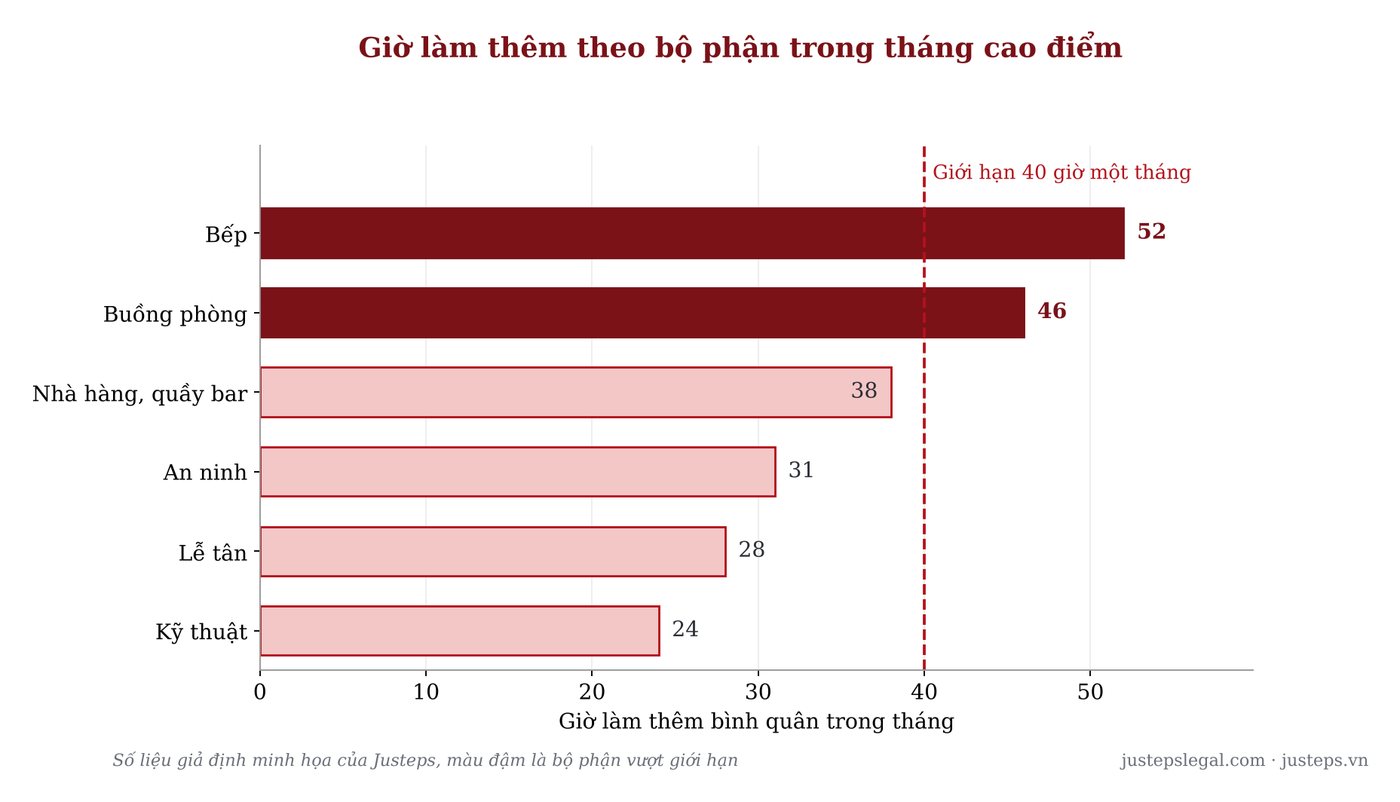
Example of average overtime hours of one employee by department in a peak month
In this example, kitchen staff worked an average of 52 hours of overtime and housekeeping staff 46 hours in the month, both above the 40-hour limit. The restaurant and bar were at 38 hours, security at 31 hours, reception at 28 hours and engineering at 24 hours, which is still within the limit, although the restaurant was close to the threshold. Justeps helps the business prepare shift rosters with a column for cumulative overtime, deploy seasonal or outsourced workers for the excess, and draft overtime agreements in the correct form. From 1 March 2027, 27 July and 24 November become paid public holidays under the law amending the Labour Code[3], so shift rosters and labour costs for these days need to be recalculated.
Service charges and tips
The service charge the establishment collects from guests on the invoice is revenue of the business and is subject to value added tax together with the price of the service[4], while the portion the business distributes to staff is income from wages and remuneration subject to personal income tax[5]. Collective disputes in the sector often begin with service charges, when the share retained by the business, the distribution between departments or the deductions made are decided verbally without any written document. Deducting service charges from staff for misconduct is also a form of fine, whereas the Labour Code does not allow fines or wage cuts in place of labour discipline[1].
The allocation policy Justeps drafts publishes the retention rate and the purpose for which the retained portion is used, distributes according to objective criteria such as actual days worked and position coefficients, shows the service charge as a separate line on the payslip each period and requires accounting to withhold tax before payment. Tips that guests hand directly to staff should be covered in the internal labour rules, stating whether they are paid into a common pool or kept by the individual, to avoid suspicion between departments. The chart below illustrates the monthly income of a restaurant employee under this policy.
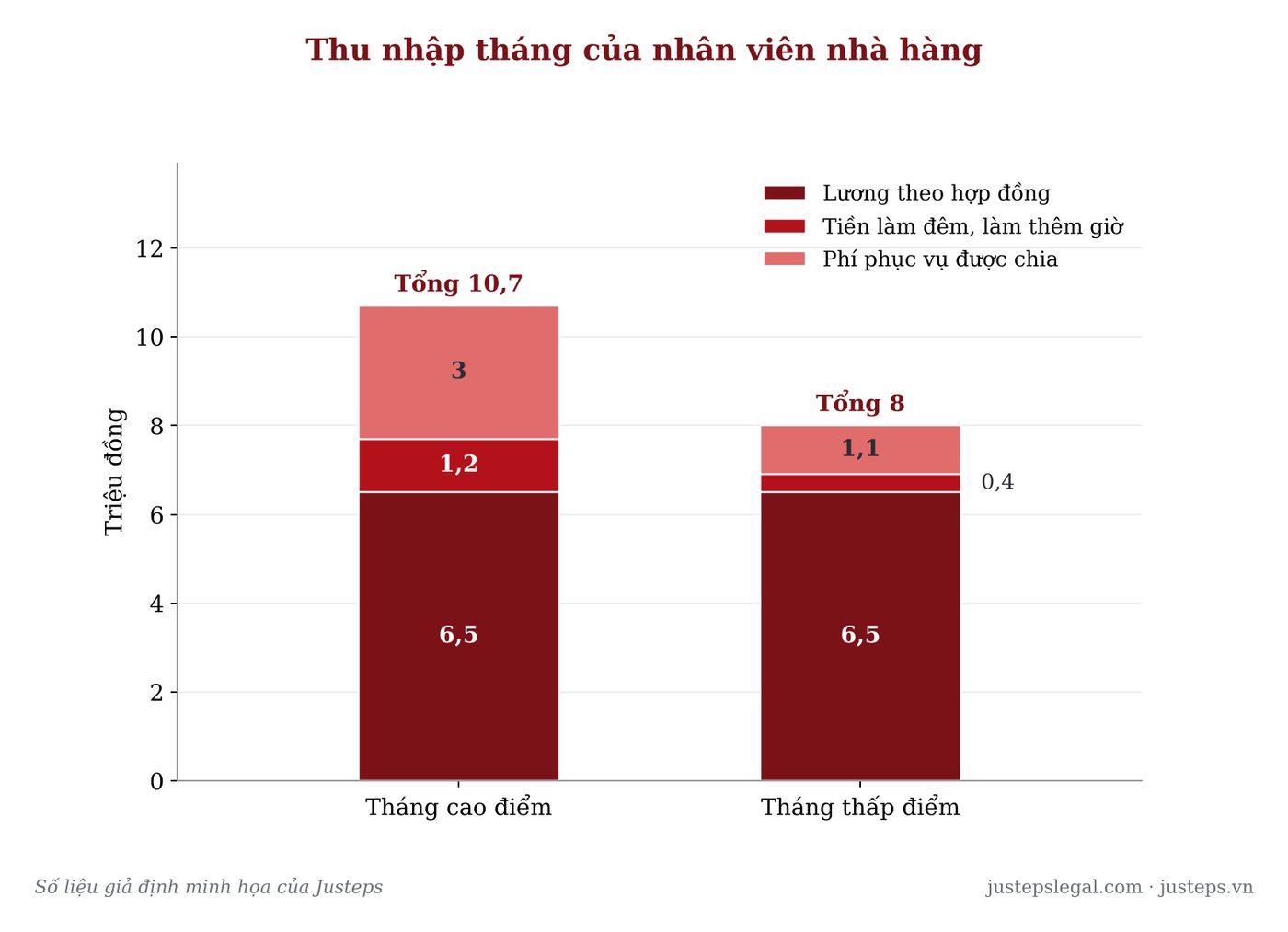
Example of the monthly income of a restaurant employee in a peak month and a low month
In this example, the contractual salary remains stable at VND 6.5 million in both months and forms the main part of the insurance contribution base. Night shift and overtime pay is VND 1.2 million in the peak month and VND 0.4 million in the low month, while the service charge share is VND 3 million and VND 1.1 million respectively. Total income therefore ranges from VND 8 million to VND 10.7 million, and the employee can see clearly which part is fixed and which depends on the establishment’s revenue. Salary scales by department and position and the method of calculating each income item are built in detail by Justeps under the salary scale and pay and bonus regulation service.
Insurance contribution base, seasonal workers and interns
Wages subject to social insurance contributions comprise the salary, salary allowances and other supplementary amounts agreed to be paid regularly and stably in each pay period[6]. Fixed monthly allowances therefore form part of the contribution base, while the share of service charges that fluctuates with revenue must be described according to its true nature in the regulation to determine how it is treated. The salary in the contract must not be lower than the regional minimum wage, which from 1 January 2027 is VND 5,700,000 in Region I, VND 5,080,000 in Region II, VND 4,450,000 in Region III and VND 4,040,000 in Region IV[7], according to where the establishment operates. The business also pays a trade union fee equal to 2% of the payroll used as the basis for social insurance contributions[8].
Coastal and mountain resorts usually recruit many additional workers for the peak season. Labour contracts with a term of one full month or more are subject to compulsory social insurance[9], so signing consecutive three-month contracts to avoid allowances or insurance is both unlawful and easily detected when data is cross-checked. Meals during shifts and accommodation provided by the business for staff should be set out in the benefits policy, because their inclusion in income subject to personal income tax is subject to specific limits under the new guiding decree[10].
Students on internships under their school’s programme need a written agreement between the business, the school and the student, clearly stating the content of the internship, the supervisor and the allowance. When interns are placed on fixed shifts, do the same work as regular staff and are subject to timekeeping, the relationship may be found to be an employment relationship with full obligations on wages and insurance. Justeps drafts template internship agreements and apprenticeship and probationary training contracts, and rules limiting the work of interns in each department.
Who is the employer when there is a management company
At a resort run by a management company, most staff usually sign contracts with the owner’s company, while the management company directs them under the management agreement. In some projects, however, the management company recruits and seconds staff to work there, an arrangement that may amount to labour leasing, which is a conditional business line under the Labour Code[1]. The question of who the employer is determines who pays severance allowances, who is responsible in the event of an occupational accident and what happens to staff contracts when the owner changes management company.
Justeps reviews the management agreement together with the labour contracts to identify the employer correctly, proposes clauses on staff costs when the management agreement is terminated, and compares the brand’s human resources policies with Vietnamese law. Where a brand policy is less favourable than Vietnamese law, for example on leave or disciplinary procedures, the business must apply the Vietnamese legal standard.
Sexual harassment and safety in each department
Housekeeping staff often work alone in occupied rooms, bar staff serve guests who have been drinking and spa staff work in closed rooms, so the risk of sexual harassment is much higher than in many other sectors. The decree guiding the Labour Code defines acts of sexual harassment in the workplace and requires employers to have rules on prevention, on receiving and handling complaints and on protecting the confidentiality of the person harassed[11]. Justeps drafts specific rules allowing staff to leave a room when they feel unsafe and setting out how to report the conduct of guests and colleagues, and incorporates them into the internal labour rules.
The kitchen carries risks of burns and fire, the laundry involves chemicals and industrial machines, engineering works with electricity and lifts, and the pool lifeguard team faces risks to life. Each group needs safety training, personal protective equipment and a procedure for reporting occupational accidents under the Law on Occupational Safety and Health, which was amended in November 2026[12]. A business employing 10 or more employees must have written internal labour rules registered with the labour authority, which can be prepared together with the internal labour rules and disciplinary handling service.
Foreign general managers, executive chefs and experts
Internationally branded hotels and resorts often recruit foreigners as general managers, department directors or executive chefs. Work permit applications submitted up to and including 4 December 2026 are governed by Decree No. 219/2025/ND-CP[13], while from 5 December 2026 Decree No. 393/2026/ND-CP applies, with new criteria for managers, chief executives, experts and technical workers[14]. Justeps assesses which group the intended position falls into, prepares the application and calculates the insurance and personal income tax costs for the foreign employee, including where part of the income is paid abroad by the management company.
Implementation process, deliverables and fees
A project to standardise labour, wages and insurance for an accommodation establishment usually takes about eight weeks, and for resorts it should be done in the low season so that staff sign new contracts before the shift roster fills up.
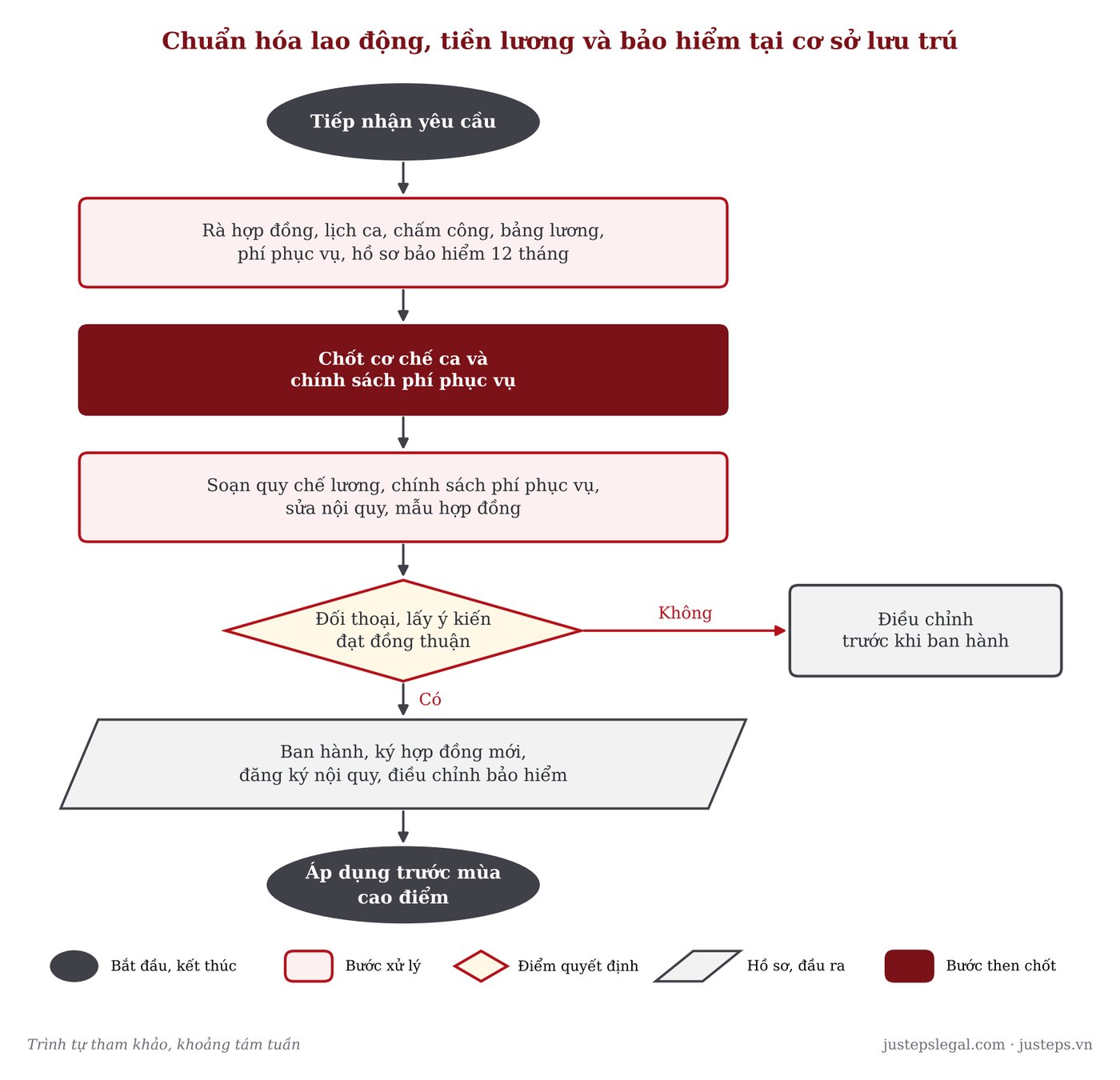
Sequence for standardising labour, wages and insurance at an accommodation establishment
In the first two weeks Justeps reviews the contracts, shift rosters, timesheets, payroll, service charge distribution and insurance records for the last 12 months, and interviews human resources, accounting and the heads of department. In the third week management agrees the shift arrangements and the service charge policy, because these decisions directly affect employees’ income, after which Justeps drafts the documents and the business holds a dialogue and consults the employee representative organisation at the workplace, if there is one, before issuing them. The deliverables include the following documents:
- A labour and insurance review report with an estimate of financial risk and the order of remedial steps.
- A salary scale and pay regulation covering allowances, night pay, overtime pay, bonuses and deductions.
- A service charge allocation policy and rules on tips.
- Internal labour rules with provisions on shifts, night work and the prevention of sexual harassment, together with the registration file.
- Template labour contracts, seasonal contracts and internship agreements, an occupational accident reporting procedure and a safety training plan by department.
Justeps quotes the project fee as a fixed fee in writing after the initial meeting, depending on the number of staff and departments, the number of establishments, whether a service charge policy is needed, the extent of errors in the current insurance records, the need for bilingual documents where there is an international management company and whether the business needs Justeps’ support for dialogue or for dealing with the authorities. Businesses with outstanding insurance contributions should remedy them proactively before an inspection, which can be done together with the compulsory social insurance advisory service.
How Justeps can help
Alongside labour, wages and social insurance services, hotel, resort and homestay businesses may combine the following Justeps services:
- Organisational structure design for hotel, resort and homestay businesses. Justeps sets staffing by room count and season, as the basis for shift rosters and recruitment plans.
- Ongoing legal advisory for hotel, resort and homestay businesses. Justeps follows labour situations arising in the peak season closely and provides updates when labour law changes.
- Salary scales and pay and bonus regulations. Justeps builds salary scales by department and position, including how night pay and the service charge share are calculated.
- Compulsory social insurance advisory. Justeps reviews the contribution base, resolves outstanding contributions and prepares files for dealing with the social insurance authority.
- Internal labour rules and disciplinary handling. Justeps drafts internal labour rules with provisions on shifts, sexual harassment and the code of conduct towards guests.
Frequently asked questions
Is the service charge distributed to staff subject to social insurance contributions?
It depends on how it is designed. A fixed amount paid regularly each pay period forms part of the wages subject to contributions[6], while an amount that fluctuates with revenue must be described according to its true nature in the policy to determine how it is treated.
How much extra is paid for night shifts?
At least 30% of the wage for a normal working day for hours worked between 22:00 and 06:00[1]. If those hours are also overtime, the employee is additionally entitled to the overtime premium.
May service charges be deducted from staff who commit misconduct?
This should not be done, because it is a form of fine that the Labour Code does not allow in place of disciplinary action. Misconduct should be dealt with under the internal labour rules and the disciplinary procedure, while service charges are distributed according to objective criteria.
Do interns need to sign labour contracts?
Students on internships under a training programme usually need only a written agreement with the school and the student. If the intern works like a regular employee, the relationship may be treated as an employment relationship with full obligations on wages and insurance.
Are seasonal workers subject to social insurance contributions?
Yes, where the contract has a term of one full month or more[9]. This cost should be included in the peak-season staffing budget from the outset.
Must a hotel register its internal labour rules?
A business employing 10 or more employees must have written internal labour rules registered with the labour authority. The internal labour rules of an accommodation establishment should include provisions on shifts and the prevention of sexual harassment[11].
Which rules apply to a foreign general manager’s work permit application filed after 5 December 2026?
Applications filed from 5 December 2026 are governed by Decree No. 393/2026/ND-CP[14]. Applications filed before that date continue to be processed under the previous rules, so the business should fix the filing date as soon as it has a recruitment plan.
Related articles
- Organisational structure design for hotel, resort and homestay businesses by operating model and room count
- Ongoing legal advisory for hotel, resort and homestay businesses in day-to-day operations
- Managing seasonal workers and freelance collaborators in line with the true nature of the contract and contribution obligations
- Moving from paper to electronic labour contracts, with the conditions, platforms and storage requirements
Notes
[1] The Labour Code No. 45/2019/QH14 dated 20 November 2019.
[2] Article 60 of Government Decree No. 145/2020/ND-CP dated 14 December 2020 detailing and guiding the implementation of a number of articles of the Labour Code on working conditions and labour relations.
[3] The Law amending and supplementing a number of articles of the Labour Code, the Law on Archives, the Law on Gender Equality, the Law on Red Cross Activities and the Law on Employment, passed by the National Assembly on 21 November 2026, effective from 1 March 2027.
[4] The Law on Value Added Tax No. 48/2024/QH15 and Government Decree No. 181/2025/ND-CP dated 1 July 2025 detailing this Law.
[5] The Law on Personal Income Tax No. 109/2025/QH15, effective from 1 July 2026.
[6] Clause 1 of Article 31 of the Law on Social Insurance No. 41/2024/QH15 dated 29 June 2024.
[7] Government Decree No. 399/2026/ND-CP dated 2 November 2026 on the minimum wage for employees working under labour contracts, applicable from 1 January 2027.
[8] Point b of Clause 1 of Article 29 of the Law on Trade Unions No. 50/2024/QH15 dated 27 November 2024.
[9] Point a of Clause 1 of Article 2 of the Law on Social Insurance No. 41/2024/QH15 dated 29 June 2024, effective from 1 July 2025, as amended and supplemented by the law passed by the National Assembly on 21 November 2026.
[10] Points g and h of Clause 2 of Article 8 of Government Decree No. 253/2026/ND-CP dated 30 June 2026 detailing a number of articles of the Law on Personal Income Tax.
[11] Articles 84 to 86 of Government Decree No. 145/2020/ND-CP dated 14 December 2020.
[12] The Law on Occupational Safety and Health No. 84/2015/QH13 dated 25 June 2015 and the amending law passed by the National Assembly on 21 November 2026.
[13] Government Decree No. 219/2025/ND-CP on foreign employees working in Vietnam, applicable until the end of 4 December 2026.
[14] Government Decree No. 393/2026/ND-CP dated 20 October 2026 on foreign employees working in Vietnam, effective from 5 December 2026.
This article is for reference and reflects the regulations in force at the time of publication. Please consult Justeps for advice tailored to your company’s records and situation.
For further information, please contact:
📩 Email: info@justeps.vn
🌐 Website: https://justepslegal.com · https://justeps.vn
🌐 Page: Justeps
☎️ Hotline (Zalo): 096 172 2607
📍 Thanh Xuan Office: 12th Floor, Licogi 13 Tower, 164 Khuat Duy Tien Street, Thanh Xuan Ward, Hanoi, Vietnam
📍 Ha Dong Office: LK06B, No.10, Dong Dua Area, Ha Dong Ward, Hanoi, Vietnam
📍 Ho Chi Minh City Branch: 528 Le Van Sy, Ho Chi Minh City, Vietnam
📍 Hai Phong Office: Truong Thinh Village, Ha Dong Commune, Hai Phong, Vietnam
📍 Quang Ninh Office: Van Don Special Zone, Quang Ninh Province, Vietnam





