
Key takeaways
- A driver’s continuous driving time must not exceed 4 hours, while daily and weekly working time follows the Labour Code[1], so the rules must state clearly whether time spent waiting for loading, unloading or customs clearance counts as working time.
- Trip-based pay agreed and paid regularly every month may have to be included in the wage on which social insurance is calculated[3], so how a driver’s income is divided into wages, allowances and road expenses determines both the contribution obligation and the risk of reassessment.
- Keeping the original driving licence of a driver or collecting a cash deposit from him is prohibited[2], even though many businesses still regard this as a way to retain staff and protect vehicles.
- Delivery staff who are rostered, timed, uniformed and disciplined like permanent employees are in an employment relationship[2], even if the parties sign a collaborator or service contract.
Logistics businesses have a larger and more dispersed workforce than most other service sectors. Container drivers travel long distances for days, warehouse workers work three shifts, seasonal workers double in number during the year-end peak and last-mile delivery staff spend the whole day on the road, yet many businesses still use one contract template and one pay method for everyone. As a result, disputes over overtime pay, insurance reassessment and occupational accidents tend to surface together when an inspection or an accident occurs.
This page introduces Justeps’ service of standardising labour, wages and social insurance for freight forwarding, warehousing and freight transport businesses. It focuses on the specific features of the sector, namely drivers’ working time, trip-based pay and the basis for insurance contributions, delivery staff and seasonal workers, compensation for damaged goods, road accidents and heavy work. The number of drivers, warehouse workers and indirect staff in each unit is determined first under the organisational structure design service for logistics, warehousing and freight transport businesses.
Drivers’ working time under two layers of rules
Commercial transport drivers are subject to both labour law and traffic law. The Law on Road Traffic Order and Safety limits continuous driving time to no more than 4 hours, and from 1 July 2026 a driver’s daily and weekly working time is governed by the Labour Code[1]. The Labour Code in turn limits normal working hours and overtime per day, month and year, and requires the employee’s consent to overtime[2].
The question Justeps is asked most often is whether time waiting for loading and unloading, for clearance at a border gate or for the port to accept a container counts as working time. The law does not list this case specifically, but if the driver must stay with the vehicle and be ready to move on request, it is likely to be paid working time. The rules therefore need to distinguish genuine rest from waiting time with responsibility for guarding the vehicle and goods, specify how this is recorded in the tracking data and how it is counted towards overtime. The business should also check whether it falls within the cases permitted to organise up to 300 overtime hours a year before building its trip schedules; the detailed timekeeping method can be set up through the working time, overtime and timekeeping service.
Trip-based pay, road allowances and the basis for insurance contributions
A driver’s income usually consists of a low fixed wage, pay per trip or per kilometre, allowances and road expenses. Under the Law on Social Insurance effective from 1 July 2025, the wage on which contributions are based comprises the wage level, wage allowances and other supplementary amounts agreed to be paid regularly and stably in each pay period[3]. Many businesses contribute only on the fixed wage while trip pay is paid regularly every month, and this is the largest source of insurance reassessment Justeps sees in the transport sector.
The chart below illustrates the monthly income of a long-haul container driver and which parts are wages and which are reimbursement of expenses.
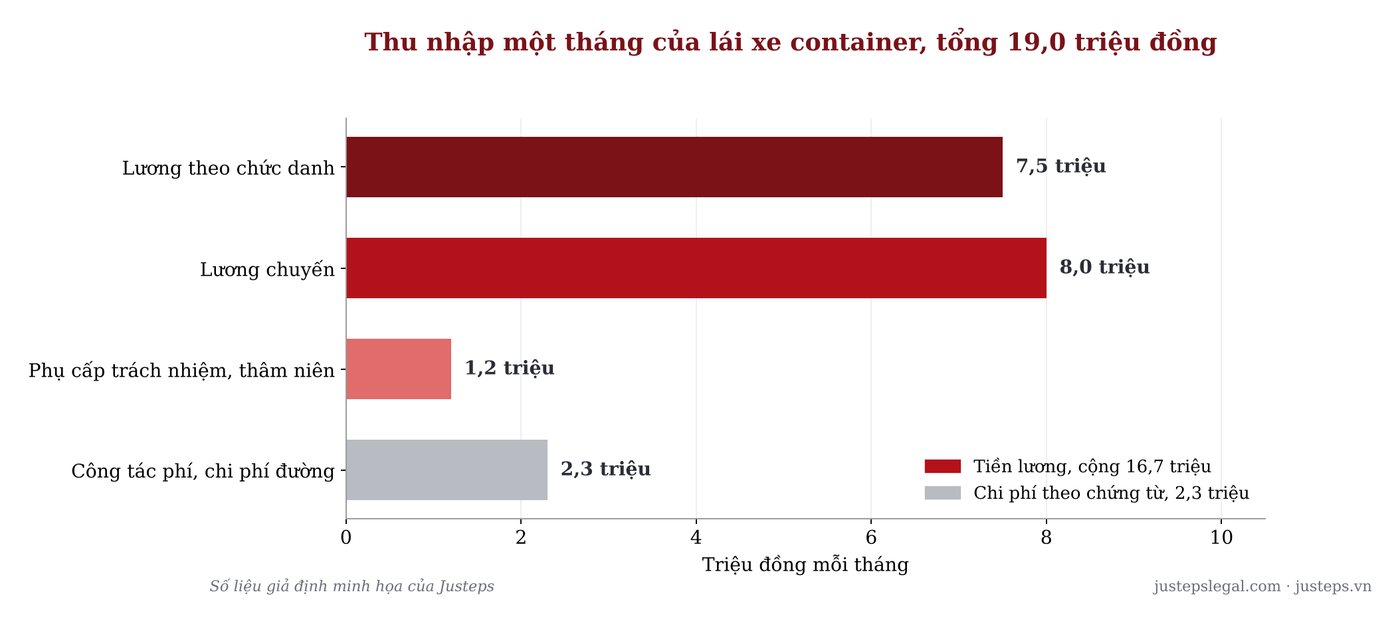
Example monthly income structure of a long-haul container driver
In the example, the driver receives a total of VND 19.0 million, comprising a job-title wage of VND 7.5 million, trip pay of VND 8.0 million, responsibility and seniority allowances of VND 1.2 million, and VND 2.3 million of travel and road expenses reimbursed against documents. The first three items add up to VND 16.7 million of wages, while the last is a business expense provided there are proper rules and documents. Justeps builds the pay scale, trip pay rules and travel expense rules so that each item has its correct nature, then recalculates the insurance contribution obligation so the business can decide on an adjustment roadmap. The job-title wage must not be lower than the regional minimum wage where the employee works, with new levels applying from 1 January 2027[4].
Trip-based piece rates also do not replace pay for overtime, night work and work on public holidays[2]. If the rules cannot show that the trip rate already includes these amounts, the business may have to pay the difference in a dispute. From 1 March 2027 employees have two additional public holidays on 27 July and 24 November[5], so trip schedules on these days should be costed in advance. The pay scale and volume-based bonus rules can be developed in detail through the pay scale and wage and bonus regulations service.
Delivery staff, seasonal workers and leased labour
Last-mile delivery staff are often engaged under collaborator or service contracts, yet they are rostered, location-tracked, uniformed and sanctioned for late deliveries. The Labour Code treats an agreement on paid work subject to the management, direction and supervision of one party as an employment contract regardless of its name[2]. A service contract is suitable only where the courier genuinely decides the time, vehicle and method of work, so Justeps reviews actual management practice before choosing the type of contract.
Peak-season workers with contracts of one month or more are subject to compulsory social insurance[3], so they cannot be left off the contribution list merely because the work is short-term. Contracts can be concluded electronically so that hundreds of people can sign within a few days[6]. Warehouses using leased labour from a supplier should note that from 1 March 2027 labour leasing moves from licensing to a deposit and notification regime, and the client becomes responsible for monitoring the payment of wages and insurance contributions for leased workers[5].
Driving licences, cash deposits and compensation for damaged goods
To prevent drivers leaving with a vehicle or goods, many businesses keep the original driving licence or identity card or require a cash deposit. The Labour Code prohibits employers from keeping originals of employees’ identity papers, diplomas and certificates and from requiring employees to provide security in money or other assets for the performance of the contract[2]. Justeps replaces these measures with rules on handover of vehicles and goods against a record, monitoring through tracking devices and liability for compensation under the internal labour rules.
When goods are damaged or a vehicle has an incident through an employee’s fault, the business may claim compensation only through the procedure set out in the registered internal labour rules. For damage caused by negligence of a value not exceeding the statutory threshold, compensation is capped at three months’ wages, and monthly deductions may not exceed 30% of the wages actually paid after social insurance and personal income tax[2]. The internal labour rules of a transport business should also provide for alcohol testing at the start of the shift, recording the result and processing the test data under the Law on Personal Data Protection[7]; the rules can be drafted and registered through the internal labour rules and disciplinary handling service.
Road accidents and heavy work
A road accident occurring while the driver is performing his duties is an occupational accident. The business must provide first aid, pay medical costs, pay full wages during treatment, report and investigate the accident and prepare the file for the employee to receive benefits from the occupational accident insurance fund[8], and may also have to compensate injured third parties[9]. From 1 March 2027 employees may also report an accident directly to the competent authority, so late reporting can hardly be concealed.
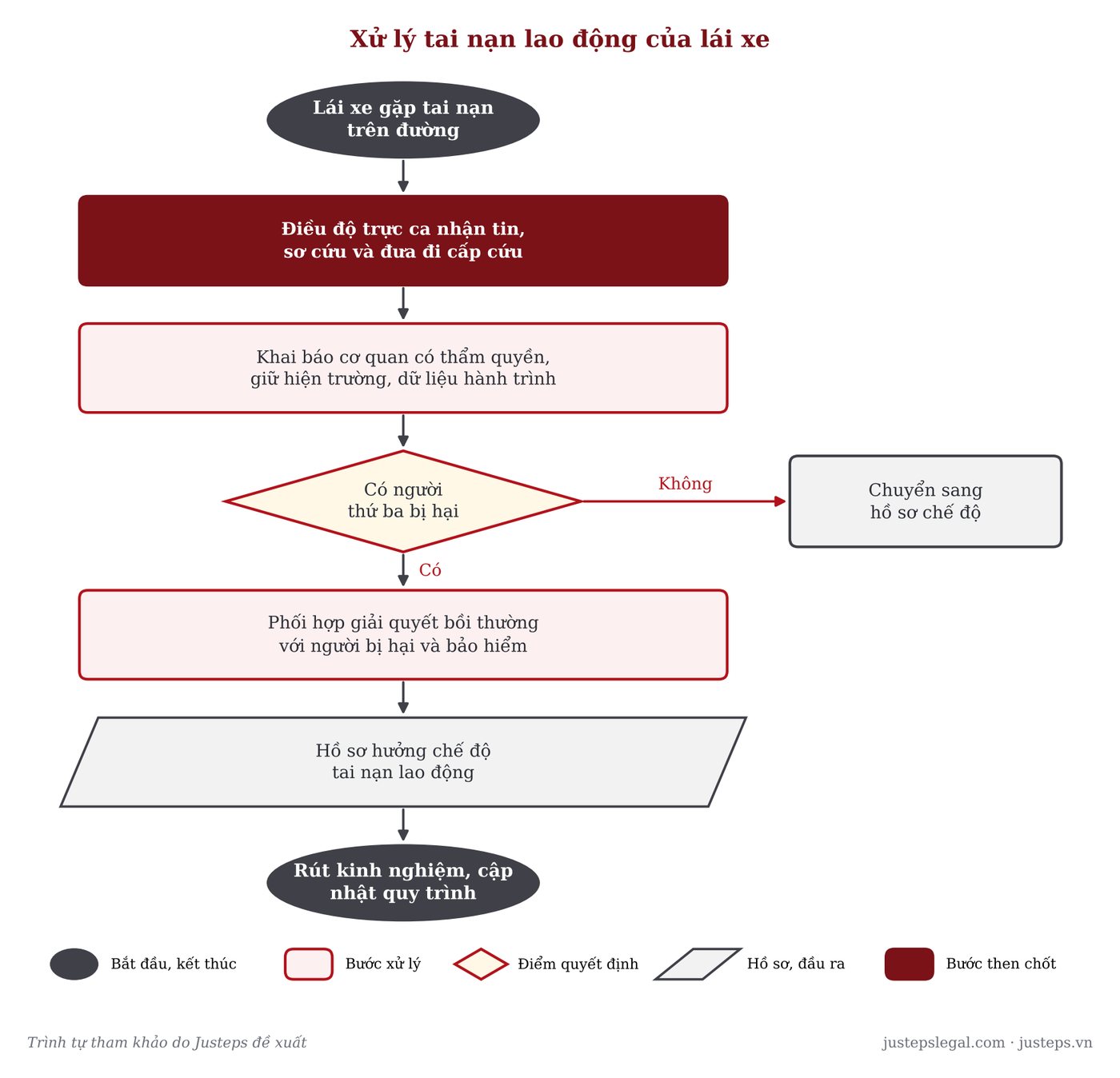
Sequence for handling an occupational accident involving a driver on the road
Under this sequence, the duty dispatcher is the first to receive the news and must ensure that the injured person receives first aid and is taken for emergency treatment before anything else. The two steps most often delayed are reporting to the competent authority and preparing the benefit file, so Justeps prepares template records, a list of documents and the time limit for each step so that the duty dispatcher and HR can act at once, even outside office hours. Compensation to third parties and dealings with investigating authorities are coordinated with the ongoing legal advisory service for logistics, warehousing and freight transport businesses.
Some work such as driving heavy trucks, manual loading and unloading or working in cold stores may be on the list of heavy, hazardous or dangerous occupations. Employees in these jobs receive periodic health checks at least once every six months and additional days of annual leave[8][2]. Justeps compares each position against the current list and then reflects the corresponding entitlements in the pay scale, health check schedule and leave plan.
Implementation process, deliverables and fees
A standardisation project usually takes about eight weeks and should begin before the year-end peak so that new contracts can be signed with seasonal workers in time. The roadmap below is the sequence Justeps usually applies.
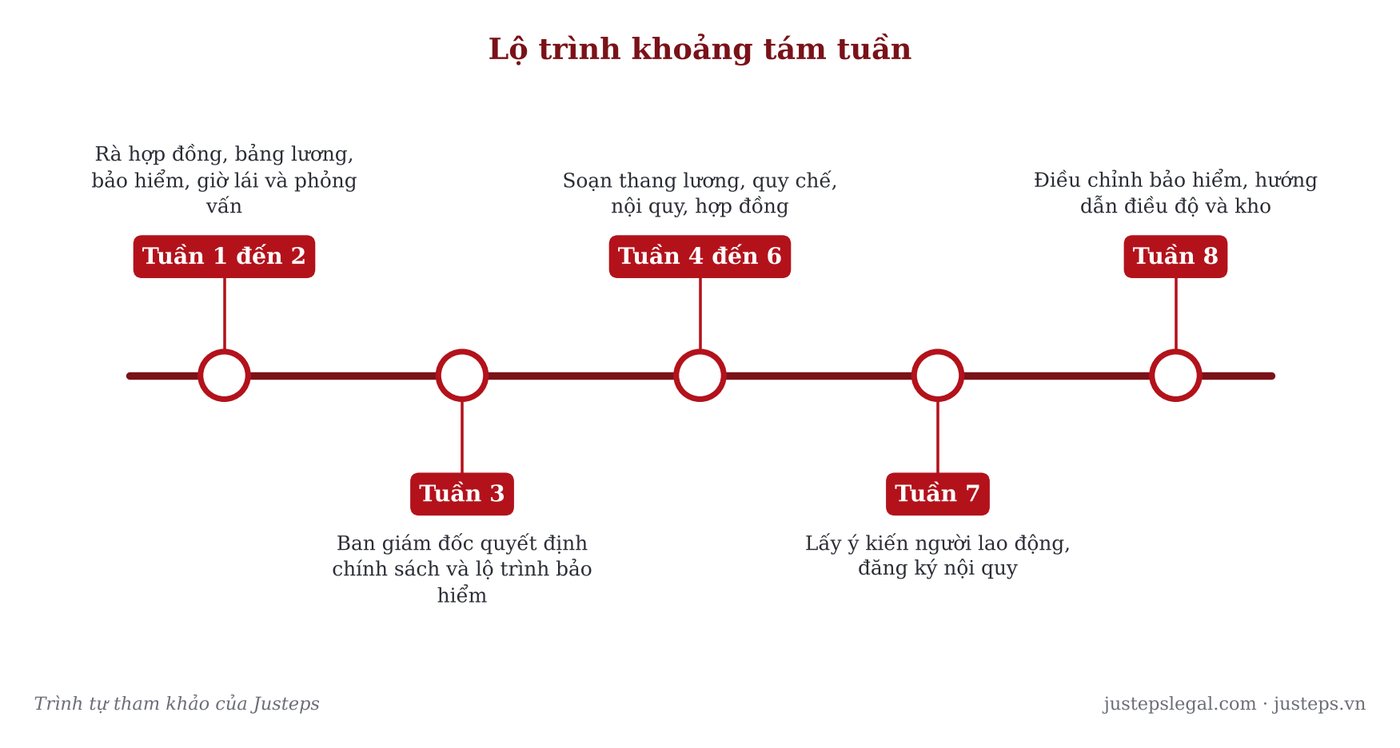
Roadmap for standardising labour, wages and social insurance in a logistics business
In the first two weeks Justeps reviews contracts by group, the last three months of payroll, insurance records, internal labour rules and driving-hour data, and interviews driver representatives and warehouse team leaders to understand how trips are calculated and time is recorded in practice. In the third week the management board decides on policy and the insurance adjustment roadmap. In the following weeks Justeps drafts the pay scale, regulations, internal labour rules and new contracts, consults the employee representative organisation where there is one, registers the internal labour rules with the provincial labour authority[2] and then adjusts the insurance records. The deliverables comprise the following documents:
- A labour, wage and insurance review report with remediation priorities.
- A pay scale, payroll table, trip pay rules and travel expense rules for drivers, warehouse workers, dispatchers and office staff.
- Rules on drivers’ working and rest time and on shifts, night work and overtime in the warehouse.
- Internal labour rules covering alcohol, handover of vehicles and goods and the compensation procedure, with registration documents.
- Template employment contracts by group, a template for seasonal workers and a suitable template for delivery staff.
- An occupational accident handling procedure with forms and a list of documents.
Justeps quotes a fixed fee in writing after the initial meeting, depending on the number of employees and job groups, the number of warehouses and branches, the extent of insurance discrepancies to be remedied and the number of localities where internal labour rules must be registered. Businesses with foreign managers or supervisors should note that work permit applications submitted up to 4 December 2026 are processed under Decree No. 219/2025/ND-CP[10], while Decree No. 393/2026/ND-CP applies from 5 December 2026[11], and this work can be included in the same project.
How Justeps can help
In addition to labour, wages and social insurance services, logistics, warehousing and freight transport businesses can combine the following Justeps services:
- Organisational structure design for logistics, warehousing and freight transport businesses. Justeps determines the headcount of drivers, warehouse workers and indirect staff before building the pay scale.
- Internal procedures and regulations for logistics, warehousing and freight transport businesses. Justeps writes dispatch, pre-trip inspection and loss handling procedures linked to the internal labour rules.
- Pay scales and wage and bonus regulations. Justeps builds pay scales by driver, warehouse and dispatch position with trip pay and volume bonuses.
- Internal labour rules and disciplinary handling. Justeps drafts and registers internal labour rules and guides the discipline and compensation procedure.
- Working time, overtime and timekeeping. Justeps sets up how driving hours, waiting time and overtime are recorded for drivers and warehouse workers.
Frequently asked questions
Does time waiting for loading and unloading count as a driver’s working time?
The law has no specific rule for this case. If the driver must stay with the vehicle and be ready to work on request, it is likely to be working time[2], so the business should define it clearly in its rules and contracts.
Is trip pay subject to social insurance contributions?
It depends on how it is agreed and paid. An amount agreed to be paid regularly and stably in each pay period may form part of the wage on which contributions are based[3], so Justeps examines each item individually.
May the business keep drivers’ driving licences?
No. The Labour Code prohibits keeping originals of employees’ identity papers, diplomas and certificates and prohibits requiring a deposit in money or assets[2].
Must peak-season workers be insured?
Persons working under employment contracts of one month or more are subject to compulsory social insurance[3]. The business should plan seasonal contracts from the start of the season.
If a driver causes an accident, must the business compensate the injured party?
Yes. The business compensates for damage caused by an employee while performing assigned duties and may require the employee at fault to reimburse it as prescribed[9], through the compensation procedure of labour law.
May drivers be tested for alcohol before each trip?
Yes. Testing should be provided for in the internal labour rules, with a record of the result and clear consequences. Test data is personal data and must be stored and used in accordance with the Law on Personal Data Protection[7].
Related articles
- Organisational structure design for logistics, warehousing and freight transport businesses by service chain and handover point
- Internal procedures and regulations for logistics, warehousing and freight transport businesses, from handover to compensation
- Ongoing legal advisory for logistics, warehousing and freight transport businesses on contracts, claims and tax
- Labour, wages and social insurance services for import-export trading businesses with commissions and foreign employees
Notes
[1] Article 64 of the Law on Road Traffic Order and Safety No. 36/2024/QH15, as amended and supplemented by Law No. 118/2025/QH15, effective from 1 July 2026.
[2] The Labour Code and the documents amending and supplementing it.
[3] The Law on Social Insurance and the documents amending and supplementing it.
[4] Government Decree No. 399/2026/ND-CP dated 2 November 2026 on the minimum wage for employees working under employment contracts, applicable from 1 January 2027.
[5] The Law amending and supplementing a number of articles of the Labour Code, the Law on Archives, the Law on Gender Equality, the Law on Red Cross Activities and the Law on Employment, effective from 1 March 2027.
[6] Government Decree No. 337/2025/ND-CP on electronic employment contracts.
[7] The Law on Personal Data Protection No. 91/2025/QH15, effective from 1 January 2026.
[8] The Law on Occupational Safety and Health and the documents amending and supplementing it.
[9] Articles 597 and 601 of the Civil Code No. 91/2015/QH13 dated 24 November 2015.
[10] Government Decree No. 219/2025/ND-CP on foreign workers in Vietnam, applicable until 4 December 2026.
[11] Government Decree No. 393/2026/ND-CP dated 20 October 2026 on foreign workers in Vietnam, effective from 5 December 2026.
This article is for reference and reflects the regulations in force at the time of publication. Please consult Justeps for advice tailored to your company’s records and situation.
For further information, please contact:
📩 Email: info@justeps.vn
🌐 Website: https://justepslegal.com · https://justeps.vn
🌐 Page: Justeps
☎️ Hotline (Zalo): 096 172 2607
📍 Thanh Xuan Office: 12th Floor, Licogi 13 Tower, 164 Khuat Duy Tien Street, Thanh Xuan Ward, Hanoi, Vietnam
📍 Ha Dong Office: LK06B, No.10, Dong Dua Area, Ha Dong Ward, Hanoi, Vietnam
📍 Ho Chi Minh City Branch: 528 Le Van Sy, Ho Chi Minh City, Vietnam
📍 Hai Phong Office: Truong Thinh Village, Ha Dong Commune, Hai Phong, Vietnam
📍 Quang Ninh Office: Van Don Special Zone, Quang Ninh Province, Vietnam





