
Key takeaways
- Calling tour guides collaborators does not change the nature of the relationship, because where there is paid work, wages and management, direction and supervision by the business, the relationship is an employment relationship[1].
- A day leading a group is usually longer than eight hours, and normal working hours plus overtime may not exceed 12 hours a day[3], so the business needs a method of counting working hours on tour instead of paying a lump-sum travel allowance.
- From 1 March 2027 employees have two more public holidays, 27 July and 24 November[4], both falling within the touring season, so assignment schedules and the budget for holiday pay need to be recalculated now.
- Foreigners are not issued Vietnamese tour guide cards[2], so foreign market specialists may only do office, sales or operations work and must hold a work permit unless exempt.
Work in the travel sector does not follow office hours. Demand rises sharply in summer, during public holidays, Tet and the international visitor season and then falls steeply straight afterwards; a day leading a group may begin at five in the morning and end at ten at night, while public holidays are the busiest days. To cope, businesses often keep a small group of permanent staff and rely on freelance tour guides in the peak season, paying a lump-sum travel allowance for each day on tour. This saves costs in the short term but leaves risks of back payment of insurance, disputes over overtime pay and errors in personal income tax.
This page introduces Justeps’ service on contracts, working hours, wages, insurance and personal income tax for office staff, tour operators and tour guides of travel businesses. The position of the tour guide team and of the person who approves assignment schedules within the structure falls under the organisational structure design service for travel and tour businesses, while this page deals with the rights and obligations of each group of workers.
Permanent, seasonal or trip-by-trip tour guides
The Labour Code determines an employment relationship by its substance rather than by the name of the contract, so an agreement involving paid work, wages and management, direction and supervision by one party is regarded as an employment contract[1]. A tour guide who regularly leads groups for one business, according to a schedule assigned by the business, is paid monthly and is subject to the business’s evaluation and discipline is therefore very unlikely to be regarded as an independent collaborator, even if the contract is called a service contract. Conversely, a freelance tour guide who takes individual trips from several businesses, decides independently whether to accept them and is paid only per trip may sign a service contract for each group.
Tourism law adds its own conditions, under which international and domestic tour guides, when practising, must hold a valid card and must have an employment contract with a travel business or be a member of a professional social organisation for tour guiding, and must also hold an assignment letter from the business[2]. The table below summarises how Justeps usually groups tour guides and the suitable type of contract.
| Group | Characteristics | Suitable contract |
|---|---|---|
| Permanent | Works all year, receives the schedule assigned by the business and may also do operations work in the low season. | An indefinite-term employment contract or a fixed-term employment contract of up to 36 months. |
| Seasonal | Works continuously during a peak season of a few months and is managed in the same way as permanent staff. | A seasonal fixed-term employment contract, subject to compulsory insurance if it lasts one month or more. |
| Trip by trip | A freelance guide who takes trips from several businesses and is free to accept or decline them. | A service contract for each group, with membership of a professional organisation and an assignment letter. |
| Outbound tour leader | An employee sent with a group abroad, usually from operations or sales. | The existing employment contract, with a business trip decision and travel allowance arrangements. |
The chart below illustrates the composition of the people working for an international travel business with about 60 permanent staff on a peak day.
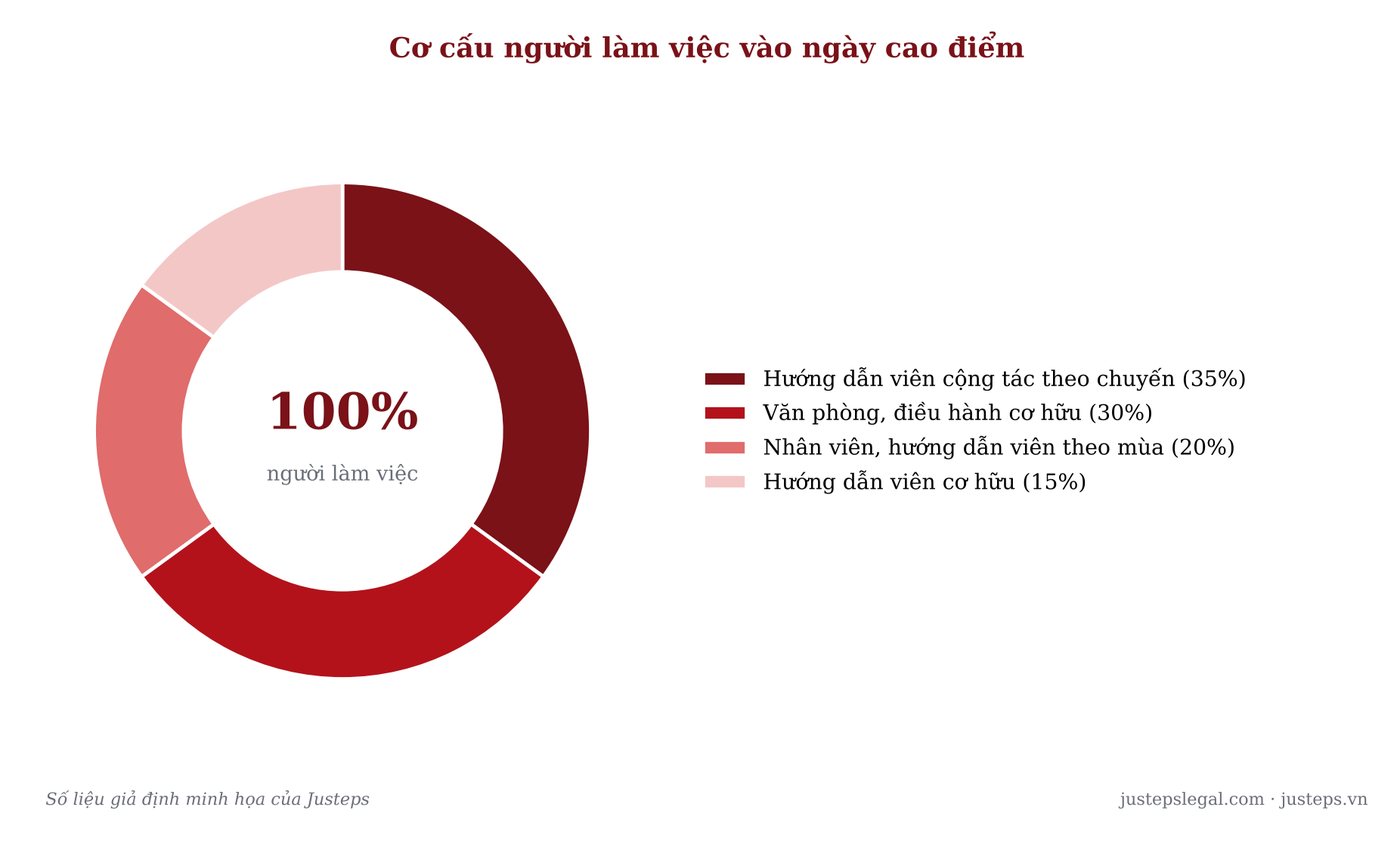
Example of the composition of people working for a travel business on a peak day
In this example, trip-by-trip tour guides make up 35% of the people working for the business, permanent office and operations staff 30%, seasonal staff and tour guides 20%, while permanent tour guides account for only 15%. The trip-by-trip group carries the highest legal risk because it is the largest in number and the most easily misclassified. Justeps reviews the list of tour guides for the last 12 months, identifies those who in practice work as employees and proposes either moving them to seasonal employment contracts or keeping service contracts with records demonstrating their independence.
Working hours on tour, overtime and public holidays
Normal working hours may not exceed eight hours a day, overtime may not exceed 50% of normal daily working hours, and the total may not exceed 12 hours a day[3]. A day leading a group from early morning to late evening exceeds these limits if all the time spent with the group is counted. Justeps helps the business build a method for counting working hours on tour into the internal labour rules, distinguishing working time from genuine rest time between stops, assigning two tour guides in rotation for long tours and preparing overtime agreements in the correct form. Internal labour rules with specific provisions on working hours on tour can be prepared together with the internal labour rules and disciplinary procedures service.
Work on public holidays is paid at least 300% of wages under the Labour Code, in addition to the holiday pay the employee is still entitled to. The Law amending and supplementing the Labour Code passed on 21 November 2026 adds two public holidays, 27 July and 24 November, with effect from 1 March 2027[4], bringing the total number of public holidays and Tet days in a year to 13. Businesses that have taken bookings for groups departing on these two days need to recalculate labour costs and assignment schedules, and contracts with permanent tour guides need to state clearly whether time off in lieu is given or holiday pay is paid.
Salary scales, tour allowances and the insurance contribution base
From 1 January 2027, the monthly minimum wage is VND 5,700,000 in Region I, VND 5,080,000 in Region II, VND 4,450,000 in Region III and VND 4,040,000 in Region IV[5]. The salary scale of a travel business needs to distinguish office staff, tour operators and tour guides by foreign language and card type, with wages for work requiring training set above the minimum wage of the region where the employee works. In addition to the contractual wage, tour guides usually receive an allowance per day on tour, sales commissions and seasonal bonuses.
A common mistake is to keep the wage in the contract very low and put most of the income into fixed monthly allowances to reduce insurance contributions. Under the Law on Social Insurance, wages for insurance contributions include the wage level and wage allowances, together with other additional amounts agreed to be paid regularly and stably in each pay period[6], so giving them a different name does not help the business avoid the obligation. A tour allowance that arises only when the guide actually leads a group and varies with the number of days on tour may be designed as a variable item, provided that the pay regulation describes the calculation method correctly. The business also pays trade union dues of 2% of the wage fund used as the basis for social insurance contributions[7].
The chart below illustrates the monthly income of a permanent tour guide in a peak month and in a low month under the pay regulation proposed by Justeps.
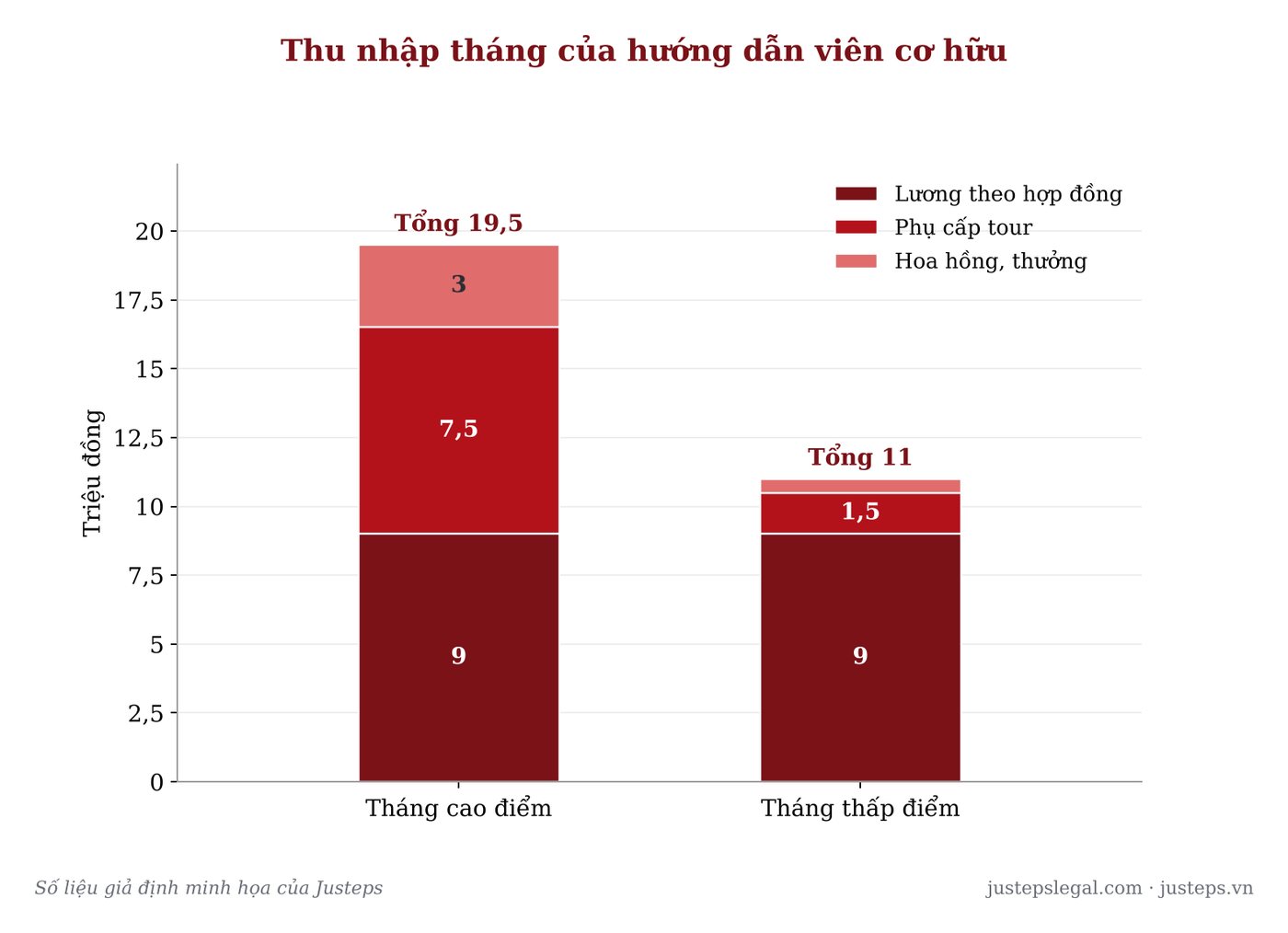
Example of the monthly income of a permanent tour guide in a peak month and a low month
In this example, the contractual wage stays at VND 9 million in both months and is the basis for insurance contributions. The tour allowance is VND 7.5 million in the peak month and VND 1.5 million in the low month, while commissions and bonuses are VND 3 million and VND 0.5 million respectively. Total income therefore ranges from VND 11 million to VND 19.5 million, but the stable wage component still ensures that the employee has a minimum income in the low season. Detailed salary scales and pay and bonus regulations can be developed together with the salary scale and pay and bonus regulation service.
Personal income tax on fees, commissions and tips
Fees paid to trip-by-trip tour guides, commissions on tour sales and commissions from shopping stops are all income subject to personal income tax, but the withholding method differs depending on whether the recipient has an employment contract and whether he or she is resident[8]. Commissions paid by shopping stops directly to tour guides are usually outside the business’s books, creating both a tax risk and an incentive to pressure customers to buy. Tips given by customers to tour guides also need to be considered in the income policy. Justeps prepares guidance on tax withholding for each type of payment for the accounting and human resources functions to apply every month, in accordance with the Law on Personal Income Tax and its guiding decree effective from 1 July 2026[9].
Accidents on tour and occupational accident insurance
An accident that happens to a tour guide or tour leader while leading a group, including when surveying a new route in mountainous or coastal areas or on adventure routes, is an accident while performing work. The business must report, investigate, prepare a file and make payments under the Law on Occupational Safety and Health, which was amended in November 2026 with stricter rules on reporting accidents[10]. Justeps drafts an occupational accident reporting procedure that applies specifically to people on tour, distinguished from accidents involving customers, and reviews contributions to occupational accident and disease insurance so that employees are not disadvantaged when an incident occurs.
Foreigners working as market specialists
Businesses receiving Korean, Chinese or European visitors often wish to recruit native speakers as market specialists. Foreigners cannot be issued tour guide cards because the conditions for issuing a card require Vietnamese nationality[2], so they may only do sales, partner relations or operations work in the office and may not lead groups directly. Work permit applications submitted up to and including 4 December 2026 are governed by Decree No. 219/2025/ND-CP[11], while from 5 December 2026 Decree No. 393/2026/ND-CP applies, with new criteria for experts, managers and technical workers[12]. Justeps assesses which group the intended position falls into, prepares the application file and calculates the insurance and tax costs for the foreign employee.
Implementation process, deliverables and fees
A project to standardise labour, wages and insurance usually takes about eight weeks and should be completed one to two months before the peak season, so that tour guides sign new contracts before the departure schedule fills up.
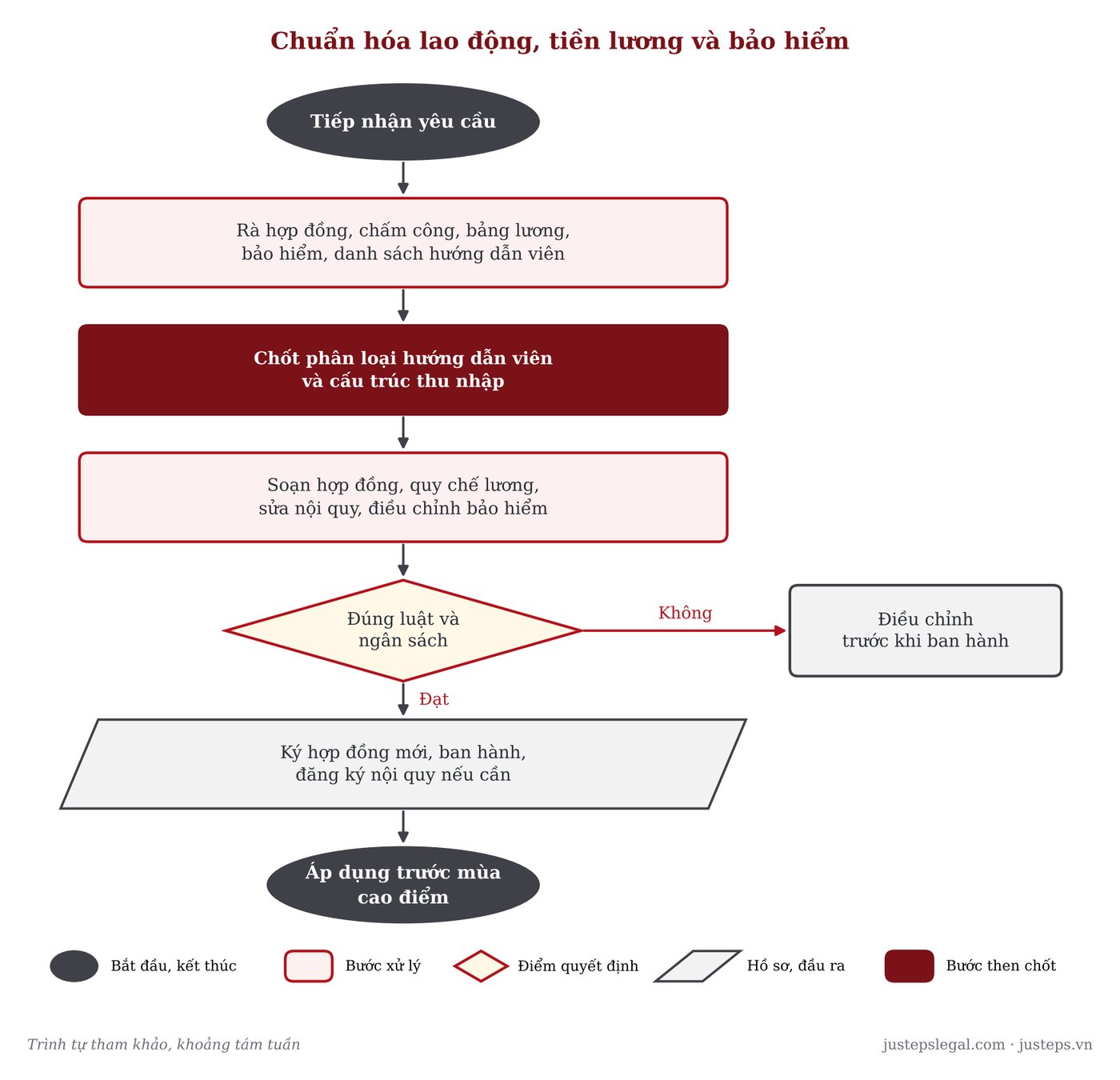
Sequence for standardising labour, wages and insurance at a travel business
In the first two weeks Justeps reviews contracts, timesheets, payrolls, insurance records and the list of tour guides for the last 12 months, and interviews management, the accountants and several tour guides. In the third week management settles how tour guides are classified and how income is structured, because these decisions directly affect costs, after which Justeps drafts contracts and the pay regulation, amends the internal labour rules and adjusts the insurance records. The deliverables include the following documents:
- A labour and insurance review report with risk ratings and a remediation plan.
- A set of employment contracts, per-group service contracts, a template assignment letter and an agreement on the confidentiality of customer data.
- A salary scale and a pay and bonus regulation covering tour allowances, commissions and seasonal bonuses.
- Internal labour rules with provisions on working hours on tour, together with the registration file where the business is required to register them.
- An occupational accident reporting procedure and guidance on personal income tax withholding for monthly use.
Justeps quotes the project fee as a fixed fee in writing after the initial meeting, depending on the number of staff and tour guides, the number of job groups needing salary scales, the extent of gaps in the current insurance records, whether the internal labour rules must be registered and whether the business needs Justeps to work alongside it with the social insurance agency or the labour inspectorate. A business that has owed insurance contributions for several years should take the initiative to remedy this before an inspection, which can be done together with the compulsory social insurance advisory service.
How Justeps can help
Alongside labour, wages and social insurance services, travel and tour businesses may combine the following Justeps services:
- Organisational structure design for travel and tour businesses. Justeps places the tour guide team, the incident contact and the person in charge of travel services in the right positions within the structure.
- Ongoing legal advisory for travel and tour businesses. Justeps follows the labour situations that arise during the peak season and provides updates when labour law changes.
- Salary scales and pay and bonus regulations. Justeps builds salary scales for tour guides by foreign language, card type and seniority, together with the method for calculating tour allowances.
- Compulsory social insurance advisory. Justeps reviews the contribution base, deals with contribution arrears and prepares files for working with the social insurance agency.
- Internal labour rules and disciplinary procedures. Justeps drafts internal labour rules with provisions on working hours on tour, a code of conduct towards customers and handling of tour guides’ violations.
Frequently asked questions
Must freelance tour guides pay social insurance through the business?
If the relationship is genuinely a per-trip service and the guide is independent, usually not. If the guide works regularly, is subject to assignment and supervision and is paid per period, the relationship may be found to be an employment relationship[1] and the business must pay compulsory insurance.
Does a 14-hour day leading a group count as overtime?
Working time beyond the normal hours under the internal labour rules is overtime, and total working hours in a day may not exceed 12[3]. The business should clearly define genuine rest time during a day on tour and arrange rotation for long tours.
From when do the two new public holidays of 27 July and 24 November apply?
From 1 March 2027[4]. Employees who work on these two days are paid holiday rates as on other public holidays, so the business needs to recalculate the costs of groups already booked.
Is the tour allowance subject to social insurance contributions?
An allowance of a fixed amount paid regularly in each pay period forms part of the wages for insurance contributions[6]. An allowance that arises only according to the actual number of days leading groups may be designed as a variable item if the pay regulation describes the calculation method correctly.
Can a short-term employment contract be signed just for the summer?
A seasonal fixed-term employment contract may be signed. Contracts of one month or more are subject to compulsory social insurance, so this cost needs to be included in the tour price.
Can foreigners be recruited as tour guides?
No, because tour guide cards are issued only to Vietnamese citizens[2]. Foreigners may work as market specialists, in sales or in operations in the office and need a work permit unless exempt[12].
What should a business that has owed insurance for several years do?
The business should take the initiative to recalculate the amounts payable, prepare a plan for paying the arrears and work with the social insurance agency before an inspection. Remedying the situation voluntarily usually reduces risk and cost compared with being discovered.
Related articles
- Managing seasonal workers and freelance collaborators in line with the true nature of the contract and contribution obligations
- Conditions for domestic tour operations, licences, deposits, tour contracts and management of tour guides
- Organisational structure design for travel and tour businesses by customer market and licence scope
- Ongoing legal advisory for travel and tour businesses through the peak seasons
Notes
[1] The Labour Code No. 45/2019/QH14 dated 20 November 2019.
[2] The Law on Tourism No. 09/2017/QH14 dated 19 June 2017, as amended and supplemented by the law passed by the National Assembly on 21 November 2026.
[3] Article 60 of Government Decree No. 145/2020/ND-CP dated 14 December 2020 detailing and guiding the implementation of a number of articles of the Labour Code on working conditions and labour relations.
[4] The Law amending and supplementing a number of articles of the Labour Code, the Law on Archives, the Law on Gender Equality, the Law on Red Cross Activities and the Law on Employment, passed by the National Assembly on 21 November 2026 and effective from 1 March 2027.
[5] Government Decree No. 399/2026/ND-CP dated 2 November 2026 on the minimum wage for employees working under employment contracts, applicable from 1 January 2027.
[6] The Law on Social Insurance No. 41/2024/QH15 dated 29 June 2024, effective from 1 July 2025.
[7] Point b of Clause 1 of Article 29 of the Law on Trade Unions No. 50/2024/QH15 dated 27 November 2024.
[8] The Law on Personal Income Tax No. 109/2025/QH15, effective from 1 July 2026.
[9] Government Decree No. 253/2026/ND-CP dated 30 June 2026 detailing a number of articles of the Law on Personal Income Tax, effective from 1 July 2026.
[10] The Law on Occupational Safety and Health No. 84/2015/QH13 dated 25 June 2015 and the amending law passed by the National Assembly on 21 November 2026.
[11] Government Decree No. 219/2025/ND-CP on foreign workers working in Vietnam, applicable until 4 December 2026.
[12] Government Decree No. 393/2026/ND-CP dated 20 October 2026 on foreign workers working in Vietnam, effective from 5 December 2026.
This article is for reference and reflects the regulations in force at the time of publication. Please consult Justeps for advice tailored to your company’s records and situation.
For further information, please contact:
📩 Email: info@justeps.vn
🌐 Website: https://justepslegal.com · https://justeps.vn
🌐 Page: Justeps
☎️ Hotline (Zalo): 096 172 2607
📍 Thanh Xuan Office: 12th Floor, Licogi 13 Tower, 164 Khuat Duy Tien Street, Thanh Xuan Ward, Hanoi, Vietnam
📍 Ha Dong Office: LK06B, No.10, Dong Dua Area, Ha Dong Ward, Hanoi, Vietnam
📍 Ho Chi Minh City Branch: 528 Le Van Sy, Ho Chi Minh City, Vietnam
📍 Hai Phong Office: Truong Thinh Village, Ha Dong Commune, Hai Phong, Vietnam
📍 Quang Ninh Office: Van Don Special Zone, Quang Ninh Province, Vietnam





