
Key takeaways
- Part-time shift workers are still employees with employment contracts[1] and may be subject to compulsory social insurance when they meet the conditions on contract term or salary level[2], so the whole group cannot be excluded from the contribution list.
- The same working hour may cost three times a normal hour if it falls on a public holiday, and from 1 March 2027 employees have two additional public holidays on 27 July and 24 November[5], so shift rosters should be drawn up according to the cost of each time slot.
- Labour law does not allow fines or salary deductions in place of discipline[1], so cash shortages at shift close or broken items must be handled through the compensation procedure set out in the internal labour regulations.
- Service charges collected from customers are revenue of the business[7], while the portion shared with staff is income from salaries and wages, so clear sharing regulations are needed and personal income tax must be calculated correctly[3].
After ingredients, labour is usually a restaurant’s second largest cost, and also the most common source of disputes. A busy café may have half of its staff made up of students working part-time, with shifts divided into morning, afternoon, evening and split shifts, and people leaving and joining almost every month. When contracts are only verbal agreements, the payroll is prepared by hand and insurance contributions depend on the individual, risks gradually accumulate until there is an inspection or an employee complains.
This page introduces Justeps’ service of standardising labour, wages and insurance for restaurants, cafés, drinks outlets and F&B chains. It focuses on the particular features of the sector, namely part-time workers, minors, night shifts and public holidays, service charges and tips, cash shortages at shift close and safety in the kitchen. The number and structure of staff at each outlet are determined beforehand under the organisational structure design service for restaurant, café and F&B chain businesses, while this page deals with the employment relationship with each individual.
Part-time workers and the appropriate type of contract
Many outlets call shift workers collaborators or interns so as not to sign employment contracts or pay insurance. Under the Labour Code, an agreement under which work is performed for pay, wages or salary and under the management, direction and supervision of one party is an employment contract, whatever its name[1]. Waiting staff and baristas working to a shift roster set by the outlet, wearing uniforms and supervised by a shift leader usually meet all of these criteria. Part-time employees have the same rights as full-time employees, differing only in hours worked and the corresponding salary.
As for insurance, the Law on Social Insurance has broadened compulsory coverage, including persons working under contracts of one month or more and part-time workers whose monthly salary is at or above the prescribed level[2]. Justeps reviews each group of workers to determine who is subject to social insurance, health insurance and unemployment insurance contributions, and who is not but from whom the business must still withhold personal income tax on payment[3]. For contributions underpaid in the past, Justeps prepares a back-payment plan in order of priority so that the business can act before the social insurance authority discovers the shortfall.
Employment contracts may be concluded by electronic means, which helps chains with high staff turnover sign quickly and store contracts centrally[4]. Justeps drafts separate contract templates for full-time staff, part-time shift workers and seasonal staff for the Tet holiday, with annexes stating the time slots, the method of calculating hourly pay and how shifts are booked.
Minors in cafés and bars
Pupils aged 15 to under 18 working during the summer holidays are common in cafés and bubble tea shops. The Labour Code allows minors to be employed but limits their working hours, prohibits overtime and night work except for certain occupations and jobs on a prescribed list, and prohibits their employment at certain workplaces such as bars, dance halls and karaoke rooms[1]. The business must also keep a separate register, obtain the consent of the legal representative for workers under 15, and assign work appropriate to their health.
Justeps draws up a list of positions and time slots in which minors may work for each outlet model, adds an age check to the recruitment procedure and blocks night-shift scheduling for this group in the timekeeping software where available. Outlets with a bar serving alcohol need extra care, because minors may not sell alcohol or beer directly and may not be allowed to work in that area.
Split shifts, night shifts, public holidays and cost by time slot
Restaurants serving lunch and dinner often roster split shifts, in which staff work at lunchtime, take a break of a few hours and then return in the evening. A split shift is lawful if total daily working hours do not exceed the limit and the break between the two parts of the shift is clearly stated, but the break must be time when the employee is genuinely free, not waiting at the outlet. Outlets open until late must note that night work is counted from 10 p.m. to 6 a.m. the following morning and is paid at least 30% extra[1].
The chart below compares the minimum pay for one working hour in different time slots, taking a normal daytime working hour as 100%.
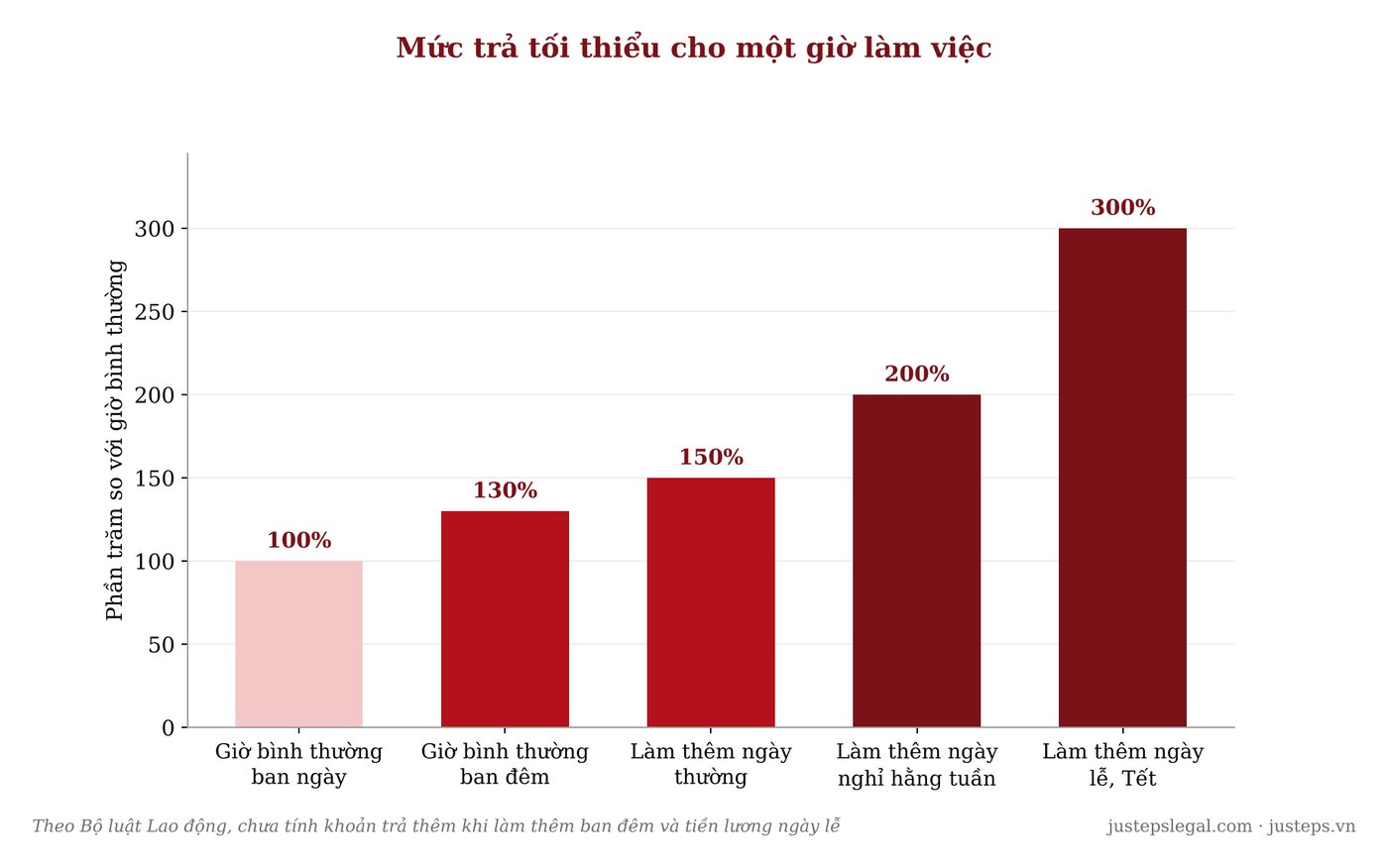
Minimum pay for one working hour by time slot compared with a normal daytime hour
Under the Labour Code, normal working hours at night are paid at least 130%, overtime on ordinary days at least 150%, on weekly rest days at least 200% and on public holidays and Tet at least 300%, excluding holiday pay for employees paid by the day[1]. Overtime at night attracts a further additional payment on top of these rates. From 1 March 2027, employees have additional public holidays on 27 July and 24 November[5], so chains that open on public holidays need to update shift rosters and labour budgets and inform staff in advance. Justeps builds a labour cost model by time slot so that outlet managers can immediately see the cost of each rostering option, while checking the daily, monthly and annual limits on overtime hours.
The hourly pay of part-time staff may not be lower than the hourly regional minimum wage for the area in which the outlet operates, and from 1 January 2027 the new rates under Decree No. 399/2026/ND-CP apply[6]. Chains with outlets in several provinces and cities need to check the region of each address rather than using a single rate for the whole chain.
Service charges, tips and shift meals
Many restaurants add a service charge to the bill and share part of it with staff, while tips given by customers in cash or via QR code are not governed by any rule. The service charge is part of the business’s revenue subject to value added tax[7], while the portion shared with staff is income from salaries and wages that must be included in the payroll and subject to personal income tax withholding as prescribed[3]. Justeps drafts sharing regulations covering the retained percentage, criteria for sharing by position and hours worked, treatment of staff who leave mid-month, and a rule that tips received into the business’s account are shared on the same principles.
Shift meals for staff are a benefit that almost every outlet provides. This expense is treated in a specific way for personal income tax purposes, with the portion exceeding the prescribed level included in taxable income[8], so the regulations must state clearly how meals are provided and the value attributed to each person. The allocation of service charges, allowances and sales bonuses can be linked to the general salary scale through the salary scale and pay and bonus regulations service.
Cash shortages, breakages and labour discipline
When the till is short at shift close or a member of staff breaks a glass, many outlets deduct the amount directly from salary or impose a fixed fine. The Labour Code prohibits fines or salary deductions in place of labour discipline, and only allows salary deductions to compensate for damage to property following the correct procedure, with monthly deductions not exceeding 30% of the salary actually paid after insurance contributions and tax[1]. To apply liability for compensation, the business must provide for it in the internal labour regulations, prepare minutes establishing the damage and the fault, allow the employee to give an explanation, and only then issue a decision.
A business employing 10 or more workers must have written internal labour regulations registered with the provincial specialised labour agency[1]. Justeps drafts internal regulations covering acts specific to the sector, such as eating in the preparation area, using phones while serving, giving customers unauthorised discounts or receiving transfers into personal accounts, with the corresponding disciplinary measures and the registration file. The shift close procedure for detecting shortages is written under the internal procedures and regulations service for restaurant, café and F&B chain businesses, while this page ensures that employees are dealt with lawfully.
Kitchen safety and the health of food handlers
Burns from hot oil, knife cuts, slips on wet floors, gas leaks and injuries from lifting are common accidents in restaurant kitchens. The business must provide occupational safety and health training and personal protective equipment, and must declare and investigate occupational accidents under the law on occupational safety and health[9]. Justeps drafts short training materials for kitchen, bar, service and delivery positions, together with an in-shift accident reporting procedure so that outlet managers do not miss the declaration.
Persons directly handling food must also meet health and food safety knowledge requirements under food safety law[10]. Justeps builds pre-employment health checks, periodic health checks and confirmation of food safety knowledge into the recruitment procedure, and sets up a tracker of each person’s expiry dates so that HR can send reminders before they lapse.
Foreign head chefs and beverage specialists
Japanese, Korean and Italian restaurant chains and specialty coffee shops often bring in foreign head chefs or beverage specialists to work in Vietnam. Applications submitted up to 4 December 2026 are processed under Decree No. 219/2025/ND-CP[11], while from 5 December 2026 Decree No. 393/2026/ND-CP on foreign workers in Vietnam applies[12]. Justeps checks whether each person qualifies as an expert or technical worker, prepares the work permit file or the confirmation of exemption from a work permit, and registers social insurance for foreign workers who are subject to it.
Implementation process, deliverables and fees
A standardisation project usually takes about eight weeks and should start outside the Tet peak season to allow time for insurance back-payments and training of outlet managers.
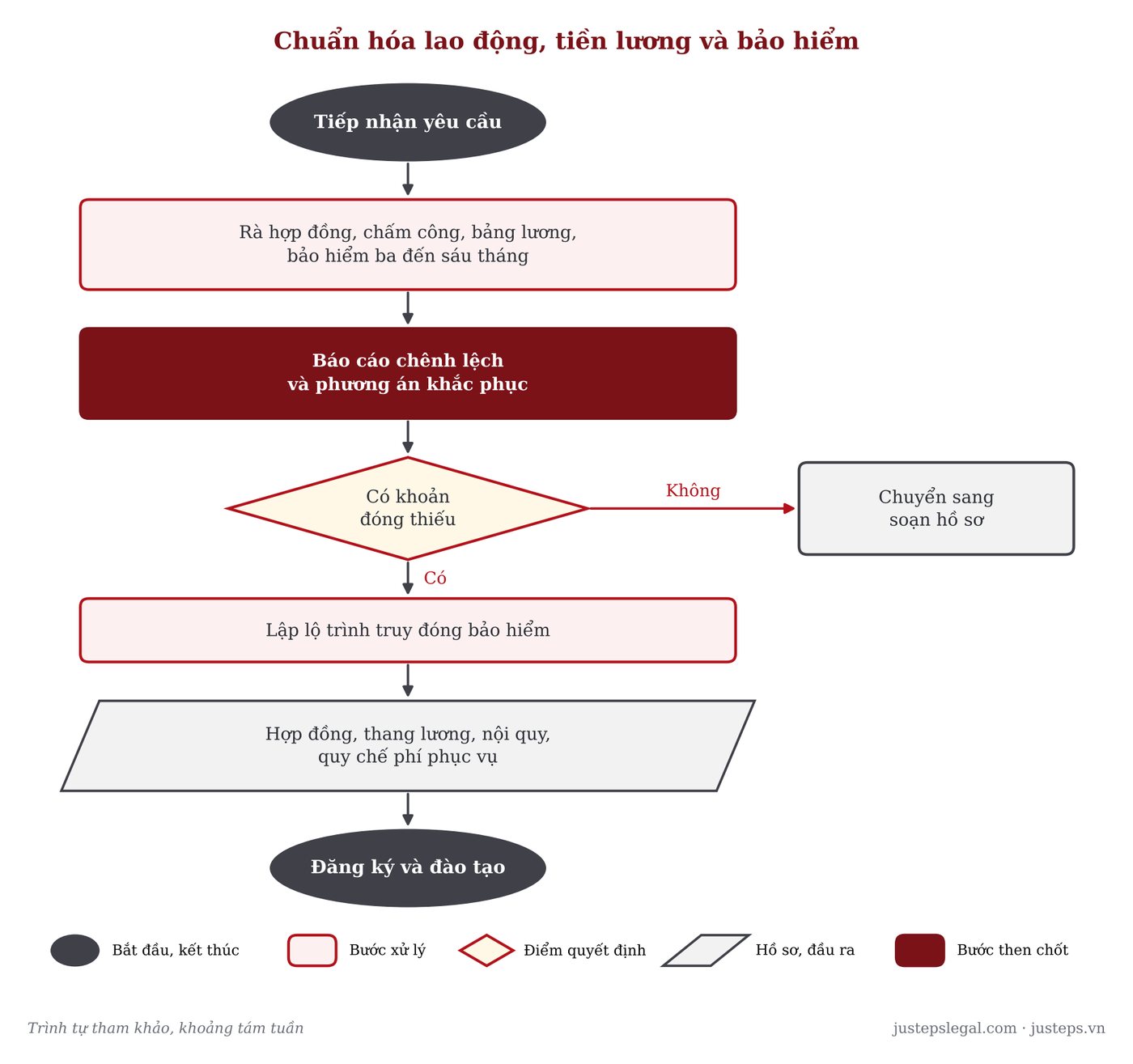
Sequence for standardising labour, wages and insurance in a restaurant and café chain
In the first two weeks, Justeps reviews contracts, timesheets, payrolls and insurance contribution lists for the last three to six months against current regulations. In the third week, the business receives a report on the points that are not compliant and the remedial plan, including a roadmap for insurance back-payments where necessary. In the following weeks, Justeps drafts contracts, salary scales, service charge sharing regulations, internal labour regulations and registration files, consults the employee representative organisation if any, adjusts the insurance records and then trains outlet managers and shift leaders. The deliverables comprise the following documents:
- A labour, wages and insurance review report with remedial priorities.
- A set of template employment contracts for full-time, part-time shift and seasonal staff.
- Salary scales, hourly pay tables, bonus regulations and regulations on sharing service charges and tips.
- Internal labour regulations with provisions on liability for compensation, together with the registration file.
- A labour cost model by time slot for rostering shifts.
- Kitchen safety training materials and the occupational accident reporting procedure.
Justeps quotes a fixed service fee in writing after the initial meeting, depending on the number of workers and outlets, the extent of the issues to be remedied, whether there are foreign workers and whether the business needs Justeps to continue reviewing the payroll monthly after the project. Matters arising later, such as employee complaints, unilateral termination of contracts or labour inspections, can be supported through the ongoing legal advisory service for restaurant, café and F&B chain businesses.
How Justeps can help
In addition to labour, wages and social insurance services, restaurant, café and F&B chain businesses can combine the following Justeps services:
- Organisational structure design for restaurant, café and F&B chain businesses. Justeps determines permanent headcount and shift workers for each outlet model before contracts are signed.
- Ongoing legal advisory for restaurant, café and F&B chain businesses. Justeps supports labour matters arising each month and provides updates when labour law changes.
- Internal labour regulations and disciplinary handling. Justeps drafts and registers internal labour regulations and guides the procedure for discipline and compensation at outlets.
- Salary scales and pay and bonus regulations. Justeps builds salary scales for kitchen, bar, service and management positions, with sales bonuses and allowances.
Frequently asked questions
Must students working part-time at an outlet pay social insurance?
It depends on the contract term and monthly salary. The Law on Social Insurance has broadened coverage to part-time workers[2], so Justeps examines each case rather than excluding the whole group.
May new staff on probation be paid a lower hourly rate?
Probationary pay is agreed by the parties but must be at least 85% of the salary for the job[1], and still not lower than the hourly regional minimum wage[6].
May an employee’s salary be deducted when the till is short?
Fines and arbitrary salary deductions are not permitted. Deductions to compensate for damage are only allowed where the internal regulations so provide, minutes establishing fault have been prepared and the monthly deduction does not exceed the statutory limit[1].
How should staff be paid when the outlet opens on 27 July and 24 November?
From 1 March 2027 these are public holidays[5], so staff working on these two days are paid as for overtime on a public holiday, at least 300% excluding holiday pay for employees paid by the day[1].
May a 16-year-old pupil work an evening shift at a café?
Minors are restricted from night work and overtime and may only do so in occupations and jobs on the prescribed list[1]. Justeps determines the specific permitted time slots for each position and blocks rostering beyond the limits.
Must tips given directly to staff by customers be included in the payroll?
Tips given personally to one individual differ from tips pooled and then shared by the business. Amounts collected and paid out by the business must be included in the payroll and subject to personal income tax as prescribed[3], so the regulations must distinguish clearly between the two cases.
Related articles
- Organisational structure design for restaurant, café and F&B chain businesses by outlet and central kitchen
- Internal procedures and regulations for restaurant, café and F&B chain businesses, from goods receipt to shift close
- Managing seasonal workers and freelance collaborators in line with the true nature of the contract and contribution obligations
- Monthly labour and payroll compliance checklist for the HR department
Notes
[1] The Labour Code and the documents amending and supplementing it.
[2] The Law on Social Insurance and the documents amending and supplementing it.
[3] The Law on Personal Income Tax and the documents amending and supplementing it.
[4] Government Decree No. 337/2025/ND-CP on electronic employment contracts.
[5] The Law amending and supplementing a number of articles of the Labour Code, the Law on Archives, the Law on Gender Equality, the Law on Red Cross Activities and the Law on Employment, effective from 1 March 2027.
[6] Government Decree No. 399/2026/ND-CP dated 2 November 2026 on the minimum wage for employees working under employment contracts, applicable from 1 January 2027.
[7] The Law on Value Added Tax No. 48/2024/QH15 and Government Decree No. 181/2025/ND-CP dated 1 July 2025 detailing this Law.
[8] Point g, Clause 2, Article 8 of Government Decree No. 253/2026/ND-CP dated 30 June 2026 detailing a number of articles of the Law on Personal Income Tax.
[9] The Law on Occupational Safety and Health and the documents amending and supplementing it.
[10] The Law on Food Safety No. 55/2010/QH12 dated 17 June 2010.
[11] Government Decree No. 219/2025/ND-CP on foreign workers in Vietnam, applicable until 4 December 2026.
[12] Government Decree No. 393/2026/ND-CP dated 20 October 2026 on foreign workers in Vietnam, effective from 5 December 2026.
This article is for reference and reflects the regulations in force at the time of publication. Please consult Justeps for advice tailored to your company’s records and situation.
For further information, please contact:
📩 Email: info@justeps.vn
🌐 Website: https://justepslegal.com · https://justeps.vn
🌐 Page: Justeps
☎️ Hotline (Zalo): 096 172 2607
📍 Thanh Xuan Office: 12th Floor, Licogi 13 Tower, 164 Khuat Duy Tien Street, Thanh Xuan Ward, Hanoi, Vietnam
📍 Ha Dong Office: LK06B, No.10, Dong Dua Area, Ha Dong Ward, Hanoi, Vietnam
📍 Ho Chi Minh City Branch: 528 Le Van Sy, Ho Chi Minh City, Vietnam
📍 Hai Phong Office: Truong Thinh Village, Ha Dong Commune, Hai Phong, Vietnam
📍 Quang Ninh Office: Van Don Special Zone, Quang Ninh Province, Vietnam





