
Key takeaways
- People working under contracts of one month or more, including seasonal workers, have been subject to compulsory social insurance since 1 July 2025, so signing a series of short contracts does not avoid the obligation to contribute[5].
- A job-based contract signed with a gang leader or a work team may still be regarded as an employment contract if the business pays the workers and directly manages and supervises them[4].
- Piece rates per kilogram or per bed must be set so that a person working standard hours earns no less than the regional minimum wage, which will rise from 1 January 2027[7].
- The harvest season may involve overtime of up to 300 hours a year for urgent work arising from its seasonal nature, but this requires the employees’ consent and notice to the provincial specialised labour authority[8].
The workforce of a high-tech agriculture business is far more varied than that of a factory of the same size. A single business may employ agronomists, foreign experts who come to install systems, net house workers employed all year round, spraying teams, workers at closed livestock farms and hundreds of seasonal workers paid by the day or by output. Many of them are farmers living near the farm who are used to working on verbal arrangements and receiving cash at the end of the day, so labour records are usually missing precisely for the largest group of people.
This page introduces Justeps’ labour, payroll and insurance service for high-tech crop businesses, fruit farms, livestock farms and businesses with large linked growing areas. It moves from the labour characteristics of the sector, how to choose the form of contract, how to build piece rates and pay scales, working hours in the season and occupational safety to the implementation process, deliverables and fee. The main legal bases are the Labour Code No. 45/2019/QH14 together with the amending law passed by the National Assembly on 21 November 2026 and effective from 1 March 2027[1], the Law on Social Insurance No. 41/2024/QH15 and the Law on Occupational Safety and Hygiene.
A workforce that fluctuates with the season
A farm’s labour needs change sharply over the year. The chart below illustrates the number of people working each month at a fruit farm with two main harvests.
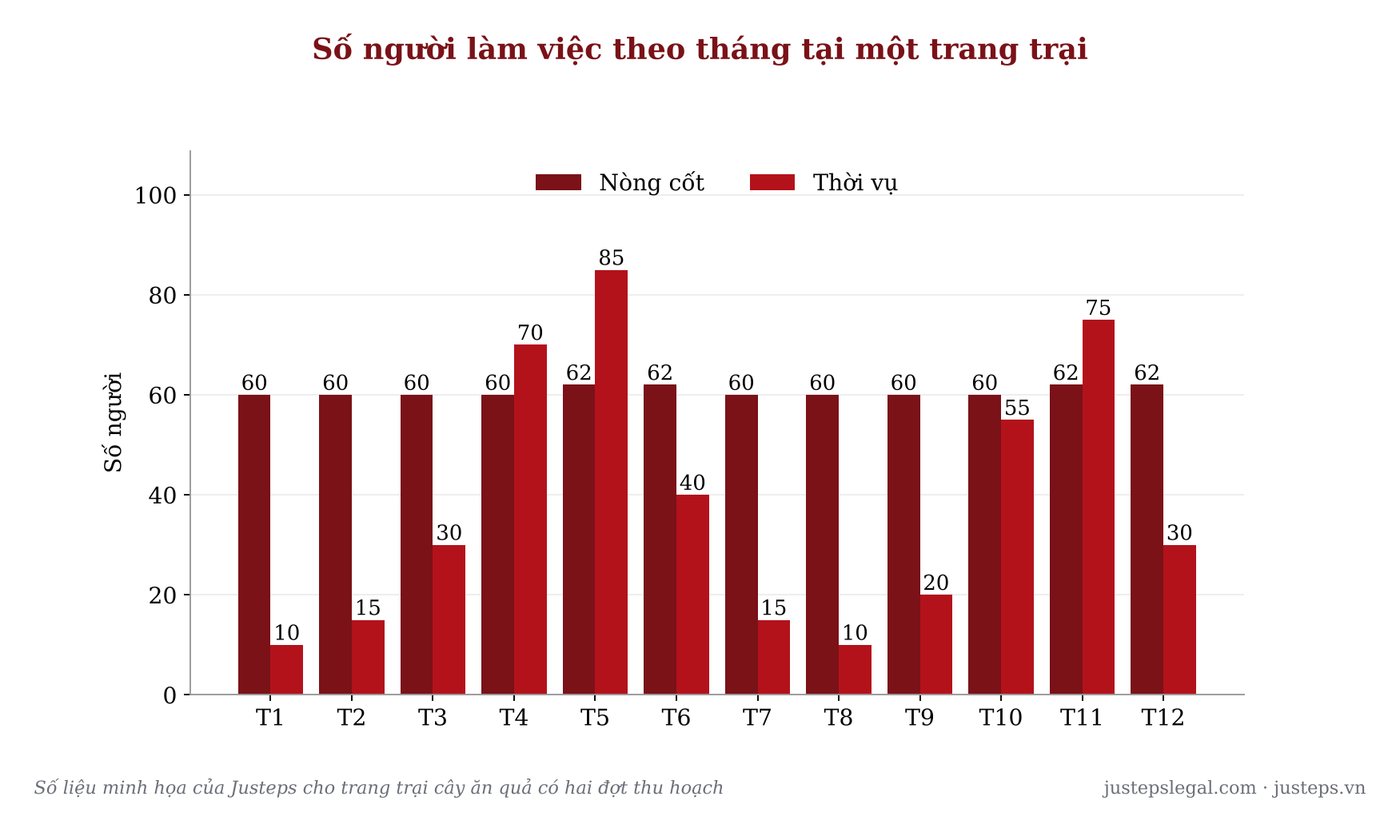
Number of people working each month at a fruit farm, divided into core and seasonal workforce
In this example, the core workforce remains stable at around sixty people, while the total number working at the peak of the harvest more than doubles thanks to seasonal labour. The business cannot use one type of contract for both groups. The core group needs long-term employment contracts and a clear pay scale, the seasonal group needs seasonal contracts that can be signed quickly, and sudden shortfalls may be met through work teams or linked households, provided that the way they are managed does not turn that relationship into a disguised employment relationship.
Choosing the right form of contract
The Labour Code now recognises only two types of contract, an indefinite-term contract and a fixed-term contract of no more than thirty-six months; there is no longer a separate seasonal contract as before[2]. A contract for less than one month may be entered into orally, except in certain cases where the law requires writing[3]. The name of a document does not determine the nature of the relationship. If a document under another name provides for paid work, wages and management, direction and supervision by one party, it is still regarded as an employment contract[4]. The flowchart below shows how Justeps guides farm managers in choosing the appropriate form for each person.
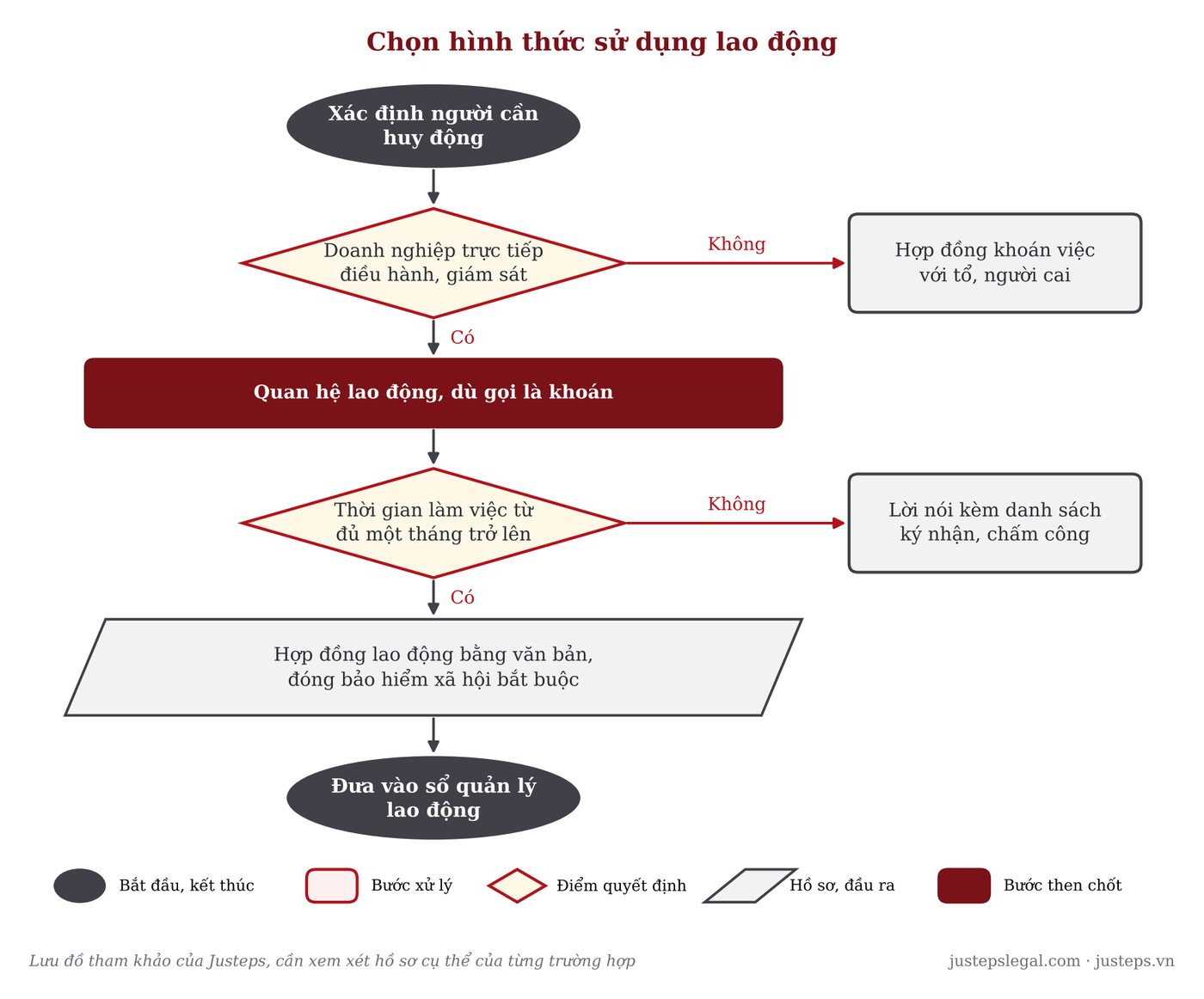
How to choose the form of engagement for people working at the farm
If the business directly assigns tasks and supervises working hours and methods, the relationship is an employment relationship even if it is called a job-based contract. In that case, work lasting less than one month may be agreed orally but should be supported by a signed attendance list and timesheet, while work lasting one month or more requires a written contract and compulsory social insurance contributions[5]. A job-based contract is appropriate only where the contractor organises its own people, decides how the work is done and is responsible for the result, such as an independent harvesting team whose leader pays its own members. For gang leaders or work teams, Justeps drafts contracts that clearly set out the scope of work, acceptance standards, safety responsibilities and the contractor’s obligations towards the people working for it.
Piece rates, pay scales and the regional minimum wage
Paying by output is a common and lawful practice on farms, such as per kilogram of fruit picked, per bed tended or per plant grafted. The risk lies in rates being set by local custom without checking actual earnings during normal working hours. Wages paid to an employee who works normal working hours and meets the norm must not be lower than the minimum wage[6]. From 1 January 2027, the monthly minimum wage is VND 4,450,000 in Region III and VND 4,040,000 in Region IV, the two regions with the most farms, while farms in Regions I and II apply VND 5,700,000 and VND 5,080,000 respectively[7].
Justeps builds piece rates by measuring the average productivity of a worker of average ability under normal conditions and then checking back that earnings during standard hours are not lower than the regional minimum wage. The rates are announced before each season, with adjustment factors for orchards that are difficult to pick or bad weather, and are written into the pay regulations to avoid disputes at the end of the season. For the core group, the pay scale is built by job group, such as net house workers, spraying teams, technicians and team leaders, together with allowances for heavy or hazardous work where applicable.
Working hours, overtime and rest in the season
The harvest, planting or livestock dispatch periods often require continuous overtime for several weeks. The Labour Code permits overtime of no more than 300 hours a year for urgent work that cannot be postponed owing to its seasonal nature or the timing of raw materials and products, and for processing agricultural products for export, provided that the employees consent and the daily and monthly limits are observed[8]. A business organising more than 200 hours of overtime must give written notice to the provincial specialised labour authority. Pay for overtime and night work must be calculated at the statutory rates, so the seasonal wage fund needs to be budgeted in advance rather than calculated at the end of the season.
Closed livestock farms have their own particular features, because workers often stay inside the farm for many days to maintain biosecurity and the animals need continuous care. Employees are entitled to at least twenty-four consecutive hours of rest each week; where the production cycle does not allow weekly rest, the employer must ensure an average of at least four days of rest per month[9]. The rotation schedule, how hours are counted while staying on the farm and the arrangements for entering and leaving the farm need to be written into the internal labour rules and the contract.
Occupational safety for spraying teams, net houses and livestock farms
The sector’s specific occupational risks include pesticide poisoning, heat stress inside net houses, machinery accidents, falls when working at height in greenhouses and diseases transmitted from animals. Some tasks, such as mixing and spraying insecticides, may fall within the list of heavy, hazardous and dangerous occupations and jobs, entailing in-kind allowances, periodic health checks, additional annual leave and specific safety training requirements[10]. Employees aged from fifteen to under eighteen must not be assigned to spraying or exposed to hazardous chemicals, so the list of seasonal workers needs a date of birth column and a person checking it before work is assigned.
A business that does not pay insurance for people subject to compulsory contributions will have to pay itself the amounts that the occupational accident insurance fund would otherwise have paid when an incident occurs, in addition to penalties and back payment with late payment interest. In addition, standards such as GlobalG.A.P. and the audit programmes of foreign retailers all examine working conditions, so breaches may cost the business its certification and its customers. Foreign experts coming to install equipment or transfer technology need to be assessed as to whether they are exempt from a work permit, and the corresponding procedures must be completed before entry[11].
Implementation process, deliverables and fee
A typical project takes about eight weeks and should start before the main harvest season so that it can be applied in time. The table below summarises the stages and the output of each stage.
| Stage | Work carried out by Justeps | Output |
|---|---|---|
| Weeks 1 and 2 | Reviewing contracts, timekeeping, payroll, piece rates, insurance and safety records for at least one season; interviewing managers, team leaders and a number of employees. | A list of non-compliant points ranked by severity. |
| Week 3 | Presenting options for the contract structure together with calculations of the impact on the wage fund and insurance costs. | The option chosen by the leadership. |
| Weeks 4 to 6 | Drafting the pay scale, piece rates, template contracts, internal labour rules and the list of special positions. | A complete set of drafts. |
| Week 7 | Consulting the employee representative organisation, if any, and test-running the new payroll on one period’s data. | A comparison of earnings before and after. |
| Week 8 | Finalising the file for registering the internal labour rules and guiding farm managers and accountants on operation. | Issuing documents and guidance materials. |
The deliverables comprise a compliance review report, a plan for structuring the forms of seasonal engagement, pay scales, payroll tables and piece rate tables, a set of template employment contracts and job-based contracts with guidance on choosing the right template, internal labour rules with specific provisions for net houses, spraying teams and livestock farms, and a list of special positions with their entitlements, health checks and training plan. The position coordinating seasonal labour and safety should appear in the organisation chart, which is dealt with under the organisational structure design service for high-tech agriculture businesses.
Justeps quotes a fixed fee in writing after a preliminary survey. The factors involved include the number of workers and farms, the number of crop and livestock types requiring separate piece rates, how complete the existing records are, any need to deal with back payment of insurance, the presence of foreign experts and any need for support during dialogue with employees. Once the new system is in operation, the business may transfer the monitoring of changes in labour law and the handling of issues that arise to the ongoing legal advisory service for high-tech agriculture businesses.
How Justeps can help
Alongside the labour, payroll and insurance service, high-tech agriculture businesses and farms may combine the following Justeps services:
- Organisational structure design for high-tech agriculture businesses and farms. Justeps places the positions for seasonal labour coordination, safety and veterinary care in the organisation chart with clear powers.
- Ongoing legal advisory for high-tech agriculture businesses and farms. Justeps monitors changes in labour and insurance law and helps resolve issues arising in each season.
- Labour records and employment contracts. Justeps standardises the records, labour management register and contract templates used for core and seasonal workers.
- Personal income tax on salaries and wages. Justeps provides guidance on tax withholding for each type of contract and on commitment forms for low-income earners.
Frequently asked questions
Do day workers at the farm need to sign a contract?
Work lasting less than one month may be agreed orally, but the business should keep a signed attendance list and timesheet as supporting records[3]. Where the period of work is one month or more, a written contract and compulsory social insurance contributions are required.
Is paying piece rates per kilogram lawful?
Yes, provided that the rate is announced in advance, output is measured transparently and the earnings of a person working standard hours are not lower than the regional minimum wage[6]. Justeps recommends rechecking the rates whenever the regional minimum wage is adjusted.
What is the maximum overtime during the harvest season?
The general limit is 200 hours a year; for urgent work arising from its seasonal nature it may be up to 300 hours, where the employees consent and the business notifies the provincial specialised labour authority[8]. The daily and monthly limits must still be observed.
Are spraying workers entitled to special arrangements?
The business needs to check the work against the list of heavy, hazardous and dangerous occupations and jobs to determine in-kind allowances, health checks, working hours and annual leave[10]. Whether or not the work is on the list, spraying workers must be trained and provided with protective equipment.
How should weekly rest be arranged at a closed livestock farm?
Where the production cycle does not allow weekly rest, the business may arrange an average of at least four days of rest per month[9]. The rotation schedule should be written into the internal labour rules and notified to employees in advance.
May people under eighteen be hired as seasonal workers?
People aged from fifteen to under eighteen may only do work that is not on the prohibited list, with limited working hours. The business must not assign this group to spraying or exposure to hazardous chemicals.
Related articles
- Managing seasonal workers and freelance collaborators in line with the true nature of the contract and contribution obligations
- Regional minimum wages from 1 January 2027 and reviewing pay scales, contracts and insurance
- Late payment and evasion of social insurance contributions under the new law and where the line lies for businesses
- Designing KPIs for production workshops on productivity, quality and safety linked to piece-rate pay
Notes
[1] Law amending and supplementing a number of articles of the Labour Code, passed by the National Assembly on 21 November 2026 and effective from 1 March 2027.
[2] Clause 1 of Article 20 of the Labour Code No. 45/2019/QH14 dated 20 November 2019.
[3] Clause 2 of Article 14 of the Labour Code No. 45/2019/QH14 dated 20 November 2019.
[4] Clause 1 of Article 13 of the Labour Code No. 45/2019/QH14 dated 20 November 2019.
[5] Point a of Clause 1 of Article 2 of the Law on Social Insurance No. 41/2024/QH15 dated 29 June 2024, effective from 1 July 2025.
[6] Articles 90 and 91 of the Labour Code No. 45/2019/QH14 dated 20 November 2019.
[7] Government Decree No. 399/2026/ND-CP on minimum wages for employees working under employment contracts, applicable from 1 January 2027.
[8] Clauses 3 and 4 of Article 107 of the Labour Code No. 45/2019/QH14 dated 20 November 2019; Article 62 of Government Decree No. 145/2020/ND-CP dated 14 December 2020.
[9] Clause 1 of Article 111 of the Labour Code No. 45/2019/QH14 dated 20 November 2019.
[10] The Law on Occupational Safety and Hygiene No. 84/2015/QH13 dated 25 June 2015; Circular No. 11/2020/TT-BLDTBXH dated 12 November 2020 issuing the list of heavy, hazardous and dangerous occupations and jobs.
[11] Government Decree No. 219/2025/ND-CP on foreign workers working in Vietnam.
This article is for reference and reflects the regulations in force at the time of publication. Please consult Justeps for advice tailored to your company’s records and situation.
For further information, please contact:
📩 Email: info@justeps.vn
🌐 Website: https://justepslegal.com · https://justeps.vn
🌐 Page: Justeps
☎️ Hotline (Zalo): 096 172 2607
📍 Thanh Xuan Office: 12th Floor, Licogi 13 Tower, 164 Khuat Duy Tien Street, Thanh Xuan Ward, Hanoi, Vietnam
📍 Ha Dong Office: LK06B, No.10, Dong Dua Area, Ha Dong Ward, Hanoi, Vietnam
📍 Ho Chi Minh City Branch: 528 Le Van Sy, Ho Chi Minh City, Vietnam
📍 Hai Phong Office: Truong Thinh Village, Ha Dong Commune, Hai Phong, Vietnam
📍 Quang Ninh Office: Van Don Special Zone, Quang Ninh Province, Vietnam





