
Key takeaways
- A medium-sized private medical establishment typically engages five or six groups of workers under different legal conditions, so a single contract template and a single payroll for everyone is the greatest source of risk.
- An arrangement labelled as collaboration that nevertheless involves work, payment of wages and management and direction is still regarded as an employment contract, bringing with it compulsory insurance obligations[2].
- A 24-hour on-call shift must be broken down into overtime hours and night hours at the premium rates set by the Labour Code, and a flat on-call allowance cannot replace this[7].
- Doctors’ income should not be linked to revenue from their own orders, because the law prohibits ordering technical services for improper gain[14].
- From 1 January 2027, regional minimum wages rise under Decree No. 399/2026/ND-CP, so chains operating in several provinces need pay scales by region[15].
A medium-sized private hospital may simultaneously engage full-time doctors, public hospital doctors examining patients outside working hours, retired doctors, foreign specialists, shift nurses, X-ray technicians and customer care staff. Each group is subject to its own rules on contracts, working hours, insurance and tax, yet many establishments still use one contract template and one payroll for all of them. The consequences usually surface only when the social insurance authority carries out an inspection, when a nurse suffers a needlestick exposure without any record, or when a doctor resigns and sues for several years of overtime pay.
This page introduces Justeps’ labour, payroll and insurance service for specialist clinics, general clinics, clinic chains and private hospitals. It covers the legal particularities of each group of workers, on-call duty and the working environment, income structure, insurance and records, the implementation process and fees. Organisational design, drafting clinical procedures and monthly legal support are presented on three other service pages for the same sector.
Legal particularities of each group of workers
Full-time doctors and holders of professional positions
A doctor’s employment contract needs to state the professional position, scope of practice, working hours registered with the health authority and the obligation to keep the practising licence valid. A practising licence is valid for five years, so the contract should require the employee to give notice ahead of the renewal deadline and the establishment to allow time for continuing medical education[1]. For the person in charge of professional matters or a head of department, the contract should provide for a notice period longer than the statutory minimum, to the extent the law allows the parties to agree, and an obligation to hand over records, so that the establishment can arrange a replacement in time.
Doctors working outside hours, collaborators and retirees
An employment contract is an agreement on paid work, wages and working conditions; an agreement bearing a different name but having this content and involving management, direction and supervision by one party is still regarded as an employment contract[2]. A doctor who examines patients on a fixed weekly schedule, is subject to work assignments and receives regular payments usually falls into this category, giving rise to obligations for social insurance, health insurance and unemployment insurance under the 2024 Law on Social Insurance[3]. A doctor working at a public hospital must also comply with the rules on public employees and the regulations of the principal workplace, and the schedule at the private establishment may not overlap with hours registered elsewhere[4]. A person receiving a retirement pension is not subject to compulsory social insurance in the same way as an ordinary employee, but the establishment must still sign a contract, withhold personal income tax and check the practising licence.
Foreign specialists and doctors
A foreign doctor needs a work permit or a written confirmation of exemption from a work permit under Decree No. 219/2025/ND-CP[5]. At the same time, that person must hold a practising licence in Vietnam and meet the language requirements for medical examination and treatment under the Law on Medical Examination and Treatment, including arranging a qualified interpreter where necessary. The two procedures have mutually dependent conditions, so Justeps draws up a single timetable so that the specialist does not have to wait for one document before obtaining the other.
Nurses, technicians and service staff
Nurses and technicians are the group working the most shifts and nights and having direct exposure to radiation, chemicals and specimens. Customer care staff, cashiers and service consultants are often paid a low base salary plus commission, so it is necessary to check that the wage stated in the contract is not below the regional minimum wage and that the commission rules are not tied to encouraging professional orders. Each group needs its own contract template, job description and wage calculation method instead of one common template.
On-call duty, night work and the working environment
Establishments with inpatient beds must operate continuously, so night shifts, 24-hour shifts and overtime occur regularly. Night work hours run from 22:00 to 06:00 the following morning[6]. Employees working overtime are paid at least 150% on normal working days, 200% on weekly days off and 300% on public holidays; night work attracts an additional payment of at least 30%, and overtime at night attracts an additional 20% of the wage for a normal working day[7]. Overtime hours are capped per month and per year, and overtime requires the employee’s consent[8]. Employees working in shifts are entitled to at least 12 hours’ rest before moving to another shift[9], a rule that is often overlooked when consecutive on-call shifts are scheduled.
Positions such as X-ray, microbiology testing or treatment of infectious diseases may fall within the list of arduous, hazardous and dangerous occupations and jobs[10]. Employees in these jobs are entitled to 14 days of annual leave instead of 12[11], to in-kind allowances and to periodic health checks under the law on occupational safety and health[12]. Female employees who are seven months or more pregnant, or six months or more if working in highland, remote, border or island areas, may not be assigned night work, overtime or long-distance business trips unless they agree[13]. Department rosters must be drawn up so that these groups are protected while the department remains adequately staffed.
Occupational exposure such as needlestick injuries or blood splashes is a situation specific to this sector. The flowchart below describes the handling sequence that both protects the employee’s health and preserves sufficient records for resolving entitlements later.
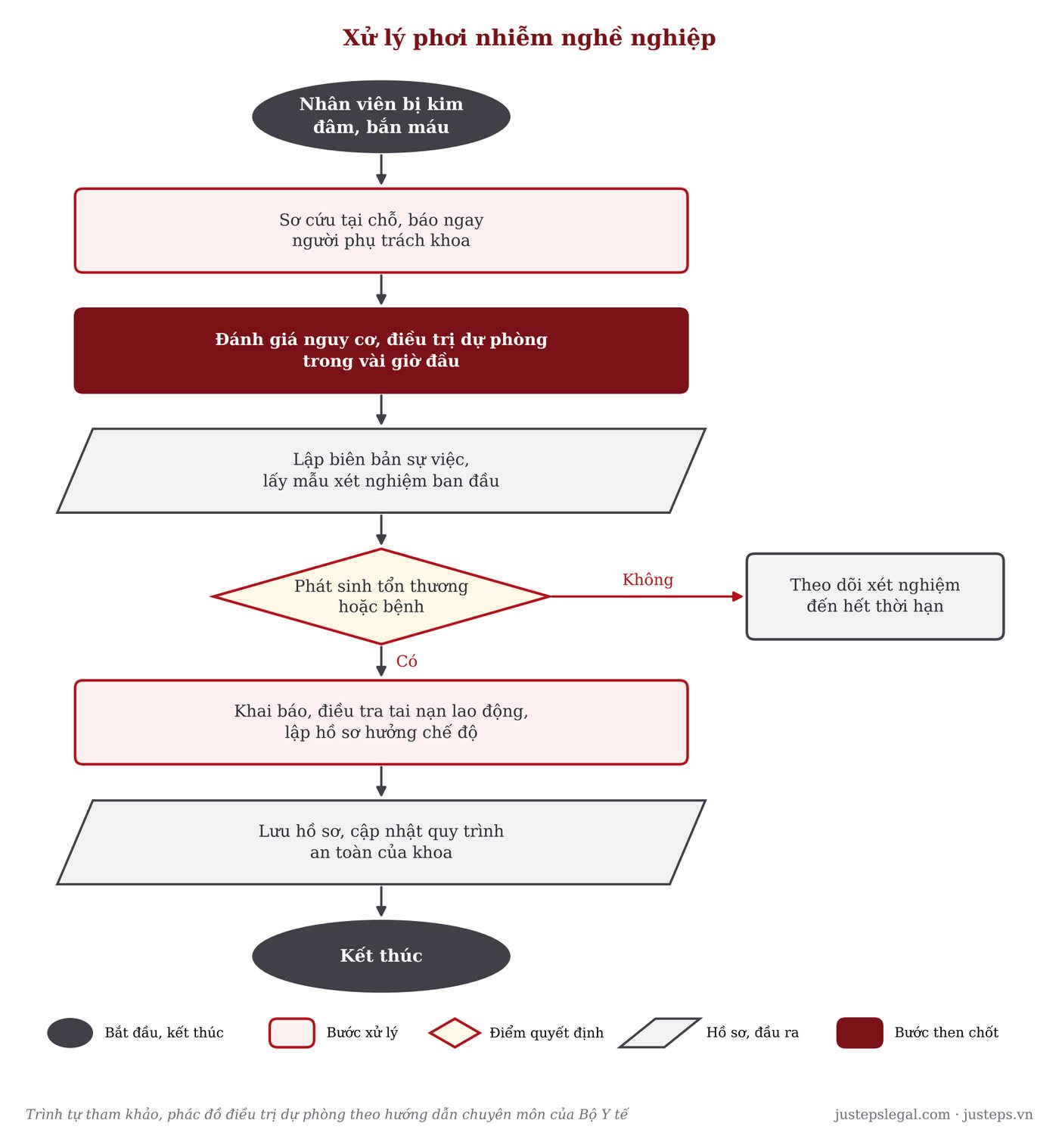
Handling sequence when a healthcare worker is exposed while on duty
First aid and risk assessment must be carried out within the first few hours, because the effectiveness of post-exposure prophylaxis depends heavily on timing. The incident report and follow-up test results form the basis for later determining an occupational accident or occupational disease. The human resources department carries out the declaration, investigation and record-keeping in accordance with the procedure so that the social insurance authority has a basis for resolving the employee’s entitlements[12].
Pay scales and income structure
Justeps divides the income of medical staff into three parts with different functions. Wages under the pay scale are the stable part, serving as the basis for insurance contributions and calculating entitlements. On-call, night work and hazard allowances compensate for working conditions. Performance-based income encourages productivity and quality, but is calculated by number of consultations, procedures performed, quality of records and patient feedback, not by revenue from the doctor’s own orders[14].
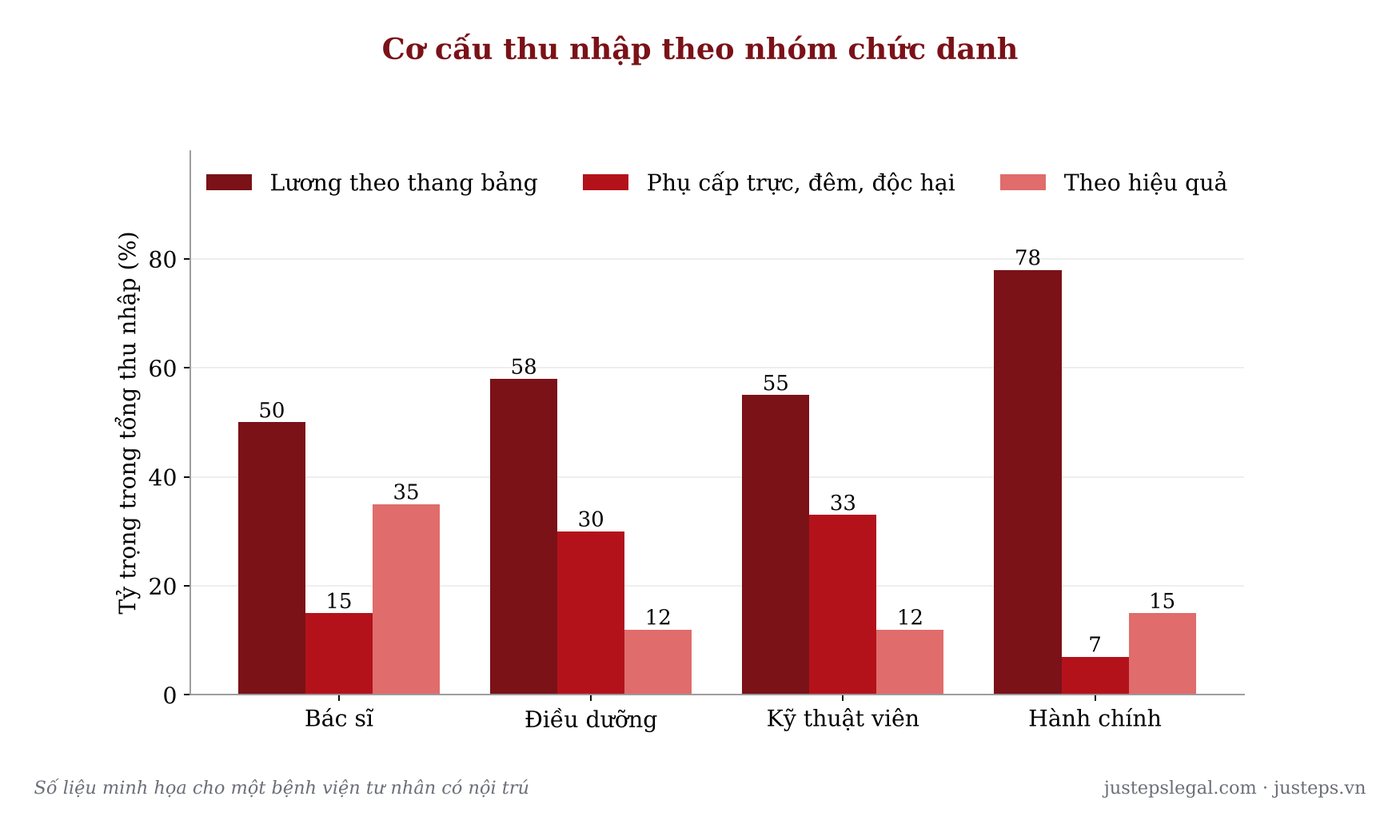
Illustrative income structure by job group at a private hospital
In this example, performance-based income accounts for the largest share for doctors, while on-call, night work and hazard allowances make up a high share for nurses and diagnostic imaging technicians because of shift work and radiation exposure. Administrative and customer care staff have the highest fixed wage component. From 1 January 2027, the monthly minimum wage is VND 5,700,000 in Region I, VND 5,080,000 in Region II, VND 4,450,000 in Region III and VND 4,040,000 in Region IV, applied according to the area where the establishment operates[15]. Clinic chains operating in several provinces need pay scales by region and should review the wages stated in contracts, especially for service staff currently paid close to the minimum.
Insurance, tax and personnel records
Justeps compares the list of workers with the insurance contribution list and the list of practitioners registered with the health authority, because discrepancies between these three lists are easily detected during inspections. Wages subject to insurance contributions are determined under the 2024 Law on Social Insurance, so allowances and bonuses need to be clearly classified in the regulations to be calculated correctly[3]. Personal income tax is withheld according to each type of contract and income level, with attention to family circumstance deductions and non-taxable allowances under the 2025 Law on Personal Income Tax[16]. An establishment employing 10 or more employees must have written internal labour regulations registered with the labour authority[17], which should include provisions on patient confidentiality and the procedure for handling breaches of clinical procedures.
Professional errors and breaches of labour discipline are two different matters. Whether a professional error occurred needs to be considered by the professional council, while labour discipline applies only to conduct specified in the internal labour regulations and must follow the procedure in the Labour Code. For doctors sent on specialist training, the training contract needs to state the costs, the period of committed service and how reimbursement is calculated if the employee leaves early[18].
Implementation process, deliverables and fees
A typical project takes about ten weeks. In the first two weeks, Justeps consultants compare contracts, on-call timesheets, payrolls, insurance records and the list of practitioners to identify discrepancies. Weeks three and four are devoted to grouping workers and agreeing a policy for each group with the executive team. Justeps then develops the pay scales, wage regulations and on-call arrangements, running them against the actual payroll for the last three months so that the executive team can see the cost changes before adoption, and then finalises the template contracts and internal labour regulations, organises dialogue with employees and supports registration of the regulations. On handover, the establishment receives the following documents:
- A review report and a table grouping workers with the appropriate type of contract for each group.
- Pay scales by region and regulations on wages, bonuses and performance-based income.
- Regulations on on-call duty, overtime and compensatory leave, with a template on-call timesheet.
- A set of template contracts by group, a training contract and a patient confidentiality agreement.
- Internal labour regulations and procedures for handling occupational exposure and occupational accidents.
- A list of insurance and tax records requiring adjustment, in order of priority.
Specialist clinics working office hours usually have no night shifts, so the focus is on classifying doctors working outside hours, income per consultation and commission for service consultants. Clinics with X-ray, computed tomography and laboratory services need to pay attention to hazard entitlements, personal radiation dose monitoring and periodic health checks, while hospitals with inpatient care need full on-call arrangements and a balance between overtime costs and hiring additional staff. Justeps quotes a fixed fee in writing after the initial meeting, depending on the number of employees and groups, whether there are inpatient services and on-call shifts, the number of hazardous positions, the number of foreign workers, the size of the insurance discrepancies to be resolved and the need for support with dialogue and registration of internal labour regulations. The positions and reporting lines underlying the pay scale are determined in the organisational structure design service for private clinic and hospital businesses.
How Justeps can help
Alongside labour, payroll and insurance services, private clinic and hospital businesses may combine the following Justeps services:
- Organisational structure design for private clinic and hospital businesses. Justeps determines the positions, reporting lines and powers that serve as the basis for grading each position on the pay scale.
- Ongoing legal advisory for private clinic and hospital businesses. Justeps tracks practising licence deadlines and handles labour issues arising each month.
- Salary scales and pay and bonus regulations. Justeps develops pay scales by region and bonus regulations not linked to revenue from orders.
- Compulsory social insurance advisory. Justeps handles back payments, adjustments to contribution levels and applications for occupational accident entitlements.
- Internal labour regulations and disciplinary procedures. Justeps drafts internal labour regulations with provisions on patient confidentiality and supports registration with the labour authority.
Frequently asked questions
What contract should a public hospital doctor working outside hours at a private clinic sign?
It depends on the actual working arrangement. If the doctor works on a fixed schedule, is subject to work assignments and receives regular wages, this is usually an employment relationship[2]; if the doctor only joins case consultations or works case by case, a service contract may be used. In all cases, the doctor must comply with the rules of the principal workplace and may not overlap with registered hours.
How is a 24-hour on-call shift paid?
Time beyond normal working hours is overtime, the period from 22:00 to 06:00 is night work, and each part carries its own premium[7]. A flat on-call allowance is valid only if the total amount is not lower than the amount calculated under the law.
Is a needlestick injury at work treated as an occupational accident?
Exposure while on duty must be recorded in a report and followed up with tests immediately. If it results in injury or illness, the employee may receive occupational accident or occupational disease entitlements when the records have been prepared in accordance with the procedure[12].
May doctors be rewarded by the number of procedures performed?
Yes, if the reward is linked to volume, quality and appropriate ordering, and not to revenue from the doctor’s own orders. The regulations should include a mechanism for post-review of records to detect unnecessary orders[14].
May a pregnant nurse be rostered for night duty?
Female employees who are seven months or more pregnant, or six months or more in certain areas, may not be assigned night work, overtime or long-distance business trips unless they agree[13]. The roster should be adjusted early once the employee gives notice of the pregnancy.
May a doctor be prohibited from opening a private clinic after leaving?
An employee’s right to work cannot be prohibited absolutely. The establishment may agree on confidentiality of patient information, trade secrets and non-solicitation of staff, with appropriate sanctions.
Related articles
- Overtime limits, how overtime pay is calculated and the records a business must keep
- Regional minimum wages from 1 January 2027 and reviewing pay scales, contracts and insurance
- Managing foreign employees, work permits, compulsory social insurance and the records to keep
- Internal labour rules, mandatory contents, registration file and effective date
Notes
[1] Clause 2 of Article 27 and Article 22 of the Law on Medical Examination and Treatment No. 15/2023/QH15 dated 9 January 2023, as amended and supplemented.
[2] Clause 1 of Article 13 of the Labour Code No. 45/2019/QH14 dated 20 November 2019.
[3] The Law on Social Insurance No. 41/2024/QH15, effective from 1 July 2025.
[4] Clause 1 of Article 36 of the Law on Medical Examination and Treatment No. 15/2023/QH15 dated 9 January 2023, as amended and supplemented.
[5] Government Decree No. 219/2025/ND-CP on foreign employees working in Vietnam.
[6] Article 106 of the Labour Code No. 45/2019/QH14 dated 20 November 2019.
[7] Article 98 of the Labour Code No. 45/2019/QH14 dated 20 November 2019.
[8] Article 107 of the Labour Code No. 45/2019/QH14 dated 20 November 2019 and Government Decree No. 145/2020/ND-CP dated 14 December 2020.
[9] Article 110 of the Labour Code No. 45/2019/QH14 dated 20 November 2019.
[10] Circular No. 11/2020/TT-BLDTBXH dated 12 November 2020 of the Minister of Labour, Invalids and Social Affairs promulgating the list of arduous, hazardous and dangerous occupations and jobs.
[11] Point b of Clause 1 of Article 113 of the Labour Code No. 45/2019/QH14 dated 20 November 2019.
[12] The Law on Occupational Safety and Health No. 84/2015/QH13 dated 25 June 2015 and its detailing instruments.
[13] Clause 1 of Article 137 of the Labour Code No. 45/2019/QH14 dated 20 November 2019.
[14] Clause 9 of Article 7 of the Law on Medical Examination and Treatment No. 15/2023/QH15 dated 9 January 2023, as amended and supplemented.
[15] Government Decree No. 399/2026/ND-CP on minimum wages for employees working under employment contracts, applicable from 1 January 2027.
[16] The Law on Personal Income Tax No. 109/2025/QH15.
[17] Articles 118 and 119 of the Labour Code No. 45/2019/QH14 dated 20 November 2019.
[18] Article 62 of the Labour Code No. 45/2019/QH14 dated 20 November 2019.
This article is for reference and reflects the regulations in force at the time of publication. Please consult Justeps for advice tailored to your company’s records and situation.
For further information, please contact:
📩 Email: info@justeps.vn
🌐 Website: https://justepslegal.com · https://justeps.vn
🌐 Page: Justeps
☎️ Hotline (Zalo): 096 172 2607
📍 Thanh Xuan Office: 12th Floor, Licogi 13 Tower, 164 Khuat Duy Tien Street, Thanh Xuan Ward, Hanoi, Vietnam
📍 Ha Dong Office: LK06B, No.10, Dong Dua Area, Ha Dong Ward, Hanoi, Vietnam
📍 Ho Chi Minh City Branch: 528 Le Van Sy, Ho Chi Minh City, Vietnam
📍 Hai Phong Office: Truong Thinh Village, Ha Dong Commune, Hai Phong, Vietnam
📍 Quang Ninh Office: Van Don Special Zone, Quang Ninh Province, Vietnam





