
Key takeaways
- A livestream host who works to the business’s schedule, uses its studio and products and carries targets set by the business is usually an employee, even if the contract is called a collaborator agreement[1].
- The base pay of livestream hosts and warehouse staff must not be lower than the regional minimum wage, which will rise from 1 January 2027[4], even where most of their income comes from commission.
- Commission should be finalised after the marketplace’s return period has expired and calculated on revenue actually received, to avoid overpaying and then having to recover money from employees.
- Before the last working day of a departing employee, access to accounts must be revoked and data handed over, while continued use of videos featuring that person requires a separate agreement[7].
The workforce of an online seller is far more varied than that of a traditional shop. In the same month, a business may work with permanent livestream hosts, KOLs and KOCs hired per session, hundreds of affiliate marketers paid commission per order, warehouse staff working in shifts, customer care staff working from home in another province, and several dozen seasonal workers during a major sales campaign. When all of them sign the same collaborator contract template, or nothing at all, risks relating to insurance, tax and disputes quietly accumulate at the pace of the business’s growth.
This page introduces Justeps’ service of standardising contracts, wages, commission and insurance for businesses selling on marketplaces, social networks and through livestreams. The headcount needed for each unit in normal and peak months is determined in advance under the organisational structure design service for e-commerce and livestream selling businesses, while this page deals with the relationship with each individual worker. Businesses that mainly manage content creators for other brands can also refer to the labour, wages and social insurance service for KOL, KOC and multi-channel network (MCN) businesses.
Classifying each working relationship before choosing a contract
The Labour Code identifies an employment contract by its actual content, namely paid work, wages and management, direction and supervision by one party, rather than by the title of the document[1]. A livestream host who works to the broadcast schedule set by the business, uses the business’s studio and products, receives sales targets and is reprimanded for arriving late usually meets all of these criteria. Conversely, a KOC hired for a few sessions who decides how to produce content on his or her own channel and is paid per campaign usually fits a service contract. The table below shows how Justeps classifies the common groups.
| Group of workers | Typical characteristics | Suitable form of contract |
|---|---|---|
| Permanent livestream hosts | Work to a schedule in the business’s studio, with targets and under supervision. | Employment contract with a commission appendix and an image use agreement. |
| KOLs and KOCs per session | Control their own content and time and are paid per session or campaign. | Service contract with clauses on content approval and advertising disclosure. |
| Affiliate marketers | Post links on their own channels and earn commission on successful orders. | Contract or electronic terms on commission, content and tax. |
| Warehouse and customer care | Work in shifts under a team leader, including when working from home. | Employment contract, with a remote working agreement where needed. |
| Peak season workers | Work a few weeks around major sales campaigns, on shifts set by the warehouse. | Short fixed-term employment contract or a fulfilment service contract with another provider. |
Calling a permanent host a collaborator to avoid paying insurance may lead to retrospective contributions, claims for allowances on termination and penalties when the authorities carry out an inspection[2]. Service contracts also usually lack the clauses a business needs most, such as discipline, confidentiality and the termination procedure. Employment contracts may be concluded by electronic means[3], which suits businesses with constant staff turnover working in many locations.
Base pay, session commission and the regional minimum wage
The income of livestream hosts and warehouse staff usually consists of a low base pay and a large variable portion based on sales or the number of orders packed. The base pay for normal working hours must not be lower than the minimum wage of the region in which the business or branch operates, and from 1 January 2027 the monthly minimum in Region I is VND 5,700,000[4]. Employees working at night between 10 p.m. and 6 a.m. the following morning are paid at least an additional 30 per cent of the wage for the same work during the day[1], which is often overlooked for livestream sessions running past midnight or night packing shifts before a sales day.
The most common error regarding commission is calculating it on the total value of orders recorded during the session, before deducting cancelled orders, returned orders and failed deliveries. The business overpays and then wants to deduct the excess the following month, whereas deductions from wages may only be made in the cases and within the limits prescribed by law[1]. The chart below compares two ways of calculating a 2 per cent commission for a livestream host over three months.
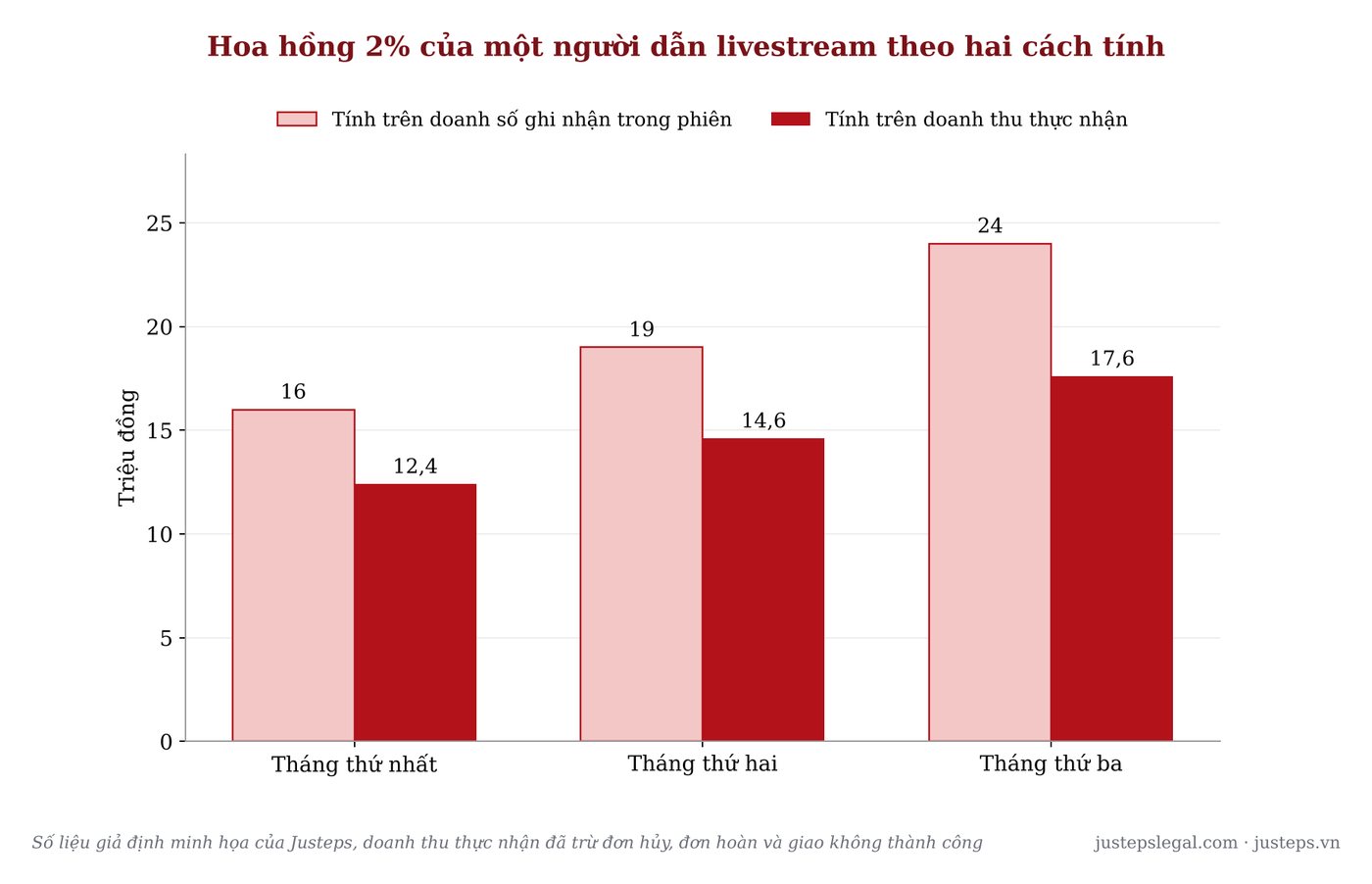
Example of a livestream host’s 2 per cent commission calculated in two ways over three months
In the example, the sales recorded during sessions over the three months are VND 800, 950 and 1,200 million respectively, while the revenue actually received after deducting cancelled orders, returns and failed deliveries is VND 620, 730 and 880 million. Commission on session sales is VND 16, 19 and 24 million, while commission on revenue actually received is VND 12.4, 14.6 and 17.6 million, a difference of about VND 14.4 million after three months. Justeps designs commission rules that link each order to a session code, finalise commission only after the marketplace’s return period has expired, include a cross-check between the channel manager and accounting to exclude fake orders, and clearly set out how matters are handled when a host leaves mid-period. The overall pay scale and bonus mechanism can be built at the same time through the pay scale and pay and bonus regulation service.
Social insurance for hosts, warehouse staff and remote workers
The Law on Social Insurance has extended compulsory coverage, including to part-time workers whose monthly wages are at or above the prescribed level, and the wage on which contributions are based comprises the wage rate, wage allowances and other supplementary amounts agreed to be paid regularly and stably in each pay period[5]. For livestream hosts, the frequent question is whether commission must be included in the wage on which insurance contributions are based. The answer depends on how the pay is designed, because a fixed amount tied to a job title and paid regularly differs from a bonus calculated on the results of each period, so Justeps examines each component of income rather than giving a general conclusion.
Customer care staff working from home under an employment contract are still subject to compulsory insurance in the same way as office staff, because remote working only changes the place of work. For businesses with staff in several provinces, Justeps determines the minimum wage and the place of insurance registration according to the location of the business or the branch managing the employee, and states this clearly in the contract. For underpaid insurance contributions, Justeps prepares a prioritised plan for retrospective payment, and can coordinate with the compulsory social insurance advisory service when it is necessary to deal with the social insurance authority.
Overtime, seasonal workers and outsourced fulfilment
During the 9.9, 11.11 and 12.12 campaigns, the warehouse may have to run twelve to fourteen hours a day for many consecutive days. Overtime is only lawful when the employee consents and the total number of overtime hours does not exceed the daily, monthly and annual limits[1], and a breach is still counted even if the employee volunteers to stay on. Justeps prepares a peak season workforce plan combining three sources, namely overtime within the limits, recruitment of seasonal workers on short-term contracts and the use of a full-service fulfilment provider, with a cost table for each option.
Many businesses take on workers through an intermediary that only supplies people and leaves the business’s warehouse to manage them, whereas this may amount to labour sub-leasing. Labour sub-leasing is a conditional business line that applies only to certain jobs on a list, and the Law amending the Labour Code passed on 21 November 2026 adjusts the regulatory framework for this activity from 1 March 2027[6]. Justeps helps the business distinguish a labour sub-leasing contract from a full-service fulfilment contract, under which the provider manages its own staff and is responsible for results, and then checks the provider’s status before signing.
Images, accounts, data and trade secrets when staff leave
When a livestream host or shop manager leaves, the business risks losing its customer list, its channel followers and even access to its shop. The use of an individual’s image requires that individual’s consent[7], so continuing to post old videos featuring a host after the cooperation ends requires an agreement on scope, duration and conditions for removal, ideally signed at the outset. Employees with access to buyer data must comply with the business’s personal data protection rules[8], and this obligation should be stated in the contract, the internal labour regulations and the confidentiality undertaking.
The Labour Code permits confidentiality agreements on trade secrets to be included in contracts[1], while clauses prohibiting work for competitors after leaving are often difficult to enforce. Justeps therefore focuses on what the business can control, namely the list of accounts and each person’s access rights, the procedure for revoking rights and changing passwords before the last working day, minutes of handover of data and content, and a confidentiality undertaking re-signed on departure. The technical steps for granting and revoking rights are written in detail under the internal procedures and regulations service for e-commerce and livestream selling businesses.
Foreign livestream hosts and experts
Cross-border sellers or foreign brands sometimes bring in Chinese- or Korean-speaking hosts or foreign operations experts to work in Vietnam. Work permit applications filed up to and including 4 December 2026 are handled under Decree No. 219/2025/ND-CP[9], while from 5 December 2026 Decree No. 393/2026/ND-CP on foreign workers in Vietnam applies[10]. Justeps checks whether the position meets the criteria for an expert, manager or technical worker, prepares the work permit file or the confirmation of exemption from a work permit, and calculates personal income tax on income earned in Vietnam[11].
Implementation process, deliverables and fees
A project usually takes about eight weeks and should avoid major sales campaigns, as that is when the business has the least time to work with the team. Justeps reviews the list of people actually working, contracts, payrolls, commission sheets and the insurance contribution status for the last three to six months.
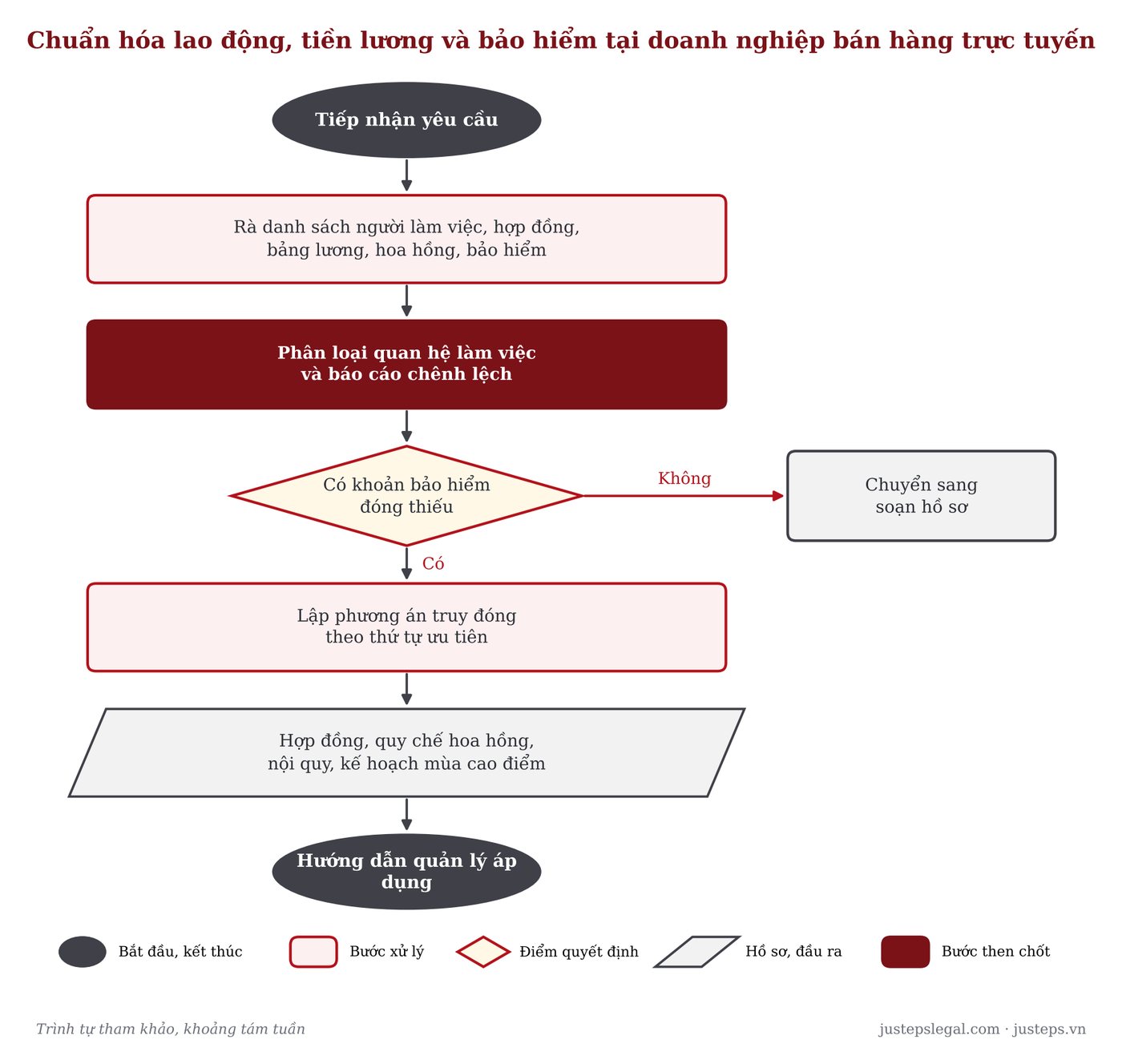
Sequence for standardising labour, wages and insurance at an online seller
In the third week the business receives the classification results, the discrepancies and the remedial plan. From the fourth to the sixth week Justeps drafts contracts, pay and commission rules, confidentiality and image use agreements; in the seventh week it finalises the internal labour regulations, the registration file for businesses with ten or more employees and the peak season workforce plan; and in the final week it adjusts the insurance records and guides managers on application. The deliverables include the following documents:
- A report classifying working relationships and reviewing insurance, with remedial priorities.
- A set of model contracts for livestream hosts, KOLs, KOCs, affiliate marketers, warehouse staff, customer care staff and seasonal workers.
- Rules on pay, bonuses and livestream session commission, with provisions on cancelled orders, returned orders and departures mid-period.
- Confidentiality agreements, image use agreements and an account handover procedure on departure.
- Internal labour regulations and the registration file, serving as the basis for handling discipline in the correct order.
- A peak season workforce plan covering overtime, seasonal recruitment and outsourced fulfilment.
Justeps quotes a fixed service fee in writing after the initial meeting, depending on the number of workers, the number of position groups needing separate contracts, the complexity of the commission mechanism, the extent of insurance discrepancies to be remedied, the need for peak season planning and whether the business needs Justeps to continue reviewing payroll monthly. Situations arising after the project, such as a host resigning unilaterally and taking the channel along, commission complaints or a labour inspection, continue to be supported through the ongoing legal advisory service for e-commerce and livestream selling businesses.
How Justeps can help
In addition to labour, wages and social insurance services, e-commerce and livestream selling businesses can combine the following Justeps services:
- Organisational structure design for e-commerce and livestream selling businesses. Justeps determines the core headcount and the supplementary peak season workforce before contracts are signed with individuals.
- Ongoing legal advisory for e-commerce and livestream selling businesses. Justeps supports labour matters arising each month and provides updates when labour law changes.
- Pay scales and pay and bonus regulations. Justeps builds pay scales for livestream hosts, warehouse staff, customer care staff and channel managers, together with commission mechanisms.
- Compulsory social insurance advisory. Justeps determines coverage, the contribution wage and a retrospective payment plan for each group of workers.
Frequently asked questions
Should a livestream host sign an employment contract or a service contract?
A person who works to the business’s schedule, uses its studio and products and carries targets set by the business is usually an employee[1]. A service contract suits KOLs and KOCs who control their own content and are paid per session or campaign.
Is social insurance payable on a livestream host’s commission?
It depends on how the pay is designed. A fixed amount tied to a job title and paid regularly and stably may form part of the contribution wage, while a bonus based on each period’s results is usually treated differently[5].
May a livestream host be prohibited from working for a competitor after leaving?
Confidentiality agreements on trade secrets are permitted[1], while non-compete clauses after departure are often difficult to enforce. The business should focus on protecting customer data, accounts and rights to content.
May the business continue to use old videos featuring a host who has left?
The consent of that person to the use of his or her image is required[7]. The agreement should clearly state the scope, duration and conditions for removal, and should be signed when the cooperation begins.
Do customer care staff working from home have to be insured?
Yes, if they work under an employment contract within the scope of compulsory coverage[5]. Remote working only changes the place of work and does not change the nature of the employment relationship.
Do affiliate marketers need to sign a contract?
There should be a contract or accepted electronic terms setting out how commission is calculated, obligations regarding advertising content and the withholding of personal income tax on payment[11].
In peak season, may warehouse staff work unlimited overtime if they agree?
No. The employee’s consent is a necessary condition, but the total overtime hours must still not exceed the daily, monthly and annual limits[1]. The business should combine seasonal workers or a fulfilment service rather than extending shifts.
Related articles
- Organisational structure design for e-commerce and livestream selling businesses based on the order journey
- Internal procedures and regulations for e-commerce and livestream selling businesses
- Ongoing legal advisory for e-commerce and livestream selling businesses on content and tax
- Developing commission rules for spa therapists linked to wages, employment contracts and service quality
Notes
[1] The Labour Code and the documents amending and supplementing it.
[2] Government Decree No. 283/2026/ND-CP dated 15 July 2026 on administrative penalties in the fields of labour and social insurance.
[3] Government Decree No. 337/2025/ND-CP on electronic employment contracts.
[4] Government Decree No. 399/2026/ND-CP dated 2 November 2026 on the minimum wage for employees working under employment contracts, effective from 1 January 2027.
[5] The Law on Social Insurance and the documents amending and supplementing it.
[6] The Law amending and supplementing a number of articles of the Labour Code, the Law on Archives, the Law on Gender Equality, the Law on Red Cross Activities and the Law on Employment, effective from 1 March 2027.
[7] Clause 1, Article 32 of the Civil Code No. 91/2015/QH13 dated 24 November 2015.
[8] The Law on Personal Data Protection No. 91/2025/QH15.
[9] Government Decree No. 219/2025/ND-CP on foreign workers working in Vietnam, applicable until 4 December 2026.
[10] Government Decree No. 393/2026/ND-CP dated 20 October 2026 on foreign workers working in Vietnam, effective from 5 December 2026.
[11] The Law on Personal Income Tax No. 109/2025/QH15 and Government Decree No. 253/2026/ND-CP dated 30 June 2026 detailing a number of articles of that Law.
This article is for reference and reflects the regulations in force at the time of publication. Please consult Justeps for advice tailored to your company’s records and situation.
For further information, please contact:
📩 Email: info@justeps.vn
🌐 Website: https://justepslegal.com · https://justeps.vn
🌐 Page: Justeps
☎️ Hotline (Zalo): 096 172 2607
📍 Thanh Xuan Office: 12th Floor, Licogi 13 Tower, 164 Khuat Duy Tien Street, Thanh Xuan Ward, Hanoi, Vietnam
📍 Ha Dong Office: LK06B, No.10, Dong Dua Area, Ha Dong Ward, Hanoi, Vietnam
📍 Ho Chi Minh City Branch: 528 Le Van Sy, Ho Chi Minh City, Vietnam
📍 Hai Phong Office: Truong Thinh Village, Ha Dong Commune, Hai Phong, Vietnam
📍 Quang Ninh Office: Van Don Special Zone, Quang Ninh Province, Vietnam





