
Key takeaways
- The name of a contract does not determine whether there is an employment relationship; a person who works for pay under the management, direction and supervision of the business may be treated as an employee even if they signed a collaboration contract[1].
- Stage crews working at height, with electricity and lifting equipment are the group at greatest risk of accidents, so the business must provide safety training and contract with them directly instead of paying through a crew leader[4].
- From 1 July 2026, payments of VND 5 million or more per payment to individuals without employment contracts are subject to 10% personal income tax withholding before payment[6].
- Performers under 15 must have a written contract with their legal representative, while children under 13 may only do suitable artistic and sporting work and require the consent of the provincial specialised labour authority[7].
An events business with twenty office staff may need two hundred people in the week of a music festival, including stage crews, sound and lighting technicians, security, volunteers, dancers, artists and hosts. Most of these people work for a few days and then move on to another show, are paid by the day or by the session, and are usually all referred to as collaborators. That label is convenient for operations but does not always match labour, insurance and tax law.
This page introduces Justeps’ labour, payroll and insurance service for businesses that organise events, produce performing arts shows, manage artists and operate entertainment venues. It covers how to classify each group of workers, pay for night work and overtime, safety for stage crews, insurance, tax withholding, young performers and foreign artists, the implementation process and the deliverables. The main legal basis is the 2019 Labour Code, the 2024 Law on Social Insurance, the Law on Occupational Safety and Health and the law on personal income tax.
A workforce that changes with each show
The number of people working for an events business does not rise steadily but is concentrated in a few days around each show, and each phase has a different make-up. The figure below gives an example of the number of people involved in an outdoor concert by phase, divided into three groups according to their relationship with the business.
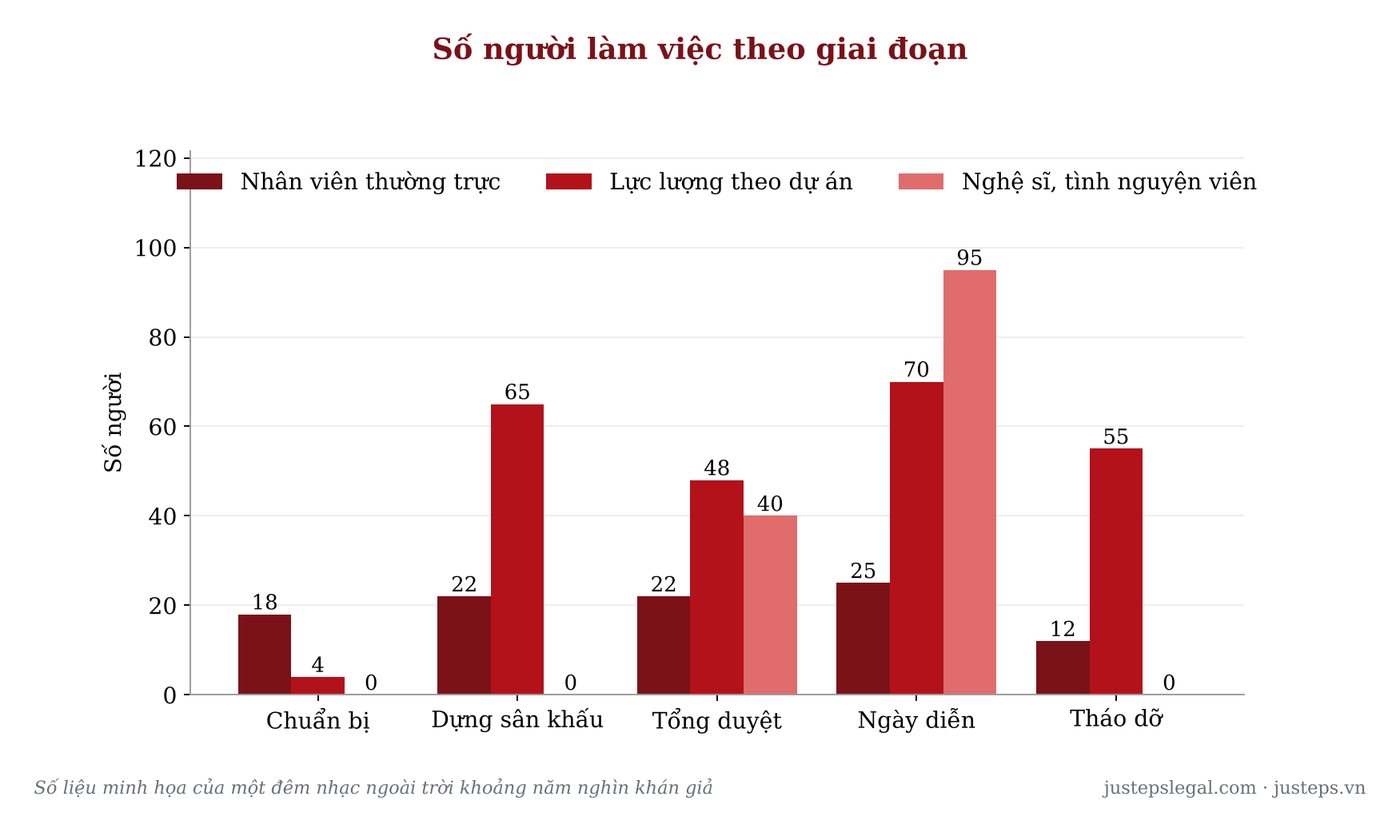
Example number of workers by phase of an outdoor concert
In the preparation phase, most of the work is done by standing staff. In the stage set-up phase, the project workforce such as rigging, electrical and sound technicians grows sharply, and this is also when the risk of accidents is highest. On show day, artists, dancers, security and volunteers are added, after which the dismantling crew works through the night. Each group needs a different type of contract, a different method of payment and a different level of insurance obligation, so the business cannot use a single collaboration contract template for everyone.
Classifying workers and choosing the type of contract
The Labour Code determines an employment contract by its content rather than its name. Where the parties agree under a different name but the content shows paid work, wages and the management, direction and supervision of one party, the agreement is treated as an employment contract[1]. A rigger who works shifts assigned by the business, uses the business’s equipment, takes orders from the technical lead and is paid by the day shows many signs of an employment relationship, even if the paperwork is called a collaboration contract.
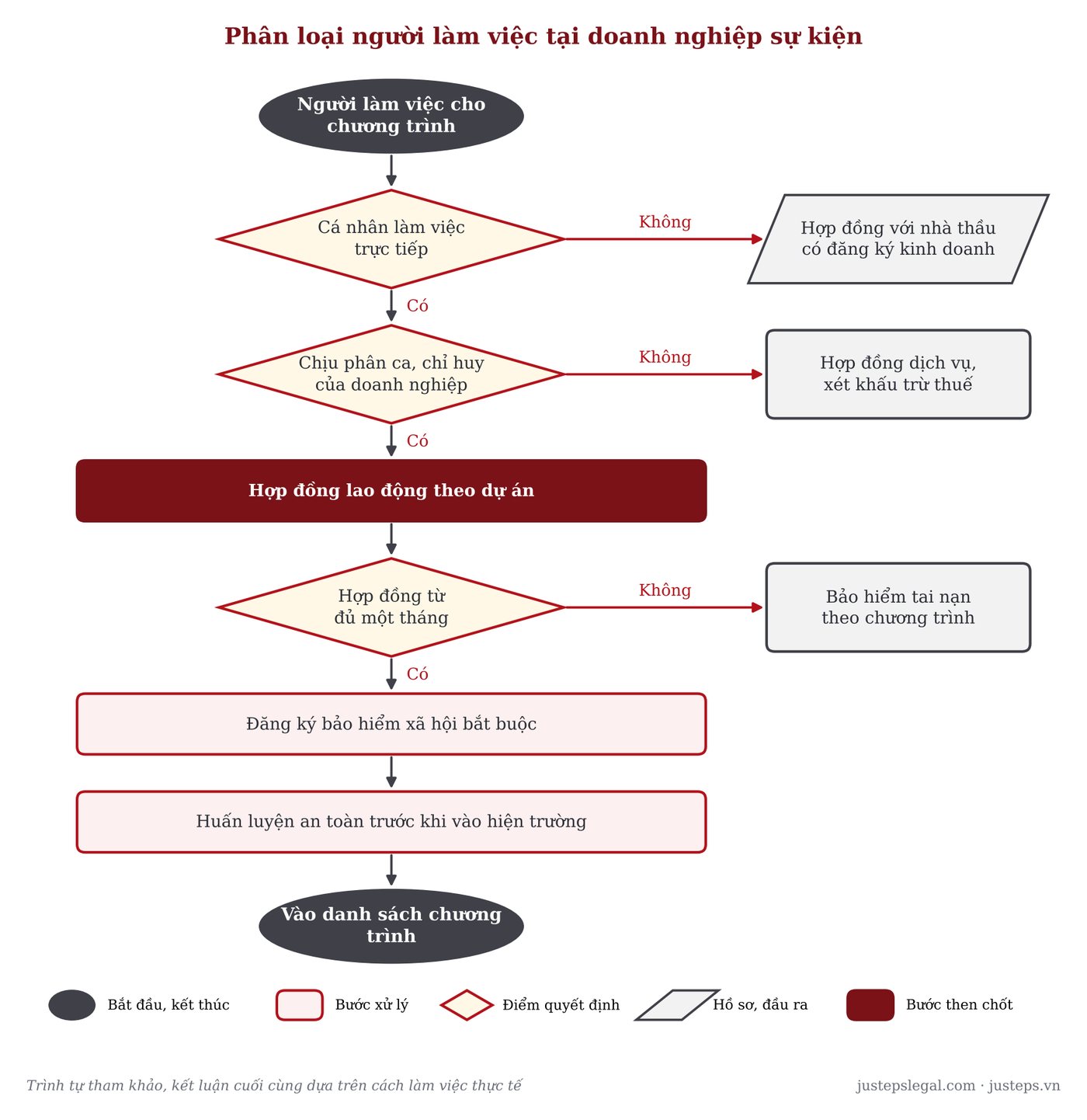
Questions for classifying workers at an events business
By contrast, an artist who decides how to present the act, prepares their own costumes and band and commits only to the result, namely the performance, is usually suited to a performance service contract. A sound and lighting supplier that brings its own technical team is in a contractual relationship between two businesses. The table below summarises how Justeps usually groups workers, although the final conclusion always depends on how each business actually operates.
| Group | Usually suitable type of contract | Obligations to note |
|---|---|---|
| Standing staff | Fixed-term or indefinite-term employment contract. | Compulsory insurance contributions, tax at progressive rates and application of the internal labour regulations. |
| Project-based crews and technicians | Employment contract for the duration of the project where they work under the business’s direction. | Safety training, protective equipment and insurance where the contract lasts one full month or more. |
| Independent collaborators | Service contract where they decide how to do the work and commit only to the result. | 10% tax withholding where a payment is VND 5 million or more. |
| Domestic artists | Performance service contract, signed directly or through a management company. | Tax withholding if paid to an individual and agreement on the performer’s rights. |
| Young performers | Written contract with the legal representative. | Limits on working hours, suitable work and consent of the labour authority for children under 13. |
| Foreign artists | Contract with the individual or with a representative organisation abroad. | Entry procedures, work permit or exemption, non-resident personal income tax or foreign contractor tax. |
Risks of paying through a crew leader
Many businesses hire a stage crew leader, transfer the full labour cost to that person and let them pay their own crew. If the crew leader is not a registered business or household business, and the crew in fact works under the business’s direction on site, the business may still be held to be the employer when an accident occurs. Justeps recommends either contracting directly with each person or working only with contractors that have business registration and requiring them to show that they have met their obligations to their own workers.
Night work pay, overtime and the minimum wage
Events are often set up and dismantled at night. Night work is counted from 22:00 to 06:00 the following morning, and employees who work at night are paid an additional amount of at least 30% of the wage for a normal working day, while overtime is paid at least 150% on normal days, 200% on weekly days off and 300% on public holidays and Tet[2]. Overtime hours are also capped by month and by year, so a schedule of three consecutive nights of set-up needs to be checked before shifts are assigned.
The daily rate the business pays stage crews is often agreed as a lump sum, but when converted to actual hours and after accounting for night work and overtime, the wage for normal working hours must not be lower than the regional minimum wage. From 1 January 2027, the monthly minimum wage for Region I is VND 5,700,000 under Decree No. 399/2026/NĐ-CP[3]. Justeps builds a formula for calculating the daily rate so that the accountant can quickly check each show in different locations.
Occupational safety and insurance for stage crews
The Law on Occupational Safety and Health requires employers to provide safety training, supply personal protective equipment, have machinery and equipment with strict safety requirements inspected, and bear medical costs and pay compensation when an employee suffers an occupational accident as prescribed[4]. Rigging, hoists and personnel lifts are common equipment on event stages. If the stage crew is treated as employees and the business has no training and inspection records, the business may have to bear all the costs when an accident occurs.
Under the 2024 Law on Social Insurance, persons working under employment contracts of one full month or more are subject to compulsory social insurance[5]. For people working for shorter periods, the business should consider buying accident insurance for each show and stating this clearly in the contract. Justeps reviews the lists of workers on the most recent shows to determine who should have been insured, estimates any arrears of contributions and proposes how to resolve the matter conclusively.
Personal income tax, young performers and foreign artists
From 1 July 2026, under Decree No. 253/2026/NĐ-CP guiding the Law on Personal Income Tax, organisations paying wages or fees to resident individuals without employment contracts, or with contracts of less than three months, must withhold 10% on payments of VND 5 million or more per payment[6]. Individuals whose only income falls into this category and who have not reached the taxable level may make a written commitment so that tax is not withheld for the time being, but the business must still compile and report the payments at the end of the year. For artists’ fees paid directly to an individual, the contract should state clearly whether the agreed fee is before or after tax.
The Labour Code only allows persons under 13 to be employed in artistic, physical training and sporting work that does not harm the child’s development, and with the consent of the specialised labour authority under the provincial People’s Committee; for persons under 15, the contract must be in writing with the legal representative and working hours are limited[7]. Shows in which children perform must also comply with child protection law, as required by the rules on performing arts[8].
Foreign artists coming to perform for short periods need to have their entry procedures checked, together with whether they require a work permit or are exempt under Decree No. 219/2025/NĐ-CP[9]. If payment is made directly to the individual, the artist is usually a non-resident individual and subject to withholding at the rate applicable to that category; if payment is made to a management company abroad, it is usually subject to foreign contractor tax. Justeps clarifies the payment structure before signing so that the agreed price correctly reflects the tax.
Implementation process, deliverables and fees
A project usually takes six to eight weeks. In the first two weeks, Justeps’ consultants read the contracts, timesheets, payment records and lists of workers from the three to five most recent shows. In week three, Justeps sends a classification and risk report. The following weeks are for drafting contract templates, rules on calculating pay and procedures for insurance registration and tax withholding, then trialling on one show and training project directors and accountants. The deliverables comprise the following documents:
- A report classifying the workforce and assessing the risks of insurance arrears, penalties and tax.
- A set of templates for project-based employment contracts, service contracts, performance contracts and contracts with young performers.
- Rules on working hours, night shifts and overtime, with a formula for calculating the daily rate by region.
- A procedure for quick insurance registration for the project workforce and a procedure for withholding and reporting personal income tax.
- An on-site safety plan and draft internal labour regulations if the business employs ten or more employees[10].
Who directs the stage crew, who acts as safety lead and who approves timesheets depend on the business’s organisation; if these roles are not yet clear, Justeps recommends combining this work with the organisational structure design service for events and performing arts businesses. Fees are quoted as a fixed package in writing, depending on the average number of workers, the number of contract types to be drafted, the level of outstanding risk and whether young performers or foreign artists are involved.
How Justeps can help
Alongside the labour, payroll and insurance service, event, performing arts and entertainment businesses can combine the following Justeps services:
- Organisational structure design for event, performing arts and entertainment businesses. Justeps separates the standing organisation from the project teams and defines the role of the safety lead who directs stage crews.
- Ongoing legal advisory for event, performing arts and entertainment businesses. Justeps answers questions on contracts with artists and collaborators and on tax on fees for each show.
- Personal income tax on salaries and wages. Justeps sets up procedures for withholding, commitments and tax finalisation for seasonal workers and artists.
- Compulsory social insurance advisory. Justeps determines who must contribute, the contribution levels and how to handle arrears for project-based stage crews.
Frequently asked questions
Do stage crews working for a few days have to sign employment contracts?
If they work shifts assigned by the business, take its orders and use its equipment, there are many signs of an employment relationship even for short periods[1]. The business should sign project-based employment contracts or work through contractors with business registration.
Must social insurance be paid for someone working two weeks?
Compulsory social insurance applies to employment contracts of one full month or more[5]. For people working shorter periods, the business should buy accident insurance for the show and must still meet its occupational safety obligations.
Must tax be withheld when paying a host a fee of VND 4 million?
From 1 July 2026, payments below VND 5 million per payment to individuals without employment contracts are not subject to mandatory withholding unless the recipient requests it[6]. The business must still compile the payments made for reporting.
What formalities are needed for a 10-year-old to perform in a show?
A written contract with the child’s legal representative, work suited to the child’s development and the consent of the provincial specialised labour authority are required[7]. Performance and rehearsal time must be arranged within the permitted limits.
Does an all-inclusive daily rate need to separate night work pay?
The business should separate it, or at least state clearly how the rate includes night work and overtime, to show that the wage for normal working hours is not below the regional minimum[2].
Does a foreign artist performing for one night need a work permit?
Depending on the duration and nature of the work, the artist may be exempt or may only need confirmation of not being subject to a work permit[9]. The business should check this early together with entry procedures and how tax will be withheld.
Related articles
- Organisational structure design for event, performing arts and entertainment businesses based on a standing organisation and project teams
- Ongoing legal advisory for event, performing arts and entertainment businesses from artist contracts to show day
- Managing seasonal workers and freelance collaborators in line with the true nature of the contract and contribution obligations
- Fire prevention and fighting records for business premises under the new law and the tasks to complete each year
Notes
[1] Clause 1 of Article 13 of the Labour Code No. 45/2019/QH14 dated 20 November 2019.
[2] Articles 98 and 106 of the Labour Code No. 45/2019/QH14 dated 20 November 2019.
[3] Decree No. 399/2026/NĐ-CP of the Government on the minimum wage for employees working under employment contracts, applicable from 1 January 2027.
[4] Law on Occupational Safety and Health No. 84/2015/QH13 dated 25 June 2015.
[5] Law on Social Insurance No. 41/2024/QH15 dated 29 June 2024, effective from 1 July 2025.
[6] Law on Personal Income Tax No. 109/2025/QH15 and Decree No. 253/2026/NĐ-CP of the Government detailing the Law on Personal Income Tax.
[7] Article 145 of the Labour Code No. 45/2019/QH14 dated 20 November 2019.
[8] Article 4 of Decree No. 144/2020/NĐ-CP dated 14 December 2020 of the Government on performing arts activities, as amended and supplemented by Decree No. 116/2026/NĐ-CP and Resolution No. 18/2026/NQ-CP.
[9] Decree No. 219/2025/NĐ-CP of the Government on foreign workers working in Vietnam.
[10] Article 118 of the Labour Code No. 45/2019/QH14 dated 20 November 2019.
This article is for reference and reflects the regulations in force at the time of publication. Please consult Justeps for advice tailored to your company’s records and situation.
For further information, please contact:
📩 Email: info@justeps.vn
🌐 Website: https://justepslegal.com · https://justeps.vn
🌐 Page: Justeps
☎️ Hotline (Zalo): 096 172 2607
📍 Thanh Xuan Office: 12th Floor, Licogi 13 Tower, 164 Khuat Duy Tien Street, Thanh Xuan Ward, Hanoi, Vietnam
📍 Ha Dong Office: LK06B, No.10, Dong Dua Area, Ha Dong Ward, Hanoi, Vietnam
📍 Ho Chi Minh City Branch: 528 Le Van Sy, Ho Chi Minh City, Vietnam
📍 Hai Phong Office: Truong Thinh Village, Ha Dong Commune, Hai Phong, Vietnam
📍 Quang Ninh Office: Van Don Special Zone, Quang Ninh Province, Vietnam





