
Key takeaways
- The know-how of an events business often sits in the heads of a few project directors, so written procedures are the way to retain the right way of working when experienced staff leave or when the business runs several shows at once.
- The work schedule for each show should count down from the show date, in which the deadline for submitting the approval file at least 07 working days before the event is a hard deadline that cannot be made up[1].
- The refund policy for cancelled shows or changes of artist needs to be published before tickets go on sale and applied consistently across all channels, because ticket buyers are protected by consumer protection law[4].
- Urgent on-site spending without supporting documents and without a deadline for settling advances is often disallowed as a deductible expense for corporate income tax[6].
Events businesses usually grow thanks to a few excellent project directors. They know whom to call when a generator is missing, where to submit the files and which artists tend to change their act at the last minute. When one of these people leaves, or when the business takes on three shows in the same week, the right way of working does not pass to newcomers, and old mistakes repeat themselves, such as late filings, advances that cannot be settled and client complaints about inconsistent ticket refunds.
This page introduces Justeps’ service for building internal procedures and regulations for businesses that organise events, produce performing arts shows and operate entertainment venues. The approach is to write procedures along the life cycle of a show, from receiving the request to archiving the file, rather than department by department. The set of procedures serves both as work instructions and as evidence that the business acted properly when an accident or complaint occurs, or when the tax authority examines expenses.
Five groups of procedures an events business needs
Justeps divides the documents into five groups. The content and formalities group covers script approval, copyright clearance, notification or approval files and formalities for foreign artists. The safety group covers risk assessment by type of show, fire prevention, medical support, security, crowd control and safety for stage crews. The ticketing group covers issuing, exchanging and refunding tickets and audience support. The project finance group covers estimates, advances, payment of artists’ fees and final accounts. The partners group covers contracts with suppliers, subcontractors and sponsors, and equipment management.
Not every business needs all five groups at the same level of detail. A business that mainly organises events for corporate clients without selling tickets needs a very lean ticketing group, but its project finance and acceptance procedures must be tight. A business that produces its own concerts is the opposite, with ticketing, copyright and crowd control at the centre. Justeps’ first review session is designed to set these priorities.
A countdown schedule from the show date
The most important procedure for an events business is the countdown schedule, because everything else hangs on it. Under current rules, the file requesting approval to organise a performance must be submitted at least 07 working days before the planned date, the authority has 03 working days to request completion if the file is invalid, and 05 working days to issue written approval once the file is complete[1]. For competitions and festivals subject to approval, the deadline is at least 30 working days. Internal procedures should set milestones earlier than these deadlines to leave time for corrections.
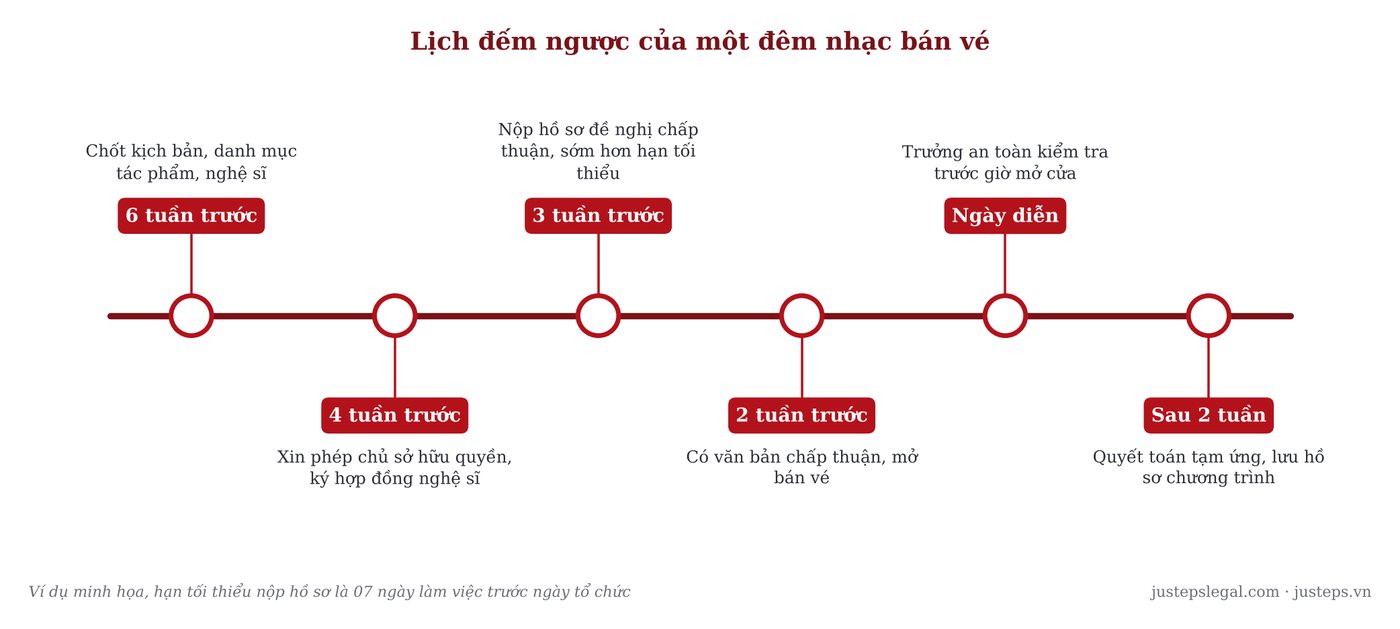
Milestones in the countdown schedule for a ticketed concert
In this example, the script and list of works must be settled about six weeks before the show date, so that the legal point of contact has time to obtain permission from rights holders and prepare translations of foreign works. The file is submitted a few days earlier than the minimum deadline, and tickets go on sale only after written approval has been received. If the venue or time has to change, the rules require notice to the approving authority at least 02 working days before the planned date, so the procedure must state who may decide on the change and who sends the notice. After the show date, final accounts and archiving also have their own deadlines.
Procedure for clearing copyright and content
The Decree on performing arts requires organisations and individuals organising performances to comply with the rules on copyright and related rights and to perform only the content that has been approved[1]. The Law on Intellectual Property treats performing a work in public as an economic right of the copyright owner, while using published sound and video recordings in business activities does not require permission but does require payment of royalties[2]. The clearance procedure must therefore go through each work individually, rather than stopping at the artist’s word that the rights have been obtained.
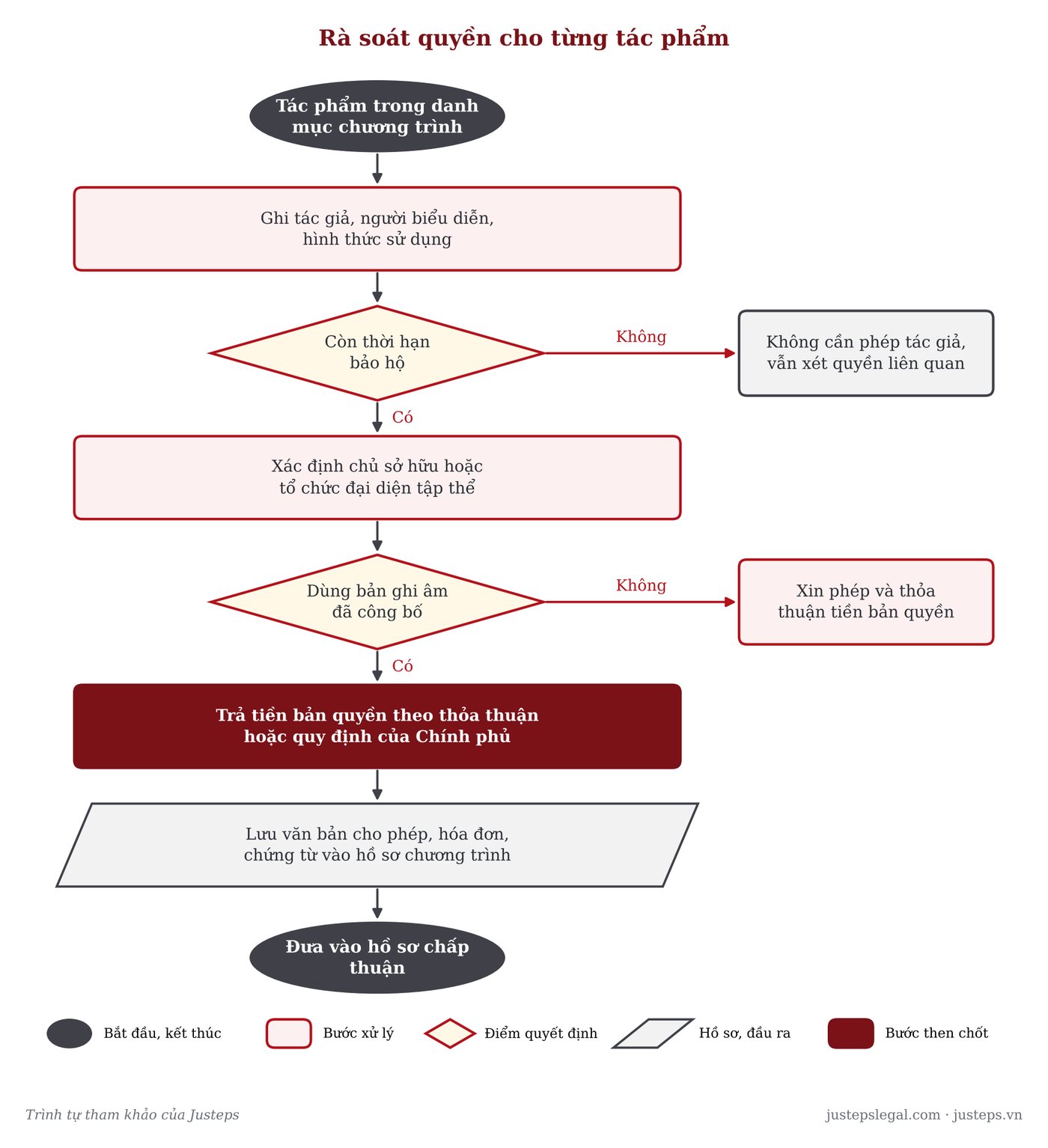
Sequence for clearing rights for a work in the show’s list of works
For each work, the person in charge of content records the author, the performer and the form of use. The legal point of contact checks whether the work is still within its term of protection, who the owner is and whether a collective management organisation has been authorised, and then requests permission and agrees royalties. Works used through existing sound recordings follow the payment branch without the need for permission. All letters of permission, invoices and royalty payment records are kept in the show file for checking when the authority carries out an inspection.
At the same stage, the procedure should control the sponsors’ advertising content appearing on stage, on screens and on the show’s social media channels. The Law on Advertising as amended in 2025 adds responsibilities for persons conveying advertising products, including artists and influencers who promote products, such as having to learn about the product and to state clearly that the content is advertising[3]. Sponsorship contracts and artist contracts should refer to this content approval procedure.
Regulations on ticket sales, refunds and buyer data
When a show is cancelled, postponed or the headline artist changes, ticket buyers are consumers and are protected by the Law on Protection of Consumers’ Rights, including in respect of terms in general terms and conditions of transactions[4]. The ticketing regulations need to set out in advance the cases in which refunds are made, the refund rate, the time limit and the refund channel, applied equally to tickets sold directly, through agents and through online platforms. The regulations also designate one person with the authority to decide on refunds within a few hours when an incident occurs, so that customer service does not give a different answer on each channel.
The list of ticket buyers is personal data. Sponsors often want to receive this list for customer care, but sharing it with a third party requires the buyer’s separate consent for that purpose under the Law on Personal Data Protection[5]. The regulations should prescribe the consent form on the ticketing page, who may access the list, how long it is kept and how it is deleted after the show ends.
Regulations on project finance, advances and final accounts
Urgent spending is a feature of the sector. The production team buys materials at midnight, hires extra vehicles when roads are closed and pays for the stage crew’s meals in cash. Without a deadline for settling advances and rules on supporting documents, these items lack valid invoices or lack non-cash payment records once the threshold is reached, and risk being disallowed as deductible expenses[6]. Suppliers’ invoices must be issued at the correct time under the rules on electronic invoices[7].
Artists’ fees need a procedure of their own, because the method of payment determines the tax obligations. Paying an individual directly, paying through a domestic artist management company or paying an organisation abroad leads to three different methods of withholding and declaration. The procedure should require the payment method to be determined when the contract is signed, rather than leaving it until the money is transferred. Businesses that already have the ongoing legal advisory package for events businesses can send each artist contract for review before signing.
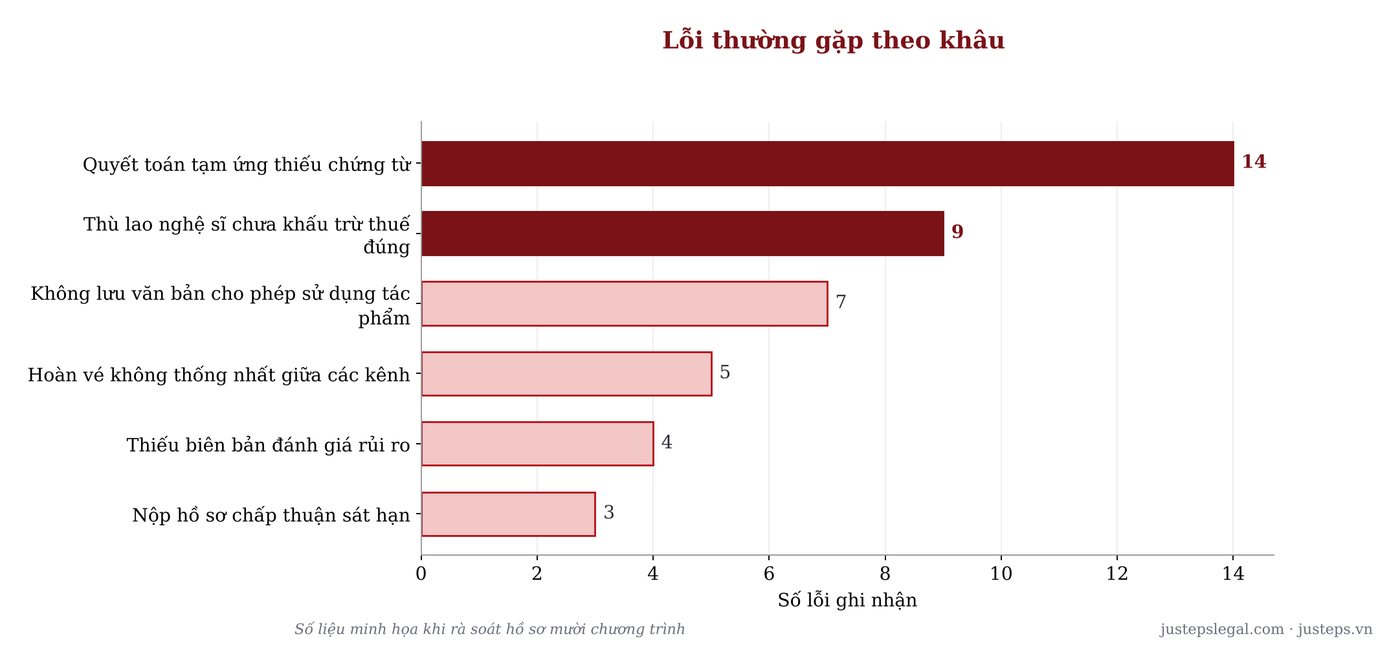
Example number of errors by stage found when reviewing the files of ten shows
The illustrative figures above follow the way Justeps usually records findings when reviewing files, and show that errors are concentrated in settling advances and in the supporting documents for artists’ fees, followed by copyright files that were not kept. Errors in submitting the approval file are fewer but have the most serious consequences, because they can prevent the show from going ahead. The order of priority when writing procedures follows both frequency and severity of consequences.
Implementation process, deliverables and fees
A project usually takes about ten weeks. In the first two weeks, Justeps’ consultants read the files of the most recent shows and interview the project directors, the accountant and the ticket sales staff. In week three, Justeps presents the list of procedures in order of priority. The following weeks are for drafting group by group, collecting comments, trialling on a real show, then finalising, issuing and training. The deliverables comprise the documents in the table below.
| Document | Main content |
|---|---|
| Content and formalities set | Procedures for script approval, copyright clearance, the countdown schedule and templates for notification and approval request files. |
| Safety set | Procedures for risk assessment by type of show, assignment of the safety lead, fire prevention, medical support and crowd control. |
| Ticketing regulations | Conditions for issuing, exchanging and refunding tickets, the data consent form and the person with authority to decide on refunds. |
| Project finance regulations | Estimate templates, advance request forms, deadlines for final accounts, rules on supporting documents and the procedure for paying artists’ fees. |
| Checklists | Lists of tasks before, during and after the show for the project director to sign off. |
| Issuance file | Draft issuance decisions and short training materials for project directors and accountants. |
Procedures only work once it is clear who holds which authority in the organisation. If the business has not yet separated the standing organisation from the project teams, Justeps recommends carrying out the organisational structure design service for events and performing arts businesses first or in parallel. Fees are quoted as a fixed package in writing after the initial discussion, depending on the number of procedure groups to be written, the number of show types, whether tickets are sold and whether foreign artists are involved.
How Justeps can help
Alongside the set of procedures and regulations, event, performing arts and entertainment businesses can combine the following Justeps services:
- Organisational structure design for event, performing arts and entertainment businesses. Justeps separates the standing organisation from the project teams and assigns the authority to stop a show, as the foundation for the procedures.
- Ongoing legal advisory for event, performing arts and entertainment businesses. Justeps reviews artist, sponsorship and venue hire contracts and provides updates on new rules for each show.
- Advertising, sales promotion and consumer protection. Justeps drafts ticket sale conditions, refund policies and the procedure for approving sponsors’ advertising content.
- Financial regulations and delegation of authority. Justeps sets advance limits, deadlines for final accounts and authority to approve spending for each project.
Frequently asked questions
Which procedures should a small business write first?
It should start with the countdown schedule together with the formalities file, the regulations on advances and final accounts, and the refund regulations if it sells tickets. These are the three stages with the most errors or the most serious consequences.
Can tickets go on sale before written approval is obtained?
Justeps recommends against it. If the show is not approved or the content has to change, the business must refund tickets and also risks penalties, so the procedure should make written approval a condition for opening sales[1].
Does using existing background music in a show require permission?
For published sound recordings used in business activities, the law allows use without permission but royalties must be paid to the owner[2]. Performing a work live still requires permission from the copyright owner.
May the list of ticket buyers be passed on to sponsors?
Only if buyers have given separate consent to sharing with the sponsor and for a specific purpose. The regulations should include a consent form on the ticketing page[5].
What is a reasonable deadline for settling advances?
The law does not set a general deadline for businesses, so the business sets one in its financial regulations. For events, Justeps usually proposes a short deadline after the show date so that supporting documents are not lost.
Do the procedures help when an accident occurs?
Yes. A risk assessment record, the assignment of a safety lead and signed checklists are evidence that the business took preventive measures, helping to determine responsibility correctly when an incident occurs.
Related articles
- Organisational structure design for event, performing arts and entertainment businesses based on a standing organisation and project teams
- Ongoing legal advisory for event, performing arts and entertainment businesses from artist contracts to show day
- Controlling advertising content within a business through a pre-publication approval procedure
- Fire prevention and fighting records for business premises under the new law and the tasks to complete each year
Notes
[1] Articles 4, 10 and 13 of Decree No. 144/2020/NĐ-CP dated 14 December 2020 of the Government on performing arts activities, as amended and supplemented by Decree No. 116/2026/NĐ-CP dated 2 April 2026 and Resolution No. 18/2026/NQ-CP dated 29 April 2026 of the Government.
[2] Articles 20 and 33 of the Law on Intellectual Property No. 50/2005/QH11, as amended and supplemented by Law No. 36/2009/QH12, Law No. 42/2019/QH14, Law No. 07/2022/QH15 and Law No. 131/2025/QH15 (effective from 1 April 2026).
[3] Article 15a of the Law on Advertising No. 16/2012/QH13, as supplemented by Law No. 75/2025/QH15, effective from 1 January 2026.
[4] Law on Protection of Consumers’ Rights No. 19/2023/QH15 dated 20 June 2023.
[5] Law on Personal Data Protection No. 91/2025/QH15, effective from 1 January 2026.
[6] Law on Corporate Income Tax No. 67/2025/QH15 and Article 9 of Decree No. 320/2025/NĐ-CP of the Government detailing the Law on Corporate Income Tax.
[7] Decree No. 254/2026/NĐ-CP dated 30 June 2026 of the Government on electronic invoices and electronic documents, effective from 1 July 2026, replacing Decree No. 123/2020/NĐ-CP and Decree No. 70/2025/NĐ-CP.
This article is for reference and reflects the regulations in force at the time of publication. Please consult Justeps for advice tailored to your company’s records and situation.
For further information, please contact:
📩 Email: info@justeps.vn
🌐 Website: https://justepslegal.com · https://justeps.vn
🌐 Page: Justeps
☎️ Hotline (Zalo): 096 172 2607
📍 Thanh Xuan Office: 12th Floor, Licogi 13 Tower, 164 Khuat Duy Tien Street, Thanh Xuan Ward, Hanoi, Vietnam
📍 Ha Dong Office: LK06B, No.10, Dong Dua Area, Ha Dong Ward, Hanoi, Vietnam
📍 Ho Chi Minh City Branch: 528 Le Van Sy, Ho Chi Minh City, Vietnam
📍 Hai Phong Office: Truong Thinh Village, Ha Dong Commune, Hai Phong, Vietnam
📍 Quang Ninh Office: Van Don Special Zone, Quang Ninh Province, Vietnam





