
Key takeaways
- A membership lasting 03 months or more counts as a continuous service under the 2023 Law on Protection of Consumers’ Rights, so the contract must be made in writing and the business must notify the member in advance before the membership ends or the next payment falls due[3].
- What a sales consultant says only protects the business if it matches the contract, so the sales script and the standard contract must be drafted together and approved by the same person.
- A health waiver signed by the member cannot replace a screening procedure, and terms excluding the business’s liability in a contract with a consumer may be invalid[4].
- Membership fees collected in advance must be invoiced at the right time and the portion of services not yet provided must be tracked, so that the business knows how much it still owes members when it closes or sells a facility[7].
A member buys a two-year membership at a gym because the sales consultant promises that it can be frozen at any time. Ten months later, the member asks to freeze it for three months to go on a work assignment and is told that the contract allows only one freeze of no more than thirty days, with two weeks’ notice. The member posts about it on social media, dozens of others share similar experiences, and the business has to deal with a crisis simply because the sales pitch and the contract said two different things. Most disputes at gyms and yoga studios stem from operational steps of this kind that have never been written down as procedures.
This page presents Justeps’ service of building internal procedures and regulations for gyms, yoga and pilates studios, martial arts schools, commercial swimming pools and sports clubs. It covers the four groups of documents a business needs, the legal requirements governing each step of the membership life cycle, daily safety procedures, rules on prepaid revenue and member data, and how Justeps carries out the work and what it delivers. The main legal basis is the Law on Protection of Consumers’ Rights No. 19/2023/QH15, the law on physical training and sports, the Law on Personal Data Protection No. 91/2025/QH15 and the rules on invoices.
Why gyms need written procedures
The business model of a gym is built on advance payment for services lasting many months, sometimes several years. During that time many changes arise, such as freezes, transfers of a membership to a relative, changes of trainer, changes to opening hours, temporary closure of an area for maintenance or moving members to another facility. If each change is handled in whatever way the person on duty sees fit, it creates a precedent, and differing precedents between facilities are the source of complaints.
Apart from its relationship with members, a gym must also comply with the conditions for commercial sports activities concerning professional staff, facilities and equipment[1], fire prevention and fighting requirements at the premises, invoicing obligations and the protection of members’ health data, images and biometric data. Written procedures help new staff do things correctly from the first day, and serve as evidence that the business has organised the performance of its obligations when an incident occurs or when the authorities carry out an inspection.
Justeps divides a gym’s set of documents into four groups, each with its own lead and review cycle. The table below summarises the scope of each group.
| Document group | Main scope | Usual lead |
|---|---|---|
| Members | Consultation, contracts, health screening, freezes, transfers, refunds and complaints. | The facility manager together with the member care unit. |
| Professional | Standards for trainers and teachers, standard training plans, substitute teaching and conduct towards members. | The head of the professional line. |
| Safety | Checks on equipment, pool and sauna, first aid, fire prevention and handling medical incidents. | The head of technical operations and the person in charge of lifeguards. |
| Finance and data | Prepaid revenue, invoices, commission, reconciliation, instalments and member data. | The chief accountant and the person in charge of data. |
The membership life cycle and the requirements of the Law on Protection of Consumers’ Rights
The 2023 Law on Protection of Consumers’ Rights treats the provision of services for a term of 03 months or more, or for an indefinite term, as the provision of continuous services[2]. Most gym and yoga memberships fall into this category, so membership procedures must be designed around the specific requirements for this type of transaction. The figure below shows the five steps in a member’s life cycle that Justeps writes up as procedures.
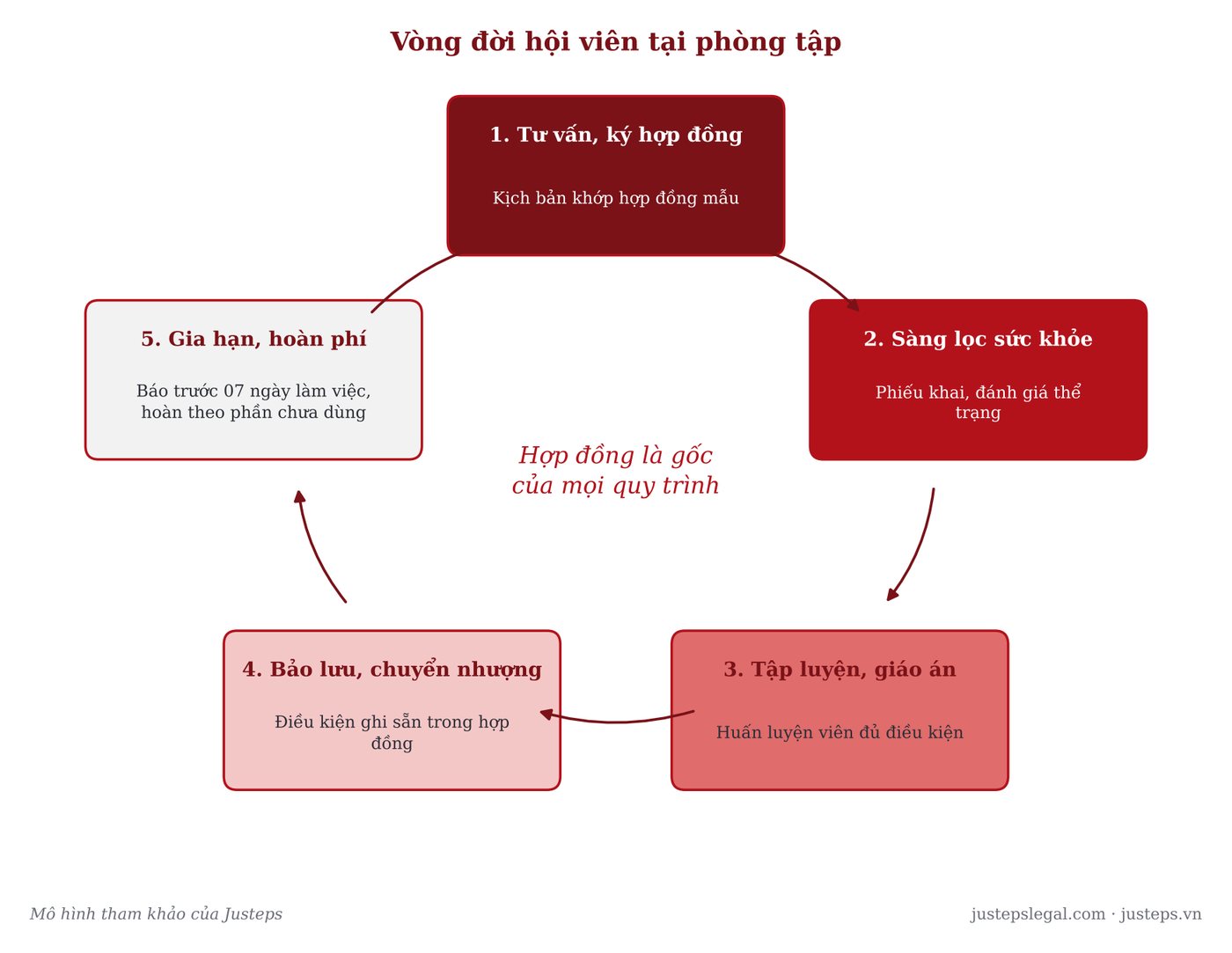
Five steps in the membership life cycle that need procedures
Consultation and signing the contract
A contract for continuous services must be made in writing and a copy given to the consumer. A standard form contract must describe the service, the time and term of provision, and the fees and any additional charges, and the business must give at least 07 working days’ notice of the next payment and of the contract end date[3]. Standard form contracts must also be made public, and terms such as excluding the business’s liability, restricting the consumer’s right to complain or forcing the consumer to agree to the business collecting and using their information in certain cases listed by the law are invalid[4].
Justeps therefore drafts the sales script at the same time as the standard contract and the general terms and conditions. Everything staff are allowed to promise, such as the number of freezes, the transfer fee, access to the pool or the number of complimentary personal training sessions, must appear in the contract. Temporary promotions are set out in time-limited annexes rather than left to consultants to agree verbally.
Health screening before training
Many gyms simply ask members to sign a waiver stating that they take responsibility for their own health. Such a document has limited value, because the service provider must still ensure the life and health of consumers, and liability exclusion terms may be void. A proper procedure includes a basic health questionnaire, an initial fitness assessment with a trainer, a rule requiring medical advice for members with cardiovascular conditions, who are pregnant or who have recently had surgery, and the right of the head of the professional line to refuse to place a member in a high intensity class when there is not enough information.
Freezes, transfers, refunds and closing a facility
Unless otherwise agreed, the consumer has the right to terminate a contract for continuous services unilaterally and pays only for the services already used[3]. The refund policy must therefore be clearly drafted in the contract, setting out when refunds are given, how the portion used is calculated, any handling fee and the time limit for refunds, and the cases in which no refund is given must be disclosed before signing. The business may not unilaterally terminate or stop providing services contrary to the contract, and when it has to suspend services for repairs or maintenance it must notify members at least 03 working days in advance, except in cases of force majeure[5].
A procedure for closing or relocating a facility is a document that businesses usually think about only when it is too late. Justeps prepares in advance a sequence covering the number of sessions and days remaining for each member, the option of moving to another facility or receiving a refund, a notice template, a channel for receiving feedback and the person responsible for replying. Where a facility is sold, this procedure is coordinated with the ongoing legal advisory service for gym and yoga businesses to deal with the remaining obligations to members in the transfer agreement.
Daily safety procedures at the facility
The conditions on facilities, equipment and lifeguards for water sports are not only checked when the certificate is applied for, but must be maintained every day[1]. Justeps builds a pre-shift checklist for each area that takes about fifteen minutes, covering the condition of treadmills, machine cables and weight racks, the temperature and operating time of the sauna, water quality and lifeguard positions at the pool, emergency exits and fire extinguishers. Each check is signed and kept, because when an injury occurs the inspection log is the most important evidence that the business has performed its obligations.
The procedure for handling medical incidents sets out who gives first aid, who calls the emergency services, who contacts the family, who preserves the camera footage and the inspection log, and who is allowed to speak publicly. Fire prevention and fighting responsibilities at the facility are determined under the 2024 Law on Fire Prevention and Fighting and Rescue[6], so the safety procedures also include an evacuation plan for the busy evening peak and a training schedule for evening shift staff.
Rules on prepaid revenue, commission and member data
A common financial mistake is to record the entire membership fee as revenue as soon as it is collected. For invoicing, when payment is collected in advance for services, the business must usually issue an invoice at the time of collection under the rules on invoices and documents[7]; for accounting, revenue is recognised gradually over time or by the number of sessions provided. Justeps’ rules on prepaid revenue set out how to track the outstanding obligation to each member, how to handle freezes, transfers and refunds, and how to reconcile the membership management software with the accounting books every month.
The commission rules for sales consultants and trainers must be linked to the same data, so that commission is calculated on money actually received, is adjusted when a member is refunded within a certain period, and is clearly separated from pay per session. Trainers must not receive money directly from members outside the system, because such payments are both off the books and make it hard for the business to show who is responsible if an accident happens during a private session.
Health questionnaires, body measurements, camera footage and facial recognition data at the entrance are types of data requiring strict protection under the 2025 Law on Personal Data Protection[8]. The business must also publish its rules on protecting consumer information and allow members to choose the scope of information they agree to provide[9]. Justeps drafts data protection rules, separate consent forms for each purpose, an alternative for members who do not wish to use facial recognition, and rules ensuring that marketing calls and messages go only to people who have agreed to receive them.
Mistakes Justeps often finds during reviews
In reviewing gym records, Justeps has found that complaints are not spread evenly but are concentrated in a few steps. The figure below is an example breakdown of complaints over one year at a chain of three facilities, used to decide which group of procedures should be standardised first.
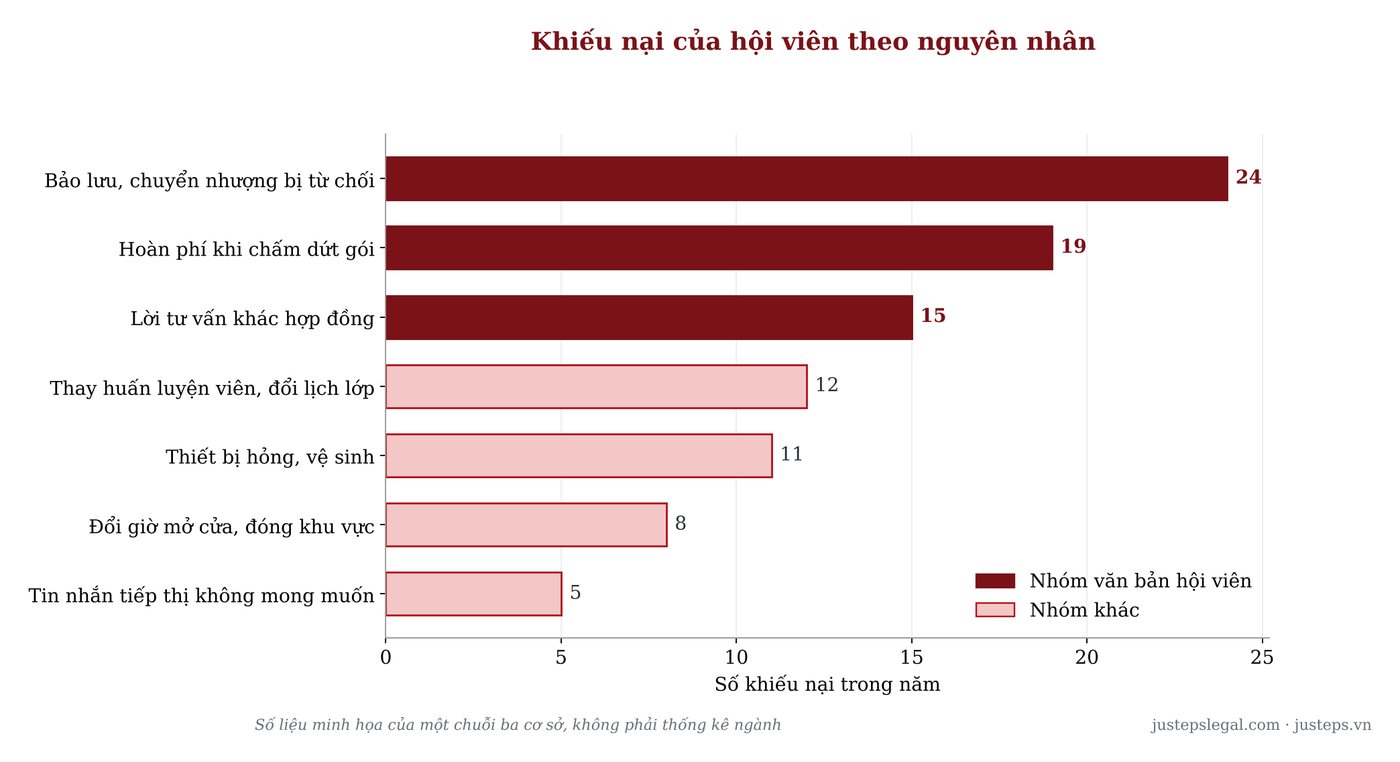
Example breakdown of member complaints by cause
In this example, more than half of the complaints relate to freezes, refunds and sales promises that did not match the contract, all of which belong to the member documents group. Justeps therefore usually proposes standardising the contract, the sales script and the freeze and refund policy first, followed by the detailed safety procedures and the financial rules. Advertising that promises weight loss results within a short time, or promoting health supplements at the front desk, also needs to be controlled, because such content is governed by the law on advertising and food safety.
Implementation process, deliverables and fees
A project usually takes about ten weeks. In the first two weeks, Justeps’ consultants visit at least one facility, read the membership contracts, current policies, complaint log, incident log and accounting treatment, and interview facility managers, sales consultants, trainers and accountants. In week three Justeps presents the list of procedures required and the risks that need immediate attention. The following weeks are spent drafting documents by group, trialling them at one facility for two weeks, adjusting them and then issuing them and training staff. The deliverables comprise the following documents:
- A standard membership contract, general terms and conditions and a sales script consistent with the contract.
- A set of membership procedures from consultation, health screening, freezes, transfers and refunds through to complaint handling and facility closure.
- Rules for trainers and teachers covering standards, standard training plans, substitute teaching and conduct towards members.
- Safety procedures and pre-shift checklists for each area, and a procedure for handling medical incidents.
- Rules on prepaid revenue, invoicing, commission and reconciliation.
- Rules on member data protection, consent forms and staff training materials.
A small yoga or pilates studio usually needs only the contract, the refund policy and rules for teachers. A gym with a pool or sauna needs the full safety group, a club with child members needs additional procedures for drop-off and pick-up, supervision and parental consent, and a franchised business must reconcile its documents with the franchisor’s standards. If responsibilities between units are still unclear, Justeps recommends starting with the organisational structure design service for gym and yoga businesses so that each procedure has a specific person to carry it out. Fees are quoted as a fixed package in writing, depending on the number of facilities, the number of sports, any special areas and the number of document groups to be drafted.
How Justeps can help
Alongside building internal procedures and regulations, gym, yoga and sports club businesses can combine the following Justeps services:
- Organisational structure design for gym, yoga and sports club businesses. Justeps separates the sales line from the professional line and assigns a person to maintain the business conditions at each facility.
- Ongoing legal advisory for gym, yoga and sports club businesses. Justeps updates membership contracts when the law changes and helps handle complaints and incidents as they arise.
- Advertising, sales promotion and consumer protection. Justeps reviews membership offers, advertising content and general terms and conditions.
- Personal data protection compliance. Justeps sets up rules, consent forms and procedures for processing members’ health and biometric data.
Frequently asked questions
Is a one-month membership subject to the rules on continuous services?
No. The rules on providing continuous services apply to services with a term of 03 months or more or with an indefinite term[2]. A one-month membership is still subject to the general obligations on information, standard form contracts and invalid terms.
Does a health waiver signed by the member protect the gym?
Only to a limited extent. Terms excluding the business’s liability in a contract with a consumer may be invalid[4], so the gym needs a screening procedure and records showing that the procedure was followed.
How should a member who wants to end a membership early be dealt with?
Unless otherwise agreed, the member has the right to terminate unilaterally and pays only for the services already used[3]. The refund policy in the contract should state clearly how the portion used is calculated, any handling fee and the time limit for refunds.
Is advance notice required to close the pool temporarily for maintenance?
Yes. When the business has to suspend services for repairs or maintenance, it must notify members at least 03 working days in advance, except in cases of force majeure[5].
May facial recognition be used for access control?
Yes, provided the member has given clear consent for this purpose and appropriate data protection measures are in place[8]. The business should offer an alternative such as a key card for members who do not consent.
When should an invoice be issued for a two-year membership paid in advance?
For services paid in advance, the invoice is usually issued at the time payment is received[7], while accounting revenue is allocated over time or by the number of sessions provided.
How often should the set of procedures be reviewed?
At least once a year, and immediately after a serious incident, a wave of complaints or a change in the relevant law.
Related articles
- Organisational structure design for gym, yoga and sports club businesses based on a sales line and a professional line
- Ongoing legal advisory for gym, yoga and sports club businesses from premises and franchising to member incidents
- How sales promotion procedures have changed in 2026 after Decree 239/2026/ND-CP and what businesses need to do
- A 72-hour playbook for handling a legal and media crisis
Notes
[1] Articles 13, 14 and 17 of Decree No. 36/2019/NĐ-CP dated 29 April 2019 of the Government detailing a number of articles of the Law amending and supplementing a number of articles of the Law on Physical Training and Sports, as amended and supplemented by Decree No. 31/2024/NĐ-CP.
[2] Clause 6 of Article 3 of the Law on Protection of Consumers’ Rights No. 19/2023/QH15 dated 20 June 2023, effective from 1 July 2024.
[3] Article 42 of the Law on Protection of Consumers’ Rights No. 19/2023/QH15 dated 20 June 2023, effective from 1 July 2024.
[4] Articles 25 and 26 of the Law on Protection of Consumers’ Rights No. 19/2023/QH15 dated 20 June 2023, effective from 1 July 2024.
[5] Clause 3 of Article 41 of the Law on Protection of Consumers’ Rights No. 19/2023/QH15 dated 20 June 2023, effective from 1 July 2024.
[6] Law on Fire Prevention and Fighting and Rescue No. 55/2024/QH15, effective from 1 July 2025.
[7] Article 9 of Decree No. 254/2026/NĐ-CP dated 30 June 2026 of the Government on electronic invoices and electronic documents, effective from 1 July 2026, replacing Decree No. 123/2020/NĐ-CP and Decree No. 70/2025/NĐ-CP.
[8] Law on Personal Data Protection No. 91/2025/QH15, effective from 1 January 2026.
[9] Articles 16 and 17 of the Law on Protection of Consumers’ Rights No. 19/2023/QH15 dated 20 June 2023, effective from 1 July 2024.
This article is for reference and reflects the regulations in force at the time of publication. Please consult Justeps for advice tailored to your company’s records and situation.
For further information, please contact:
📩 Email: info@justeps.vn
🌐 Website: https://justepslegal.com · https://justeps.vn
🌐 Page: Justeps
☎️ Hotline (Zalo): 096 172 2607
📍 Thanh Xuan Office: 12th Floor, Licogi 13 Tower, 164 Khuat Duy Tien Street, Thanh Xuan Ward, Hanoi, Vietnam
📍 Ha Dong Office: LK06B, No.10, Dong Dua Area, Ha Dong Ward, Hanoi, Vietnam
📍 Ho Chi Minh City Branch: 528 Le Van Sy, Ho Chi Minh City, Vietnam
📍 Hai Phong Office: Truong Thinh Village, Ha Dong Commune, Hai Phong, Vietnam
📍 Quang Ninh Office: Van Don Special Zone, Quang Ninh Province, Vietnam





