
Key takeaways
- VietGAP or GlobalG.A.P. certification and growing area codes only confirm that a farm met the requirements at the time of assessment; it is the internal regulations that keep each following season up to standard and identify who is responsible when something goes wrong.
- Every spraying operation should pass through four units, with the technical division issuing the order, the store releasing the chemicals, the spraying team recording the diary and the quality division locking the lot until the pre-harvest interval has elapsed.
- Growing area codes are now issued mainly on the basis of self-declaration and post-issue checks, so farming diaries have become the main evidence when the authorities or the importing country carry out a review[2].
- Nutrient formulas, varieties under trial and microclimate parameters are assets of the business and require confidentiality regulations and clauses on ownership of results in contracts with engineers.
A farm may invest in automatic drip irrigation, moisture sensors and crop management software, yet workers still mix chemicals by experience, the input store keeps no record of issues and receipts, and lots are picked whenever the customer calls without anyone checking the most recent spraying. Modern machinery does not by itself create working discipline. Most of the risk in a high-tech agriculture business lies in the gap between the equipment and the way people operate, record and hand work over to one another.
This page introduces Justeps’ service for building internal procedures and regulations for businesses growing crops in net houses, businesses growing fruit for export, closed-system livestock farms and businesses in linkage with cooperatives and farming households. It moves from the reasons why separate regulations are needed, the core documents and common mistakes to how the work is carried out, the deliverables and the fee. Organisational design, labour arrangements and monthly legal support are covered on three other service pages for the same sector.
Why a farm needs its own set of regulations
The first reason is that sector-specific law requires record keeping and traceability. Livestock farms must record the farming process, feed, veterinary drugs and vaccines for traceability and keep the records for at least one year after the end of each cycle[1]. Growing area codes are issued online on the principle that organisations and individuals declare for themselves and bear responsibility for their declarations, with checks before issue only where the importing country requires them and mostly after issue otherwise[2]. When the authorities carry out a post-issue check or a foreign partner traces a lot, the business can only prove its case with diaries and records that were kept correctly from the start.
The second reason is that farming know-how is an asset. Nutrient formulas for each stage of plant growth, care schedules and temperature and humidity thresholds are built up over many seasons, but often exist only in the heads of a few engineers. While those parameters remain unwritten, the business finds it hard to replicate them at a new farm or train replacements, and loses them altogether when an engineer leaves. The set of regulations is therefore both a compliance tool and a way for the business to retain the value it has invested.
The core documents and how they connect
Justeps does not draft a single set of regulations for every farm but draws up a list of documents according to the crops, livestock and sales markets. The table below shows the list commonly found in a business that grows crops for export and runs a livestock farm.
| Group of documents | Main content | Lead unit |
|---|---|---|
| Crop and livestock procedures | Parameters for each product and growth stage, with diary forms to be completed in the field. | Drafted by the technical division and implemented by the farm. |
| Chemical and fertiliser regulations | Products permitted for each market, spraying orders, dosage, pre-harvest intervals and protective equipment when mixing. | Approved by the technical division and implemented by the store and spraying team. |
| Input store regulations | Receipts and issues against orders, periodic stock counts and reconciliation of use against the norms for each season. | Store accountant, with cross-checks by the quality division. |
| Harvest and traceability | Conditions for allowing harvest, lot codes, preliminary processing, packing, growing area code files and quarantine. | Quality division and post-harvest division. |
| Biosecurity and waste | Entry to and exit from the farm, disinfection, disposal of carcasses, livestock waste and chemical packaging. | Farm veterinarian and environmental officer. |
| Varieties, research and confidentiality | Propagation, trials, ownership of results and classification of confidential documents. | Technical division and legal owner. |
| Linkage with households | Product standards, mandatory procedures, supply of inputs, inspections, prices and remedies. | Linked area officer and legal owner. |
The documents in the table do not stand alone but are connected at the points where work is handed over. A spraying operation is the clearest example, because it passes through four units and leaves a trail in three different types of record, as shown in the diagram below.
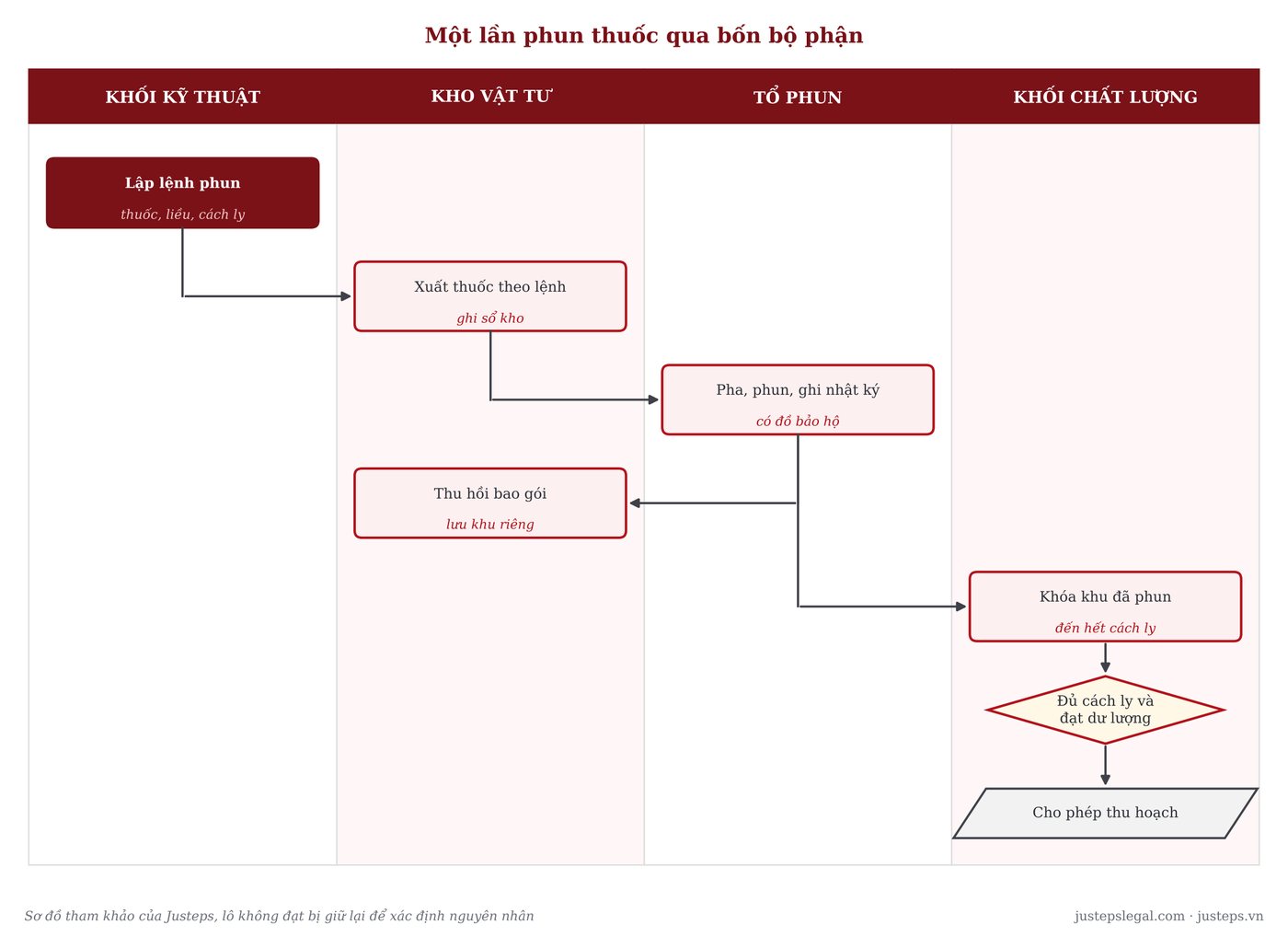
The flow for managing a spraying operation through four units until the lot may be harvested
Under this flow, the technical division issues a spraying order stating the product, dosage and pre-harvest interval, and the store releases chemicals only against an order and records the issue in the store ledger. The spraying team mixes and sprays, records the diary and returns the packaging to a separate storage area, while the quality division locks the sprayed beds or net house sections until the pre-harvest interval has elapsed. A lot may be harvested only after passing two checkpoints, namely a sufficient pre-harvest interval according to the diary and residue test results meeting the market’s requirements; a lot that fails is held back so that the cause can be identified. Used plant protection product packaging must be collected and treated in accordance with regulations issued by the Minister of Agriculture and Environment, so the regulations must specify where it is stored and which unit receives it for treatment[3].
Common mistakes when farms build their own procedures
When farm records are reviewed before standardisation, the most common errors are usually found in the production diaries rather than in the equipment. The chart below illustrates the share of the groups of errors frequently encountered.
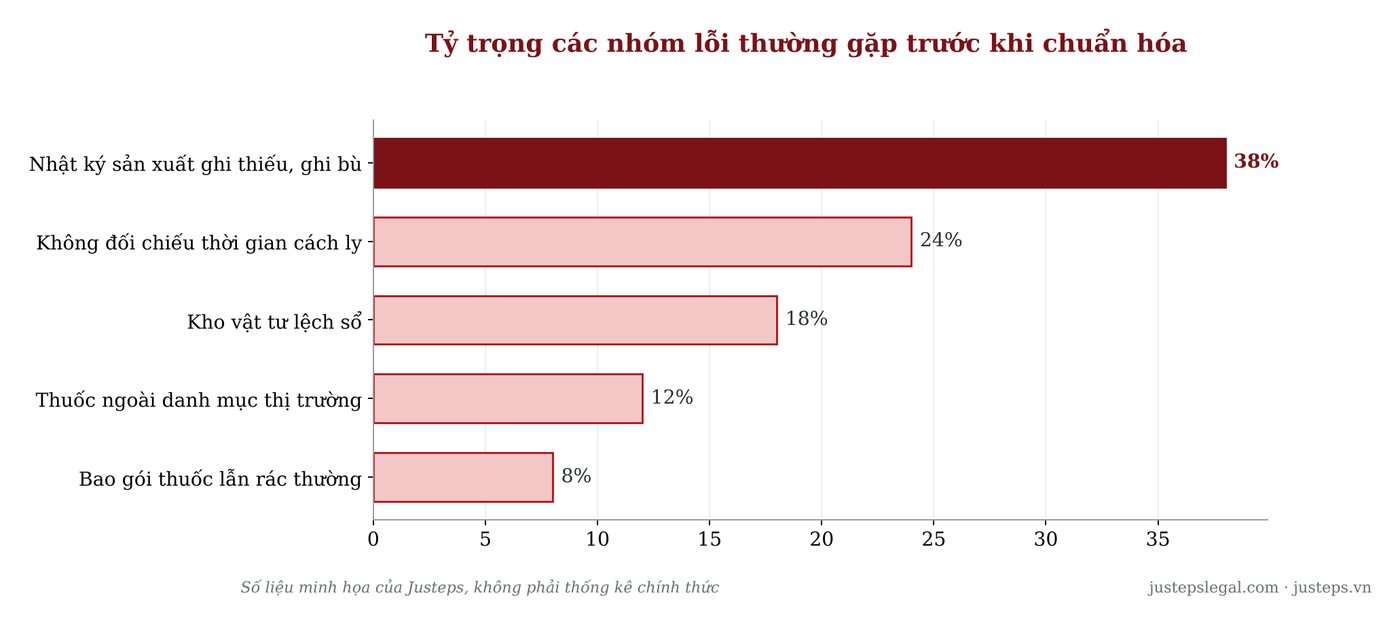
Illustrative share of the groups of errors in farm records before standardisation
Diaries left incomplete or filled in retrospectively several days later account for the largest share, because the forms are usually designed for the office rather than for someone standing outside a net house. The second largest error is failing to check the pre-harvest interval before picking, followed by discrepancies in the input store records and the use of chemicals not on the importing market’s list. In addition, many businesses apply one generic farming procedure to every crop without specific parameters and have no regulations at all on varieties and trial results.
Generic procedures without parameters
A procedure that merely says to fertilise periodically and water until moist does not help a new worker. Justeps requires every procedure to contain measurable parameters for each stage, such as the concentration of the nutrient solution, the temperature threshold for switching on fans and the volume of water per irrigation, and to state clearly who may adjust the parameters when the weather changes.
No regulations on varieties and research results
Businesses propagate plants bought from abroad or from other suppliers without checking whether the variety is under protection. Rights to plant varieties are protected under the Law on Intellectual Property, so propagation for commercial purposes may require the permission of the holder of the protection title[4]. Conversely, varieties or formulas developed by the business’s own engineers need to be confirmed as belonging to the business in the employment contract and the confidentiality agreement.
Cameras monitoring workers without any regulation
Many farms install cameras in net houses, barns and stores to control how work is done. Images recording employees are personal data, so the business needs to give notice of the purpose, scope, retention period and persons with access, and include this content in its regulations[5].
Regulations on linkage with cooperatives and households
A business that buys the entire output of a linked growing area bears quality risks similar to those of its own farms, because customers do not distinguish where a lot comes from. The internal linkage regulations set out how the area officer checks households’ diaries, when samples are taken, how inputs are supplied and how cases of households using chemicals outside the permitted list are handled. This content must be consistent with the linkage contracts signed with cooperatives or households, which have their own policy framework for cooperation and linkage in the production and sale of agricultural products[6]. If the contract allows the business to reject a lot but the regulations do not specify how samples are taken, how the record is made and the notice period, a rejection can easily turn into a dispute with the household.
Implementation sequence and deliverables
A typical project takes about eleven weeks, most of which is spent drafting together with the technical team and piloting through one harvest or one batch of livestock sent to market.
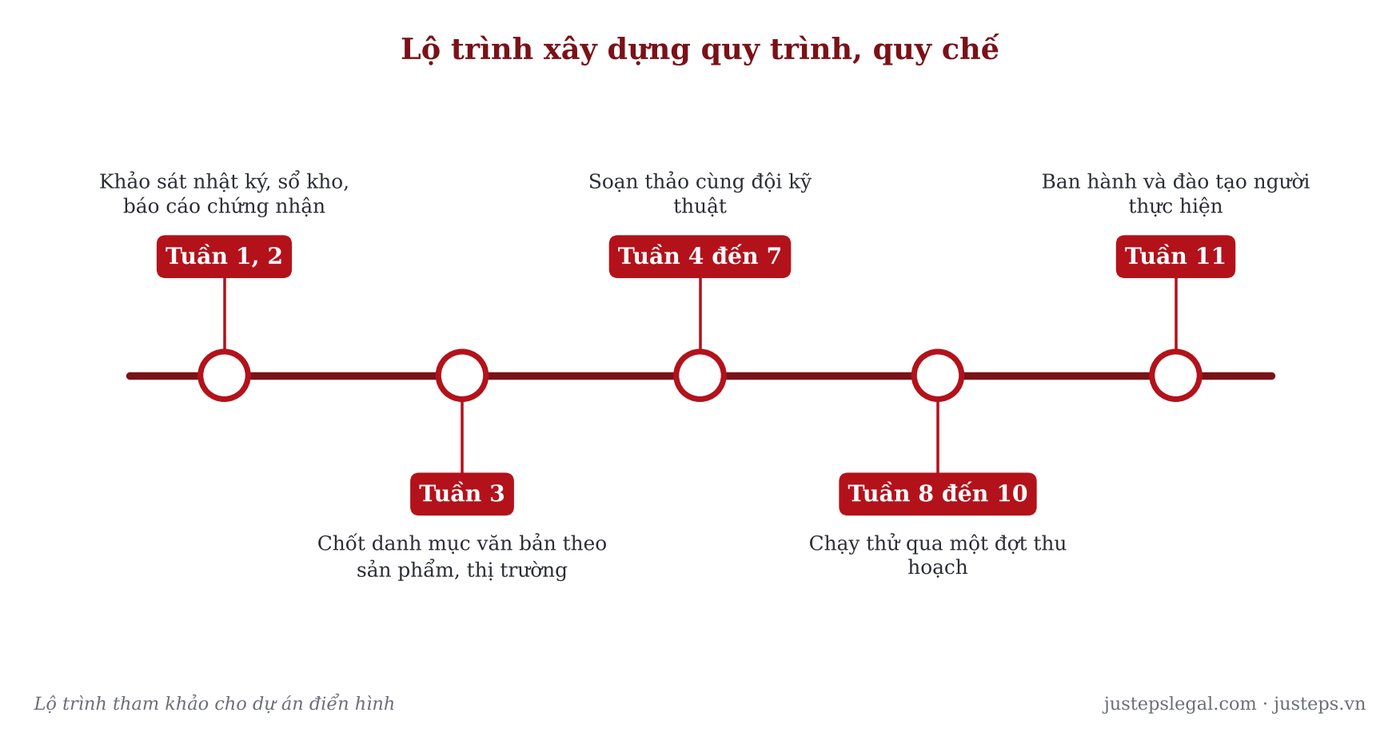
Eleven-week roadmap for building the farm’s procedures and regulations
In the first two weeks, Justeps consultants compare the production diaries, store ledgers and the latest certification audit report with actual practice on the farm. In week three, Justeps and the leadership settle the list of documents by crop, livestock and market, and then draft in parallel with the technical team so that the parameters are checked by the people who actually do the work. The drafts are piloted through one season before issue, and the final week is devoted to training team leaders, storekeepers and spraying workers. The deliverables comprise the following documents:
- A list of the internal document system with codes, versions and lead units.
- Standard farming or livestock procedures for each product, with diary forms designed to be completed on the spot in the field.
- Regulations on plant protection products, veterinary drugs, fertilisers, input stores and waste treatment.
- Procedures for harvesting, preliminary processing, packing and traceability with flowcharts, including a separate section on growing area code files.
- Regulations on varieties, research and confidentiality, and regulations on linkage with households.
- A draft issuing decision and training materials for each group of people carrying out the procedures.
The set of regulations works best when each document has a clearly designated lead position, so a business that has not yet finalised its organisation can combine this work with the organisational structure design service for high-tech agriculture businesses so that both sets of documents share one authority matrix.
Application by size and fee
A small farm should start with four documents, namely the chemical regulations, the production diary, the input store and traceability, and add others gradually. A business with several farms needs common procedures for the whole system and a mechanism for cross-checks between farms, while a large-scale livestock farm focuses on biosecurity, veterinary care and waste. A fruit exporting business needs separate procedures for growing area codes, packing facilities and quarantine files, and a business located in a high-tech agricultural zone also needs to check the rules of the zone management board. When sector-specific regulations change, the updating of regulations can be carried out under the ongoing legal advisory service for high-tech agriculture businesses.
Justeps quotes a fixed fee in writing once the list of documents has been agreed. The factors involved include the number of product types and farms, how complete the existing certification records are, the number of export markets with different lists of permitted chemicals, any need for bilingual documents and whether Justeps closely supports the pilot through one season. The proposal sets out the scope, deliverables, timeline and matters outside the scope so that the business can plan its budget.
How Justeps can help
Alongside building internal procedures and regulations, high-tech agriculture businesses and farms may combine the following Justeps services:
- Organisational structure design for high-tech agriculture businesses and farms. Justeps organises the production, technical, quality and post-harvest divisions and allocates authority over decisions on chemical use and lot release.
- Ongoing legal advisory for high-tech agriculture businesses and farms. Justeps monitors changes in sector-specific regulations and updates regulations and linkage contracts when needed.
- Intellectual property and trade mark protection. Justeps advises on protecting trade marks for agricultural products and the rights relating to plant varieties and trade secrets.
- In-house training. Justeps trains team leaders, storekeepers and spraying workers on the newly issued regulations.
Frequently asked questions
Does a farm that already holds VietGAP certification still need internal regulations?
Yes. Certification confirms that the farm met the standard at the time of assessment, whereas regulations set out who does what each day, who is responsible and how breaches are handled. Records kept under the regulations are also the basis for the next reassessment.
How must used plant protection product packaging be handled?
Packaging must be collected, stored separately and handed over to a unit authorised to treat it in accordance with the regulations of the Ministry of Agriculture and Environment[3]. The regulations should specify the storage area, the person signing the handover record and how often it is removed.
May a business propagate plants bought from abroad?
This depends on the protection status of the variety and the terms of the purchase contract. For a protected variety, propagation for commercial purposes usually requires the permission of the holder of the protection title[4].
Who owns the procedures developed by engineers?
They usually belong to the business if they were created in the course of performing assigned duties. To avoid disputes, the employment contract and the confidentiality agreement should clearly state ownership of results and the duty of confidentiality after the engineer leaves.
Does a small farm need every regulation?
Not immediately. A small farm should give priority to the chemical regulations, production diary, input store and traceability, and add the rest when it expands or begins to export.
How often should procedures be reviewed?
Justeps recommends a review after each season or each year, and immediately when the importing market’s list of chemicals changes, when varieties change or when new equipment is installed. Each amendment should update the version number and be followed by retraining of the people concerned.
Related articles
- Building internal financial regulations for a limited liability company, spending limits, approvals, advances and settlement
- A minimum set of internal governance regulations for businesses with 50 to 200 staff
- Contract lifecycle management in small and medium-sized enterprises
- Converting an agricultural processing cooperative into an enterprise, choosing a suitable model and reorganising the management structure
Notes
[1] Point dd of Clause 1 of Article 55 of the Law on Animal Husbandry No. 32/2018/QH14 dated 19 November 2018, as amended and supplemented by Law No. 146/2025/QH15 dated 11 December 2025.
[2] Article 64 of the Law on Crop Production No. 31/2018/QH14 dated 19 November 2018, as amended and supplemented by Law No. 146/2025/QH15 dated 11 December 2025; Government Resolution No. 36/2026/NQ-CP on simplifying administrative procedures for growing area codes and packing facility codes.
[3] Article 75 of the Law on Plant Protection and Quarantine No. 41/2013/QH13 dated 25 November 2013, as amended and supplemented by Law No. 146/2025/QH15 dated 11 December 2025.
[4] The Law on Intellectual Property No. 50/2005/QH11, as amended and supplemented, most recently by Law No. 131/2025/QH15 dated 10 December 2025, provisions on rights to plant varieties.
[5] The Law on Personal Data Protection No. 91/2025/QH15 dated 26 June 2025, effective from 1 January 2026, and Decree No. 363/2026/ND-CP.
[6] Government Decree No. 98/2018/ND-CP dated 5 July 2018 on policies to encourage cooperation and linkage in the production and sale of agricultural products.
This article is for reference and reflects the regulations in force at the time of publication. Please consult Justeps for advice tailored to your company’s records and situation.
For further information, please contact:
📩 Email: info@justeps.vn
🌐 Website: https://justepslegal.com · https://justeps.vn
🌐 Page: Justeps
☎️ Hotline (Zalo): 096 172 2607
📍 Thanh Xuan Office: 12th Floor, Licogi 13 Tower, 164 Khuat Duy Tien Street, Thanh Xuan Ward, Hanoi, Vietnam
📍 Ha Dong Office: LK06B, No.10, Dong Dua Area, Ha Dong Ward, Hanoi, Vietnam
📍 Ho Chi Minh City Branch: 528 Le Van Sy, Ho Chi Minh City, Vietnam
📍 Hai Phong Office: Truong Thinh Village, Ha Dong Commune, Hai Phong, Vietnam
📍 Quang Ninh Office: Van Don Special Zone, Quang Ninh Province, Vietnam





