
Key takeaways
- The most valuable controls should sit before the contract is signed, because at that point the business can still refuse a product, a counterparty or delivery terms without owing compensation to anyone.
- A standard tariff code list with a named approver keeps declarations consistent, and declaring differently from a classification result already notified by the customs authority may be treated more severely than an ordinary error[3].
- Customs files must be kept for five years[5] while accounting documents must usually be kept for ten years[6], so the retention rules need to define a standard shipment file, who keeps it and where, rather than leaving it in personal mailboxes.
- From 1 March 2027, a post-clearance audit may last up to forty days[9], so the business needs a ready procedure for gathering documents and providing explanations before it receives an audit decision.
In most import-export businesses, knowledge of how to declare a product, how to apply for a certificate of origin or how a bank examines a document set exists only in the heads of a few long-serving employees. When such a person leaves, when the business takes on new products or switches to a different customs broker, the same product starts to be declared in several ways and errors gradually accumulate on cleared declarations. Written regulations turn personal experience into common rules, with a person responsible and records available to provide explanations when the customs authority raises questions.
This page introduces Justeps’ service of building internal procedures and regulations for import-export trading businesses, following the sequence of a shipment from before the contract is signed until the file is archived and may be audited again. It does not revisit the division of functions and allocation of authority, which falls under the organisational structure design service for import-export trading businesses, but focuses on how each position works, which forms it uses and what evidence it keeps.
What the regulations of an import-export business cover
Justeps does not draft one thick rulebook for everything but divides the regulations into short documents, each linked to one risk and one main user. This division means documentation staff only need to open their own procedure when working on a shipment, and allows the business to amend each document individually when the tariff schedule or product policies change. The table below sets out the core set of documents Justeps usually proposes for a medium-sized business.
| Document | Main content | Main user |
|---|---|---|
| Pre-contract controls | Checking product policies, licences, specialised inspection and counterparty screening. | The salesperson prepares the form and trade compliance approves it. |
| Tariff codes, value, origin | The standard tariff code list, the list of items to be added to customs value and origin records. | The trade compliance function and the head of documentation. |
| Customs procedures | Sending data to the broker, checking the draft declaration and handling document or physical inspections. | The documentation officer responsible for the shipment. |
| International payments | Checking letters of credit, presented documents, foreign currency and records supporting the 0% rate. | The international payments officer and the accountant. |
| Cargo claims | Recording shortages and damage and notifying the seller, the carrier and the insurer within time limits. | The warehouse, purchasing and sales functions. |
| Archiving and audits | The standard shipment file, retention periods, supplementary declarations and responses to post-clearance audits. | The head of documentation and the chief accountant. |
Controls before the contract is signed
Justeps places the most important control steps before the foreign trade contract is signed. If the business only discovers after signing that the product requires a licence, specialised inspection or a certificate of origin on import, it may fail to deliver on time, have to keep goods in storage for a long period and be charged contractual penalties by the counterparty. The law on foreign trade management provides for management measures by product and market, such as prohibitions, licences, conditions, quotas and trade remedies[1], so the control form must ask exactly these questions for each tariff code.
The pre-contract control form, prepared by the salesperson, includes a description of the goods, the expected tariff code, the country of origin, the Incoterms delivery terms, the payment terms and full information on the counterparty and the end consignee. The compliance function checks the counterparty against the sanctions lists applied by the business’s bank and the counterparty’s bank, because a transaction held up by a bank can block the entire cash flow of the shipment. Goods with potential military use or shipped through an unusual intermediate country are referred to the general director for a decision, together with the written opinion of the compliance function.
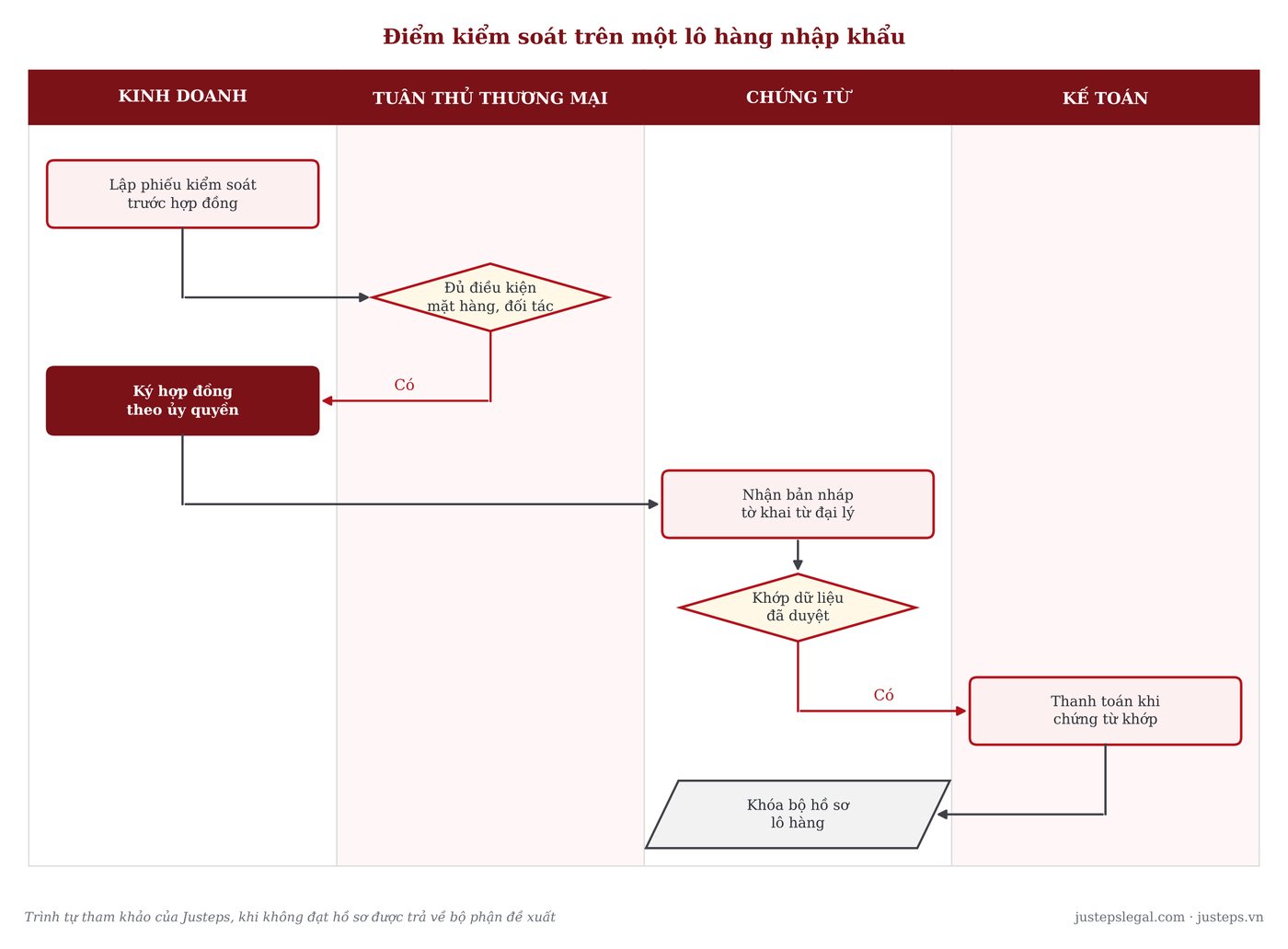
Control points on an import shipment from the proposal form to the archived file
Under this sequence, an import shipment passes through four functions and two stop points. The first stop point is the pre-contract control form, where the compliance function may return the file to sales if the product or counterparty does not yet meet the conditions. The second stop point comes after the broker sends the draft declaration, when the documentation officer checks the tariff code, customs value and origin documents against the approved data before allowing transmission. The accountant only pays the seller when the contract, declaration, commercial invoice and transport documents match one another.
The standard tariff code list and classification records
The most common error Justeps finds in reviews is the same product being declared under several different tariff codes, depending on who handles it or which broker is used. The regulations need a standard tariff code list for every product the business trades, with the technical description, basis for classification, applicable tax rate and name of the person who approved it. Documentation staff may only use codes on the list, and a new product must go through the procedure for adding it to the list before its first shipment is declared.
For products open to more than one interpretation or of high value, the regulations should set the conditions under which the business requests an advance ruling on the tariff code from the customs authority, with the declarant providing information, documents and samples for this purpose[2]. Every advance ruling, classification notice or audit conclusion relating to tariff codes must be entered on the list immediately, because continuing to declare differently from these documents may be treated as tax evasion rather than a mistaken declaration[3]. The list is reviewed whenever the tariff schedule or the goods nomenclature changes.
Customs value and the items to be added
The dutiable value of imported goods is often higher than the price stated on the commercial invoice. Depending on the delivery terms and the content of the contract, the business must consider adding transport costs, international insurance, royalties or licence fees connected with the imported goods, selling commissions, indirect payments to the seller and the value of goods and services supplied free of charge by the buyer to the seller[4]. A common case is a purchase contract on FOB terms where the declaration does not add freight and insurance, or a business that pays trade mark fees to its parent company without anyone linking this payment to the imported goods.
Justeps drafts a customs value checklist for each new purchase contract, completed once by the compliance function and attached to the contract file. The checklist asks specific questions about the delivery terms, any special relationship between buyer and seller, payments outside the invoice and price adjustments after delivery. Where the final price cannot be determined at the time of declaration, the regulations name the person who monitors the matter so that a supplementary declaration is made on time once the official price is known.
Origin and supporting records
For imported goods, a valid proof of origin determines whether the special preferential tax rate under free trade agreements can be applied, so the regulations need a step to check the form, signatures, origin criteria and validity of the document before declaration. For exported goods, obtaining the certificate is not the end of the process. The business must keep records proving that the goods meet the rules of origin, including invoices for the purchase of materials, supplier declarations, norms and production processes, because the competent authority of the importing country may request verification many years later[1].
Trading businesses exporting goods sourced in Vietnam face a particular difficulty, as the material records are held by the manufacturer rather than by the business. Justeps’ purchasing regulations therefore require the supplier to undertake in the purchase contract itself to provide origin records, together with an obligation to cooperate when verification is requested. For goods exported to a market conducting a trade remedy investigation, the regulations add a step to check the origin of the main materials to avoid being regarded as circumventing the measure.
The shipment file, archiving and tax records
The customs declarant must keep customs files for cleared goods for five years from the date the declaration is registered[5], while accounting documents used for bookkeeping and preparing financial statements must usually be kept for at least ten years[6]. In practice, the documents for a shipment are scattered across salespeople’s mailboxes, the customs broker’s system, the shipping line’s portal and the bank. The retention rules define a standard shipment file and specify who assembles it, when the file is closed, how files are named and where they are kept.
The standard file for exported goods must be sufficient to prove the conditions for applying the 0% VAT rate, including the contract, the customs declaration and proof of payment through a bank[7], together with electronic invoices issued in accordance with current rules[8]. Before closing the file, the accountant matches the amount received in the account against the contract and declaration, recording any differences due to bank charges or price adjustments. A file that is complete from the moment it is closed spares the business from having to look for documents again when applying for a tax refund or when audited.
Reviews of sample files usually show that archiving is the largest category of errors, even though few people notice it until explanations are required. The chart below is an example of the results of a Justeps review of 120 declarations at a business that imports materials and exports processed agricultural products.
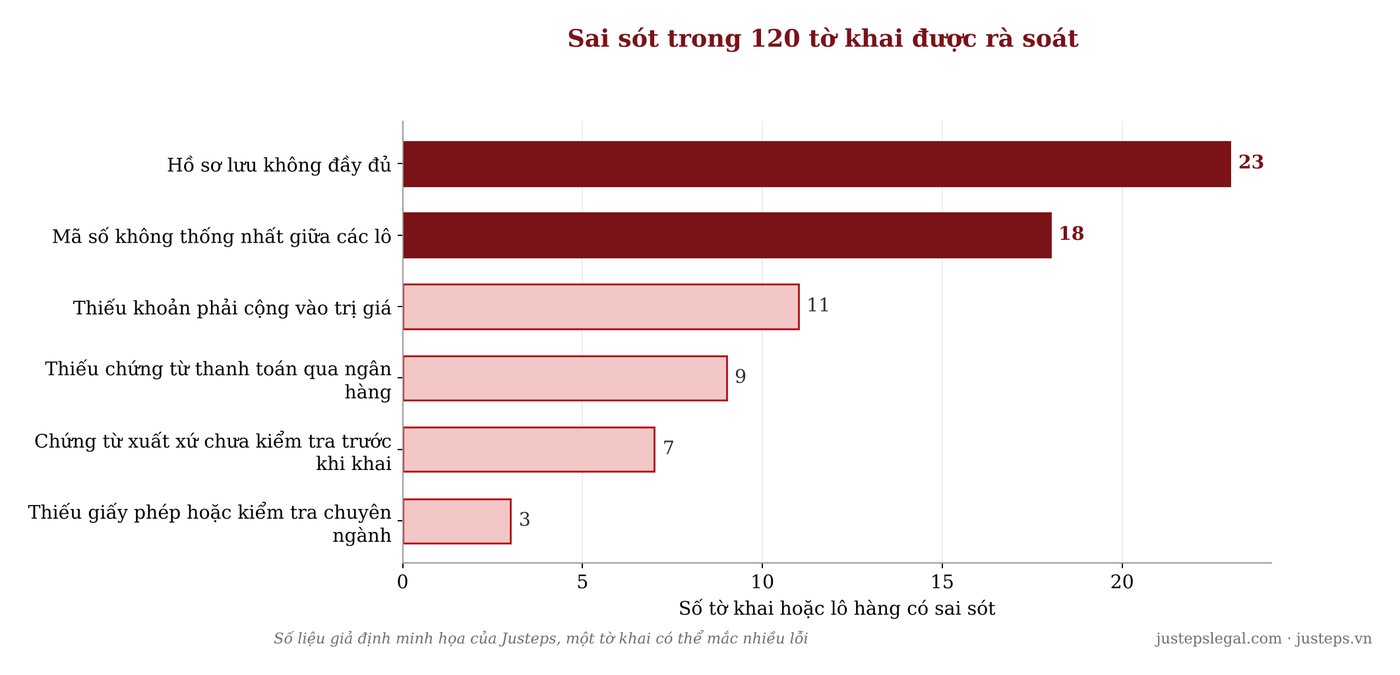
Example number of declarations with errors by category among 120 declarations reviewed
In the example, 23 declarations had incomplete archived files, 18 used tariff codes inconsistent with other shipments of the same product and 11 omitted items that should have been added to customs value. In addition, 9 export shipments lacked appropriate proof of payment through a bank, 7 declarations had origin documents that were not checked before declaration and 3 shipments lacked a licence or specialised inspection result. One declaration may contain several errors, so the total number of errors exceeds the number of declarations with problems. Justeps uses these results to decide the order in which regulations are drafted, giving priority to categories with both many errors and tax consequences.
Supplementary declarations and responding to post-clearance audits
When a review uncovers errors on cleared declarations, the business should assess them early and consider making a supplementary declaration within the permitted period. Under the new penalty rules in the customs sector, certain cases of self-adjusting customs value or making a supplementary declaration on time, as well as incorrect declarations that do not change the tax payable, may be considered for exemption from penalties subject to specific conditions[3]. The regulations need to specify who may decide on a supplementary declaration, who recalculates the tax and late payment interest, and who reports to the board of directors.
For post-clearance audits, the law amending the Law on Customs provides that from 1 March 2027 an audit may not exceed twenty days from the date the decision is announced and may be extended once by no more than twenty days for complex cases[9]. Time spent working with the audit team may therefore be longer than before, so Justeps’ response procedure specifies the point of contact, the list of documents to be gathered for each declaration named in the decision, how opinions are recorded in the minutes and how daily reports are made to the board of directors. Where the business needs an opinion on the grounds for its explanations or for a complaint against the conclusion, this is handled under the ongoing legal advisory service for import-export trading businesses.
Timeline, deliverables and fees
A typical project takes about nine weeks. In the first two weeks, Justeps reviews sample shipment files from the last one to two years and interviews the sales, documentation and accounting functions; in the third week it presents an error report so that management can choose priorities. From the fourth to the seventh week, Justeps drafts the regulations and works with the documentation function to build the standard tariff code list from the technical documents of each product, in the eighth week the rules are piloted on real shipments, and in the final week they are issued and staff are trained. The deliverables comprise the following documents:
- A report reviewing sample shipment files, setting out errors and the level of risk in each category.
- The set of regulations and procedures following the core document table, with a diagram of control points.
- A standard tariff code list with the basis for classification and the approver.
- Customs value and origin checklists and the pre-contract control form.
- A template shipment file, naming rules and retention periods.
- Guidance on supplementary declarations and the procedure for responding to post-clearance audits.
Justeps quotes a fixed project fee in writing after the initial meeting. The fee depends on the number of products and tariff code groups, the number of markets and free trade agreements in use, the number of declarations to be reviewed, the need for bilingual documents and whether the business needs support in assessing supplementary declaration options for declarations where errors have been found. A small business may start with three documents on tariff codes, customs value and archiving, then add the remaining documents as shipment volume grows.
How Justeps can help
In addition to internal procedures and regulations, import-export trading businesses can combine the following Justeps services:
- Organisational structure design for import-export trading businesses. Justeps identifies the position holding each control point before the regulations assign tasks to those positions.
- Ongoing legal advisory for import-export trading businesses. Justeps updates the regulations when tariff schedules, trade agreements or product policies change and provides support during audits.
- Drafting and reviewing commercial contracts. Justeps builds obligations to provide origin records, delivery terms and price adjustment mechanisms into purchase and sale contracts.
- Internal financial control system. Justeps connects the import-export regulations with the accounting steps for matching, payment and closing the books.
- Tax, customs and international trade. Justeps gives in-depth opinions on classification, customs value and tax refund files for difficult products.
Frequently asked questions
Should we request an advance ruling on tariff codes from customs?
This is worth considering for new products, high-value goods or goods whose code is open to more than one interpretation. The notice of the advance ruling is valid as a basis for the customs authority to carry out procedures[2] and helps the business declare consistently for later shipments.
What should we do if we find that old declarations were incorrect?
The business should immediately assess the tax difference, the number of declarations affected and the time remaining for a supplementary declaration. Declaring early usually limits late payment interest and may fall within the cases considered for exemption from penalties[3].
May shipment files be kept electronically?
Yes, provided that integrity and retrievability are ensured and someone is responsible for managing them. Original documents that the law requires in paper form must still be kept, and retention periods differ between customs and accounting, so the regulations should state each type clearly.
Who is responsible when the customs broker makes an incorrect declaration?
The owner of the goods still bears the tax obligations before the customs authority, while the relationship with the broker is governed by the service contract. The regulations therefore need a step to check the draft declaration before transmission.
Do regulations help clear goods faster?
They have an indirect effect. Files prepared correctly from the outset are less often subject to requests for additional documents, and a good compliance history over many years is a basis for the business to receive more favourable risk management treatment.
How often should the regulations be updated?
As soon as the tariff schedule, the list of goods subject to specialised management or a trade agreement changes, or the business opens a new product line or market, with a comprehensive review once a year. The law amending the Law on Foreign Trade Management, effective from 1 July 2027, is one milestone that calls for a review[1].
Related articles
- Organisational structure design for import-export trading businesses by order flow and control point
- Ongoing legal advisory for import-export trading businesses on contracts, payments and customs
- Labour, wages and social insurance services for import-export trading businesses with commissions and foreign employees
- Internal procedures and regulations for logistics, warehousing and freight transport businesses
Notes
[1] The Law on Foreign Trade Management and the documents amending and supplementing it, including the Law amending and supplementing a number of articles of the Commercial Law, the Law on Competition, the Law on Foreign Trade Management and the Law on Consumer Rights Protection, passed by the National Assembly on 13 November 2026.
[2] Article 28 of the Law on Customs No. 54/2014/QH13 dated 23 June 2014, as amended and supplemented by subsequent laws, most recently Law No. 11/2026/QH16 effective from 1 March 2027.
[3] Government Decree No. 169/2026/ND-CP dated 15 May 2026 on penalties for administrative violations in the customs sector, effective from 1 July 2026, replacing Decree No. 128/2020/ND-CP.
[4] The Law on Export Duties and Import Duties No. 107/2016/QH13 dated 6 April 2016 and the documents amending and supplementing it, together with the guiding documents on customs value.
[5] Point dd, Clause 2, Article 18 of the Law on Customs No. 54/2014/QH13 dated 23 June 2014, as amended and supplemented by subsequent laws, most recently Law No. 11/2026/QH16 effective from 1 March 2027.
[6] Article 13 of Government Decree No. 174/2016/ND-CP dated 30 December 2016 detailing a number of articles of the Law on Accounting.
[7] The Law on Value-Added Tax No. 48/2024/QH15 and Article 17 of Government Decree No. 181/2025/ND-CP dated 1 July 2025, together with the documents amending and supplementing them.
[8] Government Decree No. 254/2026/ND-CP dated 30 June 2026 on electronic invoices and electronic documents, effective from 1 July 2026.
[9] Article 79 of the Law on Customs No. 54/2014/QH13, as amended by Law No. 11/2026/QH16, effective from 1 March 2027.
This article is for reference and reflects the regulations in force at the time of publication. Please consult Justeps for advice tailored to your company’s records and situation.
For further information, please contact:
📩 Email: info@justeps.vn
🌐 Website: https://justepslegal.com · https://justeps.vn
🌐 Page: Justeps
☎️ Hotline (Zalo): 096 172 2607
📍 Thanh Xuan Office: 12th Floor, Licogi 13 Tower, 164 Khuat Duy Tien Street, Thanh Xuan Ward, Hanoi, Vietnam
📍 Ha Dong Office: LK06B, No.10, Dong Dua Area, Ha Dong Ward, Hanoi, Vietnam
📍 Ho Chi Minh City Branch: 528 Le Van Sy, Ho Chi Minh City, Vietnam
📍 Hai Phong Office: Truong Thinh Village, Ha Dong Commune, Hai Phong, Vietnam
📍 Quang Ninh Office: Van Don Special Zone, Quang Ninh Province, Vietnam





