
Key takeaways
- Most insurance disputes arise from the way contracts are sold and handled, because the insurer must prove that it fully explained the exclusion clauses and that the policyholder confirmed them[1].
- For unit-linked insurance, the sales procedure must include a step recording the advice given when the policyholder signs the insurance application and a step in which the insurer checks the sale again before issuing the contract[5].
- The claims procedure should be designed backwards from the statutory deadline, because unless the contract provides otherwise the insurer must pay within fifteen days of receiving a complete and valid file[4].
- The fraud prevention regulation should sit inside the claims procedure and run before the approval step, rather than being a separate document used only after payment has been made.
When a customer complains of having been introduced to a unit-linked insurance product as if it were a savings deposit, the first question asked by the regulator and by the business itself does not concern the terms of the contract. The question is whether the business has kept evidence of what the adviser said, what the customer confirmed and who checked the sale again before the contract was issued. Internal procedures and regulations are where that evidence is created, and they are also the basis on which the business proves that it controls the activities of its agents and staff.
This page introduces Justeps’ service of building internal procedures and regulations for life, non-life and health insurance businesses and for organisations acting as insurance agents. It follows the life cycle of an insurance contract, from product design, advice and conclusion of the contract and the free-look period through to claims, fraud prevention, agency management and the protection of customer data. Organising the structure and arrangements for the channel force fall outside the scope of this page.
Legal obligations that regulations must turn into operating steps
The Law on Insurance Business requires exclusion clauses to be clearly stated in the contract, fully explained and confirmed by the policyholder[1]. When concluding a contract, the insurer and its agents must provide complete and truthful information about the product, while the policyholder is obliged to declare the insured subject matter truthfully[2]. These two obligations only carry weight when they are recorded, so the sales procedure must specify the questionnaire form, how exclusions are explained, the confirmation signature and where each document is stored.
For contracts with a term of more than one year, the policyholder has twenty-one days from receipt of the contract to decide whether to withdraw and receive a refund of premiums paid, less reasonable costs if any[3]. Unless the contract provides for a different period, the insurer must pay the sum insured or compensation within fifteen days of receiving a complete and valid file, and late payment attracts interest[4]. These are deadlines that the contract management system must count and flag automatically, rather than leaving each officer to remember them.
For unit-linked insurance, Circular No. 67/2023/TT-BTC requires agents to record the advice given when the policyholder signs the insurance application, including details of the agent, benefits, investment risks, premium level, premium payment term and free-look period, and also requires a questionnaire assessing the policyholder’s financial capacity[5]. Circular No. 96/2026/TT-BTC adds further requirements on premium allocation, advance notice before changing premium levels and responsibility for monitoring the quality of agents’ advice[6]. In addition, life insurers are subject to anti-money laundering obligations[7], and customers’ health data falls within the category of sensitive personal data under the Law on Personal Data Protection[8].
Where the risks are concentrated
Not every procedure carries the same level of risk, so Justeps sets the drafting order by risk level rather than by the department chart. The figure below assesses each stage against three types of consequence that insurance businesses commonly face, namely mass complaints, administrative penalties and direct financial loss.
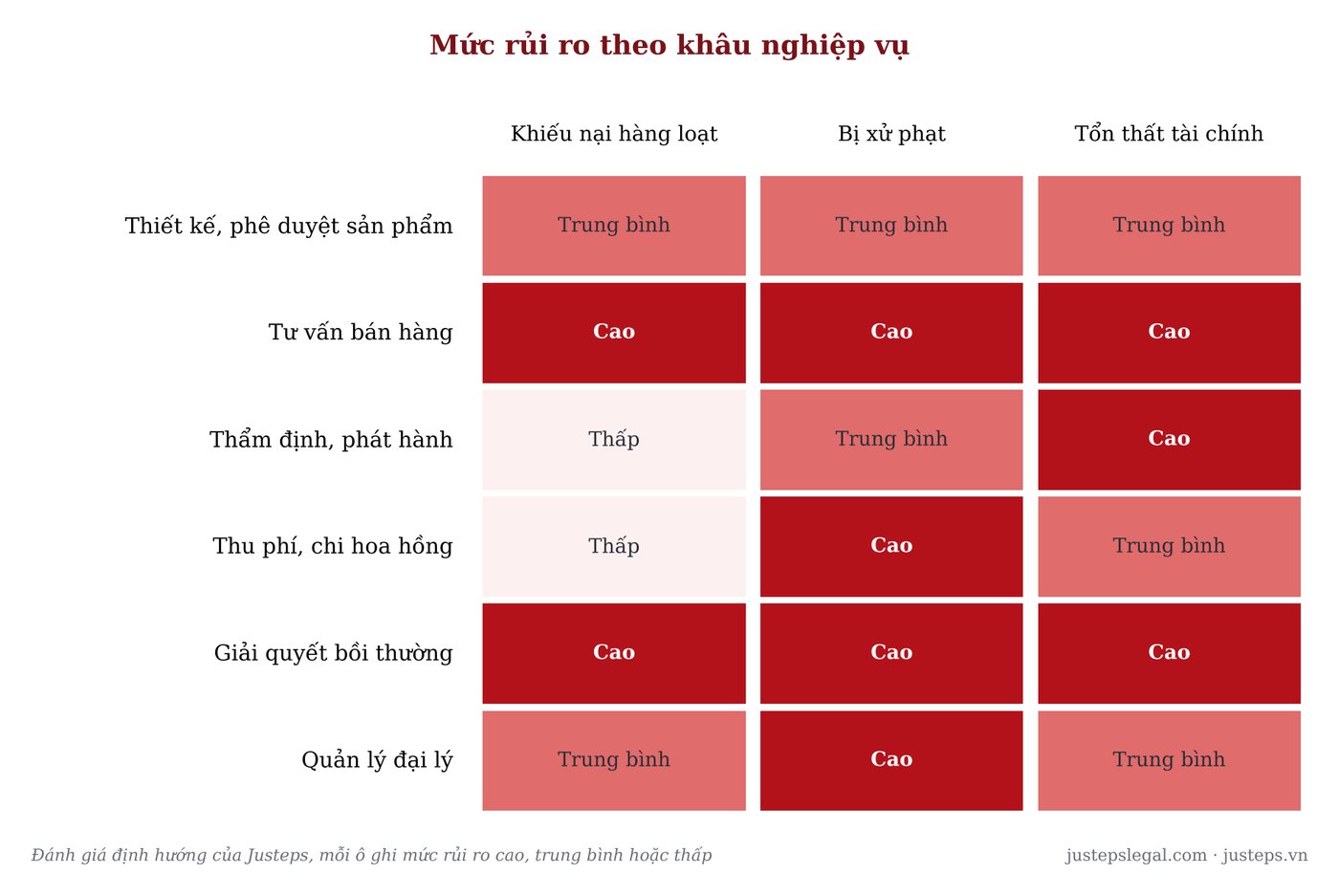
Risk level at each operational stage of an insurance business
Sales advice and claims settlement are the two stages with high risk across all three types of consequence, because both directly determine whether customers feel they have been treated fairly. Underwriting and policy issuance mainly lead to financial loss when risks are accepted too easily, while premium collection and commission payments cause few complaints but readily attract penalties if maximum rates are exceeded or agents are allowed to hold premiums for too long. From this assessment, the business knows which documents to issue first and where to concentrate its review resources.
Common shortcomings in existing sets of regulations
The first shortcoming is a claims procedure without criteria for applying exclusion clauses, so that two identical files receive different outcomes depending on who handles them, and rejection letters do not state specific grounds. The second is an agency regulation that sets out recruitment and sales targets in detail but deals only briefly with monitoring advice quality, discipline and termination of agency contracts, even though the law requires the business to manage and train its agents and allow them to sell only products on which they have been trained[9]. The third is that the insurer and the corporate agent, particularly a bank, each have their own procedure, leaving gaps as to who assesses needs, who keeps the recording and who calls the customer to confirm the sale.
The fourth shortcoming is a fraud prevention regulation separated from the claims procedure, so that signs of fraud are usually detected only after money has been paid out. For the bancassurance channel, the procedure must also ensure that the credit institution does not tie the sale of non-compulsory insurance to the provision of banking services[10] and complies with the restrictions on when unit-linked insurance may be offered around the loan disbursement date under the guidance of the Ministry of Finance. These points need to be written as specific checks in the joint procedure between the two parties, together with the insurer’s right to inspect the point of sale.
Redesigning the claims procedure
The claims procedure is where Justeps usually makes the most changes, because it is the stage customers experience most directly and also the one inspected most often. The principles are to separate the loss assessor from the approver, screen for signs of fraud before approval, delegate authority by value threshold and always send a written explanation of the reasons when rejecting a claim in whole or in part. The flow below illustrates how those principles fit into a single procedure.
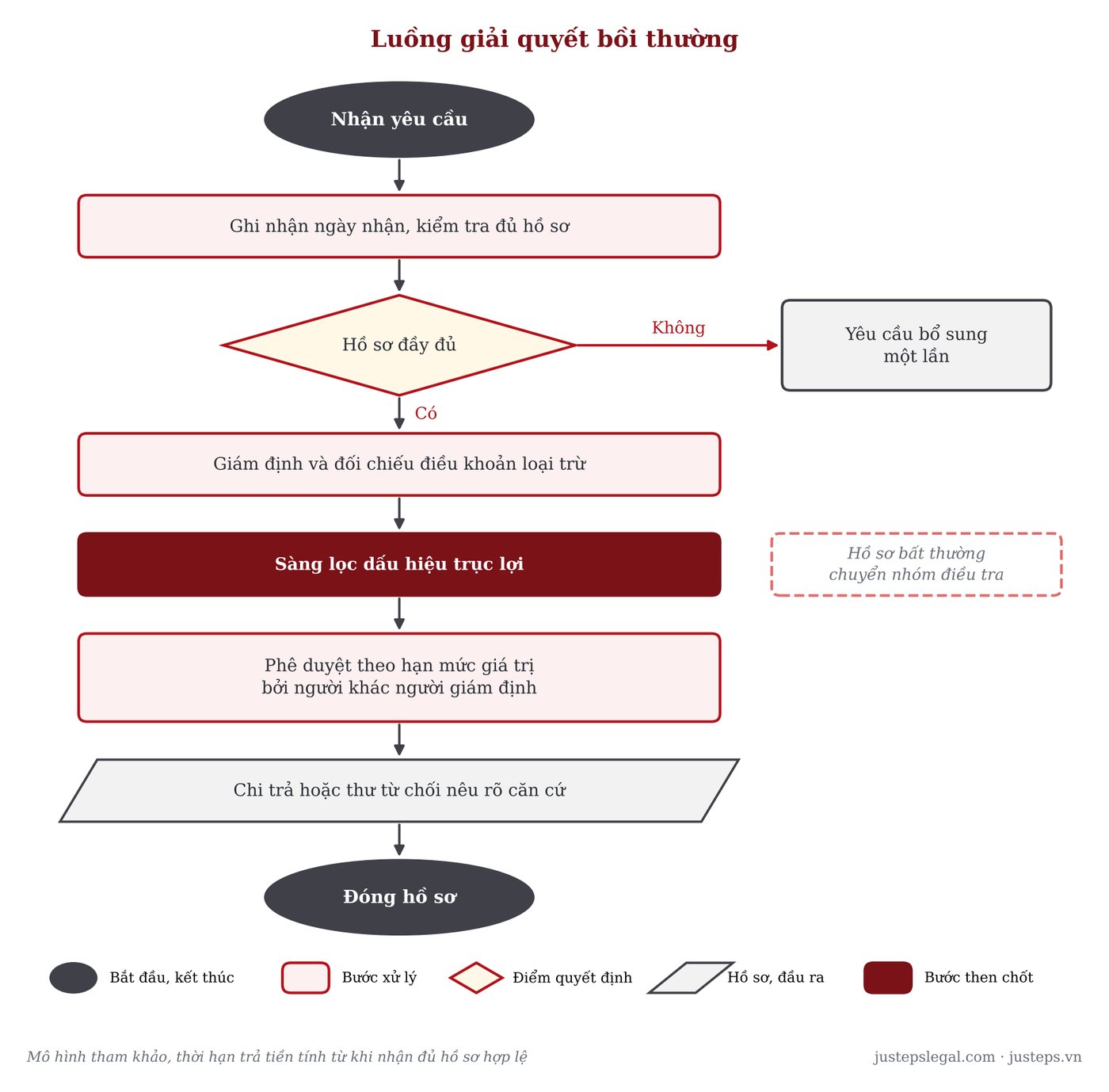
Claims handling flow with fraud screening before approval
Files are checked for completeness on receipt, because the fifteen-day deadline only starts once the business has received a complete and valid file, so every request for additional documents must be sent at once and have a clearly recorded date. Files showing irregularities are passed to the fraud investigation team before reaching the approval step, while ordinary files go straight to the approver at the relevant threshold. The policyholder has one year from the date of the insured event to submit a claim[11], so the procedure should also set out how to handle files submitted late for objective reasons.
Deliverables and how the work is carried out
Justeps begins with a list of mandatory documents by licence type and line of business, then reads the complaint files from the past year and the inspection conclusions to find the real weaknesses. A full project for an insurance business usually takes around twelve weeks, of which the first four are spent surveying and mapping the procedures currently running on the policy administration and claims systems. Before issuance, the new procedures are trialled on real files to test deadlines and forms, after which Justeps trains the agency and bancassurance channels. The table below summarises the main groups of documents.
| Document group | Main content |
|---|---|
| Governance and control | Regulations on risk management, compliance and internal audit and a mechanism for reporting breaches. |
| Products | Procedures for product design and approval, and approval of marketing materials and benefit illustrations. |
| Distribution and issuance | Procedures for advice, needs assessment, recording, underwriting, issuance and tracking of the free-look period. |
| Claims and complaints | Criteria for applying exclusions, approval thresholds, fraud screening, rejection letter templates and complaint handling. |
| Agency management | Selection, training, code issuance, monitoring of advice quality, commission payment, clawback and termination of contracts. |
| Data and money laundering | Regulations on personal data protection, health data, customer identification and suspicious transaction reporting. |
Together with the set of documents, the business receives a list of mandatory documents with review dates, a set of forms for advice, customer confirmations and claim rejection letters, and short training materials for agents and bank staff. If the drafting shows that a procedure cannot work because a department reports along the wrong line, Justeps will propose adjustments under organisational structure design for insurance businesses and insurance agents.
Application by type of business and fees
Life insurers need to focus on sales advice, the free-look period, agency management and anti-money laundering. Non-life insurers need to pay attention to underwriting, loss assessment, claims, reinsurance and delegation to branches, while health insurers need strict rules on health data and coordination with medical facilities. An organisation acting as an agent only needs a compact set of procedures on advice, premium collection and remittance, record keeping and confidentiality, but these must match the procedures of the insurer for which it acts.
Justeps quotes a fixed fee in writing after a preliminary review of the existing regulations. The main factors are the licence type, the number of lines of business and distribution channels, the number of documents to be drafted or amended, the level of system automation, the need for bilingual documents and whether the business needs support after issuance. The set of regulations should be reviewed once a year, with ad hoc reviews whenever new legislation, a new product, a new channel or an inspection conclusion arises.
How Justeps can help
To make the procedures and regulations work effectively, insurance businesses and insurance agents may combine the following Justeps services:
- Organisational structure design for insurance businesses and insurance agents. Justeps places the control, claims and agency management functions on the correct reporting lines so that each procedure has a clearly accountable owner.
- Ongoing legal advisory for insurance businesses and insurance agents. Justeps answers questions arising when the regulations are applied, reviews sales materials and updates the regulations when legislation changes.
- Personal data protection and cybersecurity. Justeps develops regulations on processing health data, data processing impact assessments and procedures for responding to customer requests.
- Anti-money laundering and transaction compliance. Justeps drafts internal rules on customer identification and suspicious transaction reporting for life insurers.
Frequently asked questions
Which contracts does the twenty-one-day free-look period apply to?
The free-look period applies to insurance contracts with a term of more than one year and runs from the date the policyholder receives the contract[3]. The procedure must record the contract delivery date with evidence, because it is the starting point of the period.
Is recording mandatory when advising on every insurance product?
The recording requirement under Circular No. 67/2023/TT-BTC applies to unit-linked insurance when the policyholder signs the insurance application[5]. For other products, the business may add its own requirement if it needs evidence of the advice given.
How long does an insurer have to pay a claim?
If the contract does not specify a period, the insurer must pay within fifteen days of receiving a complete and valid file, and late payment attracts interest[4]. The procedure must therefore define clearly when a file is considered complete.
Does an organisation acting as an agent need its own regulations?
Yes, a corporate agent needs procedures for advice, premium collection and remittance, record keeping and protection of customer information. These procedures must match those of the insurer for which the organisation acts, particularly on recording and keeping evidence of advice.
How should customers’ health data be handled?
Health data is sensitive personal data[8], so the regulations should limit who has access, record customer consent and govern how data is shared with medical facilities and reinsurers. Health records should be kept separate from the ordinary sales system.
How often should the set of regulations be reviewed?
Justeps recommends a review once a year, and an immediate review when new legislation such as Circular No. 96/2026/TT-BTC is issued, when a new product or channel is launched, or when an inspection conclusion is received.
Related articles
- Building internal procedures and regulations for securities, investment fund and consumer finance businesses
- Organisational structure design for insurance businesses and insurance agents
- Ongoing legal advisory for insurance businesses and insurance agents
- Personal data protection in the HR department under the 2025 Law on Personal Data Protection
Notes
[1] Article 19(2) of the Law on Insurance Business No. 08/2022/QH15 dated 16 June 2022, as amended and supplemented by Law No. 139/2025/QH15 dated 10 December 2025.
[2] Article 22(1) of the Law on Insurance Business No. 08/2022/QH15 dated 16 June 2022, as amended and supplemented by Law No. 139/2025/QH15 dated 10 December 2025.
[3] Article 35 of the Law on Insurance Business No. 08/2022/QH15 dated 16 June 2022, as amended and supplemented by Law No. 139/2025/QH15 dated 10 December 2025.
[4] Article 31(1) and (2) of the Law on Insurance Business No. 08/2022/QH15 dated 16 June 2022, as amended and supplemented by Law No. 139/2025/QH15 dated 10 December 2025.
[5] Circular No. 67/2023/TT-BTC dated 2 November 2023 of the Ministry of Finance guiding the Law on Insurance Business and Decree No. 46/2023/ND-CP, provisions on the sale of unit-linked insurance products.
[6] Circular No. 96/2026/TT-BTC dated 2 July 2026 of the Ministry of Finance amending and supplementing a number of articles of Circular No. 67/2023/TT-BTC.
[7] Law on Anti-Money Laundering No. 14/2022/QH15 dated 15 November 2022.
[8] Law on Personal Data Protection No. 91/2025/QH15, provisions on sensitive personal data.
[9] Article 128(2)(a) and (b) and Article 127(3) of the Law on Insurance Business No. 08/2022/QH15 dated 16 June 2022, as amended and supplemented by Law No. 139/2025/QH15 dated 10 December 2025.
[10] Article 15(5) of the Law on Credit Institutions No. 32/2024/QH15 dated 18 January 2024.
[11] Article 30(1) of the Law on Insurance Business No. 08/2022/QH15 dated 16 June 2022, as amended and supplemented by Law No. 139/2025/QH15 dated 10 December 2025.
This article is for reference and reflects the regulations in force at the time of publication. Please consult Justeps for advice tailored to your company’s records and situation.
For further information, please contact:
📩 Email: info@justeps.vn
🌐 Website: https://justepslegal.com · https://justeps.vn
🌐 Page: Justeps
☎️ Hotline (Zalo): 096 172 2607
📍 Thanh Xuan Office: 12th Floor, Licogi 13 Tower, 164 Khuat Duy Tien Street, Thanh Xuan Ward, Hanoi, Vietnam
📍 Ha Dong Office: LK06B, No.10, Dong Dua Area, Ha Dong Ward, Hanoi, Vietnam
📍 Ho Chi Minh City Branch: 528 Le Van Sy, Ho Chi Minh City, Vietnam
📍 Hai Phong Office: Truong Thinh Village, Ha Dong Commune, Hai Phong, Vietnam
📍 Quang Ninh Office: Van Don Special Zone, Quang Ninh Province, Vietnam





