
Key takeaways
- Most patient complaints against private establishments stem from small gaps in procedures, such as risks not being explained, incomplete records or amounts charged that differ from the price list, rather than from major professional errors.
- Surgery and invasive procedures may only be performed with the consent of the patient or the patient’s representative, so consent forms should be written separately for each group of techniques instead of one common form for every case[3].
- Medical examination and treatment establishments providing inpatient, day or outpatient treatment that are not hospitals must complete electronic medical records no later than 31 December 2026[5].
- Images, test results and diagnoses are health data, so using before-and-after treatment photographs for advertising requires separate consent for that purpose[6].
A patient visits a dermatology clinic for a laser procedure, and three weeks later the treated skin develops hyperpigmentation and the patient posts a complaint on social media. When the establishment reviews the case, the doctor had used the correct technique, but the consent form was a generic template that did not mention the risk of hyperpigmentation, the record did not note the machine settings, and the package the patient bought had a price different from the posted price list. Gaps of this kind make it hard for the establishment to prove that it acted correctly, even where there may have been no professional error at all. A set of internal procedures and regulations is written to close these gaps before they turn into complaints.
This page introduces Justeps’ service for building internal procedures and regulations for specialist clinics, general clinics, clinic chains and private hospitals. Justeps turns legal requirements on medical examination and treatment, personal data, service prices and health insurance into work steps that doctors, nurses, cashiers and managers can carry out every day. Organisational design, monthly legal support and human resources policies for medical staff are presented on three other service pages for the same sector.
A set of regulations that follows the patient journey
Justeps does not start from a list of template documents but from the actual path a patient takes through the establishment, from booking an appointment to receiving results and paying. At each stage, the consultants identify which legal obligations arise, who performs them, where they are recorded and who checks them. This approach ensures that the documents match the way the establishment actually operates, instead of copying the procedures of a public hospital that has departments, positions or equipment a private clinic does not have.
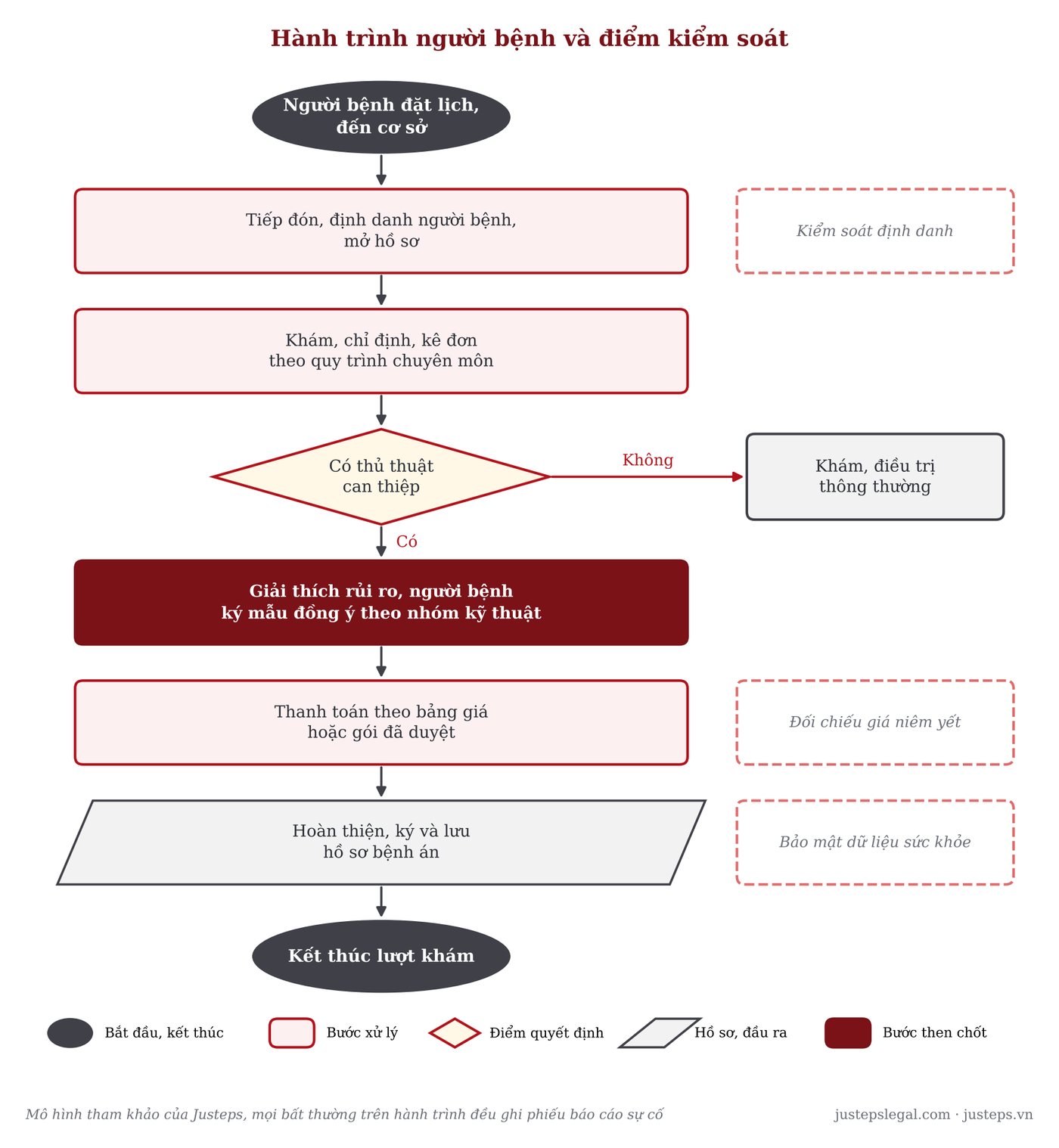
The patient journey through a private medical establishment and the legal control points
The flowchart shows five control points that private establishments often overlook. At reception, the patient must be correctly identified before a record is opened, because confusing patients is an incident that can lead to wrong orders and wrong results. Before a procedure, the doctor explains the risks and the patient signs the consent form for the relevant group of techniques. At payment, the amount must match the posted price list or an approved service package, and after each visit the medical record must be completed, signed and filed. Any abnormal event along the journey, from dispensing the wrong medicine to a patient falling, is recorded on an incident report form for the quality unit to analyse.
The core documents and their main content
Professional regulations and clinical procedures
This group of documents covers procedures for patient identification, examination and ordering, prescribing, performing procedures, first aid and transferring patients to another establishment when a case exceeds professional capability. Each procedure is written for the list of techniques the establishment is permitted to perform and is approved by the person in charge of professional matters. For establishments with X-ray or computed tomography equipment, Justeps adds procedures on radiation safety, personal dose monitoring and the appointment of a safety officer under the law on atomic energy[1].
Consent forms and the procedure for explaining risks
Patients have the right to be informed about their health condition and treatment methods and to choose a method after receiving a full explanation[2]. Surgery and invasive procedures may only be performed with the consent of the patient or the patient’s representative[3]. Justeps drafts consent forms for each group of techniques, stating the intended technique, the main risks, the alternatives and the signature of the person who gave the explanation, together with a short guide so that doctors know what to say before the patient signs. A consent form does not exempt the establishment from liability for professional errors, so Justeps does not include clauses that shift all risk onto the patient.
Regulations on medical records and health data
Paper and electronic medical records have equal legal value and must be kept and held confidential as required[4]. Under the Ministry of Health roadmap, medical examination and treatment establishments providing inpatient, day or outpatient treatment that are not hospitals must complete electronic medical records no later than 31 December 2026[5]. Health data falls within the category of personal data requiring stricter protection under the 2025 Law on Personal Data Protection[6]. The regulations drafted by Justeps set software access rights by position, how to provide a summary of the medical record at the patient’s request, retention periods, disposal methods and a separate consent form for using patient images in communications.
Regulations on pricing, cashiering and health insurance payment
Establishments must post the prices of medical examination and treatment services and of on-demand care services at the establishment[7]. Discrepancies usually arise when the sales team sets its own packages, offers campaign discounts or pays commissions to referral partners without updating the price list. The pricing regulations determine who may propose and who may approve packages and discounts, how price lists are kept for each period and how refunds are made when amounts are charged incorrectly. For establishments with a health insurance contract for medical examination and treatment, Justeps adds an internal claims review procedure before payment requests are submitted, to reduce rejected costs[8].
Infection control, waste, medicines and equipment
This is a group of non-clinical tasks in which breaches are frequently found during inspections, covering instrument sterilisation, the classification and storage of medical waste, management of medicines by expiry date, and the maintenance and inspection of equipment. Hazardous medical waste must be classified, stored and handed over in accordance with the law on environmental protection[9]. Justeps also drafts simple daily logs, because however good a procedure is, it cannot be proven if nobody fills in the log.
Handling complaints and reporting medical incidents
The prevention of medical incidents is carried out by identifying, reporting and analysing causes and issuing recommendations and preventive solutions[10]. Justeps’ procedure distinguishes minor incidents, such as a mixed-up order form, from serious incidents that must be reported immediately to the person in charge of professional matters, and encourages staff to self-report without being disciplined for having reported. Patient complaints are received through a single point of contact, have a response deadline and are classified by subject matter, whether professional, pricing or service attitude.
Common mistakes when establishments draft their own procedures
When Justeps asks establishments to score their existing documents against a self-assessment table, the shortcomings tend to cluster in a few non-clinical areas rather than in professional procedures. The chart below illustrates the self-assessment results of a general clinic before a project began.
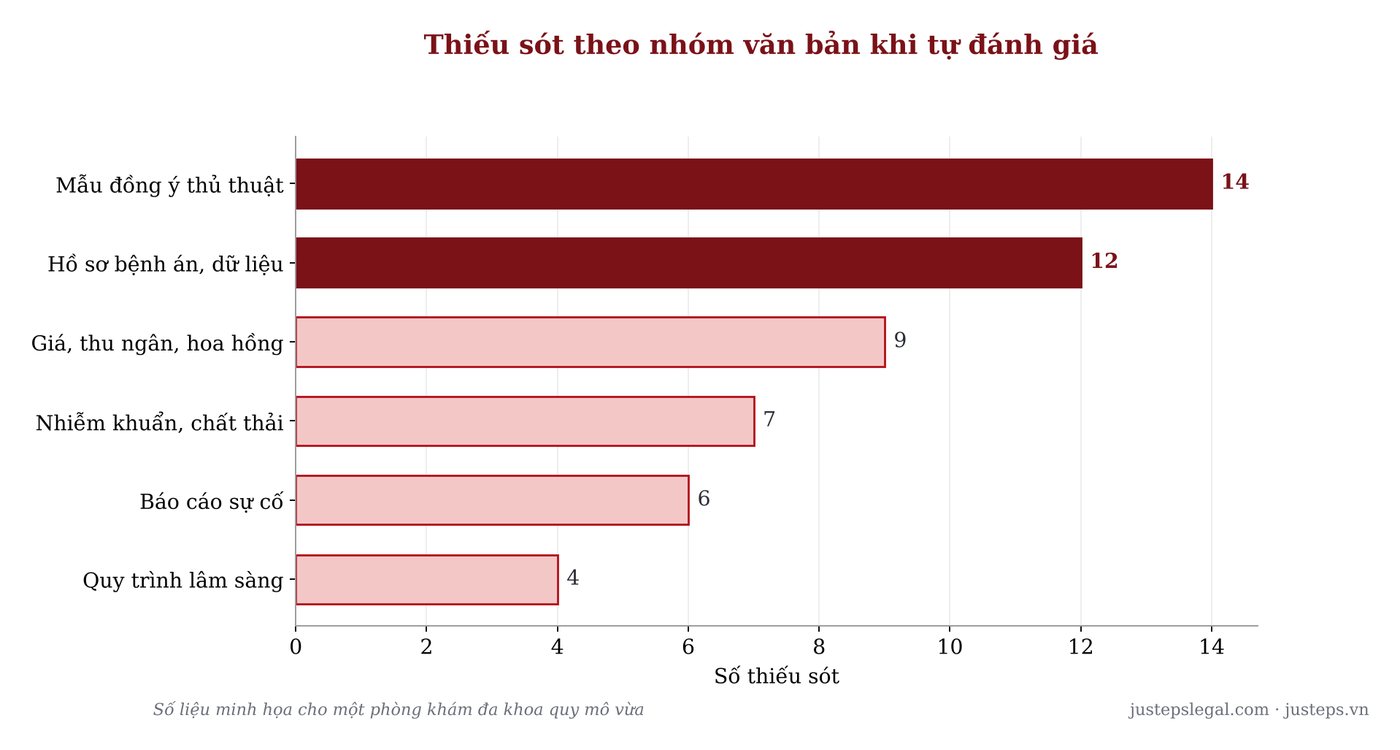
Illustrative number of shortcomings by document group in a general clinic’s self-assessment
Consent forms and medical records show the most shortcomings, because this is where a generic template is used for every technique and record-keeping depends on each doctor’s habits. Pricing and cashiering rank third because promotional packages are not added to the price list. Clinical procedures have fewer shortcomings but often do not match the actual list of techniques, a consequence of copying documents from elsewhere, as analysed below.
Copying the procedures of a public hospital wholesale
Procedures copied from a public hospital often refer to departments, councils, positions and equipment that a private clinic does not have. Inspection teams easily notice that the documents do not match reality, and when an incident occurs, those very documents show that the establishment did not follow the procedures it had issued. Procedures should be shorter, reflect the staff and equipment actually available, and be updated when the establishment adds techniques.
Commission policies that conflict with the price list
Many establishments pay commissions to partners who refer patients or reward sales consultants according to treatment package sales, but these amounts are not reflected in the price list, the accounting records or the tax policy. Bonuses linked to ordering technical services may also be regarded as conduct for improper gain prohibited by law[11]. The regulations need to separate the service advisory role of sales staff from the ordering role of doctors, and record every payment to partners in a contract.
Implementation roadmap and deliverables
A project to build a set of procedures and regulations for a general clinic or private hospital usually takes ten to twelve weeks. Justeps prioritises the highest-risk documents first, then pilots them in one or two departments before issuing them for the whole establishment.
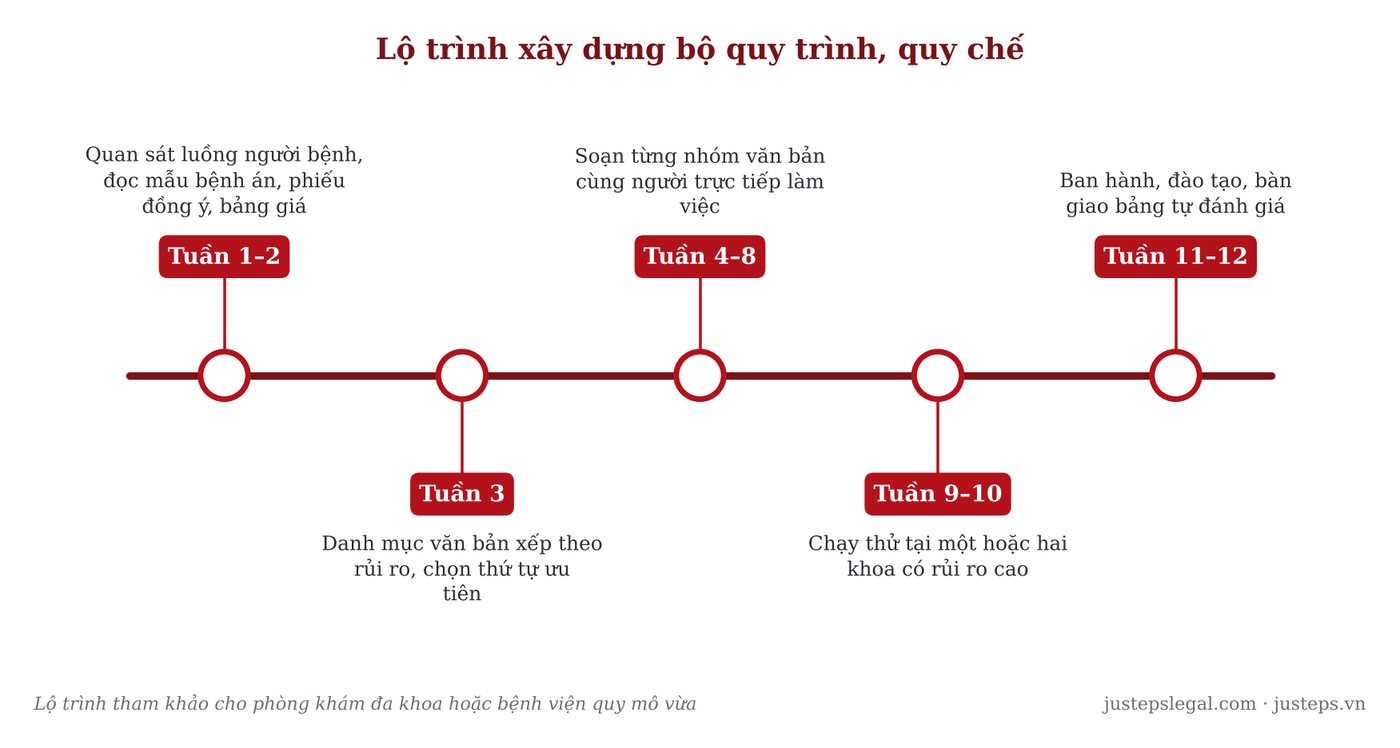
A twelve-week roadmap for building procedures and regulations for a private medical establishment
In the first two weeks, the consultants observe patient flow and read the existing medical record templates, consent forms, price lists and partner contracts. In week three, Justeps presents a list of documents ranked by risk level so that the executive team and the person in charge of professional matters can choose the order of priority. Each group of documents is drafted through working sessions with the people who actually do the work, and is then piloted in a high-risk department. Clinical procedures are approved by the person in charge of professional matters, while management regulations are issued by the person with authority under the charter, so Justeps divides the documents into two groups so that the two lines of authority do not overlap. On handover, the establishment receives the following documents:
- A list of procedures and regulations ranked by risk level, with the approver of each document.
- Professional regulations and a set of clinical procedures based on the establishment’s list of techniques.
- A set of consent forms by group of techniques and a consent form for the use of patient images.
- Regulations on medical records and health data, with a software access rights matrix.
- Regulations on pricing, cashiering, discounts, partner commissions and internal health insurance claims review.
- Logs for infection control and waste, incident report forms, training materials and a periodic self-assessment table.
Application by type of establishment and cost
Dental, dermatology and aesthetic clinics need to focus on procedure-specific consent forms, instrument sterilisation, management of patient images and rules on advising on prepaid treatment packages. Obstetrics, gynaecology and paediatric clinics also need procedures for patients who are minors and for their legal representatives. Private hospitals need a full set of regulations on on-call duty, case consultations, transfers between departments and to other hospitals, and inpatient management. Clinic chains should use one master set of procedures at company level, with separate appendices according to each establishment’s list of techniques, so that each update needs to be made in only one place. The persons responsible for organising the implementation of these procedures need to be identified in advance in the organisation chart, which Justeps does under its organisational structure design service for private clinic and hospital businesses.
Justeps quotes a fixed fee in writing after the survey meeting. The fee depends on the number of specialties and techniques, the number of establishments, whether there is a health insurance contract or radiation equipment, the number of documents to be drafted from scratch compared with those that only need standardising, any need for bilingual documents and how long Justeps supports the pilot phase. After issue, updating procedures in line with new regulations can be included in the ongoing legal advisory service for private clinic and hospital businesses.
How Justeps can help
For the procedures and regulations to take effect, private clinic and hospital businesses may combine the following Justeps services:
- Organisational structure design for private clinic and hospital businesses. Justeps identifies the approver, the performer and the checker for each procedure within the four-axis organisation.
- Ongoing legal advisory for private clinic and hospital businesses. Justeps updates procedures when the law changes and supports the handling of complaints and inspections after the regulations have been issued.
- Personal data protection compliance. Justeps prepares the impact assessment for processing health data and the data processing notice for patients.
- Internal labour regulations and disciplinary procedures. Justeps incorporates obligations to keep patient information confidential and to follow procedures into the internal labour regulations, providing a basis for handling breaches.
Frequently asked questions
Does a small clinic need written procedures?
Yes. Small size does not reduce obligations relating to medical records, infection control, medical waste and price posting. A small clinic simply needs a more concise set of documents focused on the techniques it actually performs.
Does a consent form relieve the establishment of liability?
No. A consent form proves that the patient received an explanation and accepted the inherent risks of the technique, but it does not exempt the establishment from liability for professional errors[3]. The more specific the form is about risks, the greater its evidential value.
May before-and-after treatment photographs be used for advertising?
They should be used only when the patient has clearly consented for that purpose and the advertising content complies with the law on advertising medical services[12]. The regulations need a separate consent form, the right to withdraw consent and a deadline for removing images at the patient’s request.
Must a clinic providing only outpatient examination implement electronic medical records?
The guiding circular sets a deadline of 31 December 2026 for establishments providing inpatient, day or outpatient treatment that are not hospitals[5]. An establishment unsure which category it falls into should compare its operating licence and professional scope with the latest guidance from the Ministry of Health.
Who signs and issues clinical procedures?
Professional and technical procedures are approved by the person in charge of professional matters, while internal management regulations such as pricing, cashiering and data are issued by the person with authority under the charter. Justeps arranges the documents so that these two lines of authority do not overlap.
Must internal procedures be registered with the Department of Health?
Most procedures and regulations do not need to be registered but must be ready for presentation during an inspection. Only the internal labour regulations of a business employing 10 or more employees must be registered with the labour authority[13].
How often should the set of procedures be updated?
The whole set should be reviewed once a year and updated immediately when the establishment adds techniques or equipment, after a serious incident or when the Ministry of Health issues new guidance.
Related articles
- The minimum set of internal governance rules for businesses with 50 to 200 employees
- Decree No. 363/2026/ND-CP and procedures for collecting internal data
- Personal data protection in the HR department under the 2025 Law on Personal Data Protection
- Controlling advertising content within a business and the approval process before publication
Notes
[1] The Law on Atomic Energy No. 94/2025/QH15 and the instruments detailing radiation safety in healthcare.
[2] Clause 1 of Article 9 and Clause 1 of Article 11 of the Law on Medical Examination and Treatment No. 15/2023/QH15 dated 9 January 2023, as amended and supplemented by Law No. 112/2025/QH15 and Law No. 113/2025/QH15.
[3] Clause 1 of Article 65 of the Law on Medical Examination and Treatment No. 15/2023/QH15 dated 9 January 2023, as amended and supplemented by Law No. 112/2025/QH15 and Law No. 113/2025/QH15.
[4] Article 69 of the Law on Medical Examination and Treatment No. 15/2023/QH15 dated 9 January 2023, as amended and supplemented by Law No. 112/2025/QH15 and Law No. 113/2025/QH15.
[5] Point b of Clause 2 of Article 4 of Circular No. 13/2025/TT-BYT dated 6 June 2025 of the Minister of Health guiding the implementation of electronic medical records, effective from 21 July 2025.
[6] The Law on Personal Data Protection No. 91/2025/QH15, effective from 1 January 2026, and Decree No. 363/2026/ND-CP.
[7] Clause 4 of Article 60 of the Law on Medical Examination and Treatment No. 15/2023/QH15 dated 9 January 2023, as amended and supplemented by Law No. 112/2025/QH15 and Law No. 113/2025/QH15.
[8] The Law on Health Insurance No. 25/2008/QH12, as amended and supplemented, most recently by Law No. 51/2024/QH15.
[9] The Law on Environmental Protection No. 72/2020/QH14 dated 17 November 2020 and the regulations on medical waste management.
[10] Clause 1 of Article 71 of the Law on Medical Examination and Treatment No. 15/2023/QH15 dated 9 January 2023, as amended and supplemented by Law No. 112/2025/QH15 and Law No. 113/2025/QH15.
[11] Clause 9 of Article 7 of the Law on Medical Examination and Treatment No. 15/2023/QH15 dated 9 January 2023, as amended and supplemented by Law No. 112/2025/QH15 and Law No. 113/2025/QH15.
[12] The Law on Advertising No. 16/2012/QH13, as amended and supplemented by Law No. 75/2025/QH15, and Government Decree No. 342/2025/ND-CP dated 26 December 2025 detailing a number of articles of the Law on Advertising.
[13] Articles 118 and 119 of the Labour Code No. 45/2019/QH14 dated 20 November 2019.
This article is for reference and reflects the regulations in force at the time of publication. Please consult Justeps for advice tailored to your company’s records and situation.
For further information, please contact:
📩 Email: info@justeps.vn
🌐 Website: https://justepslegal.com · https://justeps.vn
🌐 Page: Justeps
☎️ Hotline (Zalo): 096 172 2607
📍 Thanh Xuan Office: 12th Floor, Licogi 13 Tower, 164 Khuat Duy Tien Street, Thanh Xuan Ward, Hanoi, Vietnam
📍 Ha Dong Office: LK06B, No.10, Dong Dua Area, Ha Dong Ward, Hanoi, Vietnam
📍 Ho Chi Minh City Branch: 528 Le Van Sy, Ho Chi Minh City, Vietnam
📍 Hai Phong Office: Truong Thinh Village, Ha Dong Commune, Hai Phong, Vietnam
📍 Quang Ninh Office: Van Don Special Zone, Quang Ninh Province, Vietnam





