
Key takeaways
- Security staff have no power to search people, detain them at will or impose penalties; when a person is caught in the act of committing a crime, the correct course is to hold the person only as far as necessary and hand them over immediately to the nearest police, procuracy or People’s Committee[1].
- Support tools may only be used in the circumstances listed by law, and anyone who exceeds the limits of legitimate self-defence or misuses them will be dealt with, so the regulations must link the issue of tools to training and to a report after every use[3].
- The Labour Code prohibits fines and wage deductions in place of labour discipline, so sector-specific breaches such as sleeping on duty, leaving a post or letting vehicles out without checks must be written into the internal labour rules with the corresponding disciplinary measures[8].
- The regulations should give staff the right to refuse requests outside the scope of security services, such as holding property to recover a debt or stopping people from entering land under dispute, and to pass the decision up to the board of directors.
At two in the morning, a security guard at a factory gate sees a worker leaving with components hidden in a bag. Within a few minutes, the guard has to decide alone whether the bag may be opened, where and for how long the person may be held, whom to call first and whether an electric baton may be used if the person resists. If the business’s regulations only state in general terms that staff must protect the client’s property, each guard will act according to their own understanding, and a single instance of holding someone too long or a scuffle is enough to expose the business to a criminal case, a compensation claim and the risk of losing the contract.
This page introduces Justeps’ service of building internal procedures and regulations for businesses providing site security, event security and bodyguard services. The focus is on turning legal limits into short rules of action that team leaders and staff can use immediately at their posts, with log templates, guidance cards and drills. The main legal bases are Decree No. 96/2016/ND-CP on security and order conditions as amended and supplemented, the 2024 Law on Management and Use of Weapons, Explosives and Support Tools, the Criminal Procedure Code, the Labour Code and the Law on Personal Data Protection.
Legal limits the regulations must reflect
Checking people, bags and vehicles
Security staff are employees of a private enterprise, not officials performing public duties, so they have no power to carry out compulsory searches of people or vehicles. Checking bags and vehicles entering and leaving only has a basis where the client’s site rules provide for it, the people concerned have been informed and agree, and the check is carried out openly in the presence of a witness. When the person asked refuses, the correct procedure is to record the incident and report it to the control centre and the client’s representative, without struggling with the person or holding on to the property.
Catching a person in the act of committing a crime
The Criminal Procedure Code allows any person to apprehend someone who is committing a crime or who is discovered and pursued immediately after committing it, and requires the apprehended person to be taken at once to the nearest police, procuracy or People’s Committee[1]. Conversely, unlawfully apprehending or detaining a person may give rise to criminal liability[2], and beating the person, forcing a confession or keeping them in the security room to wait for the client to come and deal with the matter are the most common risks. The procedure for incidents caught in the act must therefore state clearly what must not be done and set the point for reporting to the police from the very start, as shown in the flowchart below.
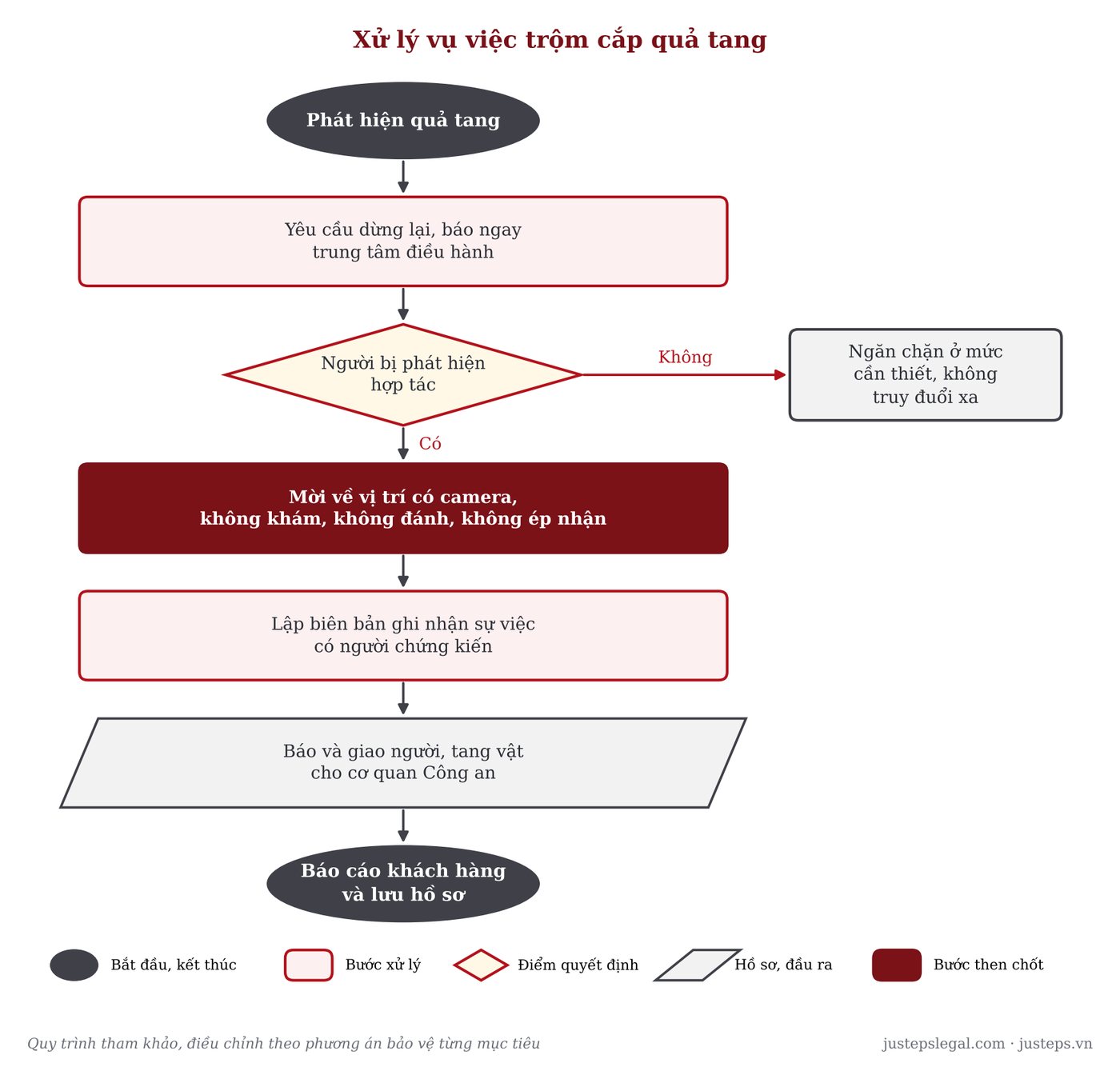
Procedure when a person is caught stealing in the act at a guarded site
The turning point of the procedure is whether the person discovered cooperates. If so, the guard asks the person to come to a location covered by a camera, prepares a record of the incident in the presence of a witness and waits for the police to arrive and take over. If the person resists or runs away, the guard only intervenes as far as necessary, giving priority to their own safety and that of people nearby, and must never pursue the person beyond the site without instructions from the control centre. In every branch of the procedure, further handling belongs to the state authorities; the business only hands over the person, the items, the record and the camera footage.
Using support tools
The 2024 Law only allows a person assigned support tools to use them in the listed circumstances, and anyone who exceeds the limits of legitimate self-defence or misuses them will be dealt with in accordance with the law[3]. The person assigned must have been trained and must carry the certificate of use while on duty[4]. Justeps’ regulations attach three conditions to every issue of tools: the name of a trained person, a signature on receipt at the start of the shift and a report immediately after every use, even when a tool is only drawn as a warning.
Requests outside the scope of the service
A business may not provide security services for persons, sites or activities that are contrary to the law[5], and debt collection services are a business line in which investment is prohibited[6]. At sites, staff still often receive requests such as holding the vehicle of someone who owes money, stopping others from entering land under dispute or helping with forced removal of belongings. The regulations should allow staff to refuse, record the request and report it to the board of directors for a decision, rather than letting the team leader go along with the client.
The set of documents Justeps builds
The regulations are divided by user so that each document is short enough for its actual readers. The table below lists the main documents and their main users.
| Document | Main contents | Main users |
|---|---|---|
| Internal labour rules | A list of breaches specific to duty shifts, the corresponding disciplinary measures and the registration file. | All staff and the HR department. |
| Site security plan | Survey template, post locations, patrol routes and scope of responsibility confirmed by the client’s signature. | Area commanders and clients. |
| Shift procedure | Taking over the shift, checking headcount and tools, patrolling, keeping the log and handing over. | Team leaders and staff at posts. |
| Support tools regulations | Issue, use, reporting, return, stocktaking and retraining. | Operations unit and team leaders. |
| Incident handling procedure | Incidents caught in the act, public disorder, fire and explosion, accidents, with a pocket guidance card. | Staff and the control centre. |
| Entry, exit and data regulations | Recording visitor information, camera footage, retention periods and who may view it. | Gate staff and clients. |
| Inspection and refusal regulations | Unannounced inspections, uniforms, badges and how to refuse requests outside the scope. | Internal inspection and team leaders. |
The site security plan is the document that links the internal regulations to the contract, because the business must sign a service contract before deploying its staff[5] and the scope of liability when property is lost depends largely on what the plan committed to. Justeps drafts a plan template with a section in which the client confirms by signature the areas outside the scope, the number of posts, patrol times and the tasks staff will not perform on the client’s behalf.
The shift cycle as the backbone of the procedures
Most cases of lost property are resolved on the basis of shift logs and patrol data, so Justeps writes the shift procedure first and the other procedures refer to it. The figure below shows the six steps of a shift.
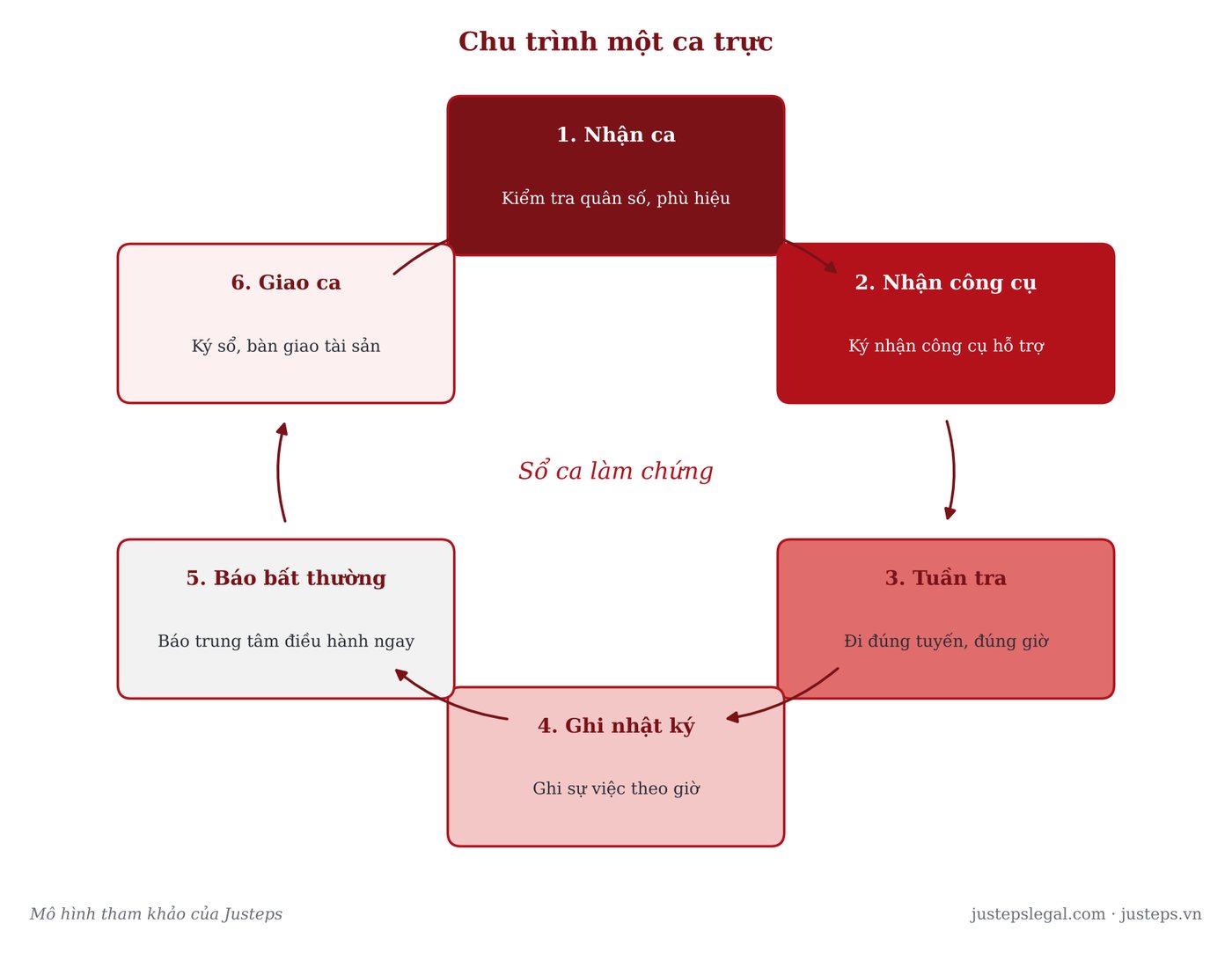
The six steps of a duty shift at a guarded site
A shift begins with checking headcount, uniforms, badges and support tools and recording them in the log before the previous shift leaves the post. During the shift, staff patrol along the approved route, record the log at set times and report anything unusual immediately to the control centre. At handover, both sides sign the log and hand over temporarily held property, key cards, sets of keys and any unfinished matters, and the incoming shift then begins a new cycle.
Internal labour rules and sector-specific discipline
A business employing 10 or more workers must have written internal labour rules and register them with the specialised labour authority[7]. The rules of a security business should list specific breaches such as sleeping on duty, leaving a post, drinking alcohol before or during a shift, accepting money or gifts to let people or goods in or out, disclosing information about the site and using support tools without authorisation, and link each breach to a disciplinary measure. One set of general rules with a separate section on work at sites is usually much easier to manage than separate rules for each client.
Many businesses still impose on-the-spot fines when they find staff sleeping on duty, or deduct wages when property is lost at a site. The Labour Code prohibits fines and wage deductions in place of labour discipline[8], while liability for compensation must follow a separate procedure, with the amount and method of deduction limited by law. Wage calculation, deductions and staff contracts are dealt with by Justeps in its labour, payroll and insurance service for the same group of businesses.
Personal data at the gate and from cameras
Security staff record the names, document numbers and vehicle registration numbers of visitors every day and manage camera footage, which means they are processing personal data under the Law on Personal Data Protection, effective from 1 January 2026[9]. The entry and exit regulations should state the purpose of recording, record only the information that is necessary, provide notice at the gate and set the retention period and who may view and extract the data. The contract with the client should also specify which party decides the purpose of processing and which party only acts on instructions, so that the security business does not bear liability on behalf of the site owner.
Regulations by type of site
Not every business needs every document at the same level of detail. The matrix below shows the priority of each group of regulations by the types of site Justeps commonly encounters.
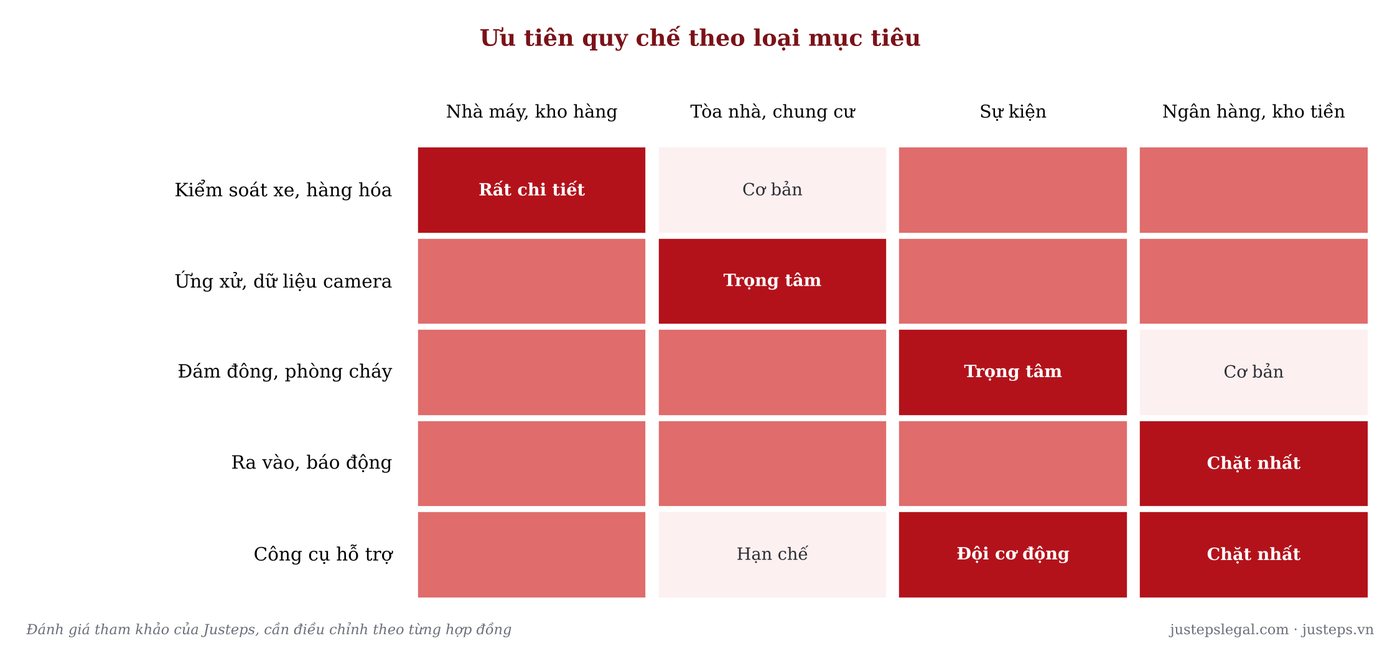
Priority of groups of regulations by type of site
Factories and warehouses need the most detailed procedures for controlling vehicles and goods, seals and checking goods issue notes. Office buildings and apartment blocks place the emphasis on conduct towards residents and on camera data, events need plans for crowds, coordination with the competent authorities and fire prevention and fighting under the 2024 Law[10], while banks and cash vaults need the strictest entry, exit and alarm procedures.
Implementation process, deliverables and fees
A project usually takes around ten weeks. In the first two weeks, Justeps consultants survey a number of sample sites during both day and night, read shift logs and incident records and compile the incidents of the last one to two years. In week three, they work with the board of directors to settle the list of documents and the limits of action when handling incidents. The following weeks are spent drafting, running drills on three scenarios, namely catching someone in the act, a visitor refusing a check and a request outside the scope, and finalising the documents. The deliverables comprise:
- Internal labour rules with a list of sector-specific breaches and the file for registering the rules.
- A site security plan template with a section in which the client confirms the scope by signature.
- A shift procedure with templates for the duty log, the handover log and the incident record.
- Support tools regulations with the issue and return register and a stocktaking plan.
- An incident handling procedure with a pocket guidance card for staff.
- Entry and exit regulations, camera data regulations and regulations on unannounced inspections.
The regulations work best when they match the organisation, because each step names the position responsible, so a business without a clear structure should first use the organisational structure design service for security service businesses. The fee is quoted as a fixed fee in writing after the initial meeting, depending on the number of documents, the number of types of site needing their own plan, the number of sites surveyed in person, the need for drills and whether support is needed to register the internal labour rules. After issue, incidents that arise can be supported under the ongoing legal advisory service for security service businesses.
How Justeps can help
Alongside internal procedures and regulations, security service businesses may combine the following Justeps services:
- Organisational structure design for security service businesses. Justeps sets up the control centre, internal inspection and the support tools unit so that every step in the procedures has a responsible person.
- Ongoing legal advisory for security service businesses. Justeps guides the handling of each incident at sites in line with the issued procedures and updates the regulations when the law changes.
- Drafting internal labour rules and handling discipline. Justeps drafts the internal labour rules and registration file and provides guidance on the disciplinary procedure for shift breaches.
- Personal data protection compliance. Justeps builds rules on processing visitor data and camera footage and on allocating roles with the site owner.
Frequently asked questions
May security staff search a person suspected of theft?
No compulsory search is permitted. Checks may only be carried out under the site rules with the consent of the person checked; if someone is caught in the act, they may be held only as far as necessary and must be handed over immediately to the nearest police or People’s Committee[1].
May the business fine staff who fall asleep on duty?
No. The Labour Code prohibits fines and wage deductions in place of labour discipline[8]. This conduct must be written into the internal labour rules and handled in accordance with the disciplinary procedure.
How should staff respond when a client asks them to stop people entering land under dispute?
Staff should refuse, record the request and report to the board of directors, unless the client has a clear basis for its right to manage that property. A business may not provide services for unlawful activities[5].
Does recording visitors’ identity card numbers breach the rules on personal data?
Not if there is a clear purpose, notice is given, only the necessary information is recorded and it is kept for a reasonable period under the regulations[9]. Photographing or keeping identity documents needs more careful consideration.
Must every use of support tools be reported?
The regulations should require a report immediately after every use, even when a tool is only drawn as a warning. If the use causes injury or damage, the business must report to the police and keep the records to establish whether the limits were exceeded[3].
How often should the regulations be reviewed and drills held?
They should be reviewed at least once a year, drills should follow the periodic training plan, and the regulations should be updated as soon as the business takes on a new type of site or after a serious incident.
Related articles
- Organisational structure design for security service businesses with a chain of command from head office to every guarded site
- Ongoing legal advisory for security service businesses from client contracts to incidents at guarded sites
- Labour, payroll and insurance services for security service businesses with lawful 12-hour shifts
- Resolving labour disputes through internal conciliation before referring them to a labour conciliator
Notes
[1] Article 111 of the Criminal Procedure Code No. 101/2015/QH13 dated 27 November 2015.
[2] Article 157 of the Criminal Code No. 100/2015/QH13 dated 27 November 2015, as amended and supplemented by Law No. 12/2017/QH14.
[3] Article 58 of the Law on Management and Use of Weapons, Explosives and Support Tools No. 42/2024/QH15 dated 29 June 2024.
[4] Article 6 of the Law on Management and Use of Weapons, Explosives and Support Tools No. 42/2024/QH15 dated 29 June 2024.
[5] Article 32 of Government Decree No. 96/2016/ND-CP dated 1 July 2016 on security and order conditions for certain conditional business lines, as amended and supplemented by Decree No. 56/2023/ND-CP, Decree No. 58/2026/ND-CP and Decree No. 392/2026/ND-CP.
[6] The Law on Investment No. 143/2025/QH15, effective from 1 March 2026, on business lines in which investment is prohibited.
[7] Articles 118 and 119 of the Labour Code No. 45/2019/QH14 dated 20 November 2019.
[8] Clause 2 of Article 127 of the Labour Code No. 45/2019/QH14 dated 20 November 2019.
[9] The Law on Personal Data Protection No. 91/2025/QH15, effective from 1 January 2026.
[10] The Law on Fire Prevention, Fire Fighting and Rescue No. 55/2024/QH15, effective from 1 July 2025.
This article is for reference and reflects the regulations in force at the time of publication. Please consult Justeps for advice tailored to your company’s records and situation.
For further information, please contact:
📩 Email: info@justeps.vn
🌐 Website: https://justepslegal.com · https://justeps.vn
🌐 Page: Justeps
☎️ Hotline (Zalo): 096 172 2607
📍 Thanh Xuan Office: 12th Floor, Licogi 13 Tower, 164 Khuat Duy Tien Street, Thanh Xuan Ward, Hanoi, Vietnam
📍 Ha Dong Office: LK06B, No.10, Dong Dua Area, Ha Dong Ward, Hanoi, Vietnam
📍 Ho Chi Minh City Branch: 528 Le Van Sy, Ho Chi Minh City, Vietnam
📍 Hai Phong Office: Truong Thinh Village, Ha Dong Commune, Hai Phong, Vietnam
📍 Quang Ninh Office: Van Don Special Zone, Quang Ninh Province, Vietnam





