
Key takeaways
- The record of equipment and technical files taken over at the start of a contract is the only basis on which the business can prove that a defect already existed, so the takeover procedure must record the condition of each system rather than merely list documents.
- A paid parking service is in substance a contract for the safekeeping of property[4], so a disclaimer printed on a parking ticket cannot replace an access control procedure and a procedure for handling a lost vehicle.
- Measures against apartments that pay late must be based on the building rules and the contract, and the business should not create additional sanctions in its internal procedures.
- The management unit must report publicly to the Management Board and at the annual residents’ meeting[2], so each procedure should generate data that can be compiled into periodic reports.
Most disputes between a building management business and residents or the Management Board do not arise because the business did something wrong, but because it cannot prove that it did things right. A flooded basement car park, a stolen motorbike or an apartment damaged by water from renovation works upstairs all lead to the same questions, namely who checked, when they checked and whether it was recorded. When each building management office works according to its manager’s habits, the answers depend on individual memory and usually come too late.
This page describes the Justeps service for building a set of internal procedures and regulations for businesses that manage apartment buildings, office buildings, shopping centres and urban areas. The content follows the life cycle of a management contract, from taking over the building, handling feedback, controlling apartment works, parking, fee collection and incident response to reporting and handover when the contract ends. Dividing departments and granting authority to building managers, which is the precondition for having people to carry out the procedures, is covered under the organisational structure design service for building and urban area management businesses.
What a building management business’s set of regulations includes
A building management business must comply with three layers of documents at once, namely housing law, the rules of each building issued by the residents’ meeting or the developer, and the service contract signed with the Management Board or owner. The business’s internal regulations are the fourth layer, whose task is to turn the other three into concrete tasks for each shift, and they may not create rights or obligations contrary to the building rules. The table below sets out the documents Justeps usually drafts for a business managing several types of project.
| Document group | Main content | Daily users |
|---|---|---|
| Takeover and handover | Checking technical files and equipment condition when receiving and returning the building. | Building manager and chief engineer. |
| Customer care | Receiving, classifying and answering feedback and surveying satisfaction. | Reception and customer care staff. |
| Apartment works | Registration, approval, supervision and acceptance of interior works. | Reception, technical team and security. |
| Parking and access | Cards, tickets, cameras, vehicle checks and handling lost property. | Security guards and the security supervisor. |
| Fees and receivables | Issuing invoices, reminders, reconciliation and handling late payers. | Project accountant and head office accountant. |
| Incidents and emergencies | Fire, power cuts, lift entrapment, flooding, gas leaks and accidents. | The whole shift, led by the shift leader. |
| Reporting and records | Monthly reports to the Management Board, operating logs and file storage. | Building manager and head office. |
Taking over the building and evidence of its initial condition
At the start of a contract, the management business takes over a building that already has a history, sometimes just handed over by the developer and sometimes just left by another management company. The law places the obligation to prepare and hand over the apartment building records on the developer and the Management Board[1], while the management unit must return the records and transfer the work to the new unit when its contract ends[2]. The business therefore needs design files, as-built drawings, equipment histories and fire safety records to operate the building, but it is not the party holding the originals.
The takeover procedure Justeps drafts requires technicians to go through each system, record the actual condition, take time-stamped photographs and state clearly which items are faulty and which lack inspection records. The takeover record is signed with the handing-over party and copied to the Management Board, so that when the fire pump fails in the third month the business has a basis to prove the fault existed earlier. The procedure for returning the building when the contract ends follows exactly the reverse structure, with lists of assets, receivables collected on behalf of others and operating logs to be handed over.
Resident feedback and apartment renovation works
The reception desk of an apartment building may receive hundreds of reports a month, from a leaking tap to night-time noise or a wrong invoice. A good procedure classifies feedback as soon as it is received, sets a response time by priority and appoints a handler, while also distinguishing matters for which the business is responsible from matters within the authority of the Management Board, the developer or state agencies. The chart below shows the breakdown of feedback over one year at an apartment building in the example.
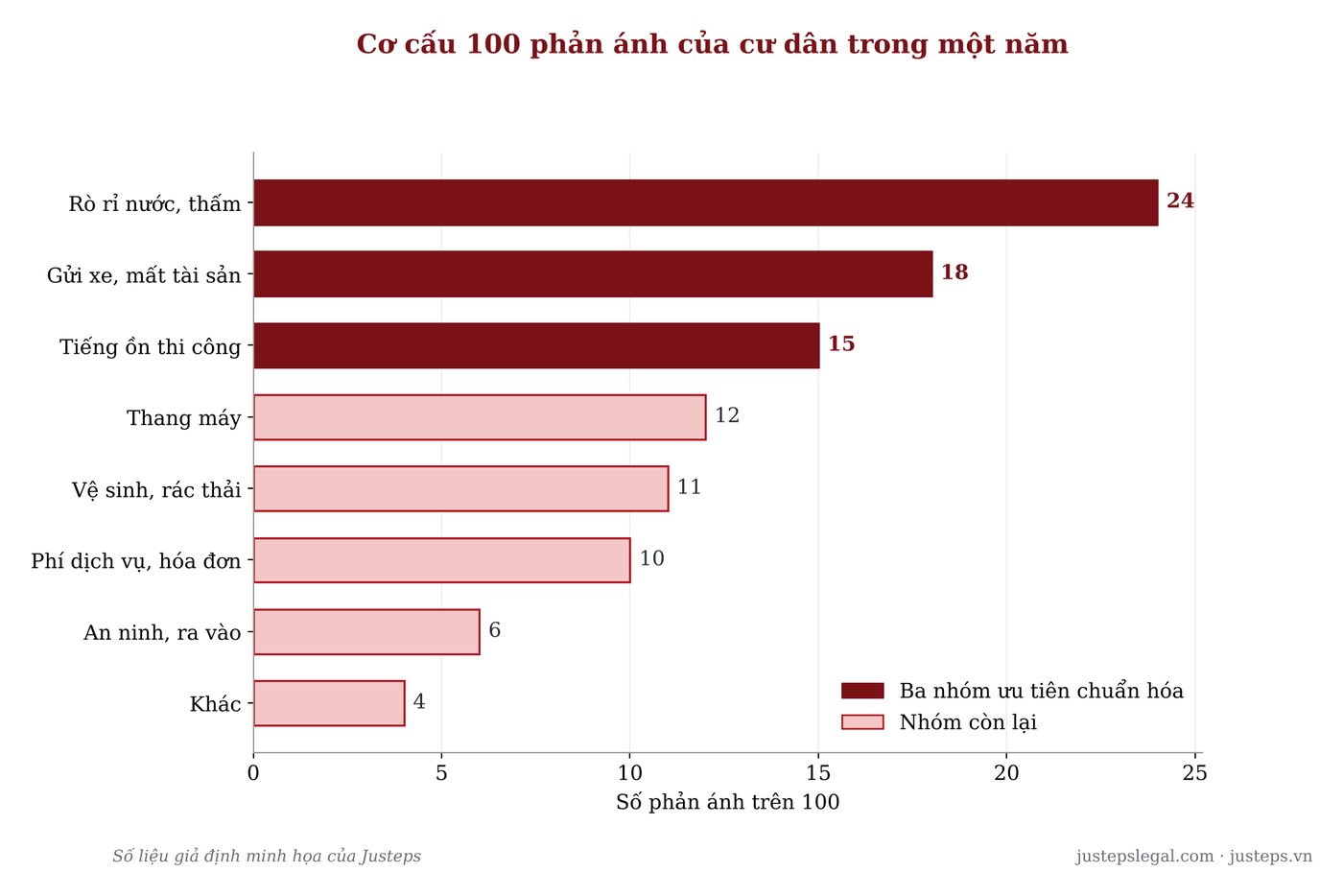
Example breakdown of resident feedback over one year at an apartment building
In the example, water leaks and seepage account for 24 of 100 reports, parking and lost property for 18 and construction noise for 15; together these three groups make up 57 reports, more than half. These are assumed figures for illustration, but they reflect what Justeps often sees when reviewing feedback logs, namely that most resident frustration relates to apartment works and the car park. Justeps therefore gives priority to these two procedures before standardising the other groups.
For apartment works, the procedure must state who approves drawings, which items may not be altered, working hours, rules on carrying materials in lifts and the deposit securing the repair of damage to common areas. The Law on Housing prohibits arbitrarily changing the function of common areas and using apartments for purposes other than residence[3], so the technician reviewing the application must be able to identify changes such as removing load-bearing walls, encroaching on corridors or converting an apartment into business premises. The diagram below shows how departments coordinate during one renovation.
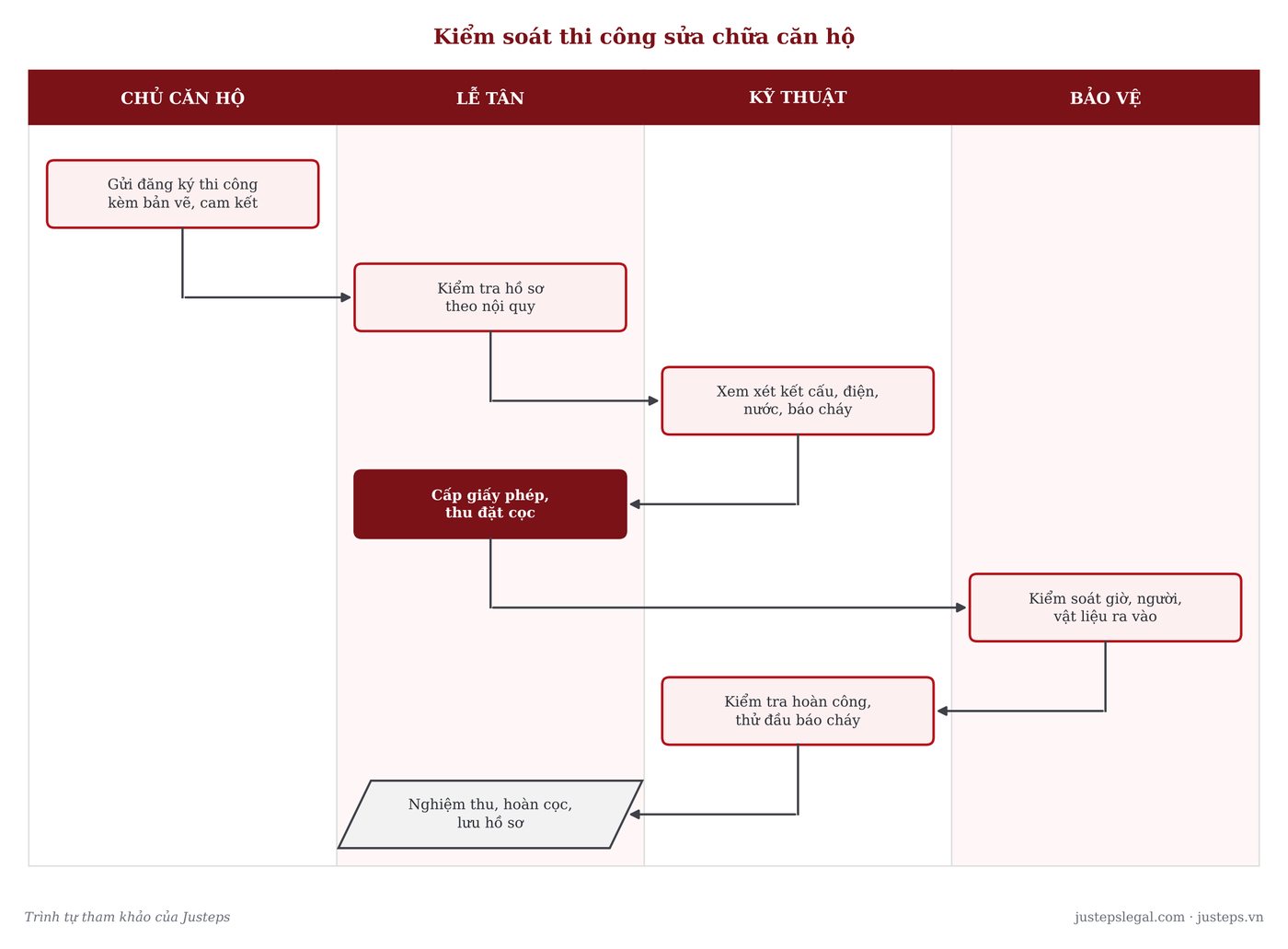
Coordination between the apartment owner, reception, technical team and security during apartment works
The apartment owner submits a registration with drawings and the contractor’s undertaking, reception checks the file against the building rules and passes it to the technical team to assess the impact on structure, pipes, electricity and the fire alarm system. Once the works permit is issued and the deposit collected, security controls working hours and the entry and exit of people and materials each day. When the works are finished, the technical team checks the result and tests the smoke detectors in the apartment, and reception then prepares the acceptance record, refunds the deposit and files the documents for use in any later dispute over leaks.
Parking, cameras and resident data
The car park is where the complaints with the highest monetary value arise. When the business charges for parking, its relationship with residents is in substance a contract for the safekeeping of property under the Civil Code[4], under which the keeper must preserve the property and may have to pay compensation if it is lost or damaged. A line on the ticket stating that management accepts no liability for property is usually not enough to exclude this obligation, so the procedure must show that the business applied adequate controls.
The parking procedure Justeps drafts covers issuing and withdrawing cards, checking number plates when vehicles leave, handling vehicles leaving without a card, end-of-shift counts and the sequence for preparing a record, extracting camera footage and reporting to the police when a vehicle is lost. Camera images, number plates, access card information and resident lists are all personal data, so their collection, storage, provision to third parties and deletion must follow the Law on Personal Data Protection[5]. The business needs to state who may review camera footage, how long images are kept and when they may be provided to residents or state agencies, and can refer further to the personal data protection and cybersecurity service.
Collecting service fees and handling late-paying apartments
The management service fee is calculated by area and does not include items such as maintenance funds, parking fees, electricity and water or the remuneration of the Management Board[6], so the fee collection procedure must separate each item on the notice sent to residents. Electronic invoices are issued under the current rules on invoice timing and content[7], and the project accountant must reconcile the list of apartments, areas and invoice recipients whenever ownership changes.
For late payers, many management offices on their own initiative stop issuing parking cards, lock lift access cards or post notices naming the owner. These measures are safe only where they are provided for in the building rules and the service contract, notified in advance and applied consistently; publishing names together with amounts owed may also breach personal data rules. The procedure Justeps drafts follows stages of written reminders, invitations to meet and requests for the Management Board to cooperate, and applies service restrictions only where the building rules provide for them. Where a debt remains outstanding, the business decides for itself whether to bring a lawsuit, and the file is prepared for transfer to a practitioner of the business’s own choosing.
Incident response and periodic reporting
High-rise buildings have incidents that require a response within minutes, such as fire, people trapped in lifts, a building-wide power cut or a flooded basement. The Law on Fire Prevention, Firefighting and Rescue requires establishments to have a firefighting plan, an on-site force and drills[8], while lifts and certain other equipment are subject to strict occupational safety requirements and must be inspected before use and periodically[9]. The incident procedures Justeps drafts give each type of incident a short one-page guide placed in the duty room, stating who is in command, whom to call first, how to inform residents and how to record the event.
Every procedure must generate data for reporting. The management unit is responsible for reporting publicly to the Management Board, reporting at the annual residents’ meeting and gathering owners’ views on service quality[2]. Justeps designs a monthly report template that takes figures directly from the feedback log, incident log, maintenance log and receivables table, so that the building manager does not have to write it from scratch and the Management Board sees the same set of indicators month after month. Spending norms for replacement materials and minor repairs used in the report can be further standardised through the internal spending regulations and cost norms service.
Timeline, deliverables and fees
A project to build procedures and regulations for a building management business usually takes about ten weeks. Justeps does not write procedures from behind a desk; it reads the real duty logs, feedback logs and incident records of one or two representative projects to see what the shifts actually do, and only then drafts the documents.
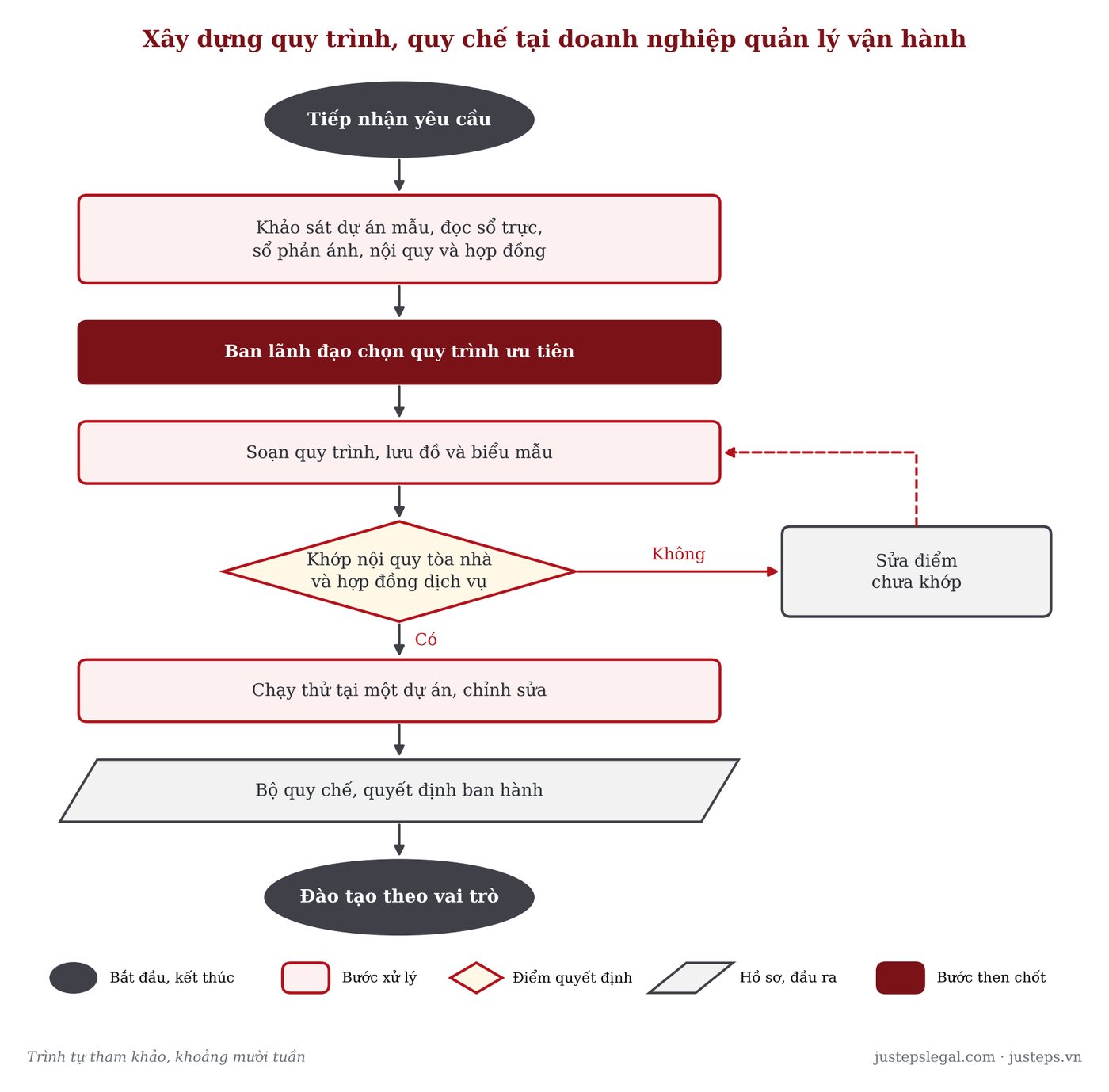
Sequence for building and applying the set of procedures and regulations at a building management business
The first three weeks are spent on surveys and document review, in the fourth week management chooses the priority procedures, and over the next four weeks Justeps drafts procedures, flowcharts and forms. Each procedure is checked against the building rules and the contract with the Management Board; any point that does not match is revised before a pilot run at one project, and the last two weeks are devoted to the pilot, revisions and role-based training. The deliverables include the following documents:
- The set of procedures and regulations in the seven groups above, with flowcharts for the main procedures.
- Forms for takeover records, feedback slips, works permits, operating logs, incident reports and lost property reports.
- Guides for handling each type of incident, placed in the duty room.
- Monthly report templates for the Management Board and templates for reports to the residents’ meeting.
- Rules on cameras, access cards and resident data.
- Issuing decisions and training materials for reception, technical staff, security and building managers.
The project fee is quoted by Justeps in writing as a fixed package after an initial discussion. The fee depends on the number of project types, the number of procedures to be drafted from scratch or merely revised, whether they must be applied in several provinces, the need for bilingual documents for foreign tenants and the number of training sessions. A business wishing to roll out the regulations to new teams itself can combine this with the training programme on building and implementing internal regulations.
How Justeps can help
In addition to building procedures and regulations, building and urban area management businesses can combine the following Justeps services:
- Organisational structure design for building and urban area management businesses. Justeps divides departments, grants authority to building managers and sets shift staffing so that procedures have people to carry them out.
- Ongoing compliance advisory for building and urban area management businesses. Justeps answers situations arising when the procedures are applied, from stolen vehicles and leaks to apartments paying fees late.
- Personal data protection and cybersecurity. Justeps builds policies for processing camera footage, access card data and resident information.
- Internal spending regulations and cost norms. Justeps sets norms for materials, minor repairs and operating costs for each type of project.
- Training on building and implementing internal regulations. Justeps trains managers on how to maintain and update the set of regulations after issue.
Frequently asked questions
Can internal regulations replace the apartment building rules?
No. The building rules apply to residents and are issued by the residents’ meeting or the developer, while internal regulations apply only to the business’s staff. Internal regulations must be consistent with the building rules and the contract with the Management Board.
Does a disclaimer on the parking ticket exempt the business from compensation?
Usually not, because when it charges for parking the business is the keeper of the property and must preserve it[4]. The business should be able to prove it applied adequate controls and should take out suitable insurance.
May the lift access card of an apartment that owes fees be locked?
This should be applied only where the measure is set out in the building rules and the contract, notified in advance and applied equally to all apartments. The business should not create sanctions in its internal regulations.
Who may review camera footage?
The person assigned in the regulations, for the defined purpose and retention period. Providing images to residents or third parties must comply with the Law on Personal Data Protection[5].
What should be done when records are missing on takeover from the previous unit?
The business records the missing documents in the takeover record, sends a written request to the Management Board and the developer to supply them, and surveys the actual condition itself in order to operate safely. This record is the basis for allocating responsibility later.
How often should the procedures be updated?
At least once a year, and whenever the building rules change, a new contract contains different terms, new rules on fire prevention, invoices or personal data are issued, or after a major incident.
Related articles
- Organisational structure design for building and urban area management businesses based on a head office and project management model
- Ongoing compliance advisory for building and urban area management businesses in relations with the Management Board and residents
- Labour, wages and social insurance for building and urban area management businesses with twenty-four hour shifts
- Personal data protection in the HR department under the 2025 Law on Personal Data Protection
Notes
[1] Article 10 of the Regulation on the management and use of apartment buildings issued with Circular No. 05/2024/TT-BXD dated 31/7/2024 of the Ministry of Construction, as amended and supplemented by Circulars No. 09/2025/TT-BXD, 32/2025/TT-BXD and 08/2026/TT-BXD.
[2] Article 43 of the Regulation on the management and use of apartment buildings issued with Circular No. 05/2024/TT-BXD dated 31/7/2024 of the Ministry of Construction, as amended and supplemented by Circulars No. 09/2025/TT-BXD, 32/2025/TT-BXD and 08/2026/TT-BXD.
[3] Point c, Clause 8, Article 3 of the Law on Housing No. 27/2023/QH15 dated 27/11/2023, effective from 01/8/2024.
[4] Article 554 of the Civil Code No. 91/2015/QH13 dated 24/11/2015.
[5] Law on Personal Data Protection No. 91/2025/QH15, effective from 01/01/2026.
[6] Clause 2, Article 151 of the Law on Housing No. 27/2023/QH15 dated 27/11/2023, effective from 01/8/2024.
[7] Decree No. 254/2026/ND-CP dated 30/6/2026 of the Government on electronic invoices and electronic documents, effective from 01/7/2026.
[8] Law on Fire Prevention, Firefighting and Rescue No. 55/2024/QH15, effective from 01/7/2025, and Decree No. 105/2025/ND-CP of the Government guiding this Law.
[9] Law on Occupational Safety and Health No. 84/2015/QH13 and its amending and supplementing documents.
This article is for reference and reflects the regulations in force at the time of publication. Please consult Justeps for advice tailored to your company’s records and situation.
For further information, please contact:
📩 Email: info@justeps.vn
🌐 Website: https://justepslegal.com · https://justeps.vn
🌐 Page: Justeps
☎️ Hotline (Zalo): 096 172 2607
📍 Thanh Xuan Office: 12th Floor, Licogi 13 Tower, 164 Khuat Duy Tien Street, Thanh Xuan Ward, Hanoi, Vietnam
📍 Ha Dong Office: LK06B, No.10, Dong Dua Area, Ha Dong Ward, Hanoi, Vietnam
📍 Ho Chi Minh City Branch: 528 Le Van Sy, Ho Chi Minh City, Vietnam
📍 Hai Phong Office: Truong Thinh Village, Ha Dong Commune, Hai Phong, Vietnam
📍 Quang Ninh Office: Van Don Special Zone, Quang Ninh Province, Vietnam





