
Key takeaways
- The client’s approval of the final version does not replace the agency’s obligation to check documents, so the review procedure must produce a review form and a separate file for each campaign[2].
- Advertising accounts, design libraries and software must be held in the name of the business or of the client as the contract provides, not under an employee’s personal email address.
- A payment of VND 5 million or more is a deductible expense only if it is supported by non-cash payment documents, so the rules on advances and payments on behalf of clients need to specify the payment method from the outset[4].
- An agency can transfer rights in designs and videos to a client only when it has a contract with the author, including a freelance collaborator, recording that the rights belong to the agency[8].
Many agencies run on the experience of a few long-serving people. They know which clients tend to change requirements at the last minute, which platforms must be topped up in advance, which suppliers require a deposit and where the original design files are kept. When such a person leaves, the company may lose administrator rights to advertising accounts registered under a personal email address, lose the original design files and no longer have anyone who knows which amounts were advanced for which client.
Justeps designed its service for building internal procedures and regulations for every type of agency, from creative teams of a few people to integrated advertising companies with digital media buying, public relations and events. The aim is to turn habitual practice into clear documents that keep the speed of creative work while controlling the risks relating to content, money and intellectual property. Arranging divisions and allocating authority, monthly legal support and labour relations are presented on three other service pages in the same sector.
A set of documents arranged around the life cycle of a campaign
Justeps does not divide the regulations by department but by the steps a campaign passes through, so that a new employee can see at a glance which step he or she is at and which document applies. For an integrated agency, the set of documents usually includes the following procedures and regulations:
- A procedure for receiving briefs, quoting, signing contracts and controlling changes to the scope of work.
- A procedure for reviewing advertising content, with a review list and a template review form.
- Regulations on managing advertising accounts and digital assets and on handling takedown requests.
- Regulations on advances, payments on behalf of clients, cost reconciliation and receivables management for each client.
- A procedure for selecting, verifying and contracting influencers, artists, models and collaborators.
- Regulations on copyright, creative resources, confidentiality of pitch ideas and data on potential customers.
- A procedure for acceptance, handover of deliverables and archiving of campaign files.
Receiving briefs, quoting and controlling additional work
Most disputes between agencies and clients are not about creative quality but about the scope of work. The client asks for a few more rounds of edits, changes the publication channel or adds a short video, the client team agrees by text message to preserve the relationship, and at acceptance neither side can agree on the price. Justeps’ procedure requires the quotation to state the number of revision rounds included, which deliverables count as additional work, the unit price for additional work and the conditions for cancelling the campaign.
A civil transaction expressed by a data message by electronic means is regarded as a transaction in writing[1], so an email confirming additional work is valid if it is sent to the right person with authority and is kept. For this reason, the procedure does not require the client to sign an annex for every small change but sets out a template confirmation email, who it is sent to, the time limit for the client’s response and where the email is filed under the campaign code. Only when the value of additional work exceeds a threshold chosen by the business does the procedure require a signed annex.
Two-gate content review
An agency is obliged to check the documents relating to the advertising conditions of the organisation or individual and of the products it agrees to advertise[2]. If it relies only on the client’s approval, the agency has no record proving that it carried out the check when the regulator asks. Justeps designs a review procedure with two gates: the first gate examines the legal documents for the product, the second examines the design itself, and only when both have been passed is the design sent to the client for final approval.
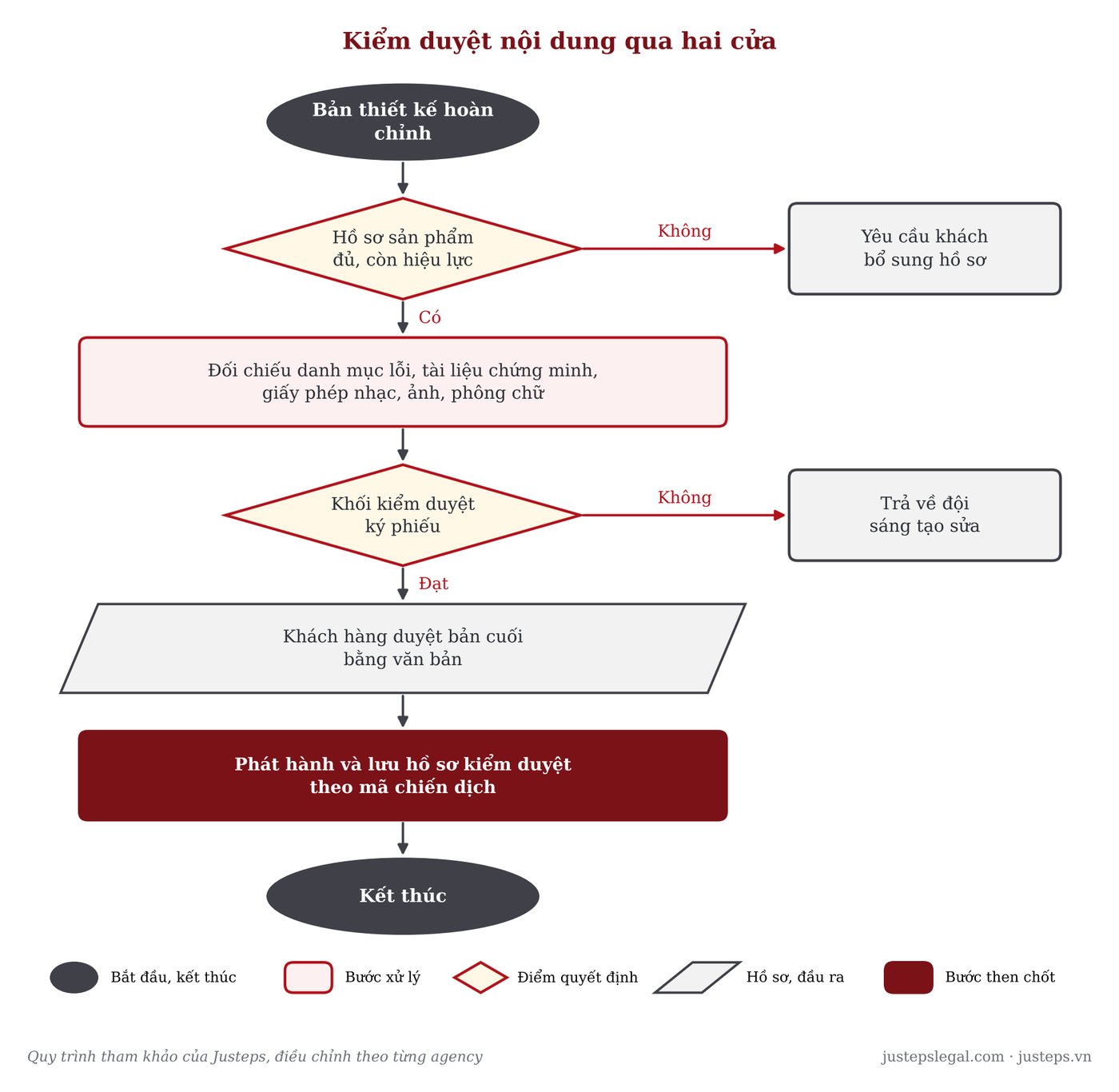
Two-gate content review procedure before publication
At the first gate, the reviewer checks the product’s registration and declaration documents and, where the law requires it, the written certification of the advertising content; if documents are missing, the client is asked to supply them before the creative team starts work. At the second gate, the reviewer compares the design with the list of errors and signs the review form, with the power to send it back to the creative team even if the publication date is close. The version with a signed review form is sent to the client for approval in writing, and the whole file is then kept under the campaign code for use if an explanation is required.
The list of errors is written in groups, each accompanied by the documents the reviewer must see before signing the review form. The table below is the framework Justeps commonly uses, which is then supplemented according to the product categories of the agency’s actual clients.
| Error group | Documents required before signing the review form |
|---|---|
| Absolute terms | Lawful, valid survey results, certifications or awards supporting phrases such as best, only or number one. |
| Comparison with other products | Lawful documents proving the comparison, because comparative advertising without such documents is prohibited[10]. |
| Images of real people | Written consent from the person whose image is used, stating the scope, duration and remuneration[11]. |
| Music, fonts, stock images | A commercial use licence matching the channel, territory and publication period. |
| Products requiring content certification | A valid certification document and a script that does not go beyond the certified content. |
| Online advertising | Signs identifying the content as advertising, as required by the Law on Advertising for online advertising[12]. |
Advertising accounts, digital assets and takedown requests
Advertising accounts on platforms, brand pages, design libraries and licensed software are highly valuable assets, yet they are often registered under the email address of the person who set them up. Justeps’ digital asset regulations require every account to be held in the name of the business or the client depending on the contract model, with a register recording who has been granted administrator rights, the date of grant, the date of withdrawal and the two-factor authentication method. When the agency buys advertising and resells it to the client, the account usually belongs to the agency; when the agency only operates it on the client’s behalf, the account belongs to the client and the agency is granted rights, so the regulations must separate these two cases.
The time limit for removing an infringing advertisement after a competent authority requests it in writing is only 24 hours and applies to every party in the advertising chain[3]. The regulations therefore designate an on-duty contact, give this person the power to suspend distribution without waiting for the director, and require the client and the influencers concerned to be informed immediately. Takedown requests from third parties, such as the owner of a piece of music, are recorded and passed to the person in charge of legal matters for assessment before a decision is made, because not every request is well founded.
Advances, payments on behalf of clients and receivables
Agencies often have to pay advertising platforms in advance, pay deposits for event venues and make advances to influencers, while clients pay only after acceptance. One large client paying late can drain the cash of the whole company, so the advance regulations set a limit for each client, conditions for stopping advances once the client is overdue, and a requirement to reconcile actual costs with the invoices issued to the client after each campaign.
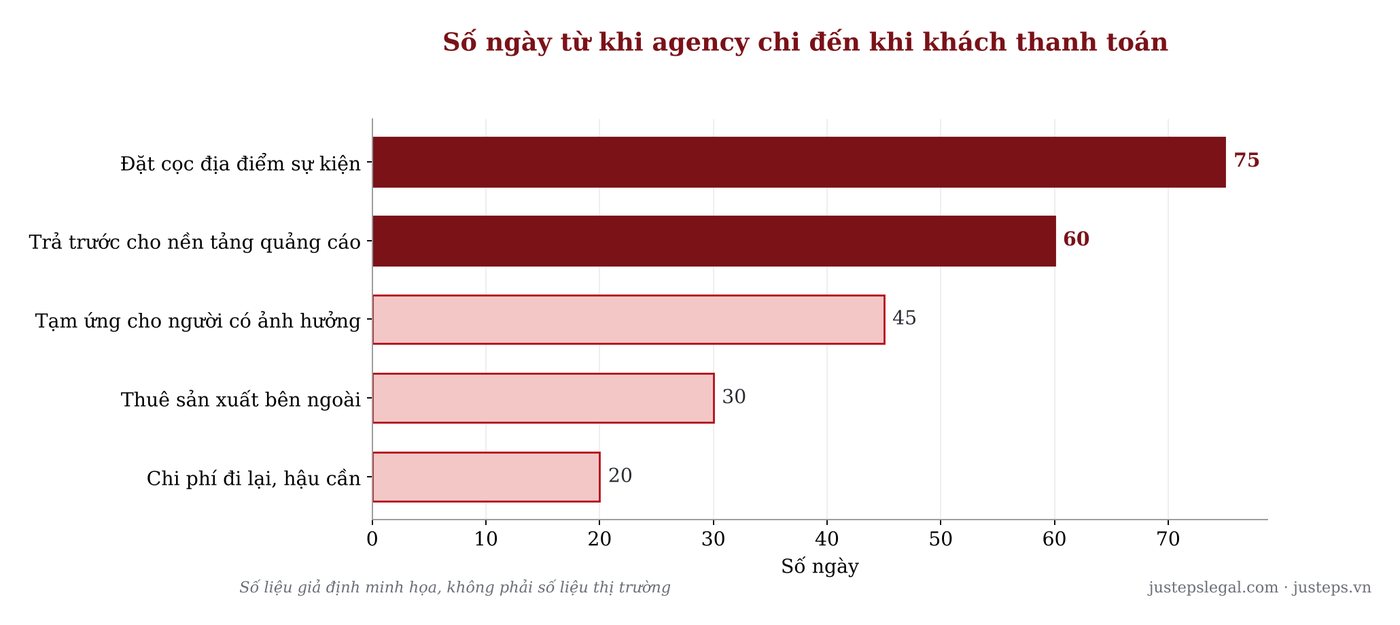
Example of the number of days the agency’s money is tied up for each type of expenditure
In this example, venue deposits and advance payments to platforms tie up the agency’s money the longest, so these are the two items that need strict limits and for which the contract with the client should state clearly the advance payment ratio before the campaign starts. Outsourced production is usually shorter because payment to the supplier can be agreed in stages tied to acceptance. The figures are illustrative only; Justeps recalculates them using each agency’s actual receivables data before proposing thresholds.
The regulations also deal with the documentary and tax issues that come with money paid out on behalf of clients. From 15 December 2025, a payment of VND 5 million or more must be supported by non-cash payment documents to be counted as a deductible expense for corporate income tax purposes[4], so the regulations prohibit employees from taking cash advances to pay suppliers and set out the procedure when an employee is authorised to pay with a personal card. For overseas advertising platforms, the regulations state which unit checks whether the supplier has registered and declared tax in Vietnam itself or whether the agency must withhold and pay on its behalf under the rules on tax administration[5], and the invoice issued to the client must correctly reflect the amount paid on its behalf and the service fee under the rules on electronic invoices[6].
Influencers, collaborators and rights in creative products
The procedure for selecting influencers begins with identity verification, a review of the content they have posted over a period and a check of any past controversies. Influencers must verify the advertiser, check the product documents and announce that they are advertising when they do so[7], so the agency sends with the contract the product file, the script with a signed review form and guidance on how to apply the label for each format. Justeps’ template contract includes clauses on standards of conduct, the obligation to post according to the script, the right to require removal, and the right to terminate and recover payments when the influencer is in breach.
An organisation or individual that enters into a contract with an author is the owner of the economic rights in the work, unless otherwise agreed[8]. The regulations require every design, copywriting, filming and editing collaborator to sign a contract before starting, with a clause establishing that the rights belong to the agency and an obligation to deliver original files. For models’ images, the regulations require written consent stating a scope of use that matches the scope the agency has committed to the client, to avoid the client using images on channels or for periods to which the model has not agreed.
Data on potential customers and confidentiality of pitch ideas
Digital advertising agencies often collect the names, telephone numbers and email addresses of programme participants or people who fill in registration forms. The data subject’s consent must be voluntary and specific to each purpose, and silence is not regarded as consent[9]. In most campaigns the client decides the purpose of processing and the agency only processes data under the contract, so the regulations state where data is stored, who may access it, how it is passed to the client and when it is deleted at the end of the campaign.
Pitch ideas are the agency’s most easily lost asset, because a pure idea is not protected by copyright; only its form of expression is protected. The confidentiality regulations require a non-disclosure agreement to be signed before the presentation if the client agrees, ownership to be marked on the pitch materials, evidence of the completion date to be kept and no editable original files to be left behind after the presentation.
Implementation roadmap, deliverables and fees
Justeps usually needs eight to ten weeks to complete the set of documents for an agency. In the first two weeks, Justeps consultants interview the teams and review template quotations, contracts, payment vouchers and the files of several completed campaigns. Justeps first drafts the three highest-risk regulations, namely content review, digital assets and advances, runs them on live campaigns for about two weeks, measures review times and the number of times files are sent back, and only then finalises the remaining documents.
The set of documents is adapted to the type of agency. A small creative agency focuses on content review, copyright and collaborator contracts; a digital advertising agency also needs regulations on accounts, advances and data; an agency with a large events business may consider the service for building internal procedures and regulations for event, performing arts and entertainment businesses for procedures and programme safety. The deliverables are Word and Excel files the agency can update itself, including the following main documents:
- A set of campaign procedures from receiving the brief through to acceptance, with flowcharts and a template email confirming additional work.
- The two-gate review procedure, the grouped list of errors and the template review form.
- Digital asset regulations, a template account register and regulations on advances, payments on behalf of clients and receivables.
- Template contracts with influencers, collaborators and suppliers, including clauses on rights transfer and advertising labels.
- Regulations on copyright, confidentiality of ideas and data on potential customers, together with a draft issuing decision and training materials.
Justeps quotes a fixed fee in writing after the initial survey. The fee depends on the number of regulations to be drafted, the number of service lines, the extent of existing documents, any need for bilingual documents or alignment with group policies, and whether training and a post-issuance check are required. If it is not yet clear in the organisation who holds the power to review content and approve advances, the business should first use the organisational structure design service for communications, advertising and event agencies.
How Justeps can help
Alongside a set of internal procedures and regulations, communications, advertising and event agencies may combine the following Justeps services:
- Organisational structure design for communications, advertising and event agencies. Justeps arranges the divisions, the authority matrix and the signing limits so that each regulation has a clearly identified person to apply it.
- Ongoing legal advisory for communications, advertising and event agencies. Justeps reviews urgent content, contracts and sales promotion and event procedures every month after the regulations have been issued.
- Advertising compliance and cosmetics registration. Justeps assists with content certification files and review lists for clients in the cosmetics and health products categories.
- Building internal procedures and regulations for event, performing arts and entertainment businesses. Justeps drafts procedures on permits, safety and supplier management for agencies with a large events business.
Frequently asked questions
If the client has approved the content, does the agency still need an internal review?
Yes. The client’s approval only allocates responsibility between the parties under the contract, while the advertising service provider’s obligation to check documents remains with the agency[2]. A signed review form is evidence that the agency has fulfilled this obligation.
In whose name should advertising accounts be held?
It depends on the contract model. If the agency buys advertising and resells it to the client, the account usually belongs to the agency; if the agency only operates it on the client’s behalf, the account belongs to the client and the agency is granted administrator rights. In any case, accounts should not be held under an employee’s personal email address.
What tax obligations arise when buying advertising on overseas platforms?
An overseas supplier without a permanent establishment in Vietnam may register and declare tax itself through the tax authority’s electronic portal; otherwise the buyer in Vietnam may have to withhold and pay on its behalf[5]. The regulations should assign the accounting unit to check each supplier before payment.
What if a client reuses an idea presented in a pitch?
A pure idea is not protected by copyright; only its form of expression is protected. The agency should sign a non-disclosure agreement before presenting, mark ownership on the materials and keep evidence of the date of creation so that it has a basis for negotiation if needed.
May the agency use data on potential customers collected for one campaign in another campaign?
Only if the person providing the data has consented to that purpose and the contract with the client permits it. Consent must be specific to each purpose[9], so the regulations should by default require data to be deleted or handed over to the client at the end of the campaign.
Does an employee who accepts gifts from a supplier breach the regulations?
That depends on the business’s regulations. Justeps usually drafts rules on gifts and conflicts of interest stating the permitted value, the duty to declare and how breaches are handled, because a person approving suppliers who accepts gifts can easily push up campaign costs.
How often should the regulations be updated?
Justeps recommends a review every year and an immediate update when the law on advertising, e-commerce or personal data changes or when a major platform changes its policies. The list of review errors should be updated more often in light of actual cases.
Related articles
- Controlling advertising content within a business and the approval process before publication
- Sales promotion procedures in 2026, when to notify, register and report results
- A 72-hour playbook for handling a legal and communications crisis
- Building internal procedures and regulations for event, performing arts and entertainment businesses across the life cycle of a show
Notes
[1] Clause 1 of Article 119 of the Civil Code No. 91/2015/QH13 dated 24 November 2015.
[2] Point b of Clause 2 of Article 13 of the Law on Advertising No. 16/2012/QH13 dated 21 June 2012, as amended and supplemented by Law No. 75/2025/QH15, effective from 1 January 2026.
[3] Clause 2 of Article 18 of Government Decree No. 342/2025/ND-CP dated 26 December 2025 detailing a number of articles of the Law on Advertising.
[4] Point c of Clause 1 of Article 9 of Government Decree No. 320/2025/ND-CP dated 15 December 2025 detailing the Law on Corporate Income Tax.
[5] The Law on Tax Administration No. 108/2025/QH15, effective from 1 July 2026, and the guiding documents on tax administration for overseas suppliers.
[6] Government Decree No. 254/2026/ND-CP dated 30 June 2026 on electronic invoices and electronic documents, effective from 1 July 2026.
[7] Clause 3 of Article 15a of the Law on Advertising No. 16/2012/QH13 dated 21 June 2012, as amended and supplemented by Law No. 75/2025/QH15, effective from 1 January 2026.
[8] Clause 2 of Article 39 of the Law on Intellectual Property No. 50/2005/QH11 dated 29 November 2005, as amended and supplemented in 2009, 2019, 2022 and 2025.
[9] Article 9 of the Law on Personal Data Protection No. 91/2025/QH15, effective from 1 January 2026.
[10] Clause 10 of Article 8 of the Law on Advertising No. 16/2012/QH13 dated 21 June 2012, as amended and supplemented by Law No. 75/2025/QH15, effective from 1 January 2026.
[11] Clause 1 of Article 32 of the Civil Code No. 91/2015/QH13 dated 24 November 2015.
[12] Article 23 of the Law on Advertising No. 16/2012/QH13 dated 21 June 2012, as amended and supplemented by Law No. 75/2025/QH15, effective from 1 January 2026.
This article is for reference and reflects the regulations in force at the time of publication. Please consult Justeps for advice tailored to your company’s records and situation.
For further information, please contact:
📩 Email: info@justeps.vn
🌐 Website: https://justepslegal.com · https://justeps.vn
🌐 Page: Justeps
☎️ Hotline (Zalo): 096 172 2607
📍 Thanh Xuan Office: 12th Floor, Licogi 13 Tower, 164 Khuat Duy Tien Street, Thanh Xuan Ward, Hanoi, Vietnam
📍 Ha Dong Office: LK06B, No.10, Dong Dua Area, Ha Dong Ward, Hanoi, Vietnam
📍 Ho Chi Minh City Branch: 528 Le Van Sy, Ho Chi Minh City, Vietnam
📍 Hai Phong Office: Truong Thinh Village, Ha Dong Commune, Hai Phong, Vietnam
📍 Quang Ninh Office: Van Don Special Zone, Quang Ninh Province, Vietnam





