
Key takeaways
- A group policy written in English only binds employees in Vietnam once it is incorporated into the internal labour regulations, the labour contract or a regulation issued by the competent body.
- An employer with 10 or more employees must have internal labour regulations in writing and register them, and it may not impose fines or salary deductions in place of labour discipline[3].
- Every payment to the parent company should pass through a procedure that requires a contract, evidence that the service was provided, withholding of foreign contractor tax and related-party documentation before the money is transferred.
- Justeps keeps most of the content of group policies and deals only with the points that differ from Vietnamese law in a separate local application annex, so the group can approve and update the documents easily.
Foreign-invested enterprises (FDI enterprises) usually receive from the parent company a full set of policies written in English, including a code of conduct, human resources policies, a spending policy, anti-bribery rules and data security rules. Many entities simply send the link to their staff and treat that as having regulations in place. The problem only surfaces when the company disciplines an employee for a breach, when the tax authority asks about fees paid to the parent company, or when the bank requests additional documents before transferring money abroad.
This page introduces the Justeps service for building internal procedures and regulations for FDI enterprises and representative offices of foreign traders (representative offices). It explains how to bring group policies into a system of documents that are effective in Vietnam, which groups of regulations to prioritise, how the work is carried out with group head office, the deliverables and the fees. The design of the management structure and the statutory positions is covered on the organisational structure service page in the same group.
How far group policies take effect in Vietnam
In principle, parent company policies are internal governance documents of the group and do not automatically become obligations of the employees or managers of the Vietnamese legal entity. To bind employees, their content must be incorporated into registered internal labour regulations, a salary and bonus regulation or the labour contract. To bind managers, the regulation must be issued by the body competent under the charter, for example by a decision of the owner, the Company Chairman or the General Director depending on the subject matter. For a representative office, regulations are issued under the authorisation of the foreign trader and must remain within the functions of the office[1].
The table below suggests which document to use to turn some common group policies into rules that are effective in Vietnam.
| Group policy | Document in Vietnam | Points to adjust |
|---|---|---|
| Code of conduct, discipline | Internal labour regulations registered with the labour authority, and the labour contract. | Remove fines and salary deductions; breaches and disciplinary measures must be stated specifically. |
| Spending and approval | Financial regulation issued by the body competent under the charter. | Limits expressed in Vietnamese dong and aligned with the authority matrix of the legal entity. |
| Intra-group payments | Procedure for payments to foreign parties, supported by service or licence agreements. | Add steps for withholding foreign contractor tax and preparing related-party documentation. |
| Anti-bribery | Regulation on gifts, hospitality and dealings with state authorities. | Add the rules of Vietnamese criminal law and anti-corruption law. |
| Data security | Personal data protection rules and file for transferring data abroad. | Add the legal basis for processing, consent and impact assessment files under Vietnamese law. |
Where the Vietnamese and English versions are issued together, the issuing decision should state which version prevails in internal relations. For documents registered with state authorities, such as the internal labour regulations, the Vietnamese version is the one that state authorities and the Court will consider, so the translation must be carefully checked for terminology.
Groups of regulations FDI enterprises should prioritise
Internal labour regulations and discipline
The greatest risk usually lies in global human resources policies that provide for fines, salary deductions or dismissal based on performance reviews. The Labour Code prohibits fines and salary cuts in place of labour discipline, and only permits discipline for conduct that is set out in the internal labour regulations, the labour contract or the law[2]. An employer with 10 or more employees must put its internal labour regulations in writing, consult the employee representative organisation where one exists, and register the regulations with the provincial labour authority[3]. A disciplinary decision based on a policy that has not been incorporated into the registered regulations may be held unlawful if the employee complains. Businesses that need to draft or update their regulations may refer to the service for internal labour regulations and disciplinary procedures offered by Justeps.
Procedure for payments to the parent company and other group entities
Management fees, royalties and IT service fees paid to the parent company are the expenses most likely to be examined by the tax authority. Such an expense may be disallowed as a deductible cost if there is no contract, no evidence that the service was actually provided, or if the price does not follow the arm's length principle under the rules on related-party transactions[4]. The Vietnamese party usually also has to withhold, declare and pay foreign contractor tax on behalf of the foreign party before transferring the money, unless the conditions for applying a double taxation agreement are met[5]. The flowchart below describes an indicative payment procedure with the roles divided between departments.
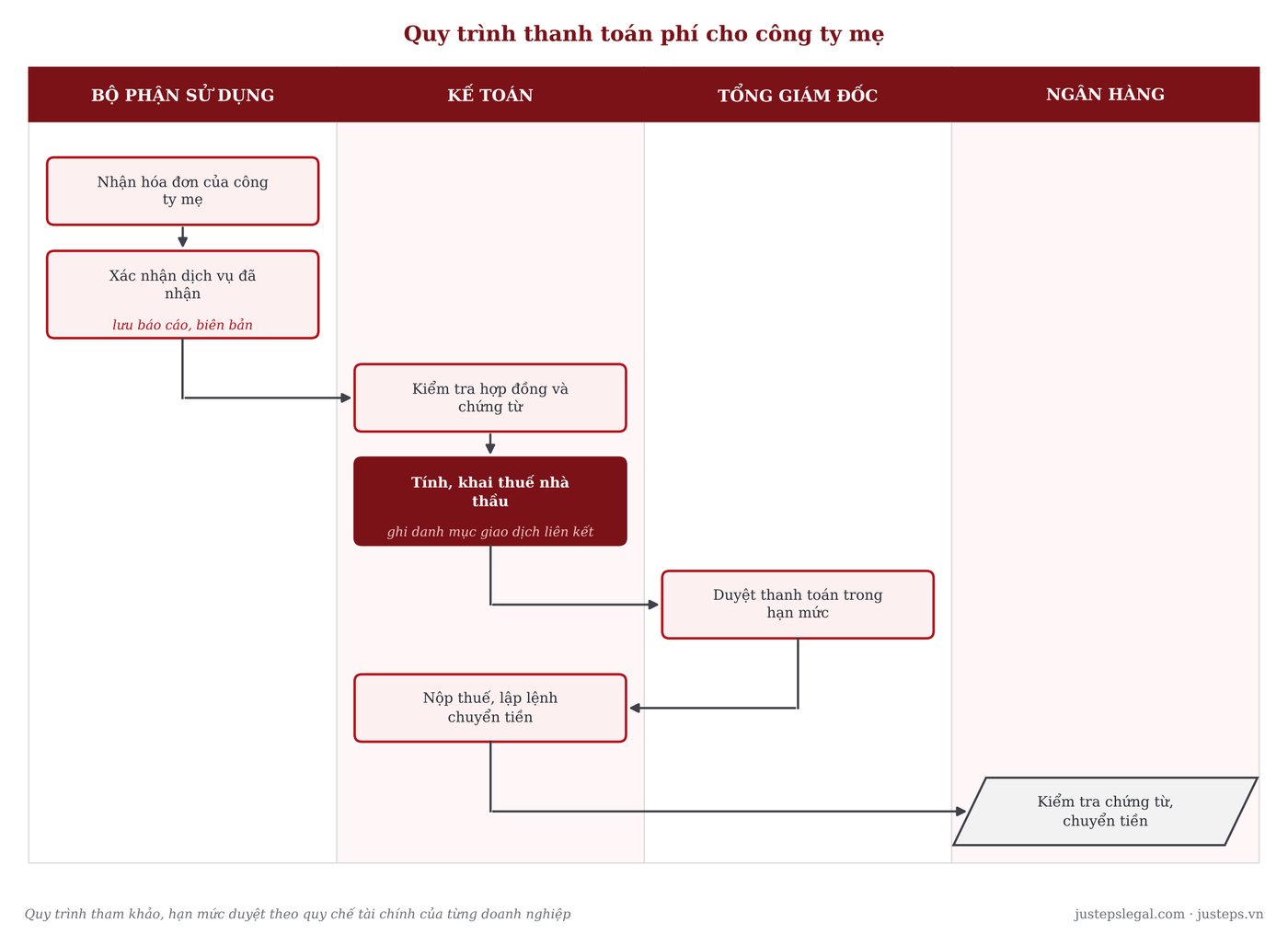
Division of roles in the procedure for paying fees to the parent company
Under this procedure, the department using the service must confirm that the service has been received and keep evidence such as reports, minutes and working emails. Accounting checks the contract, calculates foreign contractor tax and records the transaction in the list of related-party transactions before submitting it to the General Director for approval within the set limit. The bank only transfers the money when the documents are complete, and capital contributions or profits remitted to the investor must pass through the foreign investment capital account under Circular No. 38/2026/TT-NHNN, effective from 18 August 2026[6], so the procedure should keep these two types of cash flow separate.
Personal data protection and anti-bribery
Many FDI enterprises store personnel records and customer data on group systems located abroad. The Law on Personal Data Protection No. 91/2025/QH15 and its implementing instruments require a legal basis for processing, notice to data subjects and an impact assessment file when data is transferred abroad[7]. The data protection regulation must therefore state clearly which data is transferred, who is responsible and how long it is retained.
Group anti-bribery rules are usually drafted under the law of the parent company's home country, whereas employees in Vietnam are liable under the Vietnamese Criminal Code and anti-corruption legislation[8]. Justeps adds specific rules on the value of gifts, hospitality and sponsorship, on how to deal with officials during inspections, and on the internal reporting channel to use when signs of a breach are detected.
How Justeps supports businesses
The Justeps approach is to keep most of the content of group policies, translating, annotating and dealing with the points that differ from Vietnamese law in a separate annex that applies to the legal entity in Vietnam. This makes it easier for group head office to approve the documents, and when the group amends a policy, only the annex needs to be reviewed. The scope of work usually includes a report comparing the policies with Vietnamese law, an internal governance regulation, a financial regulation and a procedure for payments to foreign parties, internal labour regulations, an anti-bribery regulation and personal data protection rules, all drafted bilingually in Vietnamese and English.
Not every policy needs to be dealt with at the same time. In an indicative comparison exercise, the points requiring adjustment are usually concentrated in human resources and intra-group payments, as shown in the chart below.
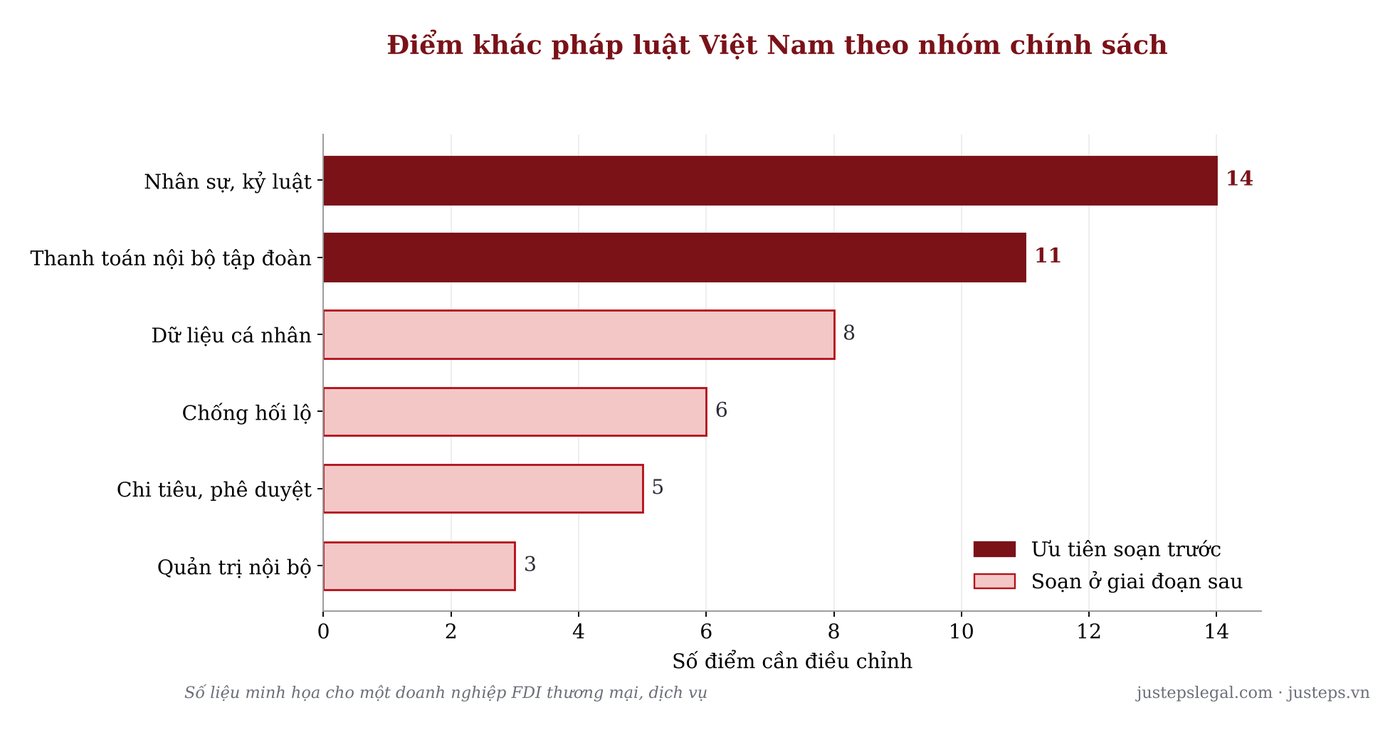
Number of points requiring adjustment by policy group in an indicative comparison exercise
The chart shows that human resources and disciplinary policies differ most from Vietnamese law, followed by the procedure for payments to the parent company. For this reason, Justeps usually drafts the internal labour regulations and the payment procedure first, followed by personal data, anti-bribery and the governance regulation. The figures in the chart are only an example, and the actual order depends on the sector and the state of each business's records. If the organisational structure or the authority matrix is still unclear, the business should first use the organisational structure design service for FDI enterprises and representative offices so that the regulations rest on a sound basis for issuance.
Delivery process and deliverables
A project usually takes ten to twelve weeks. In the first three weeks, Justeps receives the list of group policies, the Investment Registration Certificate, the charter and the regulations currently in use, and then prepares a gap report setting out each point that differs from Vietnamese law and its priority. In the following weeks, the regulations are drafted in the agreed order of priority and sent to group head office for comment in parallel with the executive team in Vietnam. Before issuance, Justeps checks the authority to issue each document, the consultation of the employee representative organisation on the internal labour regulations, and prepares the registration file.
The deliverables include the policy comparison report, the set of bilingual regulations and procedures, a local application annex for each policy, the registration file for the internal labour regulations, the impact assessment file for processing and transferring personal data abroad, the issuing decisions and bilingual training materials. Each regulation has a version tracking page so that the business knows which provision was amended, on what basis and who approved it.
Application by size and service fees
A representative office needs a compact set of regulations focusing on the work it is permitted to do, rules on spending the funds provided by the foreign trader and the annual activity report[9]. A trading or services company should focus on intra-group payments, foreign contractor tax and anti-bribery, while a manufacturing plant needs additional regulations on occupational safety and health, environment and dialogue at the workplace. Conditional sectors such as logistics, retail, education and healthcare need further procedures for monitoring and maintaining their business conditions.
Justeps quotes a fixed fee after reviewing the list of group policies. The fee depends on the number of policies to compare, the number of new regulations to draft, language requirements, the number of working rounds with group head office, and whether registration of the internal labour regulations, the personal data files and training are included. The service proposal sets out the deliverables, the timeline and the work outside the scope.
How Justeps can help
To apply the set of regulations consistently, FDI enterprises and representative offices can combine it with the following Justeps services:
- Organisational structure design for FDI enterprises and representative offices. Justeps sets out the statutory positions and the authority matrix that form the basis for issuing regulations at the right level.
- Ongoing legal advisory for FDI enterprises and representative offices. Justeps monitors legal changes and updates the local application annexes when the law or group policies change.
- Internal labour regulations and disciplinary procedures. Justeps drafts and registers internal labour regulations and guides the human resources department through lawful disciplinary procedures.
- Personal data protection compliance. Justeps prepares the impact assessment files and the files for transferring data abroad for shared group systems.
- Internal financial control systems. Justeps designs control points for spending and intra-group payments according to the level of risk.
Frequently asked questions
Can a group policy in English be applied in Vietnam?
The policy remains valid for internal governance, but to bind employees it must be incorporated into the internal labour regulations, the labour contract or a regulation issued through the proper procedure. Documents submitted to state authorities must have a Vietnamese version.
Does a representative office need internal labour regulations?
A representative office with 10 or more employees must have internal labour regulations in writing and register them as required[3]. An office with fewer staff may agree on disciplinary matters in the labour contract.
Are royalties and service fees paid to the parent company subject to foreign contractor tax?
Usually they are, and the Vietnamese party withholds, declares and pays the tax on behalf of the foreign party[5]. If the business wishes to apply a double taxation agreement, it must prepare the file following the required procedure before payment.
Must an FDI enterprise prepare transfer pricing documentation?
A business with related-party transactions must declare information on those transactions and, in many cases, prepare transfer pricing documentation, unless it is exempt under Decree No. 132/2020/ND-CP[4]. The intra-group payment procedure should collect the supporting documents for this file in advance.
Are the group anti-bribery rules sufficient?
Usually not, because the group rules follow the law of the parent company's home country. The business needs to add rules on gifts, hospitality and dealings with state authorities under Vietnamese law[8].
How often should the set of regulations be reviewed?
The business should review it annually and immediately whenever the group issues a new policy or Vietnamese law changes significantly. The period from 2026 to 2027 brings many new instruments on investment, foreign exchange, labour and data, so a more thorough review is needed.
Related articles
- A minimum set of internal governance regulations for businesses with 50 to 200 staff
- Building internal financial regulations for a limited liability company, spending norms, approvals, advances and settlement
- Personal data protection in the HR department under the 2025 Law on Personal Data Protection
- Opening a representative office of a foreign trader in Vietnam, application file, scope of activities and annual reporting
Notes
[1] Articles 17 and 18 of the Commercial Law No. 36/2005/QH11 dated 14 June 2005.
[2] Article 127 of the Labour Code No. 45/2019/QH14 dated 20 November 2019.
[3] Articles 118 and 119 of the Labour Code No. 45/2019/QH14 dated 20 November 2019.
[4] Decree No. 132/2020/ND-CP dated 5 November 2020 on tax administration for enterprises with related-party transactions.
[5] Legislation on taxes applicable to foreign organisations and individuals doing business in Vietnam or earning income in Vietnam (foreign contractor tax), including the Law on Value Added Tax No. 48/2024/QH15, the Law on Corporate Income Tax No. 67/2025/QH15 and their implementing instruments.
[6] Circular No. 38/2026/TT-NHNN dated 31 July 2026 of the State Bank of Vietnam guiding foreign exchange management for foreign investment activities in Vietnam, replacing Circular No. 06/2019/TT-NHNN.
[7] Law on Personal Data Protection No. 91/2025/QH15 dated 26 June 2025; Decree No. 363/2026/ND-CP guiding this Law.
[8] Criminal Code No. 100/2015/QH13, as amended and supplemented in 2017 (offences relating to corruption, giving and receiving bribes); Law on Anti-Corruption No. 36/2018/QH14.
[9] Decree No. 07/2016/ND-CP dated 25 January 2016 detailing the Commercial Law on representative offices and branches of foreign traders in Vietnam.
This article is for reference and reflects the regulations in force at the time of publication. Please consult Justeps for advice tailored to your company’s records and situation.
For further information, please contact:
📩 Email: info@justeps.vn
🌐 Website: https://justepslegal.com · https://justeps.vn
🌐 Page: Justeps
☎️ Hotline (Zalo): 096 172 2607
📍 Thanh Xuan Office: 12th Floor, Licogi 13 Tower, 164 Khuat Duy Tien Street, Thanh Xuan Ward, Hanoi, Vietnam
📍 Ha Dong Office: LK06B, No.10, Dong Dua Area, Ha Dong Ward, Hanoi, Vietnam
📍 Ho Chi Minh City Branch: 528 Le Van Sy, Ho Chi Minh City, Vietnam
📍 Hai Phong Office: Truong Thinh Village, Ha Dong Commune, Hai Phong, Vietnam
📍 Quang Ninh Office: Van Don Special Zone, Quang Ninh Province, Vietnam





