
Key takeaways
- The company’s revenue must go into an account in the company’s name; continuing to receive customer payments into the household business owner’s personal account makes the declared figures inconsistent with bank and invoice data.
- Expenses are deductible for corporate income tax only where they are supported by lawful invoices and documents, so the purchasing procedure must state clearly when to obtain an invoice, when to prepare a purchase list and how to pay[8].
- The cost of goods sold must be based on goods received notes, goods issued notes and stocktake records; estimated figures of the kind used in household business days will not stand up when the tax authority carries out an inspection.
- A company employing 10 or more workers must have written internal labour rules and register them with the provincial state labour authority[5].
While the business is still a household business, many operating habits work well enough because the owner is in the shop almost all day. Customers transfer money to the owner’s account, goods are bought from small sellers without invoices, wages are paid in cash at the end of the month and all trading is recorded in a single notebook. Once the business becomes a company, these same habits turn into its biggest source of tax and dispute risk, because the company must prove every receipt and payment with documents and is no longer taxed on a lump-sum basis.
This page introduces Justeps’ service for building internal procedures and regulations for household businesses that have just converted into enterprises. The service focuses on the five groups of documents needed first, namely the financial regulation, the sales and invoicing procedure, the purchasing and inventory procedure, the internal labour rules together with the pay regulation, and the personal data protection policy. Choosing the company type and management titles falls within the scope of organisational structure design and is not repeated here.
Why a new company needs regulations from the outset
From 1 January 2026, household businesses and individual traders no longer apply the lump-sum tax method[1], and for a company tax is always calculated on the basis of its books, invoices and documents. Corporate income tax is calculated on income, meaning revenue less deductible expenses, so every expense without supporting documents increases the tax payable. The tax authority increasingly matches e-invoice data against bank transaction data, and newly converted enterprises tend to attract early attention because of their history as household businesses.
Regulations are also a tool for the owner to control the company when they cannot be everywhere at once. The Law on Enterprises requires the owner to separate personal and family spending from company spending and prohibits withdrawing profits while the company has not fully paid its debts that have fallen due[2]. Without a regulation stating which amounts are the owner’s salary, which are distributed profits and when profits may be distributed, this boundary is very easily crossed in daily life.
Common mistakes after conversion
Continuing to collect sales receipts through a personal account
Leaving the owner’s personal account on the payment code displayed at the counter is the most frequent mistake in the first months after conversion. Revenue paid into a personal account means that total receipts do not match the invoices issued, and when a customer asks for a refund or a dispute arises, the company finds it difficult to prove that the money belongs to it. The financial regulation drafted by Justeps sets out the list of accounts that may be used to collect money, how to replace the payment code at the counter and how to handle payments that customers send to the old account by mistake.
Buying goods without invoices and without preparing purchase lists
Many households are used to buying from small traders, farmers or craftsmen without obtaining any documents. For a company, purchases worth VND 5 million or more require non-cash payment documents for input value added tax to be deductible[3], and purchase costs require invoices or lawful documents to be deductible for corporate income tax. For goods bought directly from producers who do not issue invoices, the law allows a purchase list to be prepared in certain cases, subject to conditions on the seller’s details and the method of payment, so the purchasing procedure must specify when a purchase list may be used.
No inventory management and cost of goods sold based on estimates
A household business paying lump-sum tax usually has no need to know its exact cost of goods sold, so stock figures exist only in the owner’s memory. A company, by contrast, must record the cost of goods sold on the basis of goods received notes, goods issued notes and periodic stocktakes; otherwise the declared profit is no more than a guess. Damaged, expired or lost goods also need a confirmation record before they can be written off as an expense, rather than letting stock discrepancies build up until the end of the year.
Which procedures and regulations Justeps builds
Justeps begins by observing an actual working day at the shop, from receiving goods, selling and collecting money to closing the books at the end of the day. The documents change only those points that the law requires or that genuinely create risk, and the rest keeps familiar practices so that sales staff and the accountant can apply them straight away.
Financial regulation and the sales and invoicing procedure
The financial regulation sets out the accounts for collecting money, the cash fund at each outlet, advance limits, authority to approve spending, how the owner is paid a salary and how profits are distributed. The accompanying sales procedure specifies when invoices are issued, how returned orders are handled and how shifts are closed. In many cases, enterprises selling retail directly to consumers must use e-invoices generated from cash registers with a data connection to the tax authority under the regulations on invoices and documents[4]. The figure below shows how three positions work together on a sales day.
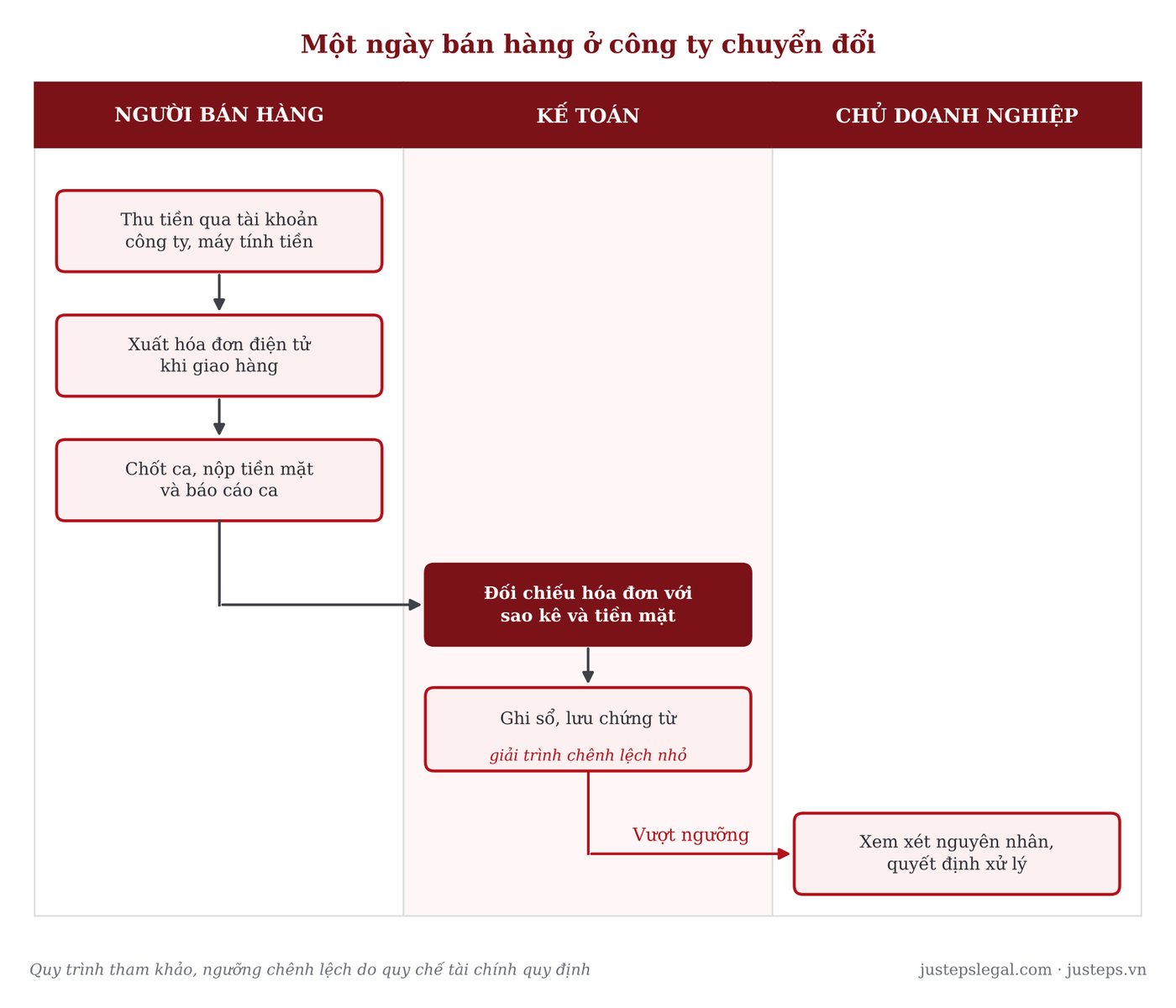
Coordination between sales staff, the accountant and the owner on a sales day
Under this procedure, sales staff collect payment through the company’s account or the cash register and issue an invoice as soon as the goods are delivered. At the end of the day, the accountant reconciles the revenue on the invoices with the bank statement and the cash handed in. Only where a discrepancy exceeds the threshold set in the regulation is the matter passed to the owner, while small discrepancies are recorded and explained by the accountant using a standard form.
Purchasing and inventory management procedures
The purchasing procedure classifies suppliers by their ability to issue invoices, specifies the method of payment for each category and provides a purchase list template for the cases where one is permitted. The inventory procedure covers goods received notes, goods issued notes, transfers of goods between outlets, periodic stocktakes and records for dealing with damaged goods. The two procedures are designed together so that every batch of goods received has an input document, a payment document and a goods received note with matching quantities.
Internal labour rules and personal data policy
Once a company employs 10 or more workers, its internal labour rules must be in writing, drawn up after consulting the employees’ representative organisation where one exists, and registered with the provincial state labour authority[5]. The registration file must be submitted within 10 days of the date of issue[6]. Internal labour rules that are unregistered or fail to list specific violations make it easy for disciplinary action against people who cause losses of cash or goods to be treated as unlawful, so Justeps also drafts rules on handing over cash and goods at each shift as a basis for determining responsibility.
Converted shops usually keep lists of loyal customers, telephone numbers for deliveries and employee records, all of which are personal data. The Law on Personal Data Protection, which took effect on 1 January 2026, requires the collection and use of such data to have a legal basis and to be notified to the data subjects[7]. Justeps drafts a concise personal data protection policy and notice templates for customers and employees, suited to the size of a small company.
Delivery process and deliverables
A project to build regulations for a converted household business usually takes around nine weeks, most of which is spent on the survey and the trial run. The expected time for each group of tasks is shown in the figure below.
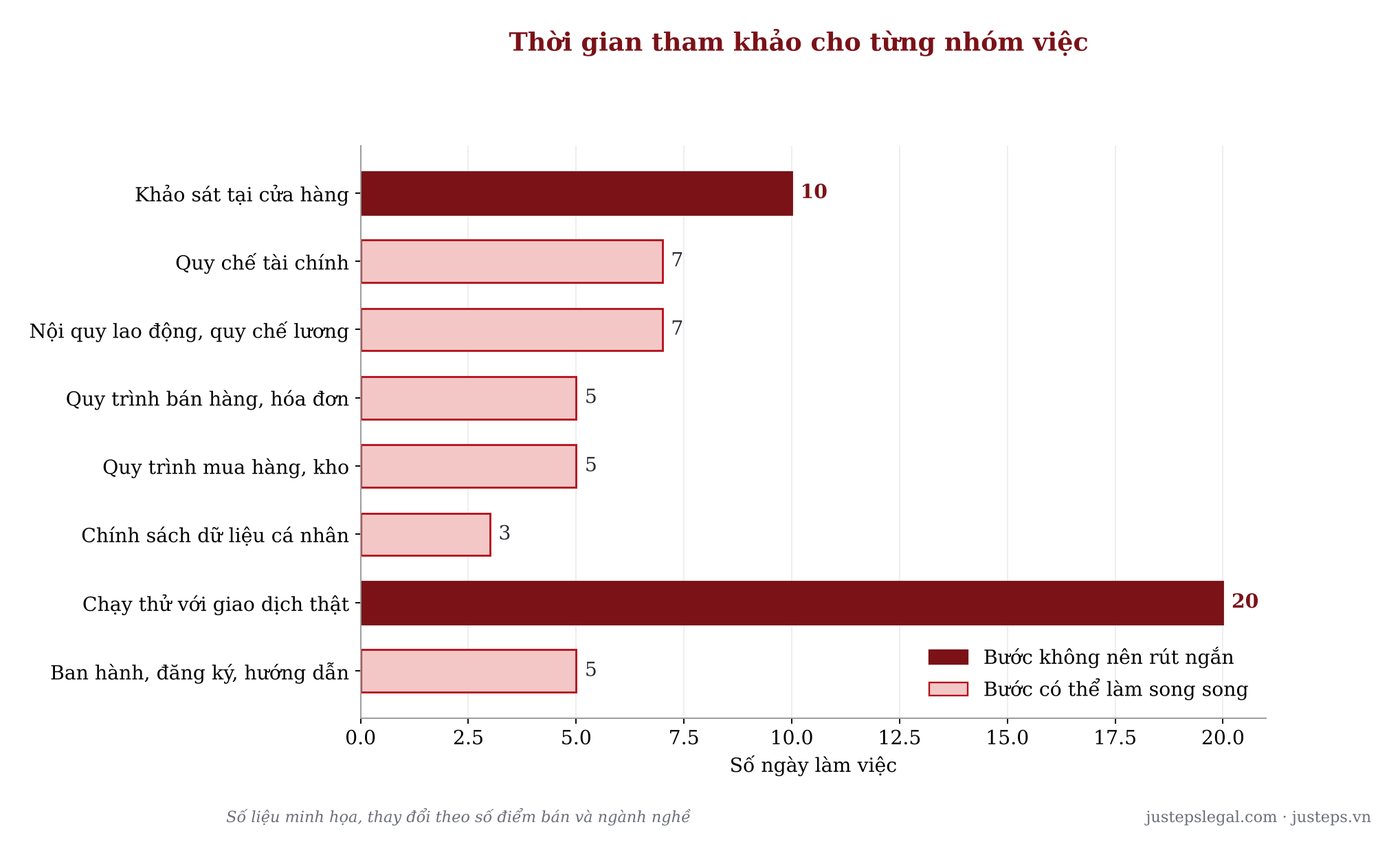
Indicative time for each group of tasks when building internal regulations
The two weeks of survey at the shop and work with the bookkeeper should not be shortened, because documents drafted from ready-made templates are usually followed by nobody. The financial regulation, the internal labour rules and the pay regulation require the owner to decide many points and are therefore done first, followed by the operational procedures and forms. The full set of documents is trialled for at least one month with real transactions, Justeps adjusts it to address the issues that arise and only then drafts the issuing decision and the registration file for the internal labour rules and runs a short briefing for each group of users.
On completion, the company receives the documents in editable electronic form and in signed form for documents requiring issue, arranged by user group and including the following main documents:
- A financial regulation setting out the accounts for collecting money, the cash fund, advances, authority to approve spending and the method of distributing profits.
- A sales, payment collection and invoicing procedure with a flowchart and a shift closing report template.
- Purchasing and inventory procedures with templates for goods received notes, goods issued notes, purchase lists and stocktake records.
- Internal labour rules, a pay and bonus regulation and the file for registering the internal labour rules with the labour authority.
- A personal data protection policy and notice templates for customers and employees.
- A decision issuing the set of regulations and a short user guide for sales staff and the accountant.
Application by size and sector
A single shop with fewer than 10 workers needs only a short set of documents focusing on accounts, invoices and supporting documents, and is not yet required to have written internal labour rules. An enterprise with several outlets also needs rules on transferring goods between outlets, a separate cash fund for each outlet and revenue reports by shift. A small production workshop needs material consumption norms to calculate production costs, together with rules on occupational safety and hygiene at the workplace.
Some sectors have specific requirements that must be built into the procedures. Food businesses need rules on retaining samples and tracing the origin of ingredients, while building materials and agricultural produce shops need a rigorous purchase list procedure because they buy heavily from small producers. Electrical appliance and mobile phone shops need warranty and returns procedures consistent with consumer protection law. The pay regulation as it relates to employment contracts and social insurance is covered in greater depth in the labour, payroll and insurance service for converting household businesses.
What determines the service fee
Justeps quotes a fixed fee in writing after the survey session, not based on the number of pages of documents. The main factors are the number of documents to be drafted, the number of outlets and warehouses, sector-specific requirements, the sales and accounting software in use and whether the company needs Justeps to support it through the trial month and the registration of the internal labour rules. The company may keep its existing software if it can issue e-invoices that comply with the regulations or connect to an e-invoice provider, in which case implementation costs are considerably lower.
How Justeps can help
In addition to internal procedures and regulations, converting household businesses may combine the following Justeps services:
- Organisational structure design for converting household businesses. Justeps chooses the company type and decides who contributes capital, who manages, who signs and how contributed assets are handled before the file is submitted.
- Labour, payroll and insurance for converting household businesses. Justeps standardises employment contracts, salary scales and insurance registration for workers moving from the household business to the company.
- Finance, accounting and internal control. Justeps designs controls over receipts and payments, supporting documents and reconciliations suited to the size of the company.
- In-house training. Justeps shows sales staff, storekeepers and accountants how to apply the new procedures through short training sessions at the shop.
Frequently asked questions
May the owner take money from the company for family spending?
The owner should not freely take company money for family spending. What the owner receives should be a salary under the company’s regulations if they work in the company, or profits distributed after the company has met its tax obligations and fully paid its debts that have fallen due[2].
Should customers still be allowed to pay to a personal payment code as before?
No, because revenue paid into a personal account distorts the company’s figures and makes reconciliation with invoices difficult. The financial regulation should provide that only accounts in the company’s name are used to collect money.
Does a company with fewer than 10 workers need internal labour rules?
The law does not yet require written internal labour rules where there are fewer than 10 workers, but labour discipline and material liability should be agreed in the employment contracts[5]. Once the number of workers reaches 10, the company must issue and register internal labour rules.
Do internal regulations have to be submitted to a state authority?
Most internal regulations do not have to be submitted, except that the internal labour rules of a company with 10 or more workers must be registered with the provincial labour authority[6]. Other documents should be kept ready for presentation when the tax authority or an inspection team asks for them.
Does the company need to replace its current sales software after conversion?
Not necessarily. The current software remains suitable if it can issue e-invoices that comply with the regulations or connect to an e-invoice provider[4]. Justeps checks this point at the survey stage.
How often should the set of regulations be reviewed?
Justeps recommends a review at least once a year and whenever there is a significant change in tax or invoicing rules, a new outlet is opened or the number of workers reaches 10. A review usually requires only a few provisions to be updated rather than redrafting everything.
Related articles
- Building internal financial regulations for a limited liability company, from approval authority to advances and their settlement
- Which documents make up the minimum set of internal governance rules for a company with 50 to 200 staff
- Selling on e-commerce marketplaces in Vietnam and the rules on invoices, tax, returns and complaints
- What the HR department must do to protect employees’ personal data under the 2025 Law on Personal Data Protection
Notes
[1] Clause 6 of Article 10 of Resolution No. 198/2025/QH15 dated 17 May 2025 of the National Assembly on a number of special mechanisms and policies for private economic development.
[2] Article 77 of the Law on Enterprises No. 59/2020/QH14, as amended and supplemented by Law No. 03/2022/QH15 and Law No. 76/2025/QH15.
[3] Law on Value Added Tax No. 48/2024/QH15 dated 26 November 2024 and its implementing documents on the conditions for deducting input tax.
[4] Decree No. 254/2026/ND-CP dated 30 June 2026 of the Government on electronic invoices and electronic documents, effective from 1 July 2026, replacing Decree No. 123/2020/ND-CP and Decree No. 70/2025/ND-CP.
[5] Article 118 of the Labour Code No. 45/2019/QH14 dated 20 November 2019.
[6] Article 119 of the Labour Code No. 45/2019/QH14.
[7] Law on Personal Data Protection No. 91/2025/QH15.
[8] Law on Corporate Income Tax No. 67/2025/QH15 and its implementing documents on expenses deductible when determining taxable income.
This article is for reference and reflects the regulations in force at the time of publication. Please consult Justeps for advice tailored to your company’s records and situation.
For further information, please contact:
📩 Email: info@justeps.vn
🌐 Website: https://justepslegal.com · https://justeps.vn
🌐 Page: Justeps
☎️ Hotline (Zalo): 096 172 2607
📍 Thanh Xuan Office: 12th Floor, Licogi 13 Tower, 164 Khuat Duy Tien Street, Thanh Xuan Ward, Hanoi, Vietnam
📍 Ha Dong Office: LK06B, No.10, Dong Dua Area, Ha Dong Ward, Hanoi, Vietnam
📍 Ho Chi Minh City Branch: 528 Le Van Sy, Ho Chi Minh City, Vietnam
📍 Hai Phong Office: Truong Thinh Village, Ha Dong Commune, Hai Phong, Vietnam
📍 Quang Ninh Office: Van Don Special Zone, Quang Ninh Province, Vietnam





