
Key takeaways
- The internal documents of a pharmaceutical business have two layers, namely standard operating procedures under the good practice principles and commercial regulations governing discounts, drug information and online sales.
- A procedure is only worth something when staff actually follow it, so each procedure needs a one-page flowchart, minimal forms and a trial period before it is issued.
- A business must be able to trace to whom each batch was sold in order to meet its recall obligations, so the recall procedure should be rehearsed at least once a year[7].
- The online retail channel may sell only non-prescription drugs and must exclude specially controlled drugs and drugs on the restricted retail list, so the online sales list needs its own regulation[12].
Almost every pharmacy and pharmaceutical distributor has a set of standard operating procedures, usually drafted in a hurry before the first good practice inspection and copied from template documents. A few years later, the sales software has changed, the warehouse has moved and the business has opened an online channel, but the procedures still describe the old way of working. Inspectors easily notice this when they ask staff how goods are checked on receipt or how returns are handled and hear an answer different from the written text. In addition, commercial risks such as customer discounts, seminar costs, sponsorship and the activities of medical representatives are often not governed by any regulation.
This page introduces Justeps’ service for building internal procedures and regulations for pharmacies, pharmacy chains and drug wholesalers and importers. It covers the structure of the document set, the core professional procedures, the commercial regulations, common mistakes, an implementation roadmap with a trial run and a recall drill, the deliverables and application by business type. Organisational design, monthly legal support and labour policies are presented on three other service pages for the same sector.
The two layers of documents in a pharmaceutical business
The first layer consists of standard operating procedures under the good practice principles applicable to the business type, namely Good Pharmacy Practice (GPP)[1], Good Distribution Practice (GDP)[2] and Good Storage Practice (GSP)[3]. These procedures describe each professional operation, the person performing it, the record forms and how deviations are handled. The second layer consists of commercial regulations governing commercial relationships carrying legal risk that the good practice principles do not address, such as pricing policy, discounts, promotions, drug information and sales through e-commerce. Both layers should share one document list, one coding system and one person managing versions so that they do not contradict each other.
| Document group | Main content | Lead unit |
|---|---|---|
| Purchasing and receipt procedure | Supplier assessment and checks on invoices, origin, expiry dates and transport conditions when goods are received. | Professional and quality |
| Dispensing procedure | Sale of prescription and non-prescription drugs, counselling and records at the counter. | Pharmacist in charge of the pharmacy |
| Storage procedure | Monitoring of temperature and humidity, arrangement, expiry control and goods awaiting decision. | Logistics |
| Recall procedure | Receipt of notices, quarantine, customer tracing, reporting and handling of recalled goods. | Professional and quality |
| Discount and promotion regulation | Customer groups, discount levels and conditions, presentation on invoices and authority to approve exceptions. | Sales and finance |
| Drug information regulation | Approval of materials, activities of medical representatives, seminars and sponsorship. | Professional and legal |
| Online sales regulation | Permitted product list, remote counselling, delivery and protection of buyers’ data. | Pharmacy channel and professional |
The core professional procedures
Purchasing, supplier assessment and receipt
The origin of drugs is the first point inspectors examine, because drugs of unknown origin lead to severe sanctions for both the business and the person in charge of professional pharmacy matters. The purchasing procedure should set out the list of assessed suppliers, the documents to be obtained from suppliers and the frequency of reassessment. On receipt, staff compare the invoice, batch number, expiry date and transport conditions with the purchase order and record any discrepancy immediately; goods with incomplete documents are kept in the pending area and may not be placed on the sales shelves. For a pharmacy chain that purchases centrally, the procedure must also describe transfers between outlets and the documents accompanying each transfer.
Dispensing prescription and non-prescription drugs
A prescription is the basis for selling prescription drugs, and the buyer has the right to choose the retail establishment from which to buy drugs under a prescription[4]. The dispensing procedure needs to state who may sell prescription drugs, how to check that a prescription is valid, how to handle electronic prescriptions, when a drug may be substituted with one having the same active ingredient, route of administration and dosage with the buyer’s consent, and how records are kept. Requirements on the form of prescriptions and on prescribing are set out in a separate instrument of the Ministry of Health[5]. For non-prescription drugs, the procedure focuses on asking for information about the user, counselling and referring the patient to a doctor when symptoms go beyond what self-treatment can address.
Storage, expiry dates and specially controlled drugs
The storage procedure specifies where temperature and humidity monitoring devices are placed, how often readings are recorded, the alert thresholds and what to do when the temperature exceeds the threshold outside working hours. Near-expiry goods, returned goods and goods awaiting a quality decision need separate, clearly marked areas and tracking registers. A business dealing in narcotic drugs, psychotropic drugs, precursors or other specially controlled drugs needs a separate procedure on warehouse conditions, records, persons with access and the reporting schedule, as this group of drugs is subject to a higher level of inspection. Wholesale of specially controlled drugs may not be carried out through e-commerce either[6].
Complaints, stop-sale and recall
The Law on Pharmacy sets out the cases in which drugs are recalled, the form, level and time limits of a recall and the responsibilities of business and retail establishments in carrying it out[7]. To do so, the business must know to which customers a batch was dispatched, in what quantity and on what date, a requirement that many businesses discover they cannot meet only when a real recall notice arrives. The procedure should distinguish a temporary stop-sale when a suspicion first arises from a recall ordered by a competent authority or a voluntary recall, and should state who may take each decision.
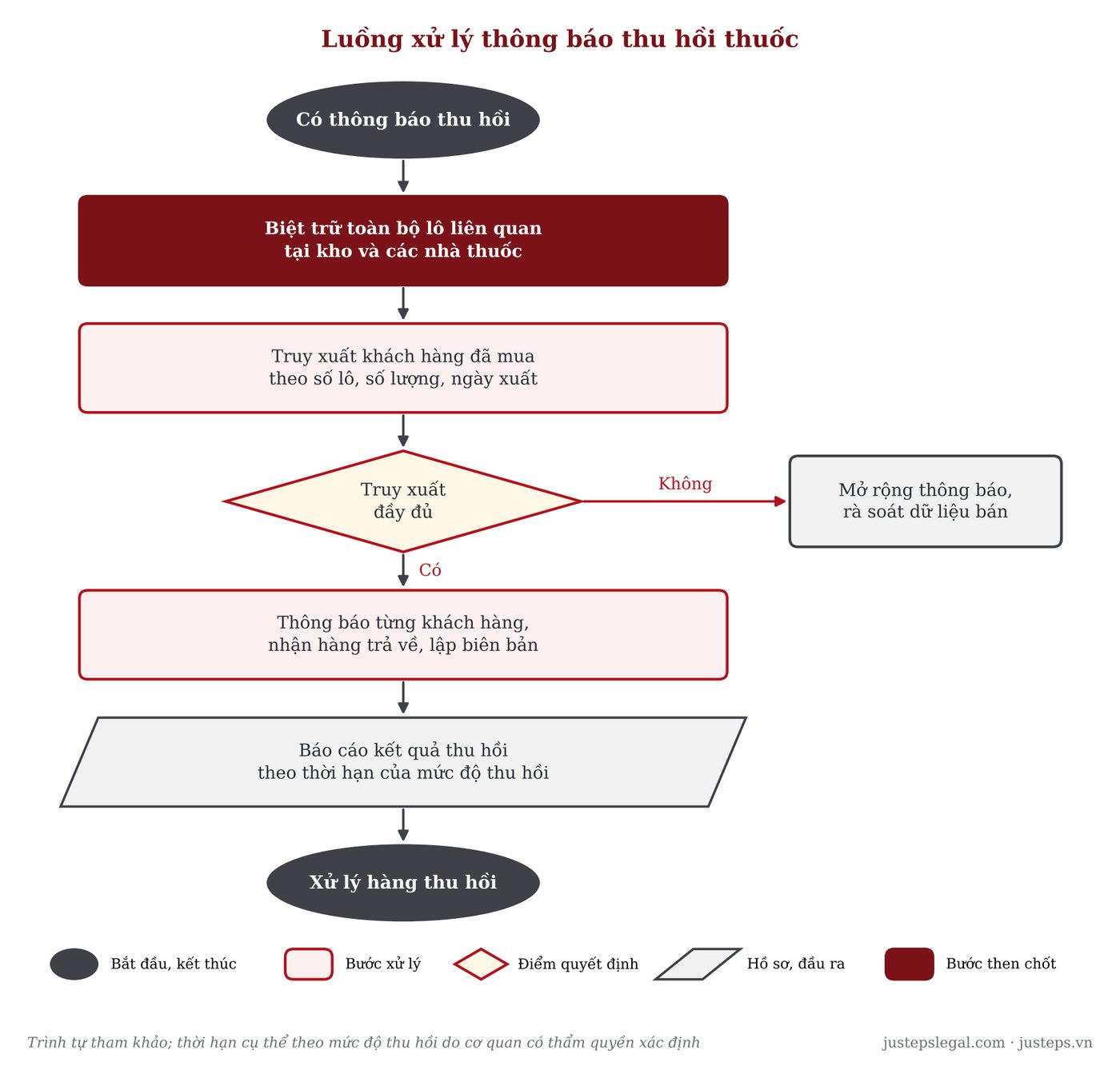
How a drug recall notice is handled in a distributor that also runs a pharmacy chain
On receiving the notice, the professional and quality division first orders quarantine of the entire batch concerned at the warehouse and at the pharmacies, and only then traces the list of customers who bought it. If tracing is complete, the business sends a recall notice to each customer, receives the returned goods, draws up minutes and reports the results within the time limit corresponding to the recall level. If tracing is incomplete, the business must widen the scope of the notice and review its sales data again, which slows down the whole process. For this reason, Justeps always includes a recall drill in the trial phase, using a hypothetical batch to measure the actual tracing time.
The commercial regulations a business needs
Discounts, promotions and receivables
Pharmaceutical law prohibits drug promotions contrary to regulations and prohibits taking advantage of drug prescribing for profit[8]. The discount regulation should group customers such as pharmacies, clinics and hospitals, state discount levels and conditions, how discounts are shown on invoices and who has authority to approve exceptions. Discounts must be recorded on invoices and documents in accordance with the rules on electronic invoices[9]; otherwise the expense may be disallowed as a deductible cost and raise suspicion of non-transparent benefits. The receivables section should set credit limits by customer group, payment terms and the suspension of deliveries when payments are overdue.
Drug information, medical representatives and seminars
Drug information must aim to guide the rational, safe and effective use of drugs and must be accurate and well founded, including the activities of persons sent by a business to introduce drugs to medical practitioners[10]. The regulation should state who may act as a medical representative, which materials may be used and who approves them, and how meetings with healthcare staff are recorded. For seminars and sponsorship, the regulation controls the purpose, the participants, cost norms and supporting documents, and prohibits any payment linked to the quantity of drugs prescribed or used. Drug advertising is a separate activity that applies only to drugs on the list of non-prescription drugs and requires confirmation of its content, so the regulation should keep drug information distinct from advertising[11].
Selling drugs through e-commerce
The amended Law on Pharmacy has formally permitted the sale of drugs through e-commerce, but online retail is only allowed for non-prescription drugs that are neither specially controlled nor on the list of drugs restricted from retail sale[12]. The business must publish full details of its certificate of eligibility for pharmaceutical business, keep buyers’ information confidential, have an online counsellor and organise delivery in a way that preserves drug quality[13]. The guiding Decree also requires publication of the practising certificate details of the person in charge of professional pharmacy matters, presentation of drug information separately from other products and the counsellor’s telephone number on each parcel delivered to the buyer[14]. A pharmacy’s online sales regulation therefore needs a permitted product list settled by the professional division, a counselling script and a packing and delivery procedure.
Common mistakes when businesses build their own documents
From its review projects, Justeps has found that most errors in pharmaceutical businesses lie not in missing documents but in documents that do not match actual operations. The chart below illustrates the share of common error groups in document sets before standardisation.
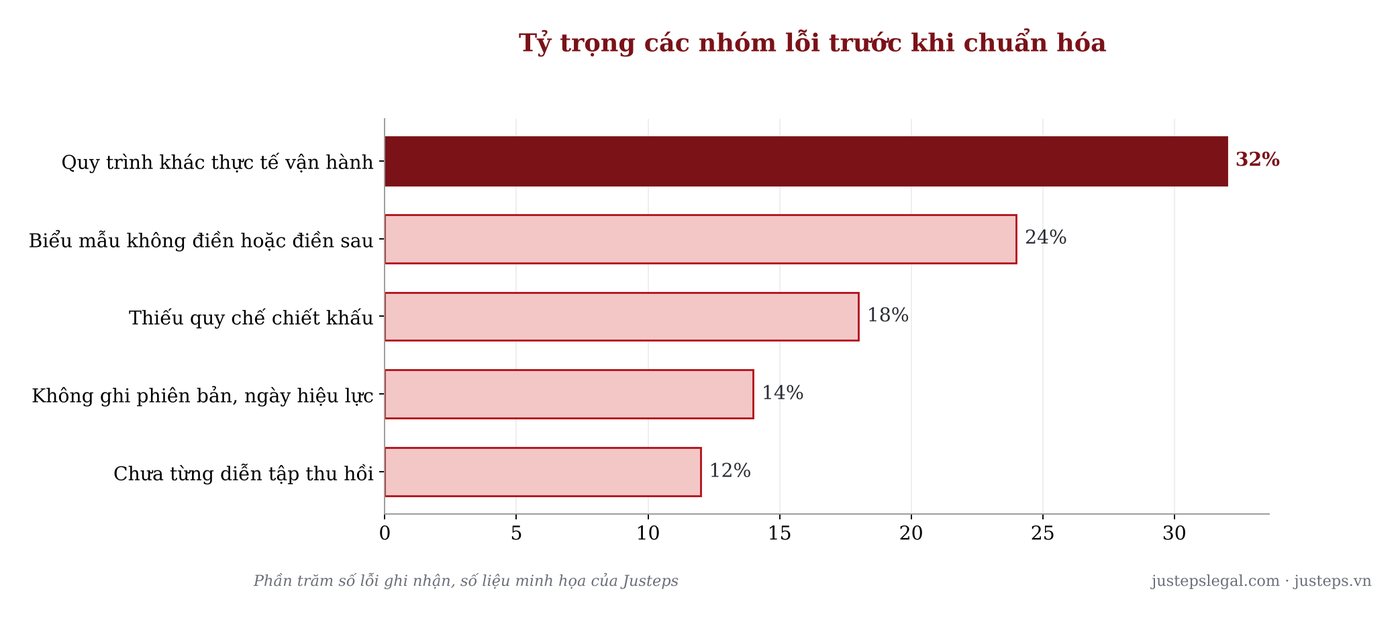
Illustrative share of error groups in the procedures of pharmaceutical businesses before standardisation
The largest error group is procedures describing a way of working different from reality, for example a procedure that records receipt in a handwritten register while the warehouse already uses barcode scanning software. Next come forms that are not filled in or are filled in afterwards, so the records cannot prove that controls were carried out at the time. Many businesses have no regulation on discounts and drug information, do not record version numbers and effective dates, or have never held a recall drill. The figures in the chart are illustrative, and the actual shares differ from one business to another.
Implementation roadmap and deliverables
A project to build a complete set of procedures and regulations for a pharmaceutical business usually takes ten to fourteen weeks, depending on the number of business types and outlets. Justeps consultants observe actual operations at the warehouse and at a number of pharmacies, interview the people doing the work and read the most recent inspection report before drafting. Each procedure has a one-page flowchart and minimal forms, while the commercial regulations are drafted in parallel and checked against tax, bidding and competition law. The trial phase lasts two to three weeks and ends with a recall drill and a final revision before issue.
The set of documents is delivered in editable electronic form, together with draft decisions for signature and issue by the competent person, and comprises the following main documents:
- A list of procedures and regulations with codes, versions, effective dates and responsible persons.
- A set of standard operating procedures with flowcharts and forms for pharmacies, the warehouse and distribution activities.
- A separate procedure for specially controlled drugs with template registers and a reporting schedule, if the business deals in this group of drugs.
- Regulations on discounts, promotions and receivables, a drug information regulation and an online sales regulation.
- Minutes of the recall drill and a lessons-learned report after the trial run.
- Staff training records and a draft issuing decision.
Procedures work best when attached to an organisation in which authority is clearly allocated; if the organisation chart does not yet make clear who is in charge and where the quality unit sits, the business should first carry out, or combine, the organisational structure design service for pharmacy and pharmaceutical distribution businesses. After issue, updating procedures in line with new legislation and answering questions that arise are handled under the ongoing legal advisory service for pharmacy and pharmaceutical distribution businesses.
Application by business type and fees
An independent pharmacy needs a compact set of procedures focusing on purchasing, dispensing prescription and non-prescription drugs, storage, expiry dates, complaints and recall. A pharmacy chain uses the same procedure content across the chain, but each pharmacy still needs local application records approved by its pharmacist in charge, together with procedures for central purchasing, transfers and cross-checks between outlets. A wholesaler needs a full set of warehouse, transport and recall procedures as well as regulations for the hospital channel, while a business that also trades in health supplements, cosmetics or medical devices needs separate areas and records for each type of goods.
Justeps quotes a fixed fee in writing after a preliminary survey. The fee depends on the number of business types on the certificate, the number of pharmacies and warehouses, whether the business deals in specially controlled drugs or sells online, the number of commercial regulations to be drafted and how complete the existing documents are. Justeps’ proposal sets out the list of documents, the trial period, the number of training sessions and the matters outside the scope.
How Justeps can help
Alongside building internal procedures and regulations, pharmacy and pharmaceutical distribution businesses may combine the following Justeps services:
- Organisational structure design for pharmacy and pharmaceutical distribution businesses. Justeps defines the powers of the person in charge of professional pharmacy matters and the quality unit as the foundation for the procedures.
- Ongoing legal advisory for pharmacy and pharmaceutical distribution businesses. Justeps updates procedures when the law changes and answers questions arising in day-to-day operations.
- Company rules and regulations. Justeps drafts general governance regulations consistent with the set of pharmaceutical procedures.
- Financial regulations and delegation of authority. Justeps links the regulations on discounts, seminars and sponsorship with spending norms and approval limits.
Frequently asked questions
Which procedures does a small pharmacy need as a minimum?
A pharmacy needs at least procedures for purchasing and quality control, dispensing prescription drugs, selling non-prescription drugs, storage and quality monitoring, and complaint handling and recall under Good Pharmacy Practice[1].
Can a pharmacy chain use a single set of procedures?
The content can be shared because the chain must apply a single quality management system[15]. Nevertheless, each pharmacy needs local application records approved by its pharmacist in charge and its own records.
How often should a recall drill be held?
Justeps recommends a drill at least once a year and after every change to the warehouse software or dispatch procedure, as this is when traceability is most likely to break down.
What should a discount regulation contain?
The regulation should state customer groups, discount levels and conditions, how discounts are shown on invoices, authority to approve exceptions and the records to be kept, so that discounts are transparent and supported by valid documents[9].
May a pharmacy sell prescription drugs through an app?
No. Retail sale through e-commerce applies only to non-prescription drugs, except in special cases when a group A infectious disease epidemic is declared in accordance with regulations[12].
If a pharmacy uses management software, does it still need written procedures?
Yes. Software helps with recording and tracing, but procedures must still be issued in writing and accurately describe how the software is used, including what to do when the software fails.
What should a business do when the Law on Pharmacy and its guiding instruments change?
The business should review its document list as soon as the new instrument takes effect, update versions, retrain the people concerned and keep records of the changes to show at an inspection.
Related articles
- Pharmacy chain management, pharmacy staff, GPP standards and inventory control
- The minimum set of internal governance rules for businesses with 50 to 200 employees
- Building internal financial rules for a limited liability company, covering spending limits, approval, advances and settlement
- Service for building a system of internal company regulations
Notes
[1] Circular No. 02/2018/TT-BYT dated 22 January 2018 of the Minister of Health on Good Pharmacy Practice, as amended and supplemented.
[2] Circular No. 03/2018/TT-BYT dated 9 February 2018 of the Minister of Health on Good Distribution Practice for drugs and drug ingredients, as amended and supplemented.
[3] Circular No. 36/2018/TT-BYT dated 22 November 2018 of the Minister of Health on Good Storage Practice for drugs and drug ingredients.
[4] Articles 74 and 75 of the Law on Pharmacy No. 105/2016/QH13 dated 6 April 2016, as amended and supplemented by Law No. 44/2024/QH15 dated 21 November 2024.
[5] Circular No. 26/2025/TT-BYT dated 30 June 2025 of the Minister of Health on prescriptions and the prescribing of drugs.
[6] Clause 18, Article 6 of the Law on Pharmacy No. 105/2016/QH13 dated 6 April 2016, as amended and supplemented by Law No. 44/2024/QH15 dated 21 November 2024.
[7] Articles 62, 63, 64 and 65 of the Law on Pharmacy No. 105/2016/QH13 dated 6 April 2016, as amended and supplemented by Law No. 44/2024/QH15 dated 21 November 2024.
[8] Clauses 11 and 12, Article 6 of the Law on Pharmacy No. 105/2016/QH13 dated 6 April 2016, as amended and supplemented by Law No. 44/2024/QH15 dated 21 November 2024.
[9] Decree No. 254/2026/ND-CP dated 30 June 2026 of the Government on electronic invoices and electronic documents, effective from 1 July 2026, replacing Decree No. 123/2020/ND-CP and Decree No. 70/2025/ND-CP.
[10] Article 76 of the Law on Pharmacy No. 105/2016/QH13 dated 6 April 2016, as amended and supplemented by Law No. 44/2024/QH15 dated 21 November 2024.
[11] Article 79 of the Law on Pharmacy No. 105/2016/QH13 dated 6 April 2016, as amended and supplemented by Law No. 44/2024/QH15 dated 21 November 2024.
[12] Clause 17, Article 6 of the Law on Pharmacy No. 105/2016/QH13 dated 6 April 2016, as amended and supplemented by Law No. 44/2024/QH15 dated 21 November 2024.
[13] Clause 4, Article 42 of the Law on Pharmacy No. 105/2016/QH13 dated 6 April 2016, as amended and supplemented by Law No. 44/2024/QH15 dated 21 November 2024.
[14] Government Decree No. 163/2025/ND-CP dated 29 June 2025 detailing and guiding the implementation of the Law on Pharmacy.
[15] Point h, Clause 1, Article 33 of the Law on Pharmacy No. 105/2016/QH13 dated 6 April 2016, as amended and supplemented by Law No. 44/2024/QH15 dated 21 November 2024.
This article is for reference and reflects the regulations in force at the time of publication. Please consult Justeps for advice tailored to your company’s records and situation.
For further information, please contact:
📩 Email: info@justeps.vn
🌐 Website: https://justepslegal.com · https://justeps.vn
🌐 Page: Justeps
☎️ Hotline (Zalo): 096 172 2607
📍 Thanh Xuan Office: 12th Floor, Licogi 13 Tower, 164 Khuat Duy Tien Street, Thanh Xuan Ward, Hanoi, Vietnam
📍 Ha Dong Office: LK06B, No.10, Dong Dua Area, Ha Dong Ward, Hanoi, Vietnam
📍 Ho Chi Minh City Branch: 528 Le Van Sy, Ho Chi Minh City, Vietnam
📍 Hai Phong Office: Truong Thinh Village, Ha Dong Commune, Hai Phong, Vietnam
📍 Quang Ninh Office: Van Don Special Zone, Quang Ninh Province, Vietnam





