
Key takeaways
- A retail chain’s regulations should follow the life cycle of goods and cash, because goods received short at the back door show up as stocktake discrepancies and money taken wrongly at the till shows up as discrepancies at shift close.
- Each master regulation needs to be accompanied by a short operating handbook for shift staff, with checklists for opening, handing over and closing a shift, because new staff cannot absorb a document several dozen pages long.
- Discounting near-expiry goods at the store and running a chain-wide sales promotion are two different matters that need two separate approval flows[5].
- Cash or stock shortages must be verified and recorded in accordance with the internal labour rules before the employee’s liability is discussed, and must never be deducted from wages automatically[7].
A convenience store may sell several thousand product lines, receive goods from dozens of suppliers every week and rotate staff across three shifts a day. When working methods are passed on only by word of mouth from old staff to new, each store gradually develops its own way of receiving goods, counting the till and handling expired goods. The consequences surface as a steadily rising shrinkage rate, shift closes with discrepancies that nobody can explain, and penalty reports for out-of-date goods still sitting on the shelves.
This page introduces Justeps’ service of building internal procedures and regulations for convenience store chains, mini-supermarkets and specialist store chains. It focuses on how staff work day to day with goods, cash and customers, together with the compliance evidence a store needs to keep when an inspection team arrives. Who may do what and who decides what has already been determined under the organisational structure design service for retail chain and convenience store businesses, while this page sets out how the work is done.
A set of regulations following the life cycle of goods and cash
Justeps does not build regulations department by department but along the path that goods and cash take through the chain, because errors at an earlier stage always appear at a later one. Goods received short but signed for in full become a stocktake discrepancy, a shelf price that does not match the system price becomes a complaint at the till, and incorrect change becomes a discrepancy at shift close. A complete set of regulations for a retail chain usually comprises the following parts:
- A goods management regulation covering ordering, receipt, display and stocktaking through to handling near-expiry goods, write-offs and returns to suppliers.
- A cash and payment regulation covering till management, shift handover, bank deposits and reconciliation of non-cash payment channels.
- A restricted sales procedure for alcohol, beer and tobacco, including the staff member’s right to refuse a sale.
- A regulation on pricing, price display and promotions, setting out which matters belong to head office and which the store may handle itself.
- A food safety procedure for the fast-food counter, a fire prevention procedure and a procedure for handling security incidents.
- A regulation on receiving complaints, exchanges and returns, and managing CCTV and member customer data.
- A procedure for verifying cash and stock shortages and passing the file to the liability procedure under the internal labour rules.
Each master regulation is written as a full document to be issued and relied on in the event of a dispute, but it is accompanied by an operating handbook of a few pages for shift staff. The handbook uses short sentences, screenshots of the sales software and checklists for opening, handing over and closing a shift, so that new staff can learn it on their first working day.
Goods receipt, product labels and near-expiry goods
The back door of a store is where most shrinkage arises, yet it receives little attention. The goods receipt procedure Justeps builds requires staff to count in the smallest unit, check against the purchase order in the software, check expiry dates and packaging, record the temperature of chilled goods and sign only for what is actually received. Missing goods, damaged goods or goods with a shorter shelf life than agreed with the supplier are recorded immediately on the delivery note and signed by the delivery person.
Goods in circulation must bear labels with the mandatory particulars, and imported goods must have labels showing the mandatory particulars in Vietnamese before being put on sale[1]. Product labelling is now governed by Decree No. 37/2026/ND-CP, which replaces Decree No. 43/2017/ND-CP and Decree No. 111/2021/ND-CP, so chains selling imported goods such as cosmetics, snacks and mother and baby products should update the label check at goods receipt. Stores also may not sell food past its expiry date[2], so the regulation sets a schedule for checking expiry dates on the shelves by product group, a first-in first-out principle and the point at which goods move into the near-expiry group.
Near-expiry goods are discounted within a range set in advance by the purchasing division, while expired goods must be removed from the shelves immediately and placed in a separate area pending destruction. Each write-off requires a report signed by the person proposing it and an independent person confirming it, with a list of product codes, quantities, reasons and photographs. A complete write-off file both closes the gap for fraud and provides the basis for the accountant to consider treating the value of destroyed goods as an expense at tax finalisation[3].
Displayed prices and sales promotions
Retail businesses must display the prices of goods and may not sell above the displayed price[4]. A common error is that the shelf label has not been changed after the price in the software has changed, or a promotional price has expired but the label remains on the shelf. Justeps’ pricing regulation provides that only head office may change prices in the system, stores print and replace shelf labels before opening on the effective date, the shift leader spot-checks a number of product codes each shift, and when a customer reports a price discrepancy the store charges the lower price and reports back to head office.
Sales promotions such as buy one get one free, gifts, prize draws or loyalty points must be carried out in accordance with the rules on promotions, including notification or registration procedures depending on the form and certain limits on the level of discount[5]. Decree No. 81/2018/ND-CP on promotions has been amended and supplemented by Decree No. 239/2026/ND-CP, so old promotion templates should be reviewed before they are used again. The regulation therefore draws a clear line between discounting near-expiry goods within an approved range, which the store may do, and sales promotions, which only head office may design, register and instruct stores to apply.
Shift closing, cash and invoices
A convenience store takes payment through several channels at once, including cash, bank cards, QR code transfers, e-wallets and gift vouchers. An electronic invoice must be issued for each transaction in accordance with the invoicing rules, usually generated directly from a cash register connected to the tax authority[6]. When the figures in the software, the cash in the till and the money arriving in the bank account are not reconciled every shift, discrepancies build up until the end of the month and nobody can explain them any more.
Justeps applies a two-person check to every cash handover. The flowchart below describes the shift closing flow Justeps usually proposes for convenience stores.
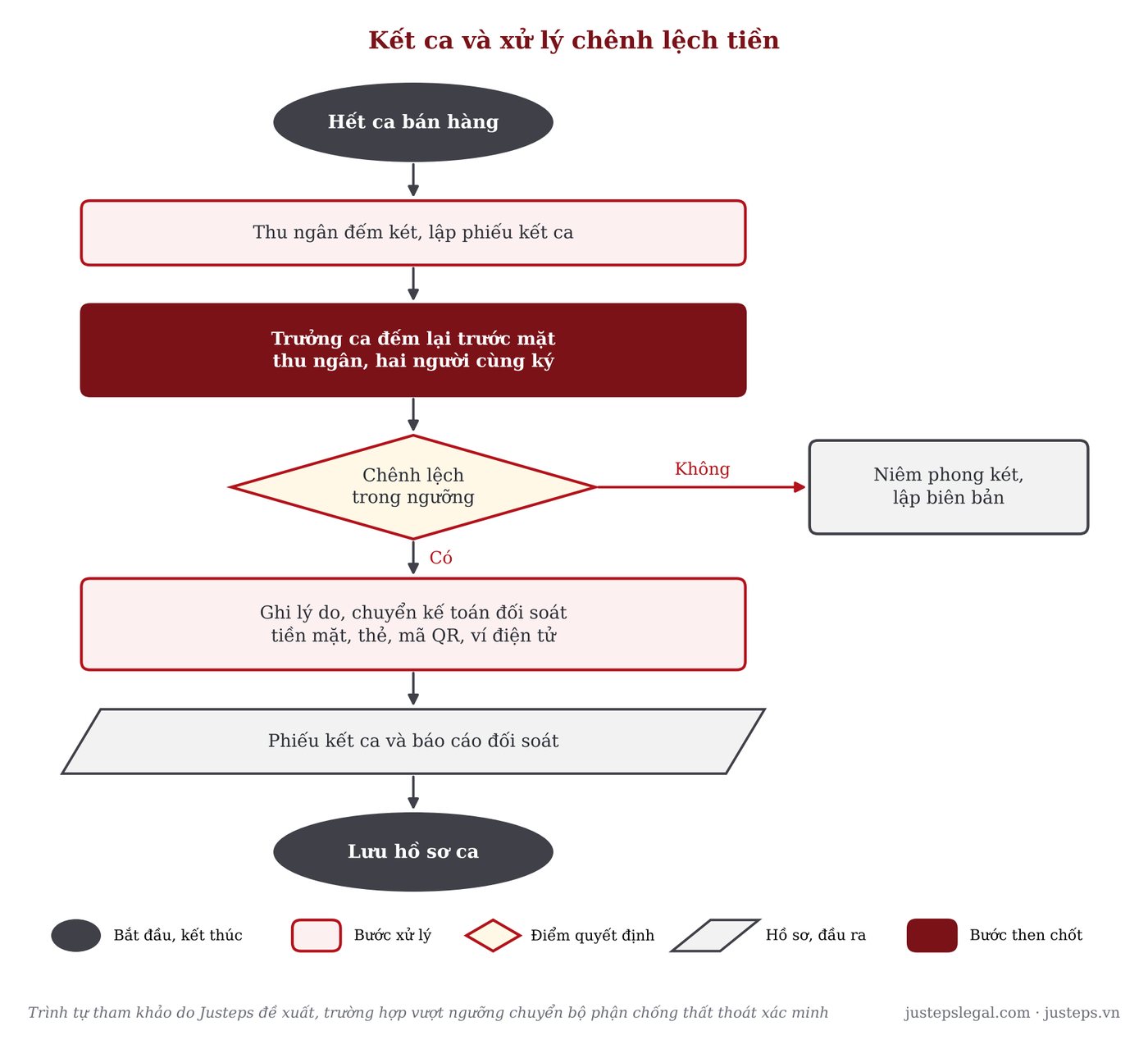
Shift closing flow and handling of cash discrepancies at a convenience store
Under the flowchart, the cashier counts the till and prepares the shift closing slip, then the shift leader recounts it in front of the cashier and both sign. If the discrepancy is within the threshold accepted by the chain, the shift leader records the reason and passes the figures to the accountant for reconciliation against card, QR code and e-wallet data. If the discrepancy exceeds the threshold, the till is sealed, both parties make a report and the loss prevention unit verifies the matter through CCTV and the transaction log. Only after that verification is the file passed to the procedure for considering liability under the internal labour rules, because labour law does not permit fines or wage cuts in place of disciplinary action[7]. How fault, compensation and wage deductions are determined is set out under the labour, wages and social insurance service for retail chain and convenience store businesses.
Selling alcohol, beer and tobacco
The law prohibits selling alcohol and beer to persons under 18[8] and prohibits selling tobacco to persons under 18[9]. E-cigarettes and heated tobacco products fall within the business lines in which investment is prohibited under the 2025 Law on Investment[10], so stores may not accept these products on consignment or display them in any form. Alcohol and tobacco also may not be used as promotional goods or free gifts under the rules on promotions[5].
Justeps’ restricted sales procedure sets up an alert on the till when alcohol, beer or tobacco is scanned so that the cashier asks for identification if the customer appears under age, and records the staff member’s right to refuse a sale without being penalised for lost revenue. Night-shift staff are trained on how to refuse a customer who is drunk, how to call for help when threatened, and to log each refusal as evidence in the event of an inspection.
Complaints, exchanges and returns, CCTV and customer data
The complaints regulation sets out the point of contact, the response time, the shift leader’s authority to exchange goods or refund immediately within a limit, and the cases that must be escalated to head office. Consumer protection law requires businesses to have a mechanism for receiving and resolving complaints and to provide truthful information about goods[11]. For goods with manufacturing defects, the procedure links to notifying the supplier and withdrawing the goods from the whole chain when a recall notice is issued.
CCTV recording customers and staff, and loyalty schemes storing telephone numbers and purchase histories, are all personal data processing activities[12]. The regulation needs to state the purpose of recording, camera locations, the retention period, who may view the footage and how requests for extraction are handled, together with a notice displayed in the store. For member schemes, Justeps drafts the notice and requests consent for each purpose, separating marketing messages from loyalty points. Chains holding large volumes of data can go further through the personal data protection compliance service.
Where shrinkage comes from
Before writing the regulations, Justeps analyses the shrinkage figures and the shift closes with discrepancies over the last few months to know which stage to prioritise. The chart below illustrates the breakdown of causes of shrinkage at a chain of about thirty convenience stores.
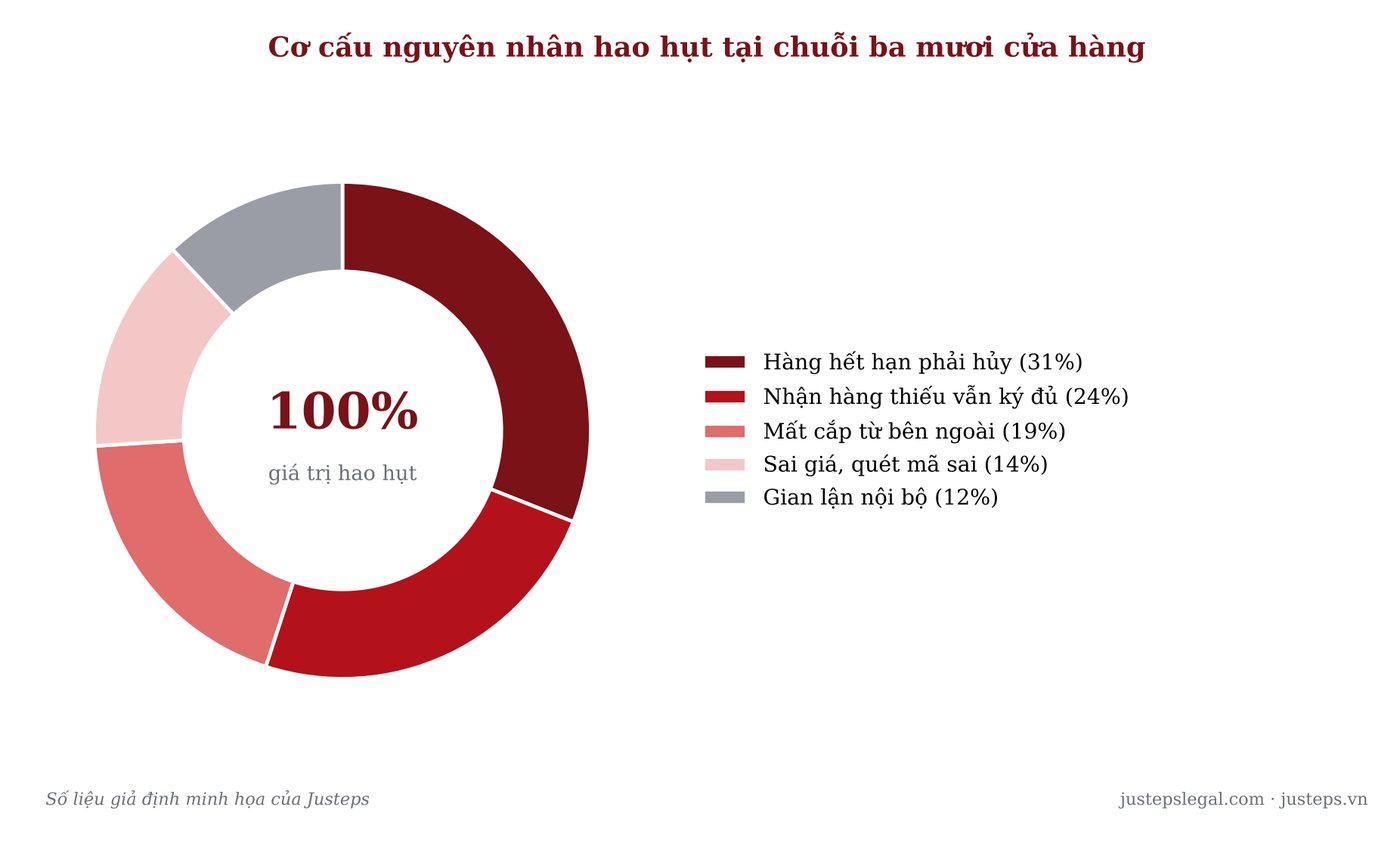
Example breakdown of causes of shrinkage at a chain of thirty convenience stores
In the example, expired goods that had to be destroyed account for 31% of the value of shrinkage and goods received short but signed for in full account for 24%, meaning that more than half of the shrinkage lies in ordering and receiving rather than at the till. External theft accounts for 19%, pricing and scanning errors for 14% and internal fraud for 12%. With this breakdown, the chain should prioritise the goods receipt procedure and expiry date management first, and only then CCTV and till controls. Approval thresholds and financial controls at chain level can be designed consistently through the financial internal control system service.
Timeline, deliverables and fees
A project usually takes eight to twelve weeks depending on the number of regulations. Justeps surveys several stores representative of each model, reviews recent shrinkage figures, complaints and inspection reports, maps current practice and then proposes a priority list together with thresholds such as the acceptable cash discrepancy and the value of write-offs a store may decide on itself. The draft is piloted at a model store and adjusted, then issued, and regional managers, store managers and shift leaders are trained. About three months after issue, Justeps checks how it is being applied at several stores and proposes amendments. The deliverables comprise the following documents:
- A set of master regulations on goods, cash, pricing, promotions, restricted sales, complaints and customer data.
- An operating handbook for shift staff with checklists for opening, handing over and closing a shift.
- A set of forms for goods receipt, cash handover, stocktaking, write-offs and explanation of discrepancies.
- Personal data processing notices for CCTV and the member scheme.
- Training materials on restricted sales and handling customer complaints.
- A draft issuing decision and a plan for periodic checks on application.
Justeps quotes a fixed project fee in writing after the initial discussion. The fee depends on the number of regulations, the number of store models to be surveyed, whether there is a food preparation counter or restricted sales, the need for bilingual documents and whether the business needs training and post-issue checks. Questions arising when applying the regulations, such as a new promotion or an inspection, can be supported through the ongoing legal advisory service for retail chain and convenience store businesses.
How Justeps can help
Alongside internal procedures and regulations, retail chain and convenience store businesses can combine the following Justeps services:
- Organisational structure design for retail chain and convenience store businesses. Justeps defines the functional divisions, the regional management tier, shift leaders and the allocation of authority on which the regulations are built.
- Labour, wages and social insurance services for retail chain and convenience store businesses. Justeps drafts internal labour rules and material liability procedures that match the shift closing procedure.
- Personal data protection compliance. Justeps reviews CCTV and member customer data and drafts notices, consent forms and impact assessment files.
- Financial internal control system. Justeps designs approval thresholds and control points for cash flow and inventory across the chain.
Frequently asked questions
May a cashier who is short at shift close have the amount deducted directly from wages?
No. Labour law does not permit fines or wage cuts in place of disciplinary action[7]. The business must verify the matter, make a report and deal with liability for compensation following the procedure in the internal labour rules.
May staff refuse to sell alcohol or tobacco when a customer cannot prove their age?
Yes, and the regulation should state this right clearly. The law prohibits selling alcohol, beer and tobacco to persons under 18[8][9], so a staff member who refuses a sale when in doubt is protecting the store.
Does discounting near-expiry goods require promotion procedures?
It depends on how it is done. Reducing the price of goods about to expire to sell them quickly differs from a promotion that is notified or involves gifts or prize draws[5]. The chain’s regulation should describe both cases clearly so that stores do not run promotions on their own.
Do customers need to be notified about CCTV in the store?
Yes. The images recorded are personal data, so the store needs to give notice of the purpose of recording, the retention period and the point of contact[12]. Justeps drafts a notice for display at the entrance and a procedure for extracting data on request.
Do internal regulations have to be registered with a State authority?
Operating regulations such as those on goods and cash do not need to be registered. However, the internal labour rules of an employer with 10 or more employees must be in writing and registered with the labour authority[7].
How often should the regulations be amended?
They should be reviewed every year and immediately when the chain changes its sales software, adds a new store model, opens a fast-food counter or when the rules on invoices, promotions or product labels change. 2026 brought many new documents in these areas, so many chains need to update.
Related articles
- Organisational structure design for retail chain and convenience store businesses, from store and region to head office
- Labour, wages and social insurance services for retail chain and convenience store businesses with night shifts and cashiers
- Sales promotion procedures in 2026, when to notify, register and report results
- The year-end stocktaking process for businesses, from planning to handling discrepancies
Notes
[1] Government Decree No. 37/2026/ND-CP dated 23 January 2026 on product labelling, replacing Decree No. 43/2017/ND-CP and Decree No. 111/2021/ND-CP.
[2] The Law on Food Safety No. 55/2010/QH12 dated 17 June 2010.
[3] The Law on Corporate Income Tax and the documents amending and supplementing it, and Government Decree No. 320/2025/ND-CP dated 15 December 2025 detailing the Law on Corporate Income Tax.
[4] The Law on Prices No. 16/2023/QH15 and the documents amending and supplementing it.
[5] The Commercial Law and the documents amending and supplementing it; Government Decree No. 81/2018/ND-CP dated 22 May 2018 detailing the Commercial Law on trade promotion activities, as amended and supplemented by Decree No. 239/2026/ND-CP dated 26 June 2026.
[6] Government Decree No. 254/2026/ND-CP dated 30 June 2026 on electronic invoices and electronic documents.
[7] The Labour Code and the documents amending and supplementing it.
[8] The Law on Prevention and Control of Harmful Effects of Alcoholic Beverages No. 44/2019/QH14.
[9] The Law on Prevention and Control of Harmful Effects of Tobacco No. 09/2012/QH13.
[10] Point l, Clause 1, Article 6 of the Law on Investment No. 143/2025/QH15 dated 11 December 2025.
[11] The Law on Protection of Consumer Rights and the documents amending and supplementing it.
[12] The Law on Personal Data Protection No. 91/2025/QH15 and Government Decree No. 356/2025/ND-CP detailing that Law.
This article is for reference and reflects the regulations in force at the time of publication. Please consult Justeps for advice tailored to your company’s records and situation.
For further information, please contact:
📩 Email: info@justeps.vn
🌐 Website: https://justepslegal.com · https://justeps.vn
🌐 Page: Justeps
☎️ Hotline (Zalo): 096 172 2607
📍 Thanh Xuan Office: 12th Floor, Licogi 13 Tower, 164 Khuat Duy Tien Street, Thanh Xuan Ward, Hanoi, Vietnam
📍 Ha Dong Office: LK06B, No.10, Dong Dua Area, Ha Dong Ward, Hanoi, Vietnam
📍 Ho Chi Minh City Branch: 528 Le Van Sy, Ho Chi Minh City, Vietnam
📍 Hai Phong Office: Truong Thinh Village, Ha Dong Commune, Hai Phong, Vietnam
📍 Quang Ninh Office: Van Don Special Zone, Quang Ninh Province, Vietnam





