
Key takeaways
- In an inspection, the first question is usually whether the business follows the procedures it has issued, so a polished regulation that does not match the systems is more damaging than a short regulation that is followed correctly.
- Internal regulations on anti-money laundering must contain all the content required by law, from the client acceptance policy to the responsibilities of each unit, and must be reviewed and assessed every year[3].
- The margin call procedure and the debt collection procedure are the two documents most likely to give rise to complaints, so they must clearly state thresholds, notification channels, contact time windows and the conduct prohibited for staff.
- Justeps delivers a list of mandatory documents with their status and review dates, a set of tested regulations, flowcharts, forms and a table matching procedures against user rights on the systems.
In a financial business, internal regulations are both an operating tool and evidence of compliance. When the State Securities Commission or the State Bank of Vietnam carries out an inspection, the inspection team usually compares the documents issued with system logs, client files and the way staff actually work. Many businesses have every required document in name, but the content has been copied from elsewhere and does not match the trading software or lending system in use, so when a dispute with a client arises, their own documents become evidence against them.
This page introduces Justeps’ service for building internal procedures and regulations for securities companies, securities investment fund management companies and finance companies operating in consumer lending. It covers the groups of documents required by law, the highest-risk procedures, common mistakes, how Justeps drafts documents and tests them on the systems, the deliverables and how the work is adapted to each type of business. Organisational design, ongoing advice and employment arrangements are covered on separate service pages in the same group.
Groups of internal documents required by law
Each type of business has its own set of business documents. A securities company needs procedures for each business line in its licence, such as brokerage, margin trading, proprietary trading, underwriting and advisory, together with regulations on internal control, risk management and professional ethics as guided by the Ministry of Finance[1]. A fund management company needs procedures for investment, asset valuation, allocation of orders between funds and portfolios, and the control of conflicts of interest. For credit institutions, the Law on Credit Institutions requires internal rules to be issued for each business activity, with control, internal audit and risk management mechanisms attached to each procedure[2].
Alongside the business documents, all three types must have internal regulations on anti-money laundering, covering the client acceptance policy, the client identification procedure, the risk management policy, the transaction reporting procedure, the procedure for detecting and reporting suspicious transactions, record-keeping and confidentiality, recruitment and training, internal control and internal audit, and the responsibilities of each unit[3]. The Law on Personal Data Protection No. 91/2025/QH15, effective from 1 January 2026, adds requirements for electronic client verification, credit scoring and data sharing with partners[4]. The table below summarises the key documents for each type of business.
| Type of business | Key business documents | Documents often overlooked |
|---|---|---|
| Securities company | Procedures for account opening, order taking, margin trading, proprietary trading, underwriting and management of the restricted list. | Rules on personal dealing by staff and the procedure for handling trading system incidents. |
| Fund management company | Procedures for investment decisions, net asset valuation, order allocation and management of discretionary portfolios. | The procedure for handling valuation errors and the priority policy when several funds place orders for the same security. |
| Consumer finance company | Procedures for appraisal, approval, disbursement, loan management, debt classification and debt collection. | A code of conduct for debt collection and the procedure for supervising outsourced debt collection partners. |
| Shared documents | Regulations on anti-money laundering, personal data protection, complaint handling and management of inside information. | Periodic review dates and the person responsible for updating each document. |
Three high-risk procedures that need the most careful drafting
Margin trading and forced selling
The Law on Credit Institutions provides that margin trading by securities companies under the securities legislation is not a banking activity prohibited for entities that are not credit institutions[5], but precisely because it is a special form of lending, disputes over forced selling occur frequently when the market falls sharply. The procedure must clearly state the margin call threshold, the forced selling threshold, the notification channels and deadlines, the order in which securities are sold and who has the power to suspend selling in exceptional circumstances. These points must be consistent with the margin trading account agreement, because where the two documents conflict, clients usually rely on whichever is more favourable to them.
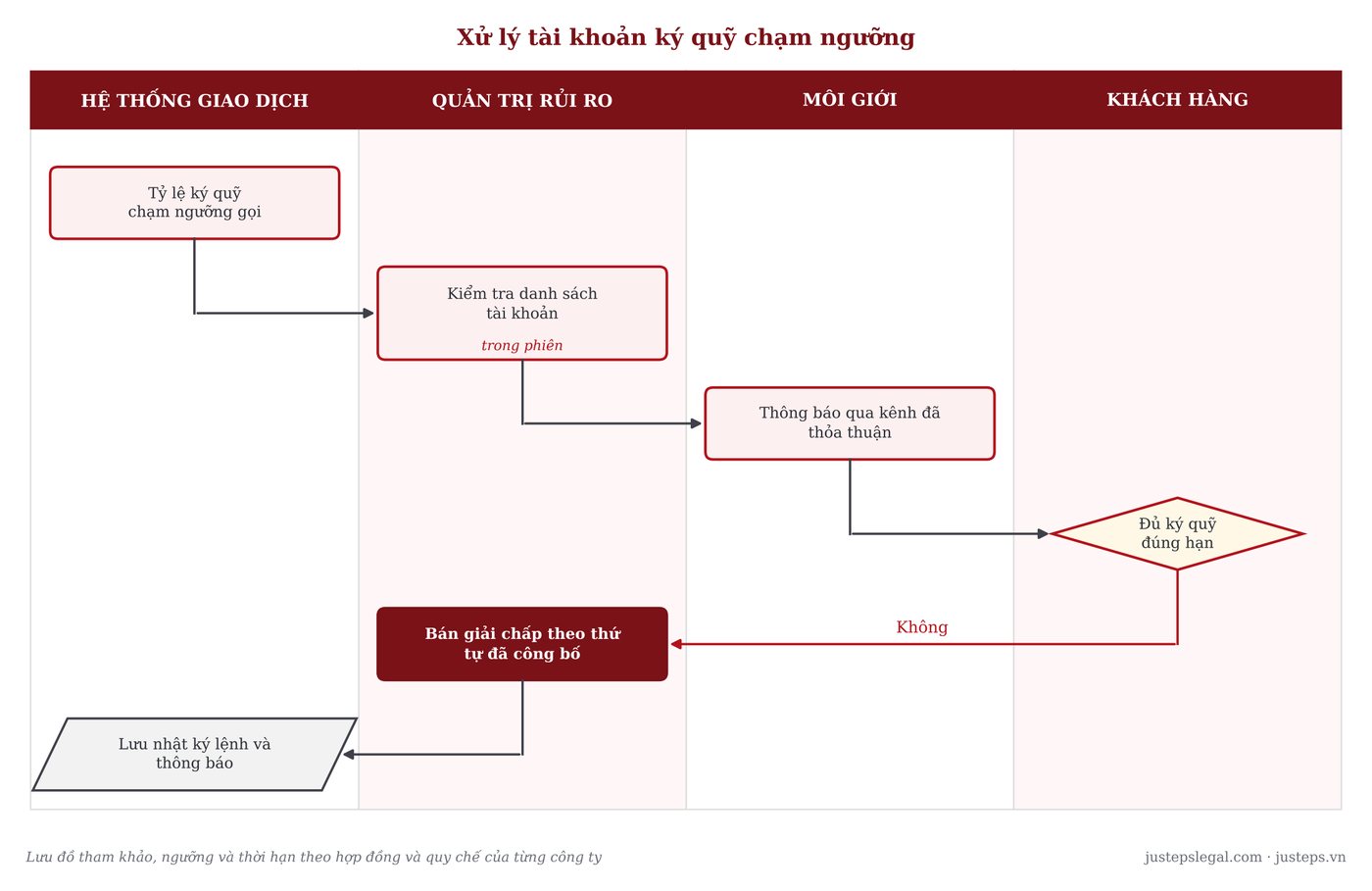
Coordination between units when a margin account reaches the threshold
The flowchart above shows that the alert is generated by the system, but the decision to force sell belongs to risk management, while the broker’s task is only to notify the client through the agreed channel. Every step must leave a trace on the system, from the moment the account reaches the threshold and the content of the notice to the sell order placed. When a complaint arises, this log is the main evidence the business has to show that it followed the procedure and the contract.
Consumer debt collection
Consumer lending by finance companies is governed by Circular No. 43/2016/TT-NHNN and its amending and supplementing instruments[6]. On 31 March 2026, the Vietnam Banks Association issued a Code of Conduct for debt collection, which stresses that collectors must not use force, threats, harassment or insults to honour and dignity, must not make contact at an inappropriate frequency or at inappropriate times, must not disclose client information, and that these rules also apply to authorised debt collection partners[7]. The business’s debt collection procedure should therefore specify contact time windows, the maximum number of contacts, the persons who may be contacted, call scripts, prohibited wording and how complaints about staff conduct are received.
Personal dealing by staff
Securities practitioners may not open or manage securities trading accounts at a securities company other than the one where they work, unless their employer does not carry on brokerage[8]. Personal dealing rules should extend to staff who hold no certificate but have access to sensitive information, and should set minimum holding periods, a restricted list and a mechanism for periodic declaration and reconciliation. At a fund management company, these rules must also prevent staff from trading ahead of the funds’ orders.
Common mistakes in building regulations
The most common mistake is to use another business’s templates, so that the procedures refer to steps the system does not have or omit steps the system requires. The second mistake is a debt collection procedure that sets only collection targets without limiting the methods used, leaving staff under target pressure to fend for themselves and exposing the business to penalties and complaints on social media. The third mistake is having no review schedule, even though securities, banking and anti-money laundering legislation changes constantly, most recently with Decree No. 245/2025/ND-CP amending Decree No. 155/2020/ND-CP, effective from 11 September 2025[9], and the amending law to the Law on Securities passed in November 2026. The chart below is an example of how Justeps sets drafting priorities according to the risk level of each procedure.
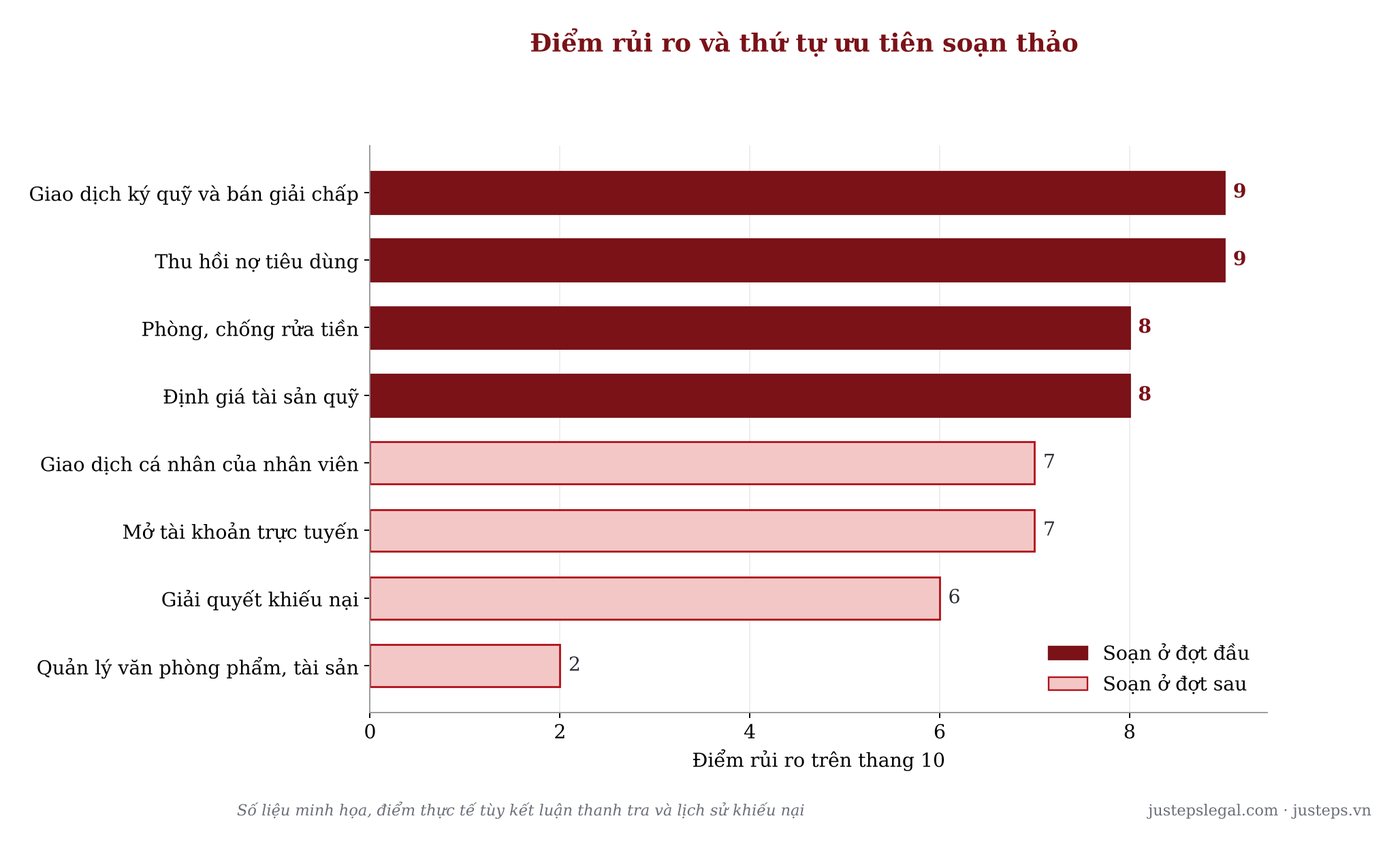
Example of drafting priorities based on the risk score of each procedure
The risk score is calculated from two factors, namely the direct loss to clients and the likelihood of penalties or a public relations crisis if the procedure is carried out wrongly. In the example, margin trading, debt collection and anti-money laundering are drafted first, while administrative procedures are drafted in a later round. The actual order for each business also depends on its most recent inspection findings and the complaints that have arisen.
How Justeps builds and tests each regulation
Justeps lists the mandatory documents for each business line in the licence, compares them with existing documents and the most recent inspection findings, and then drafts them in order of risk. Each regulation goes through a five-step life cycle, in which the third step is testing on the core systems, meaning that the procedure is run on a number of real transactions or files and compared with the system logs before it is submitted for issue. The final step is led by the business’s own compliance unit so that reviews do not depend on the consultant.
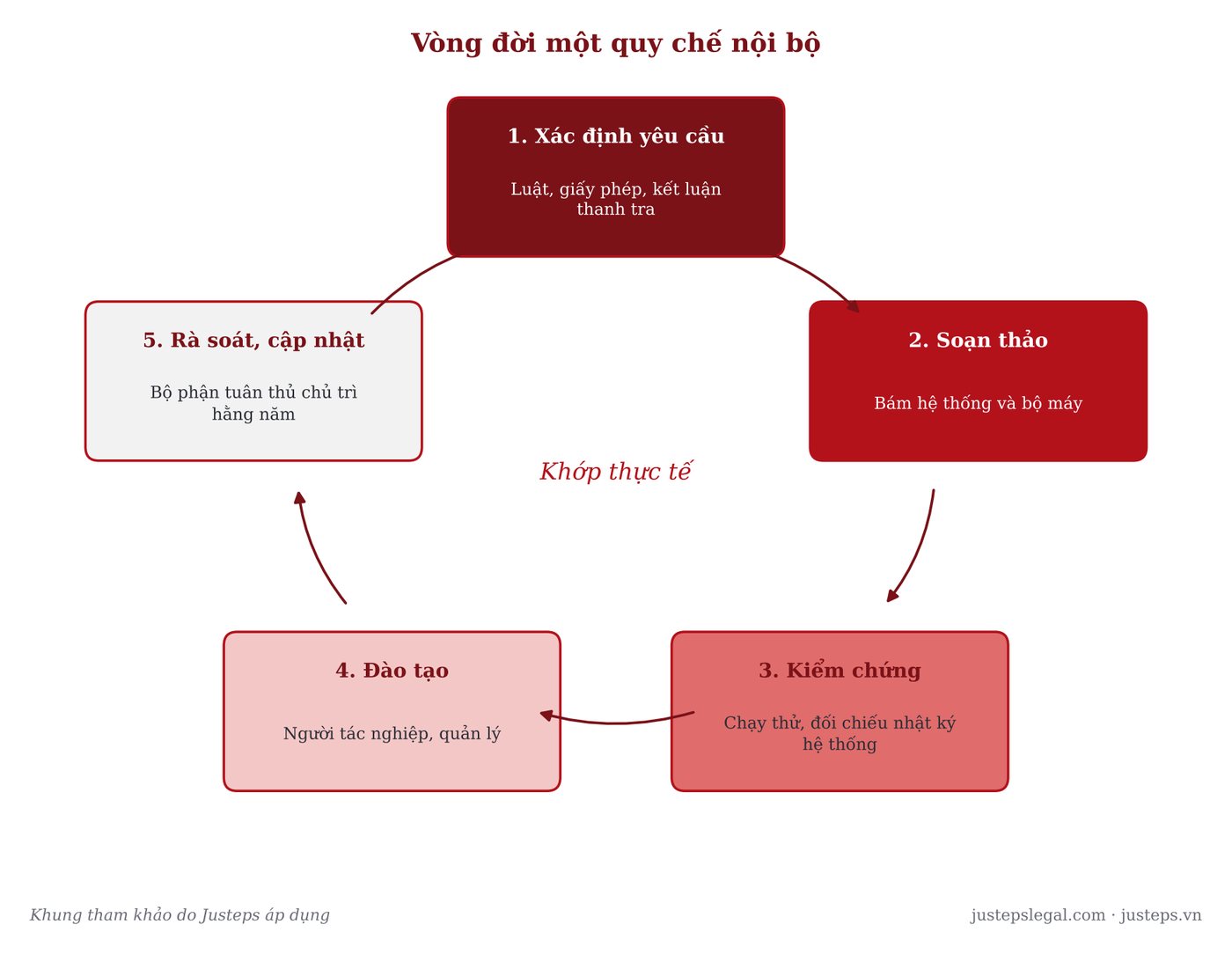
The five-step life cycle of an internal regulation in a financial business
The life cycle above is closed because the results of periodic reviews, inspection findings or changes in the law become the input requirements for the next amendment. A typical project lasts around twelve weeks, with the first four weeks spent on taking stock of documents, interviews and observing how the systems operate, and the following weeks on drafting in rounds, starting with the high-risk group. After testing, Justeps prepares the approval documents and advises on which documents must be sent or reported to the regulator.
Deliverables and adaptation to each type of business
The business receives a list of mandatory internal documents with their status and review dates, the finalised set of regulations and procedures, flowcharts and forms for each procedure, a table matching procedures against user rights on the systems, draft resolutions and decisions on issue, and staff training materials. A small securities company needs a concise but complete set of regulations, focused on online account opening and personal dealing by staff. A company with a large margin loan book needs a multi-layered risk management procedure and scenarios for periods of sharp market volatility. A foreign-invested fund management company often needs bilingual versions consistent with group policy, while a finance company with a wide network needs short procedures that are easy to train, with cross-checking steps to detect fraud.
Regulations only work when they match the organisation. If the organisation chart has not yet separated risk management from the business units or does not yet have an independent debt collection monitoring unit, the business should combine this work with Justeps’ organisational structure design service for securities, investment fund and consumer finance businesses before or alongside drafting the regulations.
What determines the service fee
Justeps quotes a fixed fee in writing after the initial meeting. The main factors are the number of business lines and the number of documents to be drafted or amended, the quality of the existing documents, the complexity of the trading and lending systems, the need for bilingual versions and whether Justeps takes part in the testing and training phase. Justeps has offices in Hanoi, Hai Phong, Quang Ninh and Ho Chi Minh City and works online with businesses in other provinces.
How Justeps can help
Alongside the set of internal regulations, securities, investment fund and consumer finance businesses may use the following Justeps services:
- Organisational structure design for securities, investment fund and consumer finance businesses. Justeps arranges the three lines of control and the list of prohibited combinations of roles so that each regulation has people performing the right roles.
- Ongoing legal advisory for securities, investment fund and consumer finance businesses. Justeps tracks changes in the law, reminds the business when regulations are due for updating and assists when clients complain about margin trading or debt collection.
- Anti-money laundering and transaction compliance. Justeps drafts internal regulations on anti-money laundering, sets of suspicious indicators and reporting procedures tailored to each business line.
- Personal data protection and cybersecurity. Justeps builds data processing procedures for online account opening, credit scoring and data sharing with partners.
Frequently asked questions
Who has the authority to issue internal regulations in a financial business?
The authority depends on the charter and the type of document. Risk management and internal control policies are usually issued by the Board of Directors or the Members’ Council, while operating procedures may be issued by the General Director under delegated authority, and Justeps records the issuing level for each item in the list of documents.
What must internal regulations on anti-money laundering contain?
The Law on Anti-Money Laundering lists the mandatory contents, including the client acceptance policy, client identification, risk management, transaction reporting, handling of suspicious transactions, record-keeping, confidentiality, training and the responsibilities of each unit[3]. The document must be reviewed and assessed every year.
Is a separate procedure needed for online account opening?
It is advisable. An online account opening procedure needs to set out how identity is verified, how suspected impersonation is handled, what data is collected and how it is stored, because this stage is subject both to client identification rules and to personal data protection rules[4].
What should a debt collection procedure limit?
The procedure should limit contact hours and the number of contacts, the persons who may be contacted and the content of calls and messages, and prohibit threats, insults and disclosure of client information. These limits must also be written into contracts with outsourced debt collection partners[7].
How often should regulations be reviewed?
Anti-money laundering regulations must be reviewed every year, and Justeps recommends applying the same cycle to all business regulations. In addition, regulations should be amended immediately when a new law is issued, when inspection findings are received or when the business changes its systems.
How should a business deal with many old, overlapping regulations?
Justeps prepares a comparison table of the old documents, identifies content that remains usable, merges documents on the same subject and proposes repealing outdated documents in the same decision that issues the new set, so that staff have a single source of rules.
Related articles
- Anti-money laundering in real estate business, customer identification and reporting obligations
- Legal compliance for fintech companies, electronic identification, data protection and partnerships with banks
- Building a customer complaint handling procedure that complies with the law, sets clear authority and leaves an audit trail
- Decree No. 363/2026/ND-CP and procedures for collecting internal data
Notes
[1] Circular No. 121/2020/TT-BTC on the operation of securities companies and Circular No. 99/2020/TT-BTC guiding the operation of securities investment fund management companies, together with their amending and supplementing instruments.
[2] Clause 1 of Article 101 of the Law on Credit Institutions No. 32/2024/QH15 dated 18 January 2024.
[3] Article 24 of the Law on Anti-Money Laundering No. 14/2022/QH15 dated 15 November 2022, effective from 1 March 2023.
[4] The Law on Personal Data Protection No. 91/2025/QH15 dated 26 June 2025, effective from 1 January 2026, and Decree No. 363/2026/ND-CP.
[5] Clause 2 of Article 15 of the Law on Credit Institutions No. 32/2024/QH15 dated 18 January 2024.
[6] Circular No. 43/2016/TT-NHNN dated 30 December 2016 of the State Bank of Vietnam on consumer lending by finance companies, as amended and supplemented.
[7] The Code of Conduct for debt collection issued together with Decision No. 15/QĐ-HHNH dated 31 March 2026 of the Vietnam Banks Association.
[8] Article 98 of the Law on Securities No. 54/2019/QH14 dated 26 November 2019.
[9] Decree No. 245/2025/ND-CP amending and supplementing a number of articles of Decree No. 155/2020/ND-CP detailing the implementation of a number of articles of the Law on Securities, effective from 11 September 2025.
This article is for reference and reflects the regulations in force at the time of publication. Please consult Justeps for advice tailored to your company’s records and situation.
For further information, please contact:
📩 Email: info@justeps.vn
🌐 Website: https://justepslegal.com · https://justeps.vn
🌐 Page: Justeps
☎️ Hotline (Zalo): 096 172 2607
📍 Thanh Xuan Office: 12th Floor, Licogi 13 Tower, 164 Khuat Duy Tien Street, Thanh Xuan Ward, Hanoi, Vietnam
📍 Ha Dong Office: LK06B, No.10, Dong Dua Area, Ha Dong Ward, Hanoi, Vietnam
📍 Ho Chi Minh City Branch: 528 Le Van Sy, Ho Chi Minh City, Vietnam
📍 Hai Phong Office: Truong Thinh Village, Ha Dong Commune, Hai Phong, Vietnam
📍 Quang Ninh Office: Van Don Special Zone, Quang Ninh Province, Vietnam





