
Key takeaways
- Each master agreement with a foreign customer contains dozens of obligations on security, source code and data, so the first task is to gather those obligations into a map before any regulation is written.
- A computer program written by an engineer as an assigned task belongs to the business that assigned the task unless otherwise agreed[1], but the regulations must still deal with grey areas such as code written outside working hours, code suggested by artificial intelligence tools and open source libraries.
- When it processes data on behalf of a customer, an outsourcing business is a personal data processor[2], so the procedures for test data, revoking access and reporting incidents must be written as individual steps, each with a person responsible.
- The records of each development stage are the evidence that the business genuinely produces software when it claims incentives, so the procedures should generate these records in the course of the work instead of reconstructing them at the end of the year.
A mid-sized outsourcing business may work at the same time for customers in Japan, Germany and the United States, each of which signs its own master agreement together with a confidentiality annex, a data processing annex and a set of security policies the supplier must follow. Without common regulations, each project team interprets those commitments in its own way, with one team allowing engineers to use personal computers and another copying a live database onto local machines for testing. The business only discovers the gaps when a customer sends a supplier assessment questionnaire or after an incident has already happened.
This page introduces Justeps’ service of building internal procedures and regulations for software outsourcing businesses, development centres serving foreign customers and companies with their own software products. Dividing the organisation into divisions, deciding where the information security unit sits and who decides what are covered under the organisational structure design service for software technology and outsourcing businesses. This page deals with the content of each document and how the documents are built into engineers’ daily work.
Starting from a map of obligations in the master agreements
Justeps does not draft regulations from a ready-made template but first reads the master agreements, confidentiality annexes, data processing agreements and security policies that customers require the supplier to comply with. Each obligation is recorded as one line in the obligation map, showing the content of the commitment, which customer requires it, the strictest standard among the customers and the unit that must carry it out. This approach shows that most commitments overlap, for example device encryption, two-factor authentication or the deadline for reporting incidents, so the business needs only one common regulation set at the strictest standard and a few separate annexes for customers with different requirements.
The obligation map also shows the board of directors which commitments have been signed but are not being performed by anyone, such as the customer’s right to inspect the office or the obligation to return data within a certain period after the contract ends. These points are placed at the top of the drafting list because this is where the business is most easily considered to be in breach of contract. For new contracts signed later, the sales division only needs to check them against the map to know which commitments are already met by a regulation and which commitments require approval before they are accepted.
The set of regulations a software business usually needs
The number of documents depends on the business model and customers’ requirements, but an outsourcing business working for foreign customers usually needs the six groups of documents below. Justeps orders the drafting by level of risk, usually starting with information security and rights to source code.
| Document group | Main contents | Lead unit |
|---|---|---|
| Information security | Access rights, devices, remote working, encryption, back-ups and handling of security incidents. | The information security unit. |
| Source code and intellectual property | Rights to source code, documentation, shared tools and engineers’ undertakings. | The legal function working with the technical division. |
| Open source and AI tools | Lists of permitted and prohibited licences, approved tools and data that must not be entered into them. | The chief architect. |
| Customer data | Processing data on behalf of customers, test data, data transfers and return or deletion of data. | The data protection officer. |
| Change and acceptance | Change requests, estimates, approval, time recording and acceptance minutes. | The project management office. |
| Software production records | Documents for each stage, where they are stored and who confirms them. | The project management office and accounting. |
Regulations attached to each development stage
Engineers follow a regulation only when it appears at the right moment in their work, not when it sits in a policy folder. Justeps therefore divides the requirements according to the six stages of a software project, as shown in the diagram below.
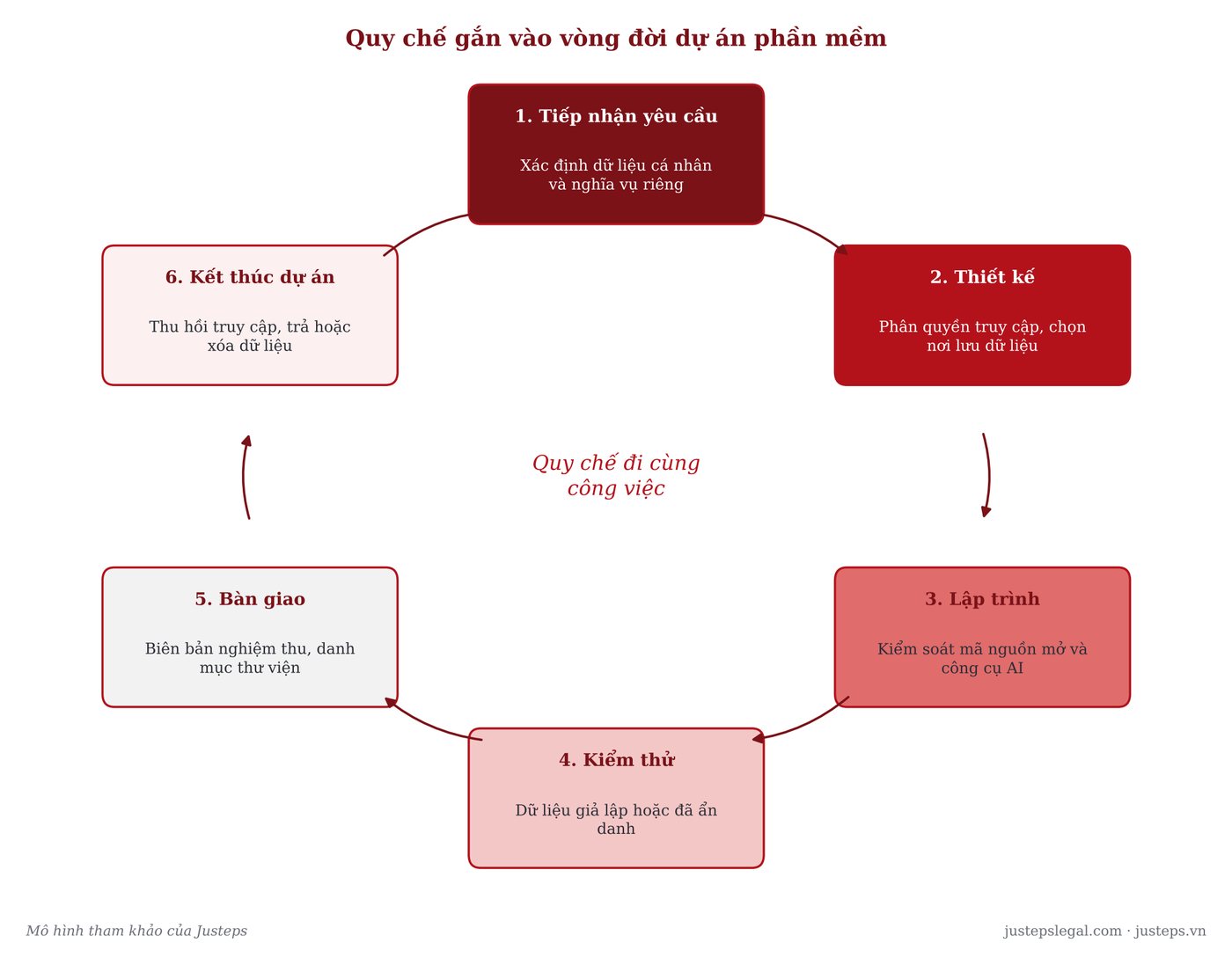
The requirements of the regulations are attached to the six stages of a software project
Under the diagram, at the requirements intake stage the project manager determines whether the project processes personal data and what specific obligations the customer’s contract imposes. At the design stage the technical team decides who may access which environment and where data is stored, while at the coding stage the focus is on controlling open source libraries and artificial intelligence tools. Testing uses only synthetic or anonymised data, delivery comes with acceptance minutes and a list of third-party libraries, and when the project ends access is revoked and data is returned or deleted under the contract. Each stage has a short form for the project manager to tick, so that compliance records are created at the same time as the product.
Source code, open source and artificial intelligence tools
Computer programs are protected by copyright, and when an engineer writes code as an assigned task, the business that assigned the task owns the rights unless otherwise agreed[1]. This rule does not by itself resolve grey areas such as an engineer writing a tool outside working hours and then using it on a project, bringing code from a former employer or pushing project code to a personal repository. Justeps’ intellectual property regulation clearly defines the scope of assigned tasks, the duty to declare what engineers bring with them when they join, how to manage shared tools that the business wants to keep when it transfers rights to the customer, and the undertaking engineers sign when they start and when they leave.
Open source libraries are the hardest risk to see. A library whose licence requires the source code of derivative products to be made public may, once it is included in a customer’s product, put the business in breach of its commitment to deliver source code free of third-party restrictions. The regulation therefore contains three lists of licences that may be used freely, that require approval and that are prohibited, together with an automated library scan before every delivery.
For artificial intelligence tools that assist with coding, a total ban is usually unworkable and also costs the business its speed advantage. Justeps proposes a list of tools that have been assessed for their data use terms, a principle that source code, data or documents of customers must not be entered into tools that have not been approved, and a requirement for engineers to review suggested code before it goes into the product. If the contract with a customer prohibits or restricts the use of such tools, the project rules must say so clearly so that the project manager can communicate it from the outset.
Customer data, test environments and incidents
When an outsourcing business processes personal data at a customer’s request, the customer is usually the controller and the business is the personal data processor[2]. A processor may do only what has been agreed, so the regulation must prevent engineers from copying, exporting or using data for other purposes on their own initiative, including for testing. The procedure Justeps drafts requires synthetic or anonymised data in development environments; where live data must be used, there must be the customer’s written approval, a period of use and a person responsible for deletion.
When personal data is leaked, the Law on Personal Data Protection sets a notification deadline of 72 hours[3], while the master agreements of many foreign customers require the customer to be notified even sooner. The incident handling procedure therefore names in advance who is notified first, who decides the scope of the incident, who informs the customer and who contacts the state authority where the business has that obligation. Fines for certain violations concerning the transfer of personal data abroad may reach 5% of the preceding year’s revenue[4], so a business that brings data from Europe or Japan to Vietnam for processing needs separate rules on storage location and the accompanying files. The impact assessment file and the data transfer file can be prepared together with the personal data protection compliance service.
A small but often forgotten procedure is revoking access when an engineer leaves a project or resigns. Justeps proposes linking this step to the staff transfer decision, so that when the project management office takes an engineer off a project, the information security unit receives a request to lock the accounts on the same day, including accounts on the customer’s systems.
Managing scope changes, time recording and acceptance
Most disagreements with customers at acceptance stem from changes requested by message or phone call, which engineers carry out immediately to keep the relationship but which nobody records. The change management procedure requires every request outside the scope to be recorded on a ticket, estimated for effort, confirmed by the authorised persons of both parties before work starts and then added to the project plan. The business may set a small threshold for work that can be done first and confirmed afterwards, but that threshold must be written into the procedure rather than left to each project manager to decide.
The timesheet serves two purposes at once, as the basis for charging the customer by the hour or by the man-month and as the record of employees’ working hours. The regulation needs to state who enters the data, who approves it, how it is corrected after approval and how long it is kept, so that the hours sent to the customer and the hours used as the basis for pay do not diverge. Calculating overtime pay from these figures is covered by the labour, wages and social insurance service for software technology and outsourcing businesses. The acceptance procedure comes with a template of minutes, a list of documents to be delivered and rules for when the customer stays silent beyond the confirmation period.
Software production records for incentives
Software production is among the activities encouraged by the State under the Law on Digital Technology Industry[5], and a business may enjoy corporate income tax incentives if it meets the conditions of the tax legislation[6]. When the tax authority carries out an inspection, the business must prove that its income comes from genuine software production rather than from supplying personnel or other services. Justeps’ record-keeping procedure specifies, for each stage such as requirements analysis, design, coding, testing and delivery, which documents are kept, where and who confirms them, and links the project code in the task management system with the contract and the invoice. The specific level of incentive and the conditions applying to each business are assessed separately on the basis of its actual records.
Reviewing the gaps before drafting
Before drafting, Justeps compares the obligation map with the way project teams are working and counts the points that are not yet met. The chart below is an example of the results of such a review at an outsourcing business with about 300 engineers.
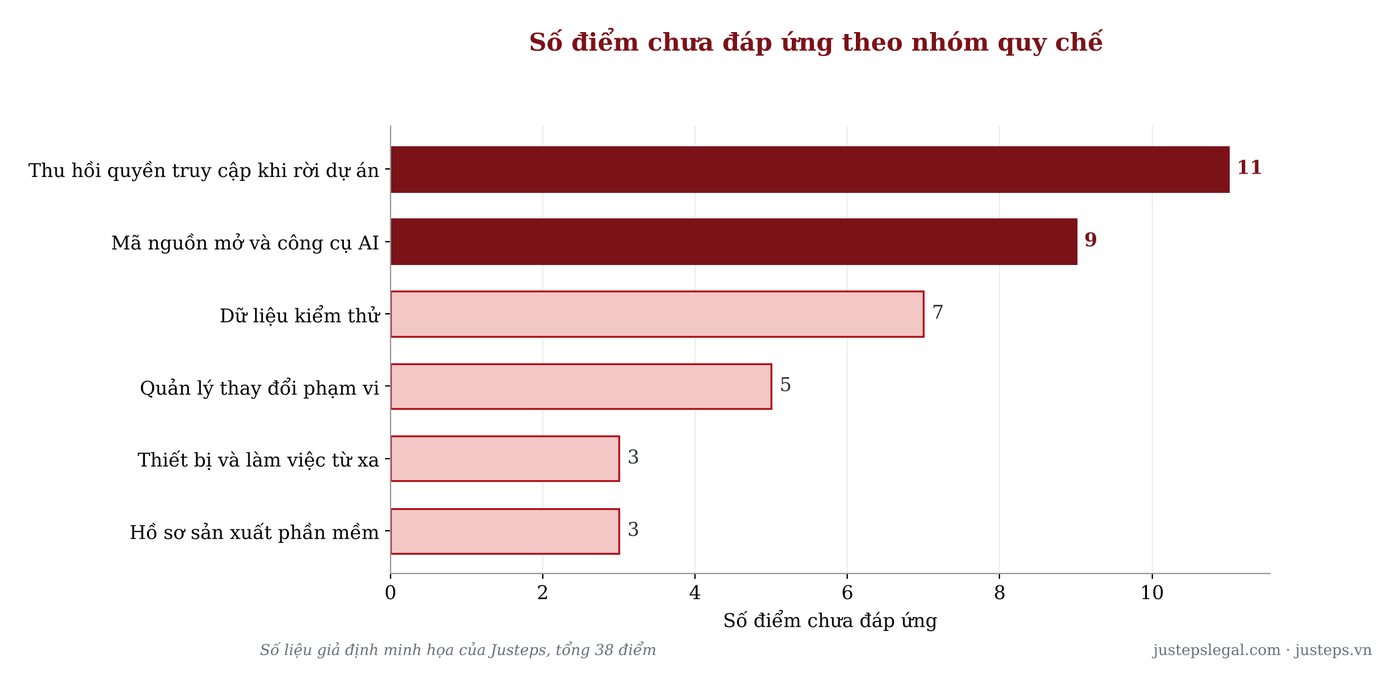
Example of the number of unmet points between commitments to customers and actual operations
In this example there are 38 unmet points in total, the largest being 11 points on revoking access when engineers leave a project and 9 points on open source and artificial intelligence tools. These two groups are drafted first because they appear in almost every supplier assessment questionnaire from foreign customers. The software production records group has only 3 points, but each point directly affects the amount of tax incentive the business receives, so it is still dealt with in the first round.
Timeline, deliverables and fees
A project usually takes about ten weeks. The first two weeks are spent reading the master agreements and customers’ policies and interviewing a few representative project teams; in the third week the obligation map is presented and the list of documents is agreed with management; in the following weeks the documents are drafted bilingually in Vietnamese and English and trialled on one or two projects before being issued, project managers are trained and engineers’ compliance undertakings are collected. The deliverables include the following documents:
- An obligation map compiled from customers’ master agreements and policies.
- An information security regulation, an intellectual property regulation, rules on open source and artificial intelligence tools and a regulation on processing customer data.
- Procedures for change management, time recording, acceptance and incident handling, with forms for each stage.
- Templates of the undertakings on confidentiality and intellectual property that engineers sign when they start and when they leave.
- Guidance on keeping software production records, draft issuing decisions and training materials.
The project fee is quoted by Justeps as a fixed fee in writing after the initial meeting, depending on the number of documents to be drafted, the number of master agreements to be checked, any need for bilingual documents, the volume of personal data the business processes and whether the business needs Justeps alongside it during a customer’s assessment. After issue, updating the regulations in line with new contracts and new legislation can be entrusted to the Ongoing legal advisory service for software technology and outsourcing businesses.
How Justeps can help
Alongside internal procedures and regulations, software technology and outsourcing businesses may combine the following Justeps services:
- Organisational structure design for software technology and outsourcing businesses. Justeps chooses the organisational model and places the information security and data protection units correctly before regulations are written for each division.
- Ongoing legal advisory for software technology and outsourcing businesses. Justeps reviews new master agreements and proposes updates to the regulations when commitments to customers change.
- Personal data protection compliance. Justeps prepares impact assessment files and files for transferring personal data abroad for customer data.
- Technology transfer and protection of digital intellectual property. Justeps advises on registering and transferring rights to software and the intellectual property the business wishes to keep.
Frequently asked questions
Who owns the source code written by engineers?
Source code that engineers write as assigned tasks belongs to the business that assigned the task unless otherwise agreed[1]. The business should still have engineers’ undertakings for grey areas such as tools written outside working hours or code brought from a former employer.
Should engineers be banned from using artificial intelligence tools to write code?
A total ban is usually hard to enforce. A more suitable approach is to allow tools that have been assessed, prohibit entering customers’ code or data into tools that have not been approved and require suggested code to be reviewed.
Is an information security certification mandatory?
Vietnamese law does not require software businesses to hold an international information security certification, but many foreign customers impose this requirement in their contracts. The regulations should be written in a structure compatible with the standard customers commonly use, so that it is easier if the business decides to apply for certification.
How quickly must a leak of customer data be reported?
The Law on Personal Data Protection sets a notification deadline of 72 hours[3], while contracts with customers may require a shorter period. The incident handling procedure should take the shortest deadline as the standard and designate the reporting person in advance.
Which regulations should a small business start with?
A business with a few dozen engineers should start with three documents, namely an intellectual property regulation with engineers’ undertakings, an access management regulation and a change management procedure. Other documents are added gradually as customers require them.
How often should the regulations be updated?
At least once a year, and immediately when the business signs a master agreement with new requirements, when new legislation is issued or when a new tool such as artificial intelligence is introduced. The obligation map makes updating quick because only new lines need to be added.
Related articles
- Software development contracts, acceptance, warranty and ownership of source code
- Setting up a technology start-up, capital structure, ESOP and ownership of source code
- The minimum set of internal governance regulations for businesses with 50 to 200 staff
- Organisational structure design for software technology and outsourcing businesses by size and delivery model
Notes
[1] Clause 1 of Article 39 of the Law on Intellectual Property No. 50/2005/QH11, as amended and supplemented in 2009, 2019, 2022 and 2025.
[2] Clause 8 of Article 2 of the Law on Personal Data Protection No. 91/2025/QH15, effective from 1 January 2026.
[3] Clause 1 of Article 23 of the Law on Personal Data Protection No. 91/2025/QH15, effective from 1 January 2026.
[4] Clause 4 of Article 8 of the Law on Personal Data Protection No. 91/2025/QH15, effective from 1 January 2026.
[5] The Law on Digital Technology Industry No. 71/2025/QH15, effective from 1 January 2026.
[6] The Law on Corporate Income Tax No. 67/2025/QH15 and its implementing documents.
This article is for reference and reflects the regulations in force at the time of publication. Please consult Justeps for advice tailored to your company’s records and situation.
For further information, please contact:
📩 Email: info@justeps.vn
🌐 Website: https://justepslegal.com · https://justeps.vn
🌐 Page: Justeps
☎️ Hotline (Zalo): 096 172 2607
📍 Thanh Xuan Office: 12th Floor, Licogi 13 Tower, 164 Khuat Duy Tien Street, Thanh Xuan Ward, Hanoi, Vietnam
📍 Ha Dong Office: LK06B, No.10, Dong Dua Area, Ha Dong Ward, Hanoi, Vietnam
📍 Ho Chi Minh City Branch: 528 Le Van Sy, Ho Chi Minh City, Vietnam
📍 Hai Phong Office: Truong Thinh Village, Ha Dong Commune, Hai Phong, Vietnam
📍 Quang Ninh Office: Van Don Special Zone, Quang Ninh Province, Vietnam





