
Key takeaways
- Most complaints from studio clients arise not from craftsmanship but from matters that were never written down, such as delivery deadlines, the number of retouched images, the conditions for changing the date and how deposit refunds are calculated.
- Terms on deposits, rescheduling and cancellation must be written consistently across the template contract, the published price list and the internal procedures, because a standard form contract is interpreted in the consumer’s favour where it is unclear[1].
- A studio may use clients’ photographs and films for promotion only with the consent of the people in them, and that consent should be kept on record so that it can be proved later[3].
- The image data regulations should specify where originals are stored, who may access them, how long they are kept after delivery and how they are deleted when a client asks[5].
A full wedding photography package usually passes through six to eight people before the album reaches the client: the consultant, the coordinator, the photographer, the videographer, the make-up artist, the retoucher, the album printer and the delivery staff. Each does their own part well, but nobody holds the whole promise made to the client. The client is promised images within three weeks while post-production schedules five, the client is told that changing the date is free while the template contract says the deposit is forfeited, and the client’s images are posted on the showcase page simply because the photographer liked them.
This page introduces Justeps’ service for building internal procedures and regulations for photo studios, wedding studios and video production companies. It focuses on the documents needed, how to write them so that staff can actually follow them, the legal points that must match client contracts, the implementation process and the deliverables. The service works best when the studio already has a reasonably stable organisation; if it is not yet clear who holds the schedule and who holds the deposits, the studio should start with the organisational structure design service for photo studios and video production.
Why a studio needs written procedures
Wedding studios work by season, with the number of shoots rising several times over in peak months and the pool of freelance collaborators changing constantly. Newcomers have no time to learn by watching, and long-standing staff each have their own habits. A written procedure, with forms and a responsible person at each step, is the only way to make quality independent of who happens to be working that day.
The second reason is the studio’s obligations to its clients. Under consumer protection law, where a studio uses standard form contracts or general trading conditions, the terms must be clear and easy to understand and are interpreted in the client’s favour where they can be read in different ways[1]. If the internal procedures allow consultants to promise things that the contract does not say, or the other way round, the studio will be in a weak position when a complaint arises.
A set of procedures following the life cycle of an order
Justeps divides the studio’s operations along the life cycle of an order, from the moment a client asks for a price until the client has received all products and the studio has archived or deleted the data. The diagram below shows how an order passes through four groups of people and the hand-over points that need forms.
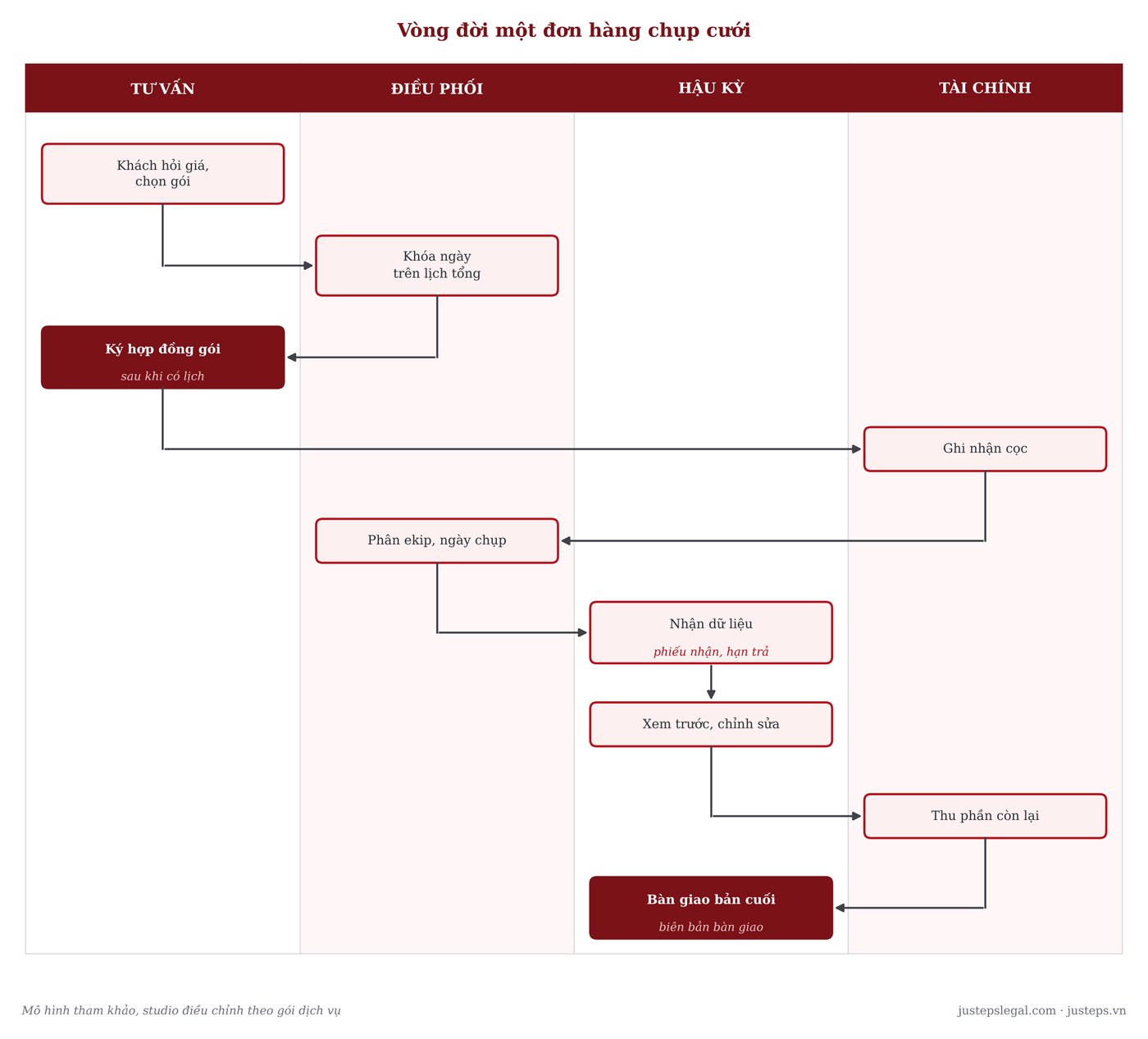
The life cycle of a wedding photography order across four functions
As the diagram shows, the consultant closes the package and signs the contract only after coordination has locked the date on the master schedule, and finance records the deposit as soon as the client transfers it. After the shoot, coordination hands the files to post-production with a receipt note stating the number of files, the date received and the return deadline. Post-production sends previews, the client selects images and requests edits within the agreed number of rounds, and finance collects the balance before the final version is delivered. Each hand-over point has a short form, because that is the evidence when a client claims that the studio delivered late or delivered less.
The package sales and deposit procedure
The sales procedure sets out the information the consultant must give before the client pays the deposit, including the content of the package, the number of images, the number of fully retouched images, the delivery deadline, extra charges and the conditions for changing the date or cancelling. Under the Civil Code, if the party paying a deposit refuses to enter into or perform the contract, the deposit is forfeited; if the party receiving it refuses, that party must return the deposit plus an equal amount, unless the parties agree otherwise[2]. Because this rule allows the parties to agree otherwise, the studio should prepare a table of refund levels according to when the client notifies a change or cancellation, and use that table consistently in the contract, on the website and in what consultants say.
The coordination and shoot-day incident procedure
The coordination procedure sets out how dates are locked, how crews are assigned, call times, the list of back-up equipment and who is authorised to change staff when someone falls ill or something goes wrong. The most important part is the incident playbook, covering faulty memory cards, data lost after a shoot or bad weather on an outdoor shoot, together with how the client is informed and the remedies approved in advance by the director.
The post-production, delivery and archiving procedure
The post-production procedure sets processing deadlines for each type of package, the number of editing rounds, the quality checks before sending to the client and how it is recorded that the client has received all products. Delivery should be documented by a hand-over record or electronic confirmation stating the number of images and films, the formats and the download links, together with how long the studio will keep the originals. When that period ends, the data is deleted under the data regulations, and the client is notified beforehand so that they can keep their own copy.
Regulations on the use of client images and data
The Civil Code provides that the use of an individual’s image requires that person’s consent, and that use for commercial purposes requires payment to the person concerned, unless the parties agree otherwise[3]. The Law on Advertising also prohibits advertising that uses an individual’s image without that person’s consent[4]. The best wedding photographs of the season may therefore appear on the showcase page, in paid advertising or in printed materials only when the studio holds the written consent of both people in the picture, which should specify the scope, channels and duration of use.
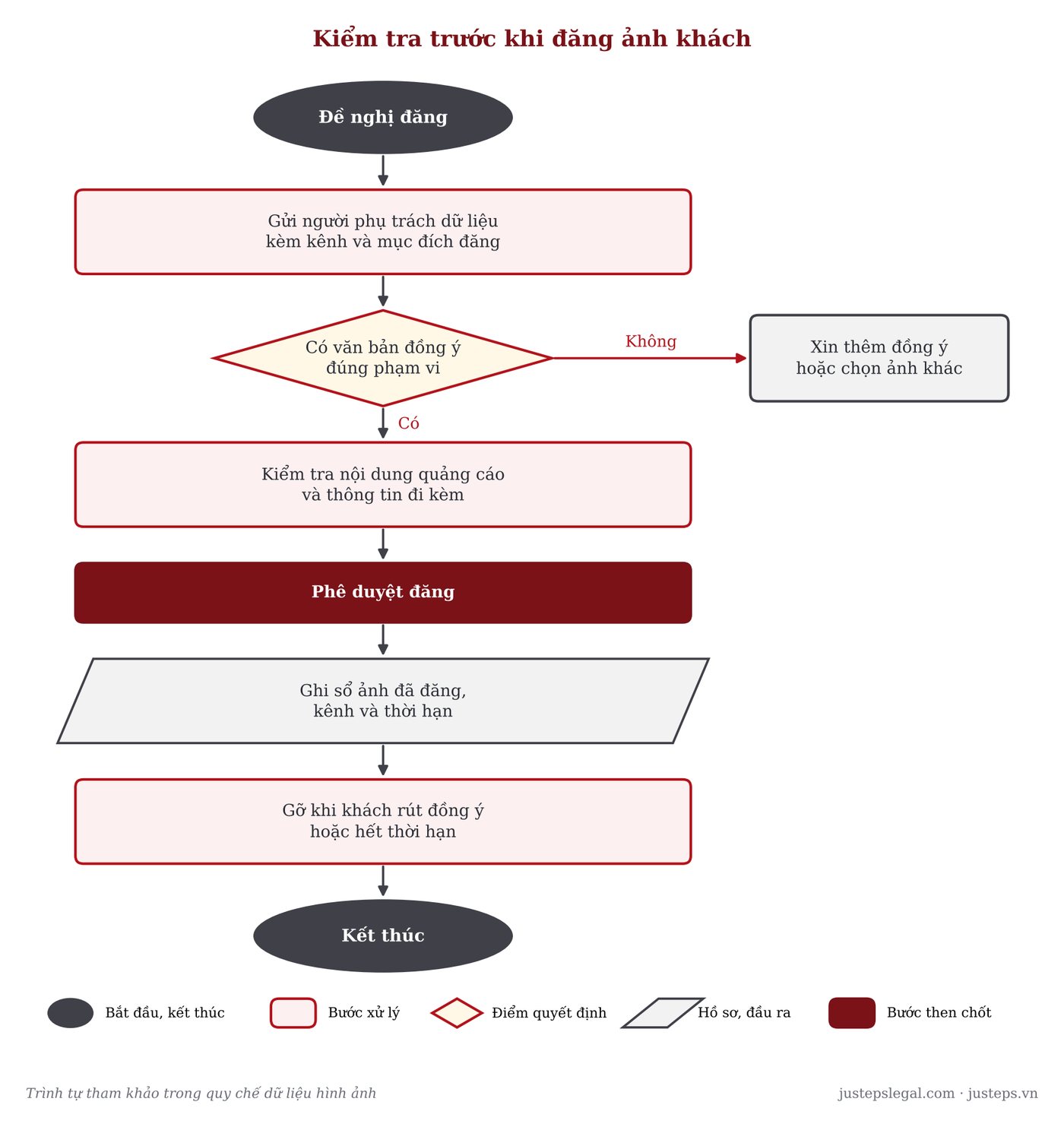
Checks before posting a client’s images
Under this sequence, the person who wishes to post sends a request to the person responsible for data, who checks the stored consent against the intended channel and purpose. If the client has not consented or the consent is narrower, the studio must ask for further consent or choose different images and must not make assumptions. When a client withdraws consent, the images must be removed from the channels managed by the studio within the time limit set in the regulations.
Beyond posting, the data regulations specify where originals are stored, a ban on keeping them on personal devices after hand-over to post-production, role-based access rights, how to handle a client’s request to delete data and how to report an image leak. These are matters the studio must organise as the controller of its clients’ personal data under the Law on Personal Data Protection No. 91/2025/QH15[5].
Regulations on equipment, costumes and deposit refunds
Cameras, lenses, lighting, drones and wedding gowns are the studio’s largest assets, yet they are often lent and returned on a verbal basis. The asset regulations provide for a log of equipment issued and returned per shoot, condition checks on issue and return, a procedure for reporting damage and determining fault, and cleaning and storage rules for costumes between rentals. The liability of staff to compensate for damaged assets must match the employment contracts and internal labour rules, so Justeps drafts it together with the labour documentation.
The deposit refund and complaints regulations determine who receives a complaint, how quickly a response must be given, who proposes the refund amount and who decides. The chart below is an example of complaints by stage at a medium-sized studio, showing that most problems lie in post-production, delivery and the rescheduling policy, which are stages that procedures can control.
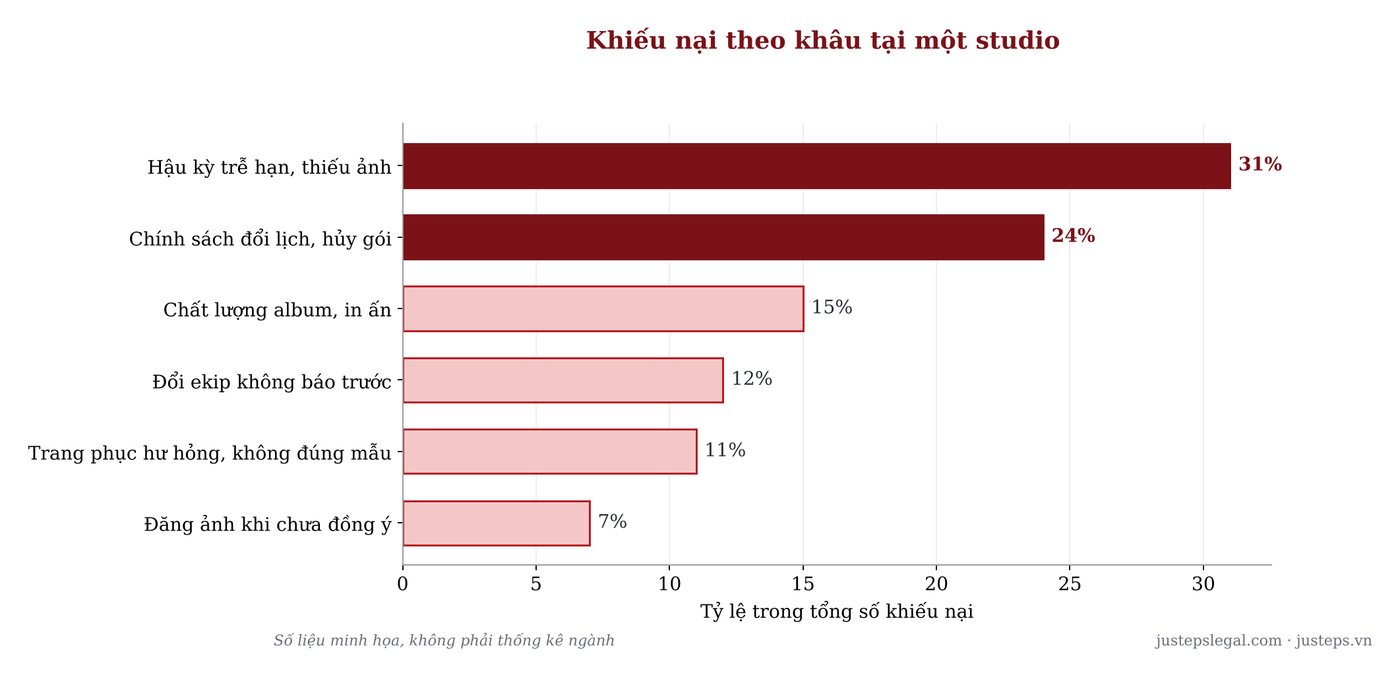
Example share of complaints by stage at a medium-sized studio
Based on this distribution, Justeps recommends that the studio first write the post-production, delivery and rescheduling procedures, and then move on to procedures that cause fewer problems. Each closed complaint should be entered in a log with its root cause, so that every wedding season the studio can review it and fix the step that is causing errors.
Implementation process, deliverables and fees
A project usually takes six to eight weeks. In the first two weeks, Justeps’ consultants read the template contracts, the price list and recent complaints, and follow an actual shoot day to record current practice. The following weeks are for writing drafts, piloting them with one crew, revising them and running briefing sessions for consultants, coordinators and post-production staff before issue. The deliverables usually comprise the documents in the table below.
| Document | Main content |
|---|---|
| Package sales procedure | Information required before taking a deposit, quotation template, refund table by date of change or cancellation. |
| Coordination procedure | Locking dates, assigning crews, back-up equipment, shoot-day incident playbook. |
| Post-production procedure | Deadlines by package, number of editing rounds, quality checks, hand-over record. |
| Data regulations | Storage of originals, access rights, retention period, deletion, written consent to post images. |
| Asset regulations | Log of equipment and costumes issued and returned, damage reports, storage between rentals. |
| Complaints regulations | Receipt, response deadlines, authority to decide refunds, root cause log. |
Fees are quoted as a fixed package after the initial discussion and depend on the number of product lines, the number of showrooms, how much existing documentation is available and whether the studio needs Justeps to redraft its template contracts with clients. After issue, many studios choose the ongoing legal advisory service for studios to update the procedures when the law changes and to receive support with difficult complaints.
How Justeps can help
Together with internal procedures and regulations, photo studios and video production companies can combine the following Justeps services:
- Organisational structure design for photo studios, wedding photography and video production. Justeps defines the functional units and the people who hold the schedule, the deposits and the image archive as the foundation for the procedures.
- Ongoing legal advisory for photo studios, wedding photography and video production. Justeps monitors changes in the law and updates procedures and template contracts when needed.
- Drafting and reviewing commercial contracts. Justeps drafts photography package contracts, costume rental contracts and general trading conditions that match the internal procedures.
- Personal data protection and cybersecurity. Justeps prepares data processing records and assesses the measures protecting the archive of clients’ original images.
Frequently asked questions
May a studio keep the whole deposit when a client cancels the package?
A party paying a deposit who refuses to perform the contract forfeits the deposit, unless the parties agree otherwise[2]. The studio should publish in advance a table of refund levels by date of cancellation to avoid disputes and to let clients assess the conditions before signing.
Once a client has signed a photography contract, may the studio post the client’s images?
Not automatically. Using images for promotion requires the consent of the people in them, so the contract or a separate document should include a consent clause specifying the channels, purpose and duration[3].
How long must a studio keep a client’s original images?
The law does not set a general period for this situation. The studio should set a reasonable period in the contract and the data regulations, notify the client before deletion and delete on time once the purpose of processing has been fulfilled.
Is a separate procedure needed for corporate video work?
Yes, it is advisable, because corporate videos involve scripts, content approval, acceptance in rounds and transfer of rights that differ from wedding packages. Justeps usually writes a separate project procedure for this line.
How long does it take to build the set of procedures?
Usually six to eight weeks, including fact-finding, drafting, piloting and briefing. The studio should finish before wedding season so that staff have time to get used to them.
Do the procedures have to be registered with a state authority?
Internal operating procedures and regulations do not need to be registered. Internal labour rules, however, must be registered when the statutory conditions are met, and this is handled as part of the studio’s labour documentation.
Related articles
- Organisational structure design for wedding photo studios and video production companies to protect bookings, deposits and client data
- Ongoing legal advisory for photo studios, wedding photography and video production companies on an annual package
- Controlling advertising content within a business through a pre-publication approval procedure
- Personal data protection in the HR department under the 2025 Law on Personal Data Protection
Notes
[1] Law on Protection of Consumer Rights No. 19/2023/QH15 dated 20 June 2023, provisions on standard form contracts and general trading conditions.
[2] Article 328 of the Civil Code No. 91/2015/QH13 dated 24 November 2015.
[3] Article 32 of the Civil Code No. 91/2015/QH13 dated 24 November 2015.
[4] Article 8 of the Law on Advertising No. 16/2012/QH13 dated 21 June 2012, as amended and supplemented by Law No. 75/2025/QH15 (effective from 1 January 2026).
[5] Law on Personal Data Protection No. 91/2025/QH15, effective from 1 January 2026.
This article is for reference and reflects the regulations in force at the time of publication. Please consult Justeps for advice tailored to your company’s records and situation.
For further information, please contact:
📩 Email: info@justeps.vn
🌐 Website: https://justepslegal.com · https://justeps.vn
🌐 Page: Justeps
☎️ Hotline (Zalo): 096 172 2607
📍 Thanh Xuan Office: 12th Floor, Licogi 13 Tower, 164 Khuat Duy Tien Street, Thanh Xuan Ward, Hanoi, Vietnam
📍 Ha Dong Office: LK06B, No.10, Dong Dua Area, Ha Dong Ward, Hanoi, Vietnam
📍 Ho Chi Minh City Branch: 528 Le Van Sy, Ho Chi Minh City, Vietnam
📍 Hai Phong Office: Truong Thinh Village, Ha Dong Commune, Hai Phong, Vietnam
📍 Quang Ninh Office: Van Don Special Zone, Quang Ninh Province, Vietnam





