
Key takeaways
- The hours the business bills to the customer are also evidence of engineers’ working hours, so every hour beyond normal working hours in the timesheet must be checked against the overtime limits of 40 hours a month and 200 hours a year[1].
- Shifts worked to North American customer hours often fall between 22:00 and 06:00, which is night work[3], and employees are paid at least an additional 30% of their wages for night hours[4].
- An allowance of a fixed amount paid regularly with each pay period still forms part of the wages subject to social insurance contributions even if it is given another name[8], so splitting engineers’ pay into several allowances to reduce contributions carries a high risk of back payments.
- When a major customer is lost, the business cannot simply lay off engineers immediately but must prepare a labour usage plan and pay job loss allowance if it has to let employees go[15].
In an outsourcing business, staff costs are tied directly to revenue because the selling price is calculated by the hour or by the man-month of engineers. An unexpected cost such as back payment of insurance contributions, unpaid overtime or severance on lay-offs goes straight into the project’s profit. Meanwhile the market for engineers is highly competitive, remuneration policies change faster than contracts and regulations, and working to customers’ time zones, remotely or abroad raises questions that template employment contracts do not answer.
This page introduces Justeps’ service on contracts, working hours, wages, insurance and personal income tax for software outsourcing businesses, development centres serving foreign customers and companies with their own software products. Who may approve overtime and where each position sits in the organisation are covered by the organisational structure design service for software technology and outsourcing businesses, while this page deals with the rights and obligations of each group of engineers.
Hours billed to the customer are also working hours
An employee’s overtime must not exceed 50% of normal daily working hours, 40 hours in a month and 200 hours in a year; in certain cases, including work requiring highly qualified technical staff that the labour market cannot supply in time, overtime of up to 300 hours a year is permitted[1]. A business that organises overtime of more than 200 and up to 300 hours a year must notify the provincial labour authority in writing[2]. The timesheets sent to customers usually record every hour an engineer has worked, so in a dispute the employee already has evidence of overtime that the business has not paid or that exceeds the limits.
Justeps compares each team’s timesheets with the attendance records and payroll for the most recent twelve months. The chart below is an example of the average annual overtime per engineer in five teams of an outsourcing business.
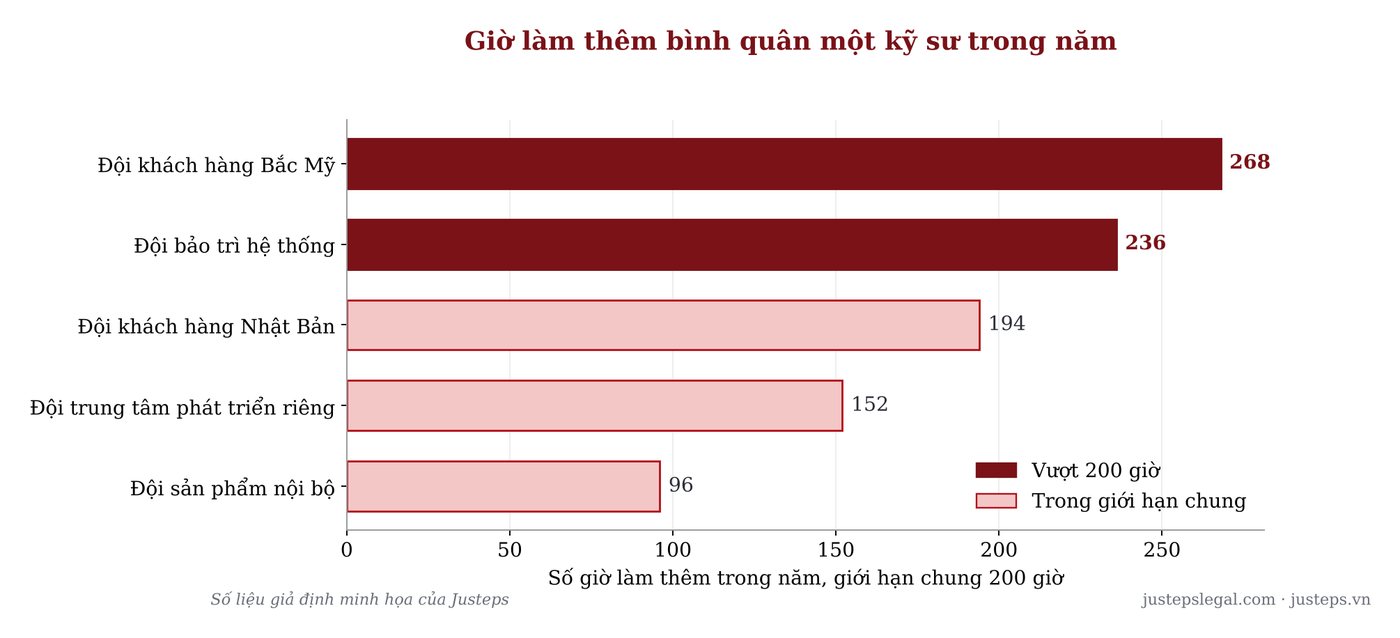
Example of average annual overtime hours per engineer by project team
In this example, the team working for North American customers averages 268 hours and the system maintenance team 236 hours, both above the 200-hour limit, so they are lawful only if the work falls within the cases allowed up to 300 hours and the business has given notice. The team working for Japanese customers has 194 hours, close to the limit, while the dedicated development centre team has 152 hours and the in-house product team 96 hours. Justeps proposes an overtime policy with warning thresholds in the time recording system, rules on who may approve overtime, a template overtime agreement with employees and a way of converting excess hours into time off in lieu where appropriate.
Shifts in customers’ time zones and system on-call duty
Night work is counted from 22:00 to 06:00 the following morning[3]. An employee working at night is paid at least an additional 30% of the wages for a normal working day, and an employee who works overtime at night is paid a further 20% of the wages calculated on the basis of a normal working day, a day off or a public holiday[4]. Teams working to North American hours often have part of their main shift within this window, so night shift pay must be calculated within the pay period itself and cannot be folded into a general allowance.
Out-of-hours system on-call duty is the point most prone to disputes. Justeps clearly distinguishes in the internal labour rules between standby time at home, paid with an allowance, when the engineer only needs to remain contactable, and time actually spent handling incidents, which counts as working time or overtime. From 1 March 2027 the law amending the Labour Code adds new public holidays[5], so holiday on-call rosters and the 2027 wage budgets of operations teams need to be recalculated.
Remote working and working abroad
Many software businesses allow engineers to work remotely on the strength of an internal announcement alone. A complete policy needs to state the place of work, the hours during which the engineer must be online, who bears the cost of equipment and connection, data security requirements and how an accident during working hours at home is handled. Software monitoring remote work devices is processing of employees’ personal data, so employees must be clearly informed of the technological measures being applied[6].
A more complex case is an engineer working remotely abroad for a long period or being sent to work at the customer’s office. The business must consider visas and work permits in the host country, where the person is tax resident, the double taxation agreement and whether insurance contributions continue in Vietnam. Depending on the form and duration, sending a person abroad may fall within the scope of the law on Vietnamese workers working abroad under contracts[7], so Justeps assesses each case and drafts a suitable secondment annex or agreement for working abroad.
Before drafting the policies, Justeps assesses each form of work the business is using against three groups of issues. The matrix below summarises the complexity of the five most common forms.
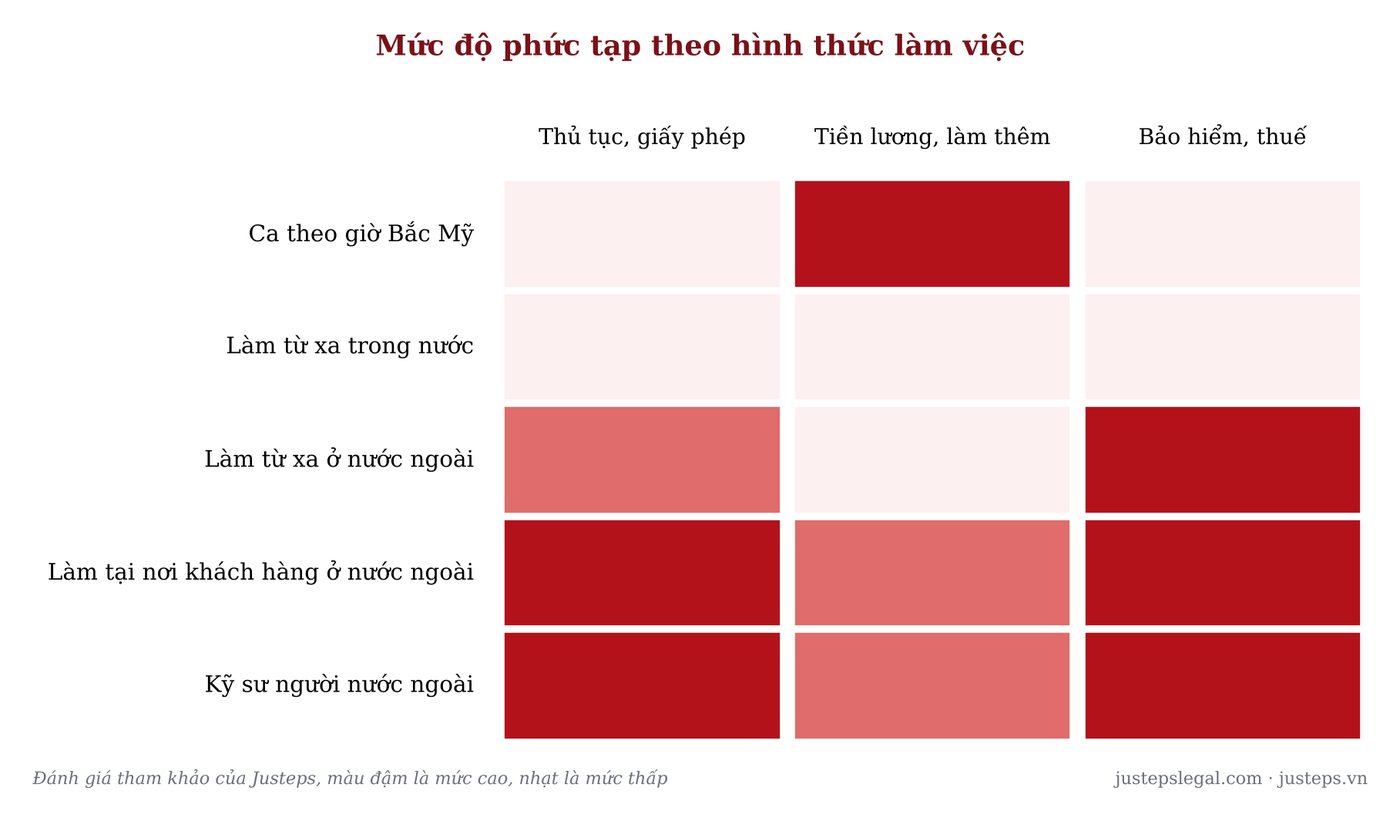
Complexity of each form of work in terms of procedures, wages, and insurance and tax
Under the matrix, working at a customer’s site abroad and employing foreign engineers are the two most complex forms in terms of procedures and of insurance and tax. Shifts on North American hours are simple in terms of procedures but the most complex in terms of wages, because they involve night work and overtime. Remote working within Vietnam is the least complex, but still needs a written policy to avoid disputes over costs and working hours.
Salary scales, allowances and the insurance contribution base
The salary scale of a software business should be built on technical grades, from newly graduated engineers to architects, linked to competence criteria that serve as the basis for pay rises, transfers and assessing whether work has been completed. Monthly wages subject to compulsory social insurance contributions comprise the wage level, wage allowances and other supplementary amounts agreed to be paid regularly and consistently in each pay period, with a ceiling of 20 times the reference level[8]. High-earning engineers are usually already above the ceiling and so are little affected, but for junior engineers and support staff, splitting pay into a language allowance, a fixed project allowance or a travel allowance paid every month is a common mistake that leads to back payments.
Rules on project bonuses and the thirteenth-month salary need to state clearly the conditions for entitlement and how they are calculated for those who leave mid-year or move between projects, to avoid them being treated as fixed payments. From 1 January 2027 the region I minimum wage is VND 5,700,000 per month[9], so the pay of support positions such as administration, reception and manual testing needs to be reviewed. Detailed salary scales and bonus rules can be prepared together with the salary scales and pay and bonus regulations service.
Engineers’ contracts, probation, confidentiality and training
Probation may not exceed 60 days for work requiring a college qualification or higher and 180 days for enterprise managers, and probation may be applied only once for the same job[10]. An engineer’s employment contract should come with an agreement on the protection of business and technology secrets, stating the duration and the employee’s entitlements and liability in the event of breach[11], together with a clause confirming rights to work products created in the course of employment, so as to match the business’s intellectual property regulation. A clause prohibiting work for competitors after leaving needs to be drafted with care because it may be seen as restricting the right to work.
A business that pays for international certifications or training courses abroad for engineers should sign a training contract stating the cost, the period of committed employment after training and the obligation to reimburse costs[12]. Without such a contract, the business will find it difficult to require reimbursement when an engineer leaves right after obtaining a certification.
Share awards and foreign engineers
A share award programme for key engineers needs rules stating the conditions, the vesting period, how departing employees are treated and when personal income tax obligations arise. New guidance under the Law on Personal Income Tax effective from 1 July 2026[13] changes how income from share awards is determined, so programmes designed before then should be reviewed before the next round of awards.
Foreign engineers and experts must have a work permit or a confirmation of exemption from a work permit before they start work. Applications submitted up to and including 4 December 2026 are governed by Decree No. 219/2025/ND-CP, while from 5 December 2026 the new decree on foreign workers applies[14], so applications in preparation need to be reviewed according to the date of submission. Justeps drafts gross or net pay agreements, determines the social insurance and tax obligations of foreign employees, and notes that the term of the employment contract should not exceed the term of the work permit.
When a major project is lost
When a major customer terminates its contract, the first reaction is often to let the project team go. The Labour Code treats this situation as a structural change or a change for economic reasons, in which case the business must prepare a labour usage plan, consult the employee representative organisation if there is one, notify the state authority in advance and pay job loss allowance to those who have to leave[15], at one month’s wages for each year of work but no less than two months’ wages[16]. Before reaching that step, the business may temporarily transfer engineers to other projects within the limits allowed by law[17] or retrain them for new technologies. Files for difficult termination situations can be prepared together with the labour dispute management and contract termination service.
Implementation process, deliverables and fees
The standardisation phase usually lasts about eight weeks, giving priority to overtime, night shifts and the insurance contribution base because these are the three groups with the largest amounts of back pay.
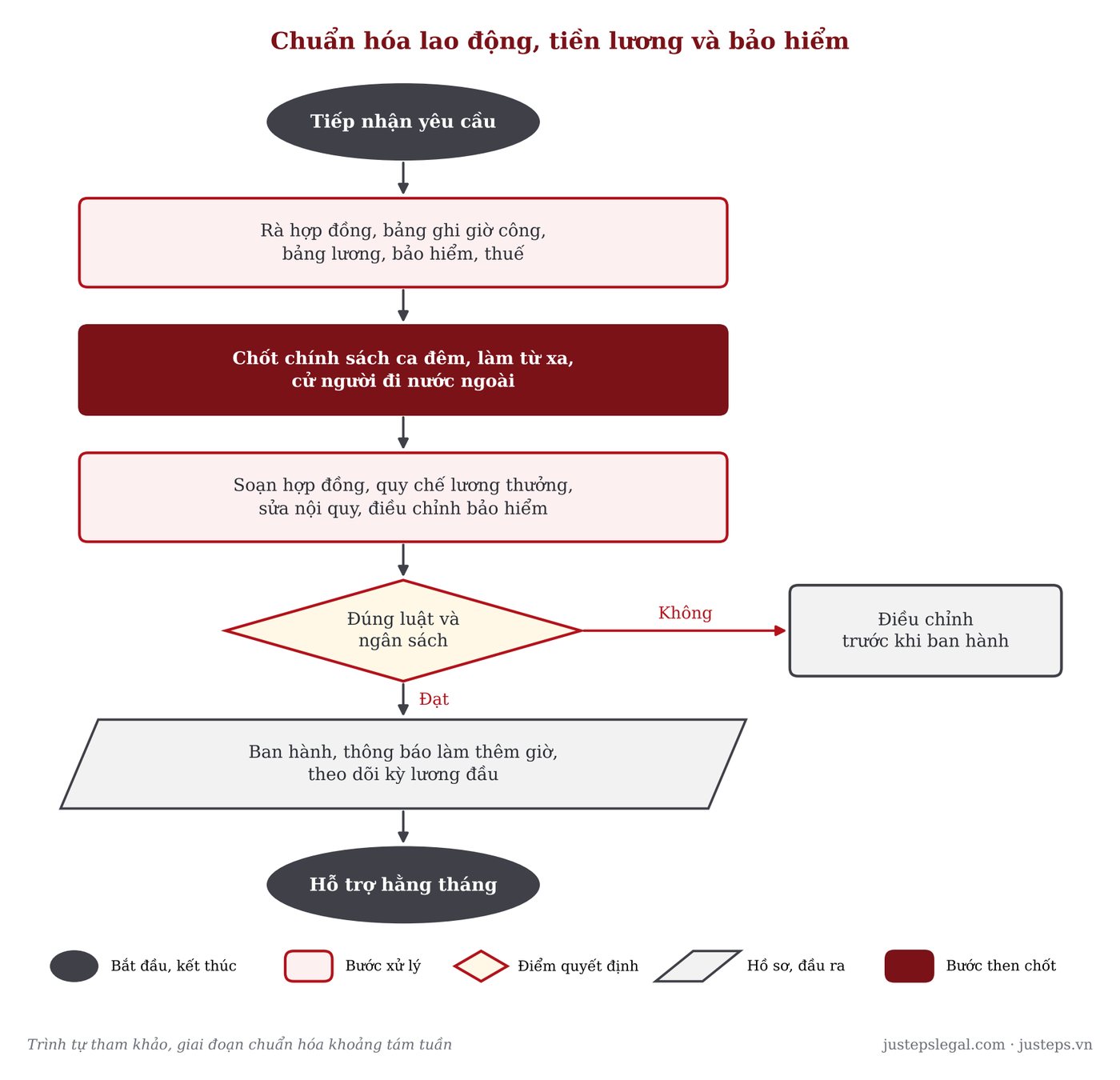
Sequence for standardising labour, wages and insurance at a software business
In the first two weeks Justeps reviews contracts, pay and bonus rules, timesheets, insurance records and tax finalisation; in the third week it works with management to settle the costly policies such as night shift allowances, remote working and sending staff abroad. The following weeks are spent drafting contracts, regulations and internal labour rules, adjusting insurance records, sending overtime notifications where needed and following the first pay period under the new policies. Monthly insurance registration and adjustments can also be entrusted to the compulsory social insurance advisory service. The deliverables include the following documents:
- A report reviewing labour, wages and insurance, setting out discrepancies, the estimated amounts of back pay and the order of priority for remedying them.
- Templates of employment contracts, confidentiality agreements, remote working annexes and annexes for working abroad.
- An overtime, night shift and on-call policy, with the corresponding amendments to the internal labour rules.
- Rules on wages, project bonuses and the thirteenth-month salary, and share award rules.
- Guidance on insurance and tax for foreign engineers and engineers working abroad, a template training contract and a framework labour usage plan.
Justeps quotes the fee in writing after the initial meeting, either as a one-off standardisation package or a monthly support package, depending on headcount, the number of workplaces, the number of foreign engineers and engineers working abroad, any need for bilingual documents, the complexity of bonus and share policies and the need for support with lay-offs. Businesses already using the Ongoing legal advisory service for software technology and outsourcing businesses can combine monthly labour support into the same package.
How Justeps can help
Alongside labour, wages and social insurance services, software technology and outsourcing businesses may combine the following Justeps services:
- Organisational structure design for software technology and outsourcing businesses. Justeps determines who approves overtime, who assesses engineers and the career paths in the organisation before pay policies are written.
- Salary scales and pay and bonus regulations. Justeps builds salary scales based on technical grades and project bonus rules for software businesses.
- Compulsory social insurance advisory. Justeps checks the contribution base and handles registration and adjustment of insurance for Vietnamese and foreign engineers.
- Labour dispute management and contract termination. Justeps prepares termination files and labour usage plans when the business loses a major project.
Frequently asked questions
What is the maximum overtime a software engineer may work in a year?
The general limit is 200 hours a year and 40 hours a month. In certain cases, such as work requiring highly qualified technical staff that the labour market cannot supply in time, up to 300 hours a year is permitted and the business must notify the labour authority[1].
May pay be split into several allowances to reduce insurance contributions?
Allowances of a specific amount paid regularly with each pay period still form part of the wages subject to social insurance contributions, even under another name[8]. This practice carries the risk of back payments, late payment interest and penalties.
Does on-call time at home count as working time?
Time when the engineer only needs to remain contactable may be paid with an on-call allowance, while time actually spent handling incidents should count as working time or overtime. The internal labour rules and contracts need to distinguish clearly between these two kinds of time.
Where do engineers working remotely abroad pay insurance and tax?
This depends on the contract, the time spent abroad, the law of that country and the double taxation agreement. The business needs to assess each case before agreeing to an engineer working abroad for a long period.
Can engineers be required to reimburse training costs when they leave?
Yes, if both parties have signed a training contract stating the cost, the period of committed employment and how reimbursement is calculated[12]. Without such a contract, a claim for reimbursement is unlikely to be accepted.
Can the project team be let go immediately when a major customer is lost?
This is not advisable. The business must prepare a labour usage plan, follow the statutory steps and pay job loss allowance to those who have to leave[15]. Transferring staff to other projects or retraining them is usually the option to consider first.
Related articles
- Overtime limits, how overtime pay is calculated and the records a business must keep
- Managing foreign employees, work permits, compulsory social insurance and the records to keep
- Lawful workforce reductions on structural or technological change, procedure and required records
- Organisational structure design for software technology and outsourcing businesses by size and delivery model
Notes
[1] Clauses 2 and 3 of Article 107 of the Labour Code No. 45/2019/QH14 dated 20 November 2019.
[2] Article 62 of Government Decree No. 145/2020/ND-CP dated 14 December 2020 detailing and guiding the implementation of a number of articles of the Labour Code on working conditions and labour relations.
[3] Article 106 of the Labour Code No. 45/2019/QH14 dated 20 November 2019.
[4] Clauses 2 and 3 of Article 98 of the Labour Code No. 45/2019/QH14 dated 20 November 2019.
[5] The Law amending and supplementing a number of articles of the Labour Code, the Law on Archives, the Law on Gender Equality, the Law on Red Cross Activities and the Law on Employment, passed by the National Assembly on 21 November 2026, effective from 1 March 2027.
[6] Point a of Clause 3 of Article 25 of the Law on Personal Data Protection No. 91/2025/QH15, effective from 1 January 2026.
[7] The Law on Vietnamese Workers Working Abroad under Contracts No. 69/2020/QH14 dated 13 November 2020.
[8] Article 31 of the Law on Social Insurance No. 41/2024/QH15, effective from 1 July 2025.
[9] Government Decree No. 399/2026/ND-CP dated 2 November 2026 on the minimum wage for employees working under employment contracts, effective from 1 January 2027.
[10] Article 25 of the Labour Code No. 45/2019/QH14 dated 20 November 2019.
[11] Clause 2 of Article 21 of the Labour Code No. 45/2019/QH14 dated 20 November 2019.
[12] Article 62 of the Labour Code No. 45/2019/QH14 dated 20 November 2019.
[13] Government Decree No. 253/2026/ND-CP dated 30 June 2026 detailing a number of articles of the Law on Personal Income Tax, effective from 1 July 2026.
[14] Government Decree No. 393/2026/ND-CP dated 20 October 2026 on foreign workers working in Vietnam, effective from 5 December 2026, replacing Decree No. 219/2025/ND-CP.
[15] Articles 42 and 44 of the Labour Code No. 45/2019/QH14 dated 20 November 2019.
[16] Clause 1 of Article 47 of the Labour Code No. 45/2019/QH14 dated 20 November 2019.
[17] Article 29 of the Labour Code No. 45/2019/QH14 dated 20 November 2019.
This article is for reference and reflects the regulations in force at the time of publication. Please consult Justeps for advice tailored to your company’s records and situation.
For further information, please contact:
📩 Email: info@justeps.vn
🌐 Website: https://justepslegal.com · https://justeps.vn
🌐 Page: Justeps
☎️ Hotline (Zalo): 096 172 2607
📍 Thanh Xuan Office: 12th Floor, Licogi 13 Tower, 164 Khuat Duy Tien Street, Thanh Xuan Ward, Hanoi, Vietnam
📍 Ha Dong Office: LK06B, No.10, Dong Dua Area, Ha Dong Ward, Hanoi, Vietnam
📍 Ho Chi Minh City Branch: 528 Le Van Sy, Ho Chi Minh City, Vietnam
📍 Hai Phong Office: Truong Thinh Village, Ha Dong Commune, Hai Phong, Vietnam
📍 Quang Ninh Office: Van Don Special Zone, Quang Ninh Province, Vietnam





