
Key takeaways
- A contract called an agency contract may still be treated as an employment contract if its content shows paid work under the management, direction and supervision of the business; this risk is concentrated at the level of team leaders, unit managers and regional directors[1].
- When a relationship is reclassified as employment, the business must pay arrears of social insurance contributions on the regular income it has paid, plus late payment interest, and any subsequent termination must follow the procedure of the Labour Code[3].
- Commission, bonuses and support for agents are all capped under Ministry of Finance rules, and the new commission table and bonus limits under Circular No. 96/2026/TT-BTC apply from 1 January 2027[4][5].
- From 1 January 2027, the region I minimum wage rises to VND 5,700,000 per month, so small corporate agents with advisory staff working in shifts need to review wages and contracts[8].
A life insurer may have only a few hundred office staff yet work with tens of thousands of agents. Employees are governed by the Labour Code and social insurance legislation, while agents are governed by insurance business legislation and their agency contracts. The line between the two relationships is very clear on paper, but it often blurs in the day-to-day management of the channel, when agency team leaders have to attend a morning roll call, receive a fixed monthly payment and carry targets like a sales employee.
This page introduces Justeps’ labour, payroll and insurance services for insurance businesses, branches of foreign insurance businesses and organisations acting as insurance agents. It focuses on distinguishing agents from employees at each channel tier, designing channel income, tax withholding, benefits for specialist staff and advisory staff, how the work is carried out and the deliverables. The placement of channel tiers on the organisation chart is covered under organisational structure design for insurance businesses and insurance agents.
The line between agents and employees
The Labour Code provides that where the parties agree under a different name but the content shows paid work, wages and the management, direction and supervision of one party, the agreement is deemed to be an employment contract[1]. Conversely, the Law on Insurance Business allows the business to manage and train its agents and requires the agency contract to state clearly the agent’s rights, obligations, commission, bonuses and support[2]. Monitoring the quality of advice is therefore not enough to turn an agent into an employee; the decisive signs are whether the agent is subject to imposed hours, place and methods of work and receives a fixed payment unrelated to results.
For individual agents who only sell, the risk is usually low. The risk rises progressively at the level of team leaders, unit managers and regional directors, where agents both sell and recruit, train and manage lower-tier agents on the instructions of the business. If the relationship is found to be one of employment, the business must pay arrears of compulsory social insurance on wages comprising the salary, allowances and other identifiable additional amounts[3], plus late payment interest, and every subsequent termination must follow the grounds and procedure of the Labour Code.
The flowchart below shows how Justeps classifies each channel tier on the basis of questions about how it is actually managed, rather than the name of the contract.
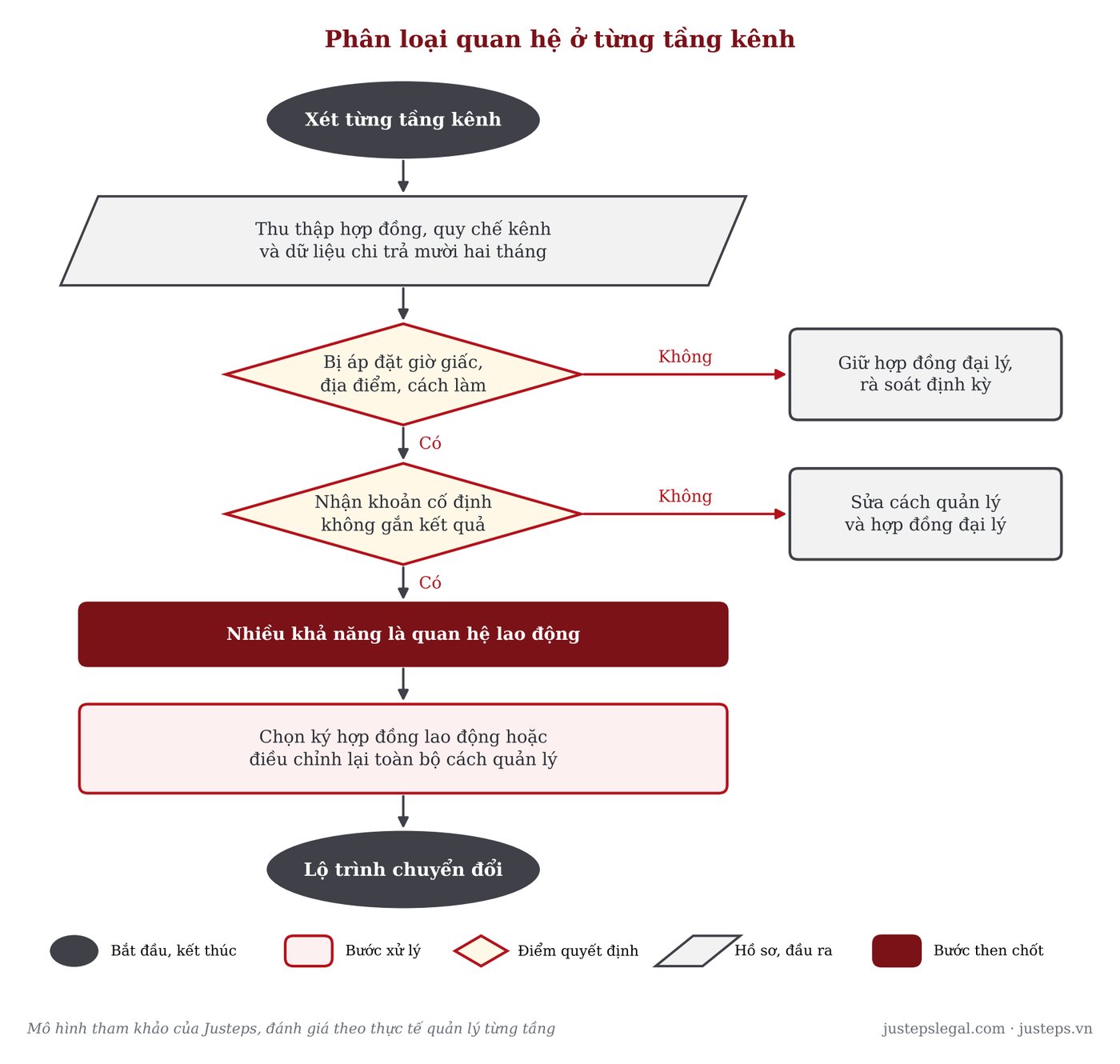
How the relationship is classified at each distribution channel tier
The first question is whether the person is subject to imposed hours, place and methods of work like an employee, and the next is whether they receive a fixed monthly payment that does not depend on sales results. If both answers are yes, the relationship is likely to be treated as employment, and the business should choose between signing an employment contract and changing the way it manages the person. If only one sign is present, Justeps proposes amending the management practice, the payment mechanism and the agency contract to reduce the risk before a dispute or inspection arises.
Designing channel income, commission and bonuses
An insurance business decides the level of commission and bonuses for its agents but may not exceed the maximum set by the Minister of Finance[4]. Circular No. 96/2026/TT-BTC replaces the maximum commission table by product type, term and premium payment method and caps bonuses and support for agents, with the new table applying from 1 January 2027[5]. The channel income policy, incentive programmes and agency contract appendices therefore need to be amended before that date, together with transitional rules for insurance contracts issued before it.
The figure below illustrates a typical income structure at each channel tier in a life insurer, divided into personal commission, performance-based bonuses and support, and a fixed monthly amount.
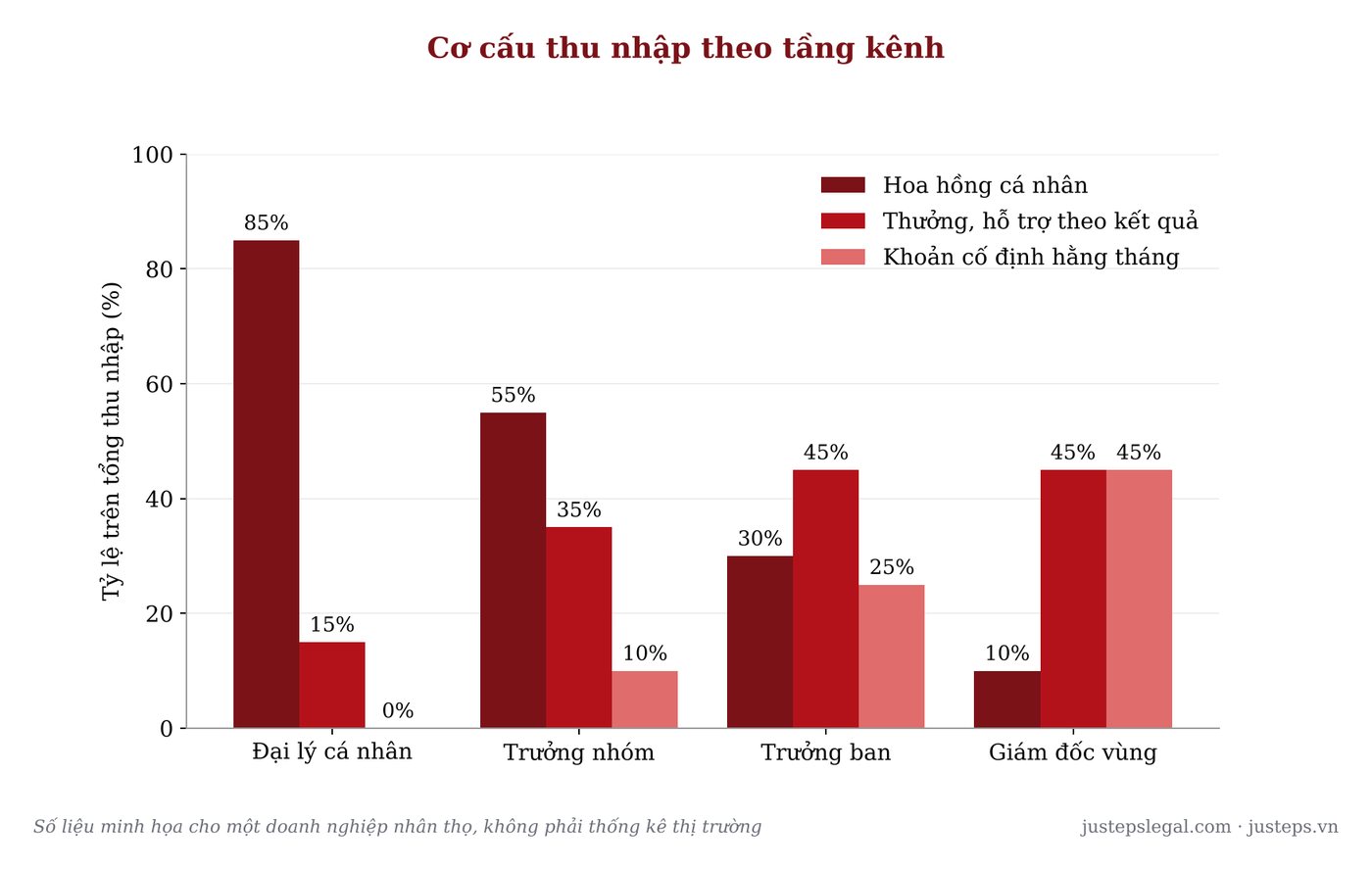
Illustrative income structure by agency channel tier
The higher the tier, the smaller the share of income from personal commission and the larger the fixed share, which is precisely the sign that makes management tiers more likely to be treated as employees. Justeps usually proposes converting the fixed amount into a bonus linked to team results within the permitted limits, or signing employment contracts for positions that are in substance managerial. When clawing back commission because a customer cancels the contract during the free-look period or because the agent is in breach, the grounds for clawback must be stated in the agency contract; for employees, the business may only make deductions from wages in the cases and amounts permitted by the Labour Code[6].
Personal income tax and insurance for the channel force
Agents’ commission, incentive bonuses and in-kind support such as reward trips and gifts are all personal income, so the insurer needs to determine the type of income and the withholding obligation for each item under the Law on Personal Income Tax No. 109/2025/QH15[7]. A common mistake is to withhold tax only on commission paid in cash while overlooking reward trips or support for opening an office. Justeps prepares withholding guidance for each type of payment so that the finance and channel departments apply it consistently.
For advisory staff of a corporate agent working in shifts at counters, shops or call centres, the relationship is usually one of employment, so a collaborator contract is easily treated as a disguised employment contract. From 1 January 2027, the minimum wage is VND 5,700,000 per month in region I, VND 5,080,000 in region II, VND 4,450,000 in region III and VND 4,040,000 in region IV[8]. Small corporate agents need to review the wages stated in contracts, their pay scales and their social insurance contribution levels before that date.
Benefits for specialist staff
Actuaries, underwriters, loss adjusters and investment specialists are hard to recruit, well paid and easily attracted by competitors. Policies for this group usually include training agreements with service commitments, confidentiality agreements covering product, pricing and customer data, and annual retention bonus schemes. For loss adjusters working in the field at non-life insurers, the regulations should state clearly the working hours, mobility allowances, equipment and safety when assessing accidents, fires and explosions.
Foreign-invested businesses often employ foreign nationals as actuaries, risk managers or channel directors, so they need to obtain work permits or exemption confirmations under Decree No. 219/2025/ND-CP[9] and align group policies with Vietnamese law. When the appointed actuary leaves, the business must also allow for the procedure to approve a replacement, so the notice period and handover obligations in the employment contract for this position should be longer and stricter than for ordinary positions.
Process, deliverables and fees
In the first two weeks, Justeps consultants review agency contracts, employment contracts, the channel income regulation and payment data for the past twelve months. The third week is spent classifying each channel tier and reporting the risks to the executive board, after which Justeps designs the policies, template contracts, amendments to the internal labour rules and regulations, and the tax withholding procedure. The final phase is converting contracts according to a roadmap and training channel managers, which usually takes eight to twelve weeks depending on the size of the channel force. The deliverables comprise the following main documents:
- A report classifying the relationship at each channel tier and assessing social insurance and tax risks.
- A distribution channel income regulation covering commission, bonuses, support and clawback mechanisms.
- A set of template agency contracts, employment contracts and confidentiality agreements for each group.
- Personal income tax withholding guidance for each type of payment to the channel force.
- HR policies for specialist staff, including foreign nationals.
The service fee is quoted as a fixed fee in writing once Justeps understands the size of the channel force. The main factors are the size of the channel force, the number of management tiers, the complexity of the income regulation, the number of foreign nationals to be handled and whether the business needs support in dealing with the social insurance and tax authorities. For questions arising after the conversion, the business may use Justeps’ ongoing advisory package.
How Justeps can help
Alongside labour, payroll and insurance services, insurance businesses and insurance agents may combine the following Justeps services:
- Organisational structure design for insurance businesses and insurance agents. Justeps arranges channel management tiers and the agency management unit on the organisation chart to limit the signs of an employment relationship.
- Ongoing legal advisory for insurance businesses and insurance agents. Justeps answers monthly questions on agency contracts, commission clawback and termination of relationships with agents.
- Compulsory social insurance advisory. Justeps determines the salary subject to social insurance contributions and handles arrears filings when a relationship is reclassified.
- Personal income tax on salaries and wages. Justeps provides guidance on withholding tax for employees and distinguishing it from agents’ commission income.
Frequently asked questions
Is an agency team leader an employee?
Not automatically, as a team leader may still be an agent under an agency contract. However, if the business imposes working hours and place and pays a fixed monthly amount, the relationship may be treated as employment[1].
May the business claw back commission paid to an agent?
Yes, if the agency contract clearly states the cases for clawback, for example where the customer cancels the contract during the free-look period or the agent is in breach. For employees, deductions from wages may only be made within the limits of the Labour Code[6].
Is tax to be withheld on reward trips for agents?
A reward trip is in-kind income of the individual, so the business needs to determine its value and the withholding obligation under personal income tax legislation[7]. Internal guidance should specify how the value is calculated for each participant.
Can advisory staff working shifts at a counter sign collaborator contracts?
If the staff work shifts arranged by the organisation, receive wages and are directly managed, the relationship is usually one of employment[1]. In that case the organisation must sign employment contracts, pay no less than the regional minimum wage and pay social insurance contributions.
When do the new commission rates apply?
Under Circular No. 96/2026/TT-BTC, the new maximum commission table and bonus limits for agents apply from 1 January 2027[5]. Businesses should amend their channel income policies and agency contract appendices before that date.
What should a foreign-invested insurer note regarding foreign specialists?
The business must obtain work permits or confirmation of exemption under Decree No. 219/2025/ND-CP[9] and deal with personal income tax and insurance as required. For the appointed actuary, it must also allow for the approval procedure when replacing the person.
Related articles
- Labour, payroll and insurance services for securities, investment fund and consumer finance businesses
- Organisational structure design for insurance businesses and insurance agents
- Ongoing legal advisory for insurance businesses and insurance agents
- A monthly procedure for managing social insurance
Notes
[1] Article 13(1) of the Labour Code No. 45/2019/QH14 dated 20 November 2019.
[2] Article 126 and Article 128(2)(a) and (b) of the Law on Insurance Business No. 08/2022/QH15 dated 16 June 2022, as amended and supplemented by Law No. 139/2025/QH15 dated 10 December 2025.
[3] Article 31(1) of the Law on Social Insurance No. 41/2024/QH15 dated 29 June 2024, effective from 1 July 2025.
[4] Article 128(1)(c) and (2)(dd) of the Law on Insurance Business No. 08/2022/QH15 dated 16 June 2022, as amended and supplemented by Law No. 139/2025/QH15 dated 10 December 2025.
[5] Circular No. 96/2026/TT-BTC dated 2 July 2026 of the Ministry of Finance amending and supplementing Circular No. 67/2023/TT-BTC dated 2 November 2023; the provisions on agents’ commission and bonuses take effect from 1 January 2027.
[6] Article 102 of the Labour Code No. 45/2019/QH14 dated 20 November 2019.
[7] Law on Personal Income Tax No. 109/2025/QH15.
[8] Decree No. 399/2026/ND-CP on the minimum wage for employees working under employment contracts, applicable from 1 January 2027.
[9] Government Decree No. 219/2025/ND-CP on foreign workers working in Vietnam.
This article is for reference and reflects the regulations in force at the time of publication. Please consult Justeps for advice tailored to your company’s records and situation.
For further information, please contact:
📩 Email: info@justeps.vn
🌐 Website: https://justepslegal.com · https://justeps.vn
🌐 Page: Justeps
☎️ Hotline (Zalo): 096 172 2607
📍 Thanh Xuan Office: 12th Floor, Licogi 13 Tower, 164 Khuat Duy Tien Street, Thanh Xuan Ward, Hanoi, Vietnam
📍 Ha Dong Office: LK06B, No.10, Dong Dua Area, Ha Dong Ward, Hanoi, Vietnam
📍 Ho Chi Minh City Branch: 528 Le Van Sy, Ho Chi Minh City, Vietnam
📍 Hai Phong Office: Truong Thinh Village, Ha Dong Commune, Hai Phong, Vietnam
📍 Quang Ninh Office: Van Don Special Zone, Quang Ninh Province, Vietnam





