
Key takeaways
- A twenty-four hour position covered by two people on twelve-hour shifts generates about 156 hours of overtime per person per month, far above the statutory limit[1], so the number of people for each duty position must be calculated from the roster rather than from the wage budget.
- An employment contract that fixes one building as the workplace makes it hard to transfer staff when a project is lost, while losing a project is not automatically a ground for terminating employment contracts.
- Technicians operating electrical systems and lifts or working at height must be trained and issued safety cards before being assigned such work[3], and a new list of work subject to strict requirements applies from 01/01/2027[4].
- From 01/01/2027 regional minimum wages increase and apply according to the location of the project[8], so businesses managing buildings in several provinces need pay scales by region.
Staff costs are usually the largest item in the management service fee, because a building needs people on duty around the clock, including on public holidays. When pricing a bid, many businesses calculate headcount from the wage budget the Management Board will accept and then arrange shifts so that enough people are present, which leads to staff working twelve hours a day for weeks on end. Unpaid overtime, night work pay and underpaid insurance accumulate quietly and then surface all at once when a group of staff resigns or a labour inspection takes place.
This page describes the Justeps labour, wages and social insurance service for businesses that manage apartment buildings, office buildings, shopping centres and urban areas. It covers rosters and overtime, allowances and the basis for insurance contributions, employment contracts for staff working at several projects, safety for technicians, relations with security and cleaning contractors, regional minimum wages and foreign workers. Determining the departments and positions of each management office is handled under the organisational structure design service for building and urban area management businesses, while this page deals with the relationship between the business and each employee.
Staff costs within the management service fee
To show why labour policy determines the profit of each contract, Justeps usually breaks the service fee down into its main cost items. The chart below shows the cost structure of a management contract for an apartment building in the example.
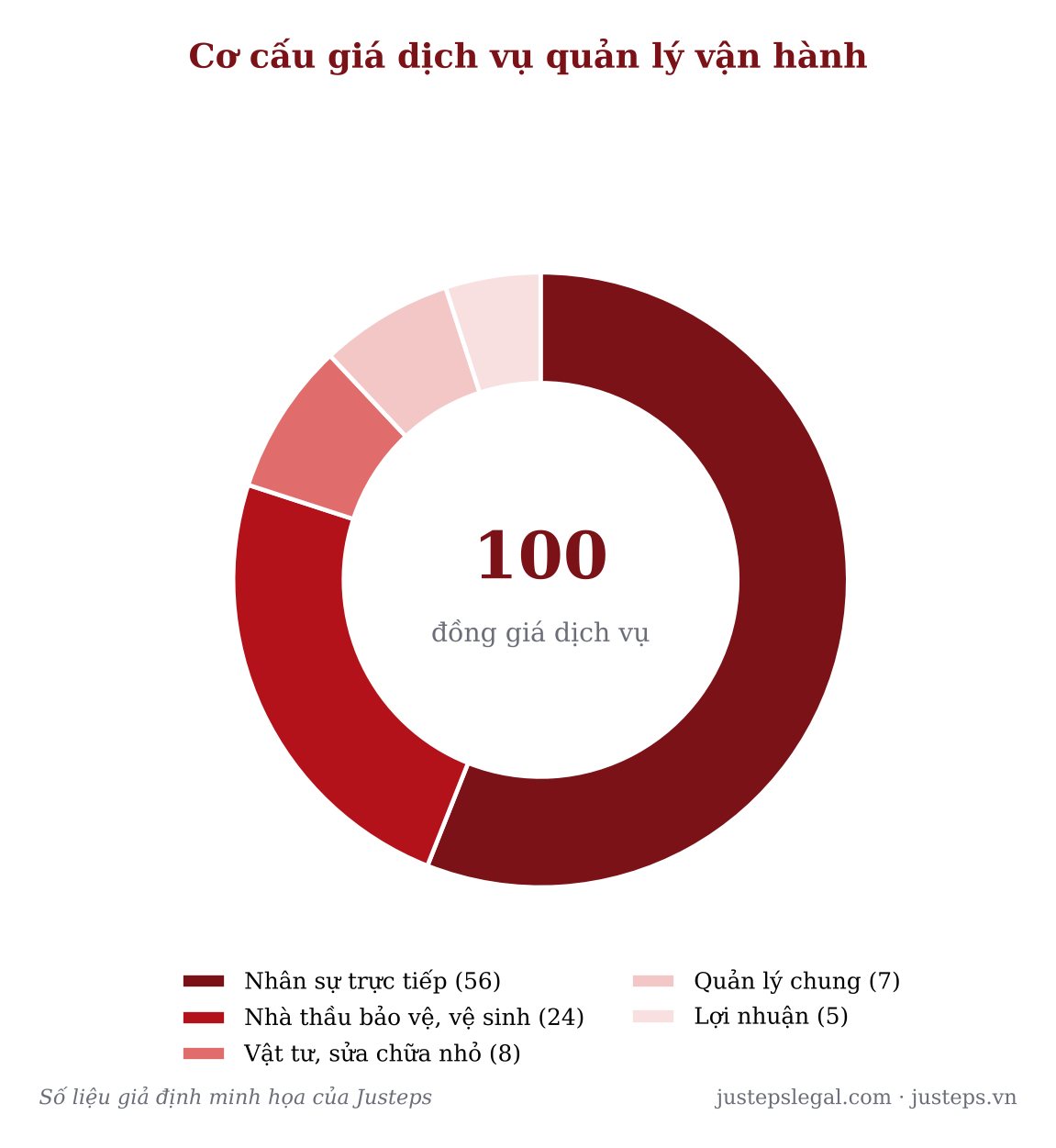
Example cost structure of the management service fee for an apartment building
In the example, the business’s direct staff account for 56 of every 100 dong of the service fee, security and cleaning contractors for 24, materials and minor repairs for 8, general management for 7, and the remaining profit is 5. These are assumed figures for illustration, but they show that a rise of one tenth in direct staff costs, about 5,6 dong, is enough to wipe out the entire 5 dong of profit on the contract. Justeps therefore calculates labour costs in line with the law from the pricing stage, rather than leaving the business to discover the shortfall a few years later.
Twenty-four hour rosters and overtime limits
The Labour Code limits normal working hours and overtime hours per day, month and year, and requires overtime and night work to be paid at a higher rate than normal hourly pay[1]. For positions that must be staffed continuously, such as gate security, the technician on duty in the plant room or the camera monitor, the total to be covered is 168 hours a week, and the number of people assigned to that position immediately determines who must work how much overtime. The chart below compares three ways of staffing one duty position.
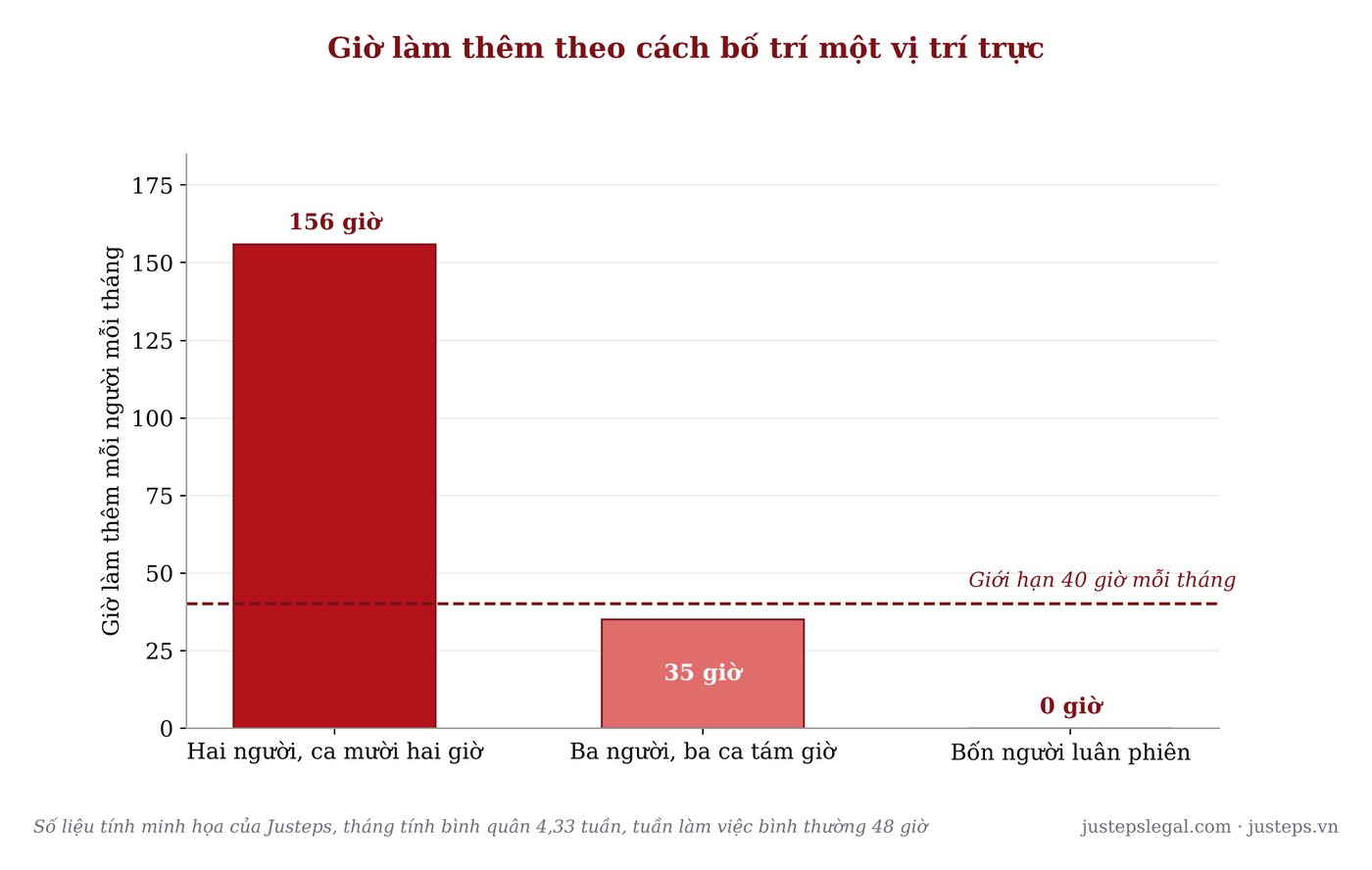
Example average overtime hours per person per month under three ways of staffing one twenty-four hour position
If two people rotate on twelve-hour shifts, each works 84 hours a week with about 156 hours of overtime a month, nearly four times the current limit of 40 hours a month. With three people on three eight-hour shifts seven days a week, each works 56 hours a week with about 35 hours of overtime a month, close to the limit and leaving no margin for public holidays or staff on leave. Four people sharing 168 hours equally work about 42 hours a week each, with no overtime and with cover available when someone is absent. These figures are illustrative; Justeps prepares actual rosters for each project and costs each option so that the business can include it in its bid price.
Night shift and on-call allowances and the salary basis for insurance
Building staff often receive several payments in addition to salary, such as night shift allowances, on-call allowances, responsibility allowances for shift leaders, hazardous work allowances for those cleaning water tanks and refuse rooms, and attendance bonuses. Under the Law on Social Insurance, the salary used as the contribution basis includes the wage, wage allowances and other supplementary amounts agreed to be paid regularly and stably in each pay period[2]. An amount called support but paid at a fixed rate every month to everyone on the night shift usually still has to be included in the contribution basis, whereas night work pay calculated on actual hours is treated differently.
Justeps prepares a classification table for each income item, showing which are subject to insurance contributions, which are overtime or night work pay and which are welfare benefits, and then rewrites the pay regulations to match this table. Where it finds underpaid contributions in the past, Justeps calculates the amount to be paid in arrears and proposes an adjustment path for the business to decide. Pay scales and pay tables by title, such as building manager, engineer, technician and receptionist, can be developed in parallel through the pay scale and pay and bonus regulation service.
Workplace, transfers and losing a project
Employment contracts for building staff usually state that the workplace is one specific building. This reflects the situation at recruitment, but when the business’s contract with the Management Board is not renewed, the business has no contractual basis to move staff to another project and staff may refuse. Conversely, losing a project does not automatically become a ground for terminating employment contracts, and mass dismissals without proper procedure can lead to collective disputes[1].
Justeps drafts contract templates stating that the workplace is the projects managed by the business within a reasonable geographical area, with an appendix assigning the specific project and a travel support mechanism for transfers to distant sites. The business also receives a playbook for losing a project, covering when to inform staff, how to reassign them to other projects, cases where staff move to work for the new unit and the documents to close their insurance records. Where employment contracts must be terminated, the business can refer further to the labour disputes and termination of employment service.
Electrical and lift technicians and work at height
Building technicians operate medium-voltage switchboards, generators, pump systems and lifts, and often work at height when replacing lights, cleaning façades or repairing pipes. Employers must train and issue safety cards to people doing work subject to strict occupational safety and health requirements before assigning them to it[3], and from 01/01/2027 the list of such work is replaced by a new list[4]. Justeps reviews the list of technicians against the new list, checks the validity of safety cards and the periodic training plan for each project.
When a workplace accident occurs, the business must report, investigate and pay benefits as required, and failing to report promptly or truthfully may be penalised[5]. The law amending the Law on Occupational Safety and Health passed in November 2026 further widens the channels through which employees can report accidents[6], so internal reporting procedures need to be shorter and more transparent. Justeps drafts an accident procedure for project management offices, covering first aid, preserving the scene, reporting to head office, notifying the competent authority and preparing the benefit file.
Security and cleaning contractors and the line with labour leasing
Building management businesses often hire contractors to provide security, cleaning and landscaping. These are service contracts in which the contractor recruits, pays, insures and manages its own staff, while the business only accepts the results. If the management office directly rosters, records attendance and disciplines the contractor’s staff, the relationship may be regarded as the use of leased labour, an activity with its own conditions which the Labour Code has just amended to move from licensing to notification, effective from 01/3/2027[1].
For security services, the contractor must also meet the security and order conditions for conditional business lines, which were amended from 15/11/2026[7]. Justeps reviews contracts with contractors to determine who gives instructions, who supervises and who is liable when a contractor’s employee is injured or causes damage, and requires the contractor to provide evidence that insurance has been paid for the people working at the project. The business’s work rules should also state how building staff coordinate with contractor staff, which can be further standardised through the work rules and disciplinary procedure service.
Regional minimum wages, older workers and foreign workers
A business managing buildings in several provinces must apply the minimum wage of the area where the employee works, and a branch applies the rate of the area where it is located[8]. From 01/01/2027 the monthly minimum wage is 5.700.000 dong in region I, 5.080.000 dong in region II, 4.450.000 dong in region III and 4.040.000 dong in region IV[8]. Security and cleaning staff are often paid close to these levels, so Justeps reviews each project’s payroll before the adjustment date and proposes how to inform the Management Board when costs rise.
Many buildings employ retired people as guards or supervisors, and the insurance treatment of this group differs from that of ordinary employees, so Justeps determines each case under the Law on Social Insurance[2] and notes the limits on heavy work and night shifts for older workers. Businesses managing grade A office buildings sometimes have a foreign director or chief engineer; work permit applications submitted up to 04/12/2026 are processed under Decree No. 219/2025/ND-CP[9], while applications submitted from 05/12/2026 fall under Decree No. 393/2026/ND-CP[10].
Implementation process, deliverables and fees
A typical project takes about eight weeks, starting with comparing actual rosters with attendance records and payroll at two or three representative projects. Justeps presents a risk report and roster and cost options for management to choose before drafting documents, because this decision affects both the bid price and staff income.
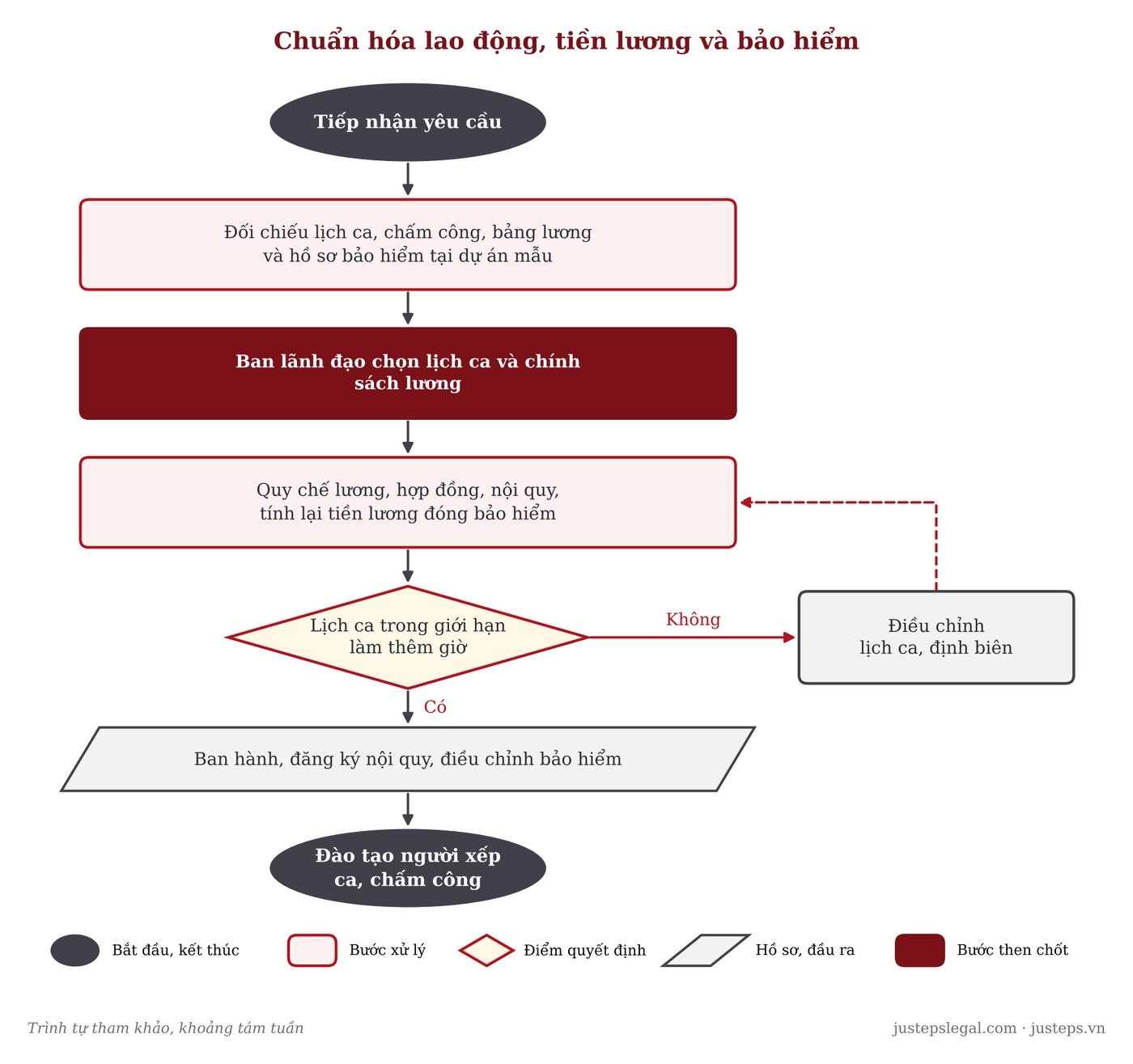
Sequence for standardising labour, wages and social insurance at a building management business
The first two weeks are spent comparing records and interviewing building managers, and in the third week management chooses the roster option and pay policy. Justeps then drafts the regulations, contract templates and work rules and recalculates the salary basis for insurance; if the roster of any project still exceeds the overtime limit, Justeps adjusts it before issue, and the final week trains the people who prepare rosters and record attendance at projects. The deliverables include the following documents:
- A compliance review report on labour, insurance and occupational safety for each project.
- Template rosters for twenty-four hour positions with a cost comparison table.
- Pay regulations covering night shift, on-call and hazardous work allowances and a classification table of items subject to insurance contributions.
- Employment contract templates with a multi-project workplace clause and a transfer appendix.
- A playbook for handling staff when projects are won and lost.
- A list of technicians requiring training and safety cards and a workplace accident procedure.
The service fee is quoted by Justeps in writing as a fixed package after an initial discussion. The fee depends on the number of employees, the number of projects and wage regions, the extent of outsourcing, whether insurance arrears must be calculated, the need to register work rules and the number of foreign workers. A business needing someone to follow labour questions arising each month can combine this with the ongoing compliance advisory service for building and urban area management businesses.
How Justeps can help
In addition to the labour, wages and social insurance service, building and urban area management businesses can combine the following Justeps services:
- Organisational structure design for building and urban area management businesses. Justeps determines departments, positions and staffing as the basis for rosters and pay scales.
- Ongoing compliance advisory for building and urban area management businesses. Justeps answers questions on labour, subcontractors and accidents arising during the year.
- Pay scales and pay and bonus regulations. Justeps builds pay scales and pay tables by title and by the wage region of each project.
- Work rules and disciplinary procedures. Justeps drafts work rules for shift staff, the registration file and the disciplinary procedure.
- Labour disputes and termination of employment. Justeps assesses the grounds, prepares the file and supports negotiation when employment contracts must be terminated.
Frequently asked questions
Do twelve-hour shifts for security guards breach the law?
A twelve-hour shift is not a breach in itself, but total weekly hours and overtime per month and year must stay within the limits of the Labour Code[1]. Two people rotating twelve-hour shifts for one continuous position usually exceed the limits.
If a building contract is lost, may the staff there be let go?
Not automatically. The business should first consider transferring them to other projects under their contracts and the work rules, and terminate employment contracts only where there is a basis and the proper procedure under the Labour Code is followed[1].
Is the night shift allowance subject to social insurance contributions?
Allowances agreed to be paid regularly and stably in each pay period form part of the contribution basis[2]. Night work pay calculated on actual hours is treated differently, so the pay regulations should name and describe each item clearly.
May the management office roster the staff of the security contractor?
This should be avoided. The business should only set requirements on posts and results, while rostering, attendance and discipline belong to the contractor; otherwise the relationship may be regarded as the use of leased labour[1].
What safety documents does a lift technician need?
People doing work subject to strict occupational safety and health requirements must be trained and issued a safety card before starting work[3]. The business should review its list against the new list applying from 01/01/2027[4].
Which minimum wage applies to a project in another province?
The rate for the area where the employee actually works applies, and a branch applies the rate where it is located[8]. A business managing many buildings should have pay tables for each region.
Related articles
- Organisational structure design for building and urban area management businesses based on a head office and project management model
- Internal procedures and regulations for building and urban area management businesses from takeover to incident handling
- Ongoing compliance advisory for building and urban area management businesses in relations with the Management Board and residents
- Building an occupational safety and health system for factories from the responsible department to training and monitoring
Notes
[1] Labour Code No. 45/2019/QH14 and the Law amending and supplementing a number of articles of the Labour Code passed by the National Assembly on 21/11/2026, effective from 01/3/2027.
[2] Law on Social Insurance No. 41/2024/QH15 and its amending and supplementing documents.
[3] Clause 2, Article 14 of the Law on Occupational Safety and Health No. 84/2015/QH13 dated 25/6/2015.
[4] Circular No. 27/2026/TT-BNV dated 20/10/2026 of the Ministry of Home Affairs issuing the List of work subject to strict occupational safety and health requirements, effective from 01/01/2027.
[5] Decree No. 283/2026/ND-CP dated 15/7/2026 of the Government on administrative penalties in the fields of labour and social insurance, effective from 10/9/2026.
[6] Law amending and supplementing a number of articles of the Law on Occupational Safety and Health passed by the National Assembly on 21/11/2026, effective from 01/3/2027.
[7] Decree No. 392/2026/ND-CP dated 20/10/2026 of the Government amending and supplementing decrees on administrative procedures and business investment conditions in the field of security and order, effective from 15/11/2026.
[8] Articles 3 and 4 of Decree No. 399/2026/ND-CP dated 02/11/2026 of the Government on minimum wages for employees working under employment contracts, applicable from 01/01/2027.
[9] Decree No. 219/2025/ND-CP of the Government on foreign workers working in Vietnam, applicable until 04/12/2026.
[10] Decree No. 393/2026/ND-CP dated 20/10/2026 of the Government on foreign workers working in Vietnam, effective from 05/12/2026.
This article is for reference and reflects the regulations in force at the time of publication. Please consult Justeps for advice tailored to your company’s records and situation.
For further information, please contact:
📩 Email: info@justeps.vn
🌐 Website: https://justepslegal.com · https://justeps.vn
🌐 Page: Justeps
☎️ Hotline (Zalo): 096 172 2607
📍 Thanh Xuan Office: 12th Floor, Licogi 13 Tower, 164 Khuat Duy Tien Street, Thanh Xuan Ward, Hanoi, Vietnam
📍 Ha Dong Office: LK06B, No.10, Dong Dua Area, Ha Dong Ward, Hanoi, Vietnam
📍 Ho Chi Minh City Branch: 528 Le Van Sy, Ho Chi Minh City, Vietnam
📍 Hai Phong Office: Truong Thinh Village, Ha Dong Commune, Hai Phong, Vietnam
📍 Quang Ninh Office: Van Don Special Zone, Quang Ninh Province, Vietnam





