
Key takeaways
- A yoga teacher who teaches to a class timetable set by the studio, is paid per session and is supervised by the head of the professional line shows many signs of an employment relationship, even if the parties sign a document called a collaboration agreement[2].
- Where base pay makes up only about one third of income, the business must be able to show that pay for normal working hours is not below the regional minimum wage, which rises from 1 January 2027[4].
- A gym may not keep the originals of a trainer’s diplomas or certificates to tie the employee down; to retain someone it has sent on training, it should use a training contract[8].
- The commission rules should state clearly whether a trainer who leaves is entitled to commission on memberships not yet used up, because this is the most common point of dispute when an employment contract ends.
A personal trainer leaves a gym after two years. The trainer claims commission on personal training packages sold but not yet fully used by members, demands the return of the original certificates the gym has kept since the first day of work, and argues that the base pay in the contract is below the regional minimum wage. The gym in turn asks the trainer to repay the cost of an advanced training course because the committed period of service has not been completed. On rereading the records, both sides find that the contract, the commission rules and the training documents are not clear enough to say who is right.
This page presents Justeps’ labour, payroll and insurance service for gyms, yoga and pilates studios, martial arts schools, commercial swimming pools and sports clubs. It covers how to classify the people who work at a gym, how to design an income structure with base pay, session pay and commission, social insurance, shift arrangements, training contracts and certificates, personal income tax withholding, the implementation process and deliverables. The main legal basis is the Labour Code No. 45/2019/QH14, the Law on Social Insurance No. 41/2024/QH15, Decree No. 399/2026/NĐ-CP on minimum wages and the law on personal income tax.
Why labour arrangements at gyms need a tailored design
The income of people working at a gym is tied to the number of sessions taught and membership sales, not only to the number of hours present. Sales consultants live mainly on commission, personal trainers are paid per session plus commission on training packages, yoga teachers may teach only a few classes a week, and receptionists, lifeguards and technicians work in shifts. A single employment contract template with a fixed salary cannot reflect these ways of paying people, so in practice businesses often use many different kinds of documents without a consistent principle.
In addition, sports instructors must meet qualification requirements, such as being a coach or a ranked athlete, holding a sports qualification or having completed professional training[1]. This is a condition imposed on the business itself, so personnel records must keep evidence of the qualifications of everyone who teaches, including substitute instructors and freelance trainers admitted to the facility. A gym’s labour records therefore serve both the employment relationship and the maintenance of its certificate of eligibility.
Classifying trainers, teachers and freelance collaborators
The Labour Code identifies an employment contract by its content, not by its name. Where the parties agree under a different name but the content shows paid work, wages and management, direction and supervision by one party, the agreement is treated as an employment contract[2]. The flowchart below shows the set of questions Justeps uses to classify each group of people working at a gym.
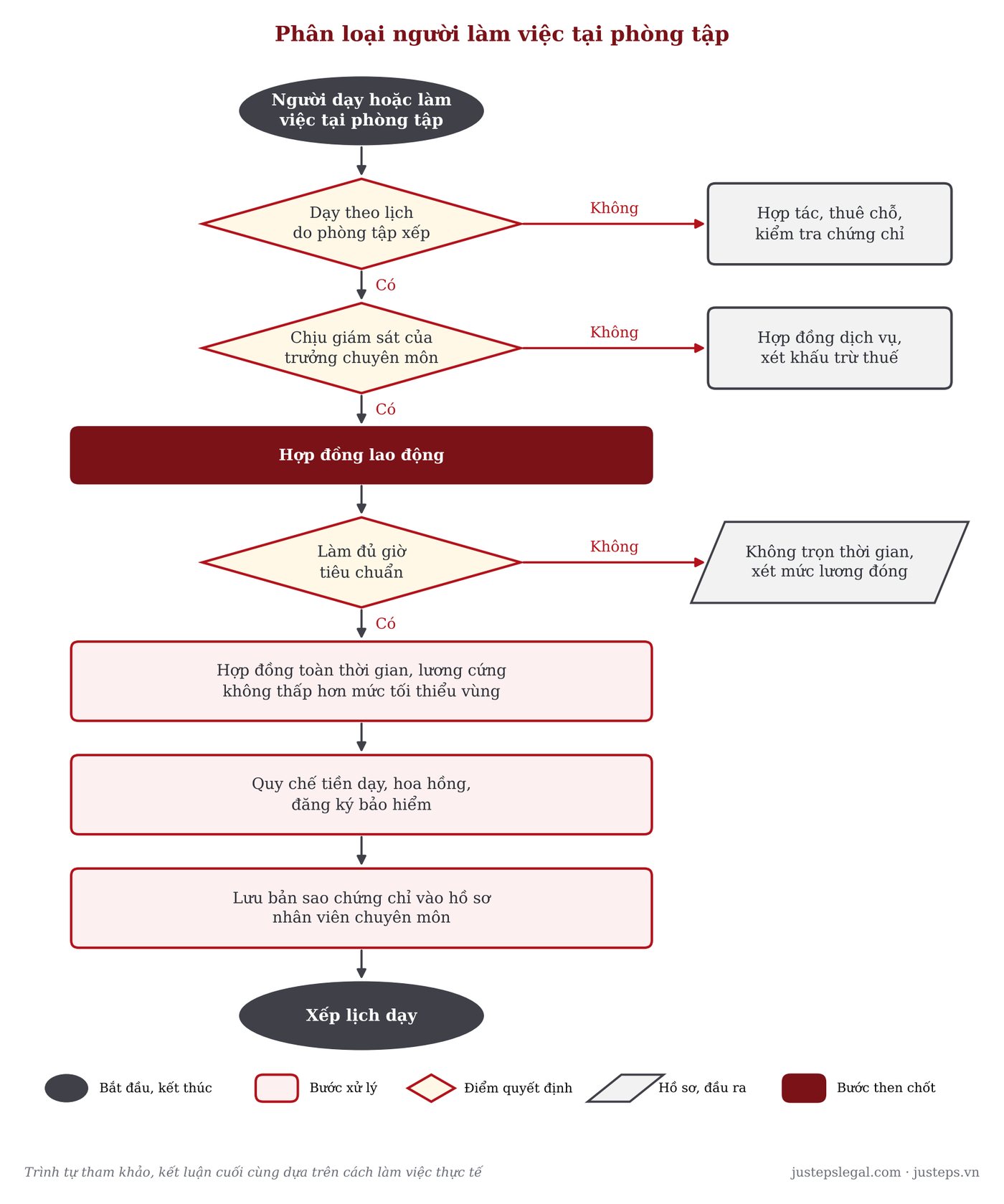
Questions for classifying people who work at a gym or yoga studio
A yoga teacher who teaches to a class timetable set by the studio, uses the studio’s rooms and mats, follows the common training plan and is assessed by the head of the professional line should usually be given an employment contract, which may be a part-time contract. By contrast, a freelance trainer who finds clients independently, decides when to teach and only rents space from or shares revenue with the gym is better suited to a cooperation agreement or a service contract, with conditions on checking certificates and on responsibility in the event of an accident. The table below summarises the usual classification, although the final conclusion depends on how the work is actually carried out.
| Group | Usually suitable contract | Points to note |
|---|---|---|
| Full-time personal trainer | An employment contract with base pay, session pay and commission. | Pay for normal working hours must not be below the regional minimum. |
| Per-class teacher | A part-time employment contract where the teacher works to the gym’s timetable. | Check whether contributions are due based on monthly wages. |
| Freelance trainer | A cooperation or space rental agreement where the trainer controls clients and teaching hours. | Check certificates and withhold tax if the business pays the individual. |
| Membership sales consultant | An employment contract with base pay and commission. | Commission is adjusted when a member is refunded. |
| Lifeguard, technician, shift receptionist | A shift-based employment contract, which may be part-time. | Safety training and night work allowance if open after 22:00. |
Income structure, minimum wage and commission
At many gyms, base pay makes up only about one third of a trainer’s total income, with the rest coming from session pay and commission. The figure below is an example of the monthly income structure of four groups of positions at a gym in Region I.
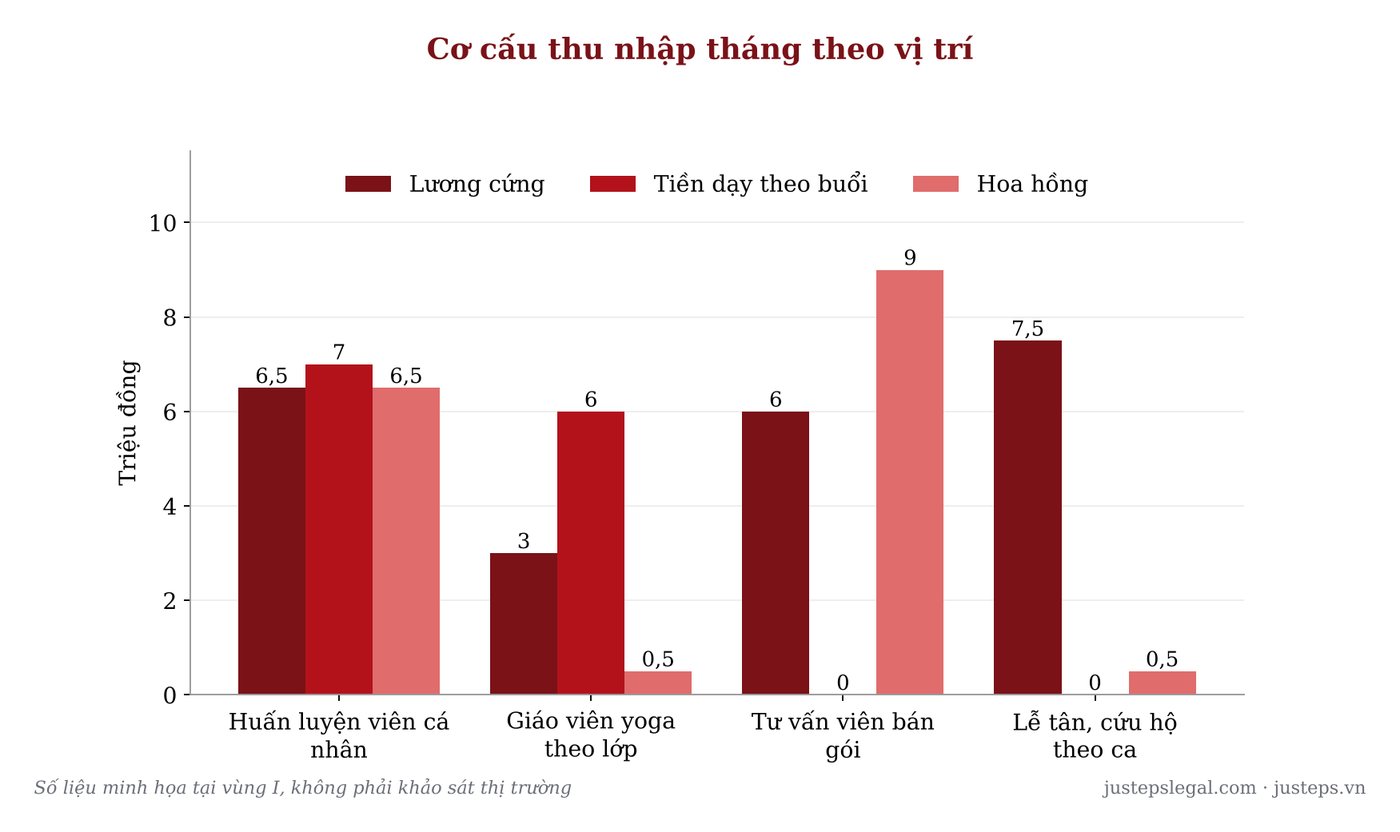
Example monthly income structure of positions at a gym
This way of paying is lawful when each component is clearly agreed, but pay for normal working hours must not be lower than the minimum wage[3]. From 1 January 2027, the monthly minimum wage is VND 5,700,000 in Region I, VND 5,080,000 in Region II, VND 4,450,000 in Region III and VND 4,040,000 in Region IV[4]. A common mistake is to set base pay below this level and shift the difference into session pay or commission, because in a month when the trainer has few sessions, pay for normal working hours will fall below the minimum.
The commission rules need to answer three questions, namely whether commission is calculated on money actually received or on the value of the package, whether it is paid in one lump sum or according to the sessions the member has attended, and how commission on unused packages is treated when the trainer leaves. The business must establish a wage scale and payroll table as the basis for agreeing wages[5], and Justeps usually designs the wage scale by trainers’ professional level, separate from the commission rules, so that the business can adjust commission rates without amending the wage scale.
Social insurance where income has several components
The 2024 Law on Social Insurance extends compulsory coverage to, among others, people working under employment contracts of one month or more and part-time workers whose monthly wages are at or above the lowest level used as the basis for contributions[6]. Yoga teachers who teach a few classes a week, previously often treated as outside the scope, now need to be reassessed against their actual monthly income.
The wages used as the basis for contributions include the wage level, wage allowances and other supplements agreed to be paid regularly and stably in each pay period[6]. The same session pay or commission may or may not attract contributions depending on how the rules describe it: a fixed payment for a committed minimum number of sessions is usually stable in nature, while commission that depends entirely on monthly sales needs to be assessed separately. Justeps reviews the payment data for the last twelve months to estimate the amounts that might have to be paid retrospectively and proposes how to redraft the rules more clearly.
Shifts, public holidays, training contracts and certificates
A gym’s staffing needs peak early in the morning and in the late afternoon and evening, so split shifts with a long midday break are a common arrangement. Split shifts must be set out in the internal labour regulations or an agreement, and total actual working hours must not exceed the limits. A club that stays open after 22:00 must pay at least an additional 30% of wages for night work, while people working on public holidays and Tết are paid at least 300%, not counting the paid holiday wage[7]. From 1 March 2027, the Law amending the Labour Code adds public holidays on 27 July and 24 November, so shift schedules and the 2027 payroll budget need to account for these two days.
An employer may not keep the originals of an employee’s identity papers, diplomas or certificates[8]. A gym should keep only certified copies for its professional staff records. When the business pays for a trainer to obtain an international certificate or take an advanced course, the lawful way to retain the trainer is a training contract stating the cost, the committed period of service and how the cost is repaid on early departure[9].
Terminating the contract of a sales consultant or trainer for missing sales targets is only justified where the business has issued rules on assessing the level of job performance and the employee regularly fails to meet the criteria in those rules[10]. A business with ten or more employees must also have written internal labour regulations registered as required[11], which should include a ban on teaching members privately outside the system and on receiving money directly from members.
Personal income tax on session pay and fees
For staff on employment contracts of three months or more, the business withholds tax at progressive rates on total income, including session pay and commission. For freelance trainers, visiting teachers or people on contracts of less than three months, from 1 July 2026 the paying organisation must withhold 10% on payments of VND 5 million or more each time[12]. Justeps sets up a procedure for reconciling the number of sessions taught in the membership management software with the timesheet before calculating pay, so that each payment matches both what actually happened and the withholding obligation.
Implementation process, deliverables and fees
A project usually takes six to eight weeks. In the first two weeks, Justeps’ consultants read the contracts, pay and commission rules, payrolls and payment records for the last twelve months, and interview facility managers, accountants and several trainers. In week three Justeps presents the classification results, the risks and the transition roadmap. The following weeks are spent drafting documents, holding a dialogue with employees on changes to the income structure and running the new payroll as a trial on one month of data. The deliverables comprise the following documents:
- A report classifying the people who work at the business and assessing the risk of retrospective insurance contributions, penalties and tax.
- A set of templates for full-time and part-time employment contracts and cooperation agreements with freelance trainers.
- A wage scale, payroll table and rules on wages, session pay and commission, including how they are handled when someone leaves.
- Template training contracts and confidentiality agreements covering member data and training plans.
- Rules on shifts, rules on assessing job performance and draft internal labour regulations.
- Guidance for the accountant on monthly insurance contributions and tax withholding.
A small studio usually only needs to reclassify its teachers and adopt a part-time contract template. A gym chain needs consistent commission rules across facilities in different wage regions, a club with a pool needs separate arrangements for lifeguards, and a club that hires foreign trainers also needs work permit procedures. If trainers’ reporting lines are still unclear, Justeps recommends combining this work with the organisational structure design service for gym and yoga businesses. Fees are quoted as a fixed package in writing after the initial discussion, depending on the number of employees, the number of facilities and the complexity of the pay scheme.
How Justeps can help
Alongside labour, payroll and insurance services, gym, yoga and sports club businesses can combine the following Justeps services:
- Organisational structure design for gym, yoga and sports club businesses. Justeps separates the professional line from the sales line so that trainers are managed on the quality of their teaching.
- Ongoing legal advisory for gym, yoga and sports club businesses. Justeps answers each situation involving resignations, discipline and commission disputes that arises during the service period.
- Developing wage scales, payroll tables and pay and bonus rules. Justeps designs wage scales by professional level and commission rules for trainers and sales consultants.
- Compulsory social insurance advisory. Justeps determines who must contribute, the wages used as the contribution basis and how to handle back payments for part-time teachers.
Frequently asked questions
Do social insurance contributions apply to membership sales commission?
It depends on what has been agreed. Supplements agreed to be paid regularly and stably in each pay period form part of the wages used as the contribution basis[6], while commission that depends entirely on sales needs to be assessed against the content of the rules.
Must insurance contributions be paid for a yoga teacher who teaches three sessions a week?
If the teacher works under a part-time employment contract and the monthly wage reaches the lowest level used as the basis for contributions, the teacher is subject to compulsory social insurance[6]. The business should check this against actual income each month.
May a gym keep the original certificates of its trainers?
No. An employer may not keep the originals of an employee’s diplomas or certificates[8]. The gym should keep only certified copies for its professional staff records.
May a trainer be dismissed for failing to meet sales targets?
Only where the business has issued rules on assessing the level of job performance with clear criteria and the employee regularly fails to meet them[10]. The business must also comply with the notice period.
How much must be paid for working on the first day of Tết?
At least 300% of wages, not counting the paid holiday wage for employees paid on a daily basis[7].
Must tax be withheld when paying VND 3 million to a freelance trainer for teaching a course?
From 1 July 2026, withholding of 10% is not mandatory for payments of less than VND 5 million each time to individuals without an employment contract[12], but the business must still aggregate the amounts paid for reporting.
May trainers be prohibited from teaching members privately outside the system?
Yes, if this is set out in the internal labour regulations or the contract and applies while the trainer works for the business[11]. After the trainer leaves, the business should rely on a confidentiality agreement covering member data rather than an absolute ban.
Related articles
- Organisational structure design for gym, yoga and sports club businesses based on a sales line and a professional line
- Ongoing legal advisory for gym, yoga and sports club businesses from premises and franchising to member incidents
- Developing commission rules for spa therapists linked to wages, employment contracts and service quality
- Managing seasonal workers and freelance collaborators in line with the true nature of the contract and contribution obligations
Notes
[1] Clause 1 of Article 13 of Decree No. 36/2019/NĐ-CP dated 29 April 2019 of the Government detailing a number of articles of the Law amending and supplementing a number of articles of the Law on Physical Training and Sports, as amended and supplemented by Decree No. 31/2024/NĐ-CP.
[2] Clause 1 of Article 13 of the Labour Code No. 45/2019/QH14 dated 20 November 2019.
[3] Articles 90 and 91 of the Labour Code No. 45/2019/QH14 dated 20 November 2019.
[4] Decree No. 399/2026/NĐ-CP of the Government on minimum wages for employees working under employment contracts, applicable from 1 January 2027.
[5] Article 93 of the Labour Code No. 45/2019/QH14 dated 20 November 2019.
[6] Article 2 and Clause 1 of Article 31 of the Law on Social Insurance No. 41/2024/QH15 dated 29 June 2024, effective from 1 July 2025.
[7] Articles 98 and 106 of the Labour Code No. 45/2019/QH14 dated 20 November 2019.
[8] Clause 1 of Article 17 of the Labour Code No. 45/2019/QH14 dated 20 November 2019.
[9] Article 62 of the Labour Code No. 45/2019/QH14 dated 20 November 2019.
[10] Point a, Clause 1 of Article 36 of the Labour Code No. 45/2019/QH14 dated 20 November 2019.
[11] Articles 118 and 119 of the Labour Code No. 45/2019/QH14 dated 20 November 2019.
[12] Law on Personal Income Tax No. 109/2025/QH15 and Decree No. 253/2026/NĐ-CP of the Government detailing the Law on Personal Income Tax.
This article is for reference and reflects the regulations in force at the time of publication. Please consult Justeps for advice tailored to your company’s records and situation.
For further information, please contact:
📩 Email: info@justeps.vn
🌐 Website: https://justepslegal.com · https://justeps.vn
🌐 Page: Justeps
☎️ Hotline (Zalo): 096 172 2607
📍 Thanh Xuan Office: 12th Floor, Licogi 13 Tower, 164 Khuat Duy Tien Street, Thanh Xuan Ward, Hanoi, Vietnam
📍 Ha Dong Office: LK06B, No.10, Dong Dua Area, Ha Dong Ward, Hanoi, Vietnam
📍 Ho Chi Minh City Branch: 528 Le Van Sy, Ho Chi Minh City, Vietnam
📍 Hai Phong Office: Truong Thinh Village, Ha Dong Commune, Hai Phong, Vietnam
📍 Quang Ninh Office: Van Don Special Zone, Quang Ninh Province, Vietnam





