
Key takeaways
- A live-stream host who works shifts scheduled by the business and uses the business’s studio, scripts and goods is usually an employee, even if the contract is called a freelance collaborator contract[1].
- A session running between 10 pm and 6 am counts as night work, and the employee must be paid at least an additional 30% of the wage for the same work done during the day[7].
- A person under 15 may only work under a written contract signed with both that person and his or her legal representative, with working hours that do not affect schooling, and a child under 13 may only do artistic, physical training or sports work with the consent of the provincial labour authority[9].
- When paying VND 5 million or more at a time to an individual who has not signed an employment contract or has signed one for less than three months, the business must withhold 10% personal income tax[14].
A KOL or KOC business with twenty people may use five different kinds of working relationship at the same time. Editors work office hours, live-stream hosts work evening and late-night shifts, camera and editing staff take on work video by video, creators sign exclusive revenue-sharing contracts, and sometimes there are young creators who appear together with their parents. Each kind of relationship brings different obligations on contracts, working hours, insurance and tax, yet most businesses use only one or two contract templates for everyone.
This page introduces Justeps’ labour, payroll and insurance service for businesses managing creators, companies built around a single KOL and multi-channel networks. It covers how each group of workers is classified, social insurance, night shifts and overtime, income structures that include commission, young creators and foreign nationals, tax withholding, internal labour rules, the implementation process and the deliverables. The organisational structure, content approval procedures and monthly legal support are presented on three other service pages for the same sector.
Classifying each group of workers correctly
The name of a contract does not determine the nature of the relationship. Where one party does paid work for a wage and is subject to the management, direction and supervision of the other party, the agreement is an employment contract even if it is called a collaboration contract or a service contract[1]. In this sector, the most obvious signs are that the business schedules shifts, sets a dress code, records attendance, assigns sales targets and imposes penalties for lateness or missed shifts.
| Group | Form usually appropriate | Points to note |
|---|---|---|
| Editors, operations staff | Employment contract. | They work office hours and are directly managed by the head of department. |
| Shift-based live-stream hosts | Employment contract, which may be part-time. | The business decides the shift, studio, script and goods, so they are hard to treat as freelance collaborators. |
| Camera and editing staff paid per product | Service contract. | Only appropriate where the person controls their own time and tools and delivers product by product. |
| Exclusive creators | Management contract or revenue-sharing cooperation contract. | No attendance records and no discipline as for employees; the creator decides most of the content. |
| Creators under 15 | Written contract with the child and the legal representative. | The limits on work and working hours for minors must be observed. |
| Foreign creators | Employment contract or service contract depending on how they work. | Check the work permit or the applicable exemption before work begins. |
The table above is a starting point, but the conclusion for each person must be based on how they actually work. Justeps interviews heads of department and reviews shift schedules, work chat groups and fee spreadsheets, because these are the documents the labour inspectorate or the social insurance authority will rely on in a dispute or an inspection. The diagram below summarises the questions Justeps uses for classification.
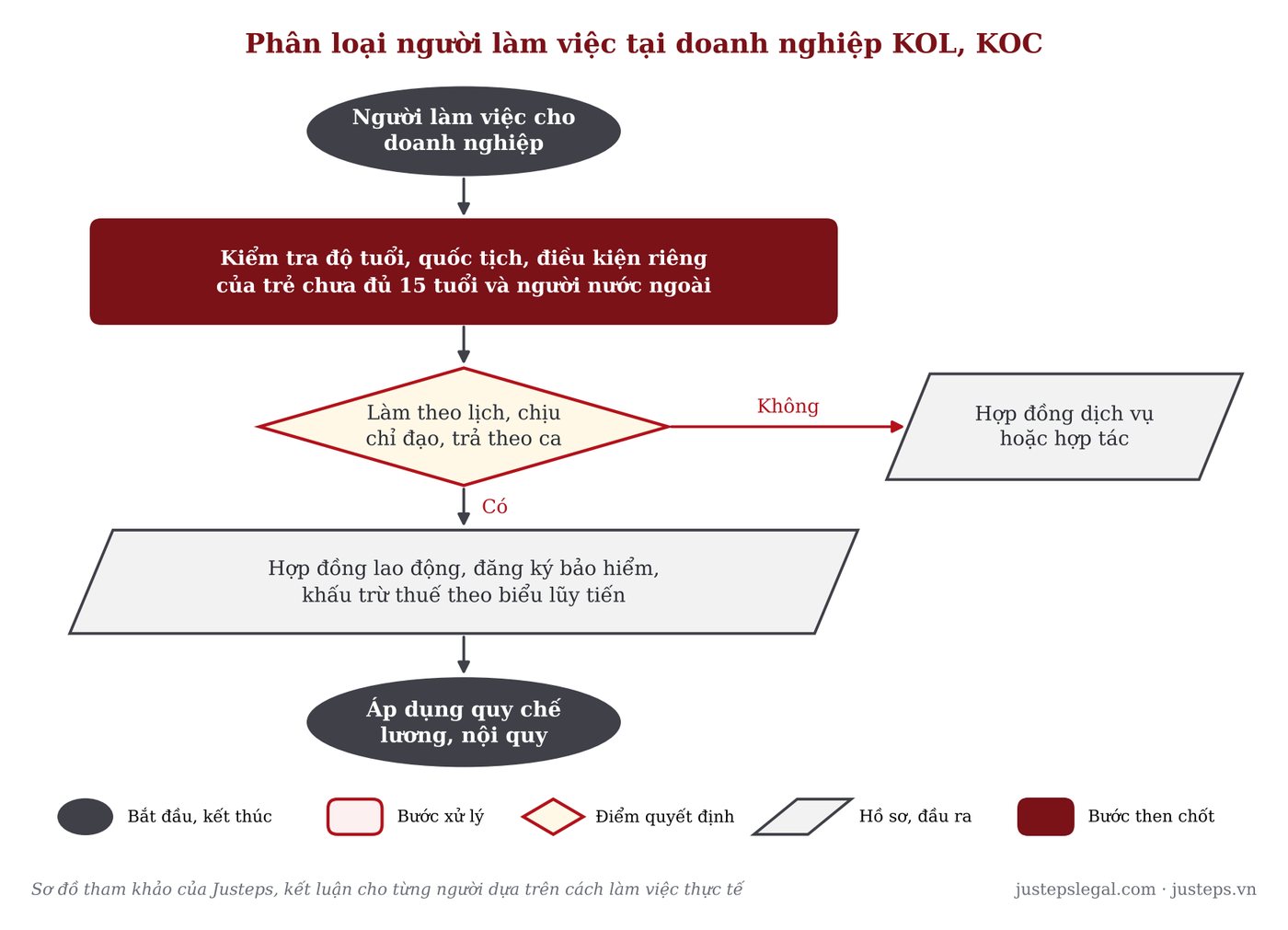
The questions used to classify a person working for a KOL or KOC business
The main question is whether the person works according to the schedule and instructions of the business; if so, and if they are paid by time or by shift, the relationship should be established through an employment contract. If the person controls how the work is done and only delivers products, a service contract is appropriate. For persons under 15 or foreign nationals, the business must check the specific conditions from the outset, before signing any kind of contract.
Social insurance for live-stream hosts and part-time workers
From 1 July 2025, people working under an employment contract of one full month or more are subject to compulsory social insurance, including where the contract has a different name but contains all the elements of an employment relationship[2]. Part-time workers are also subject to compulsory insurance when their monthly wage is at or above the lowest wage used as the basis for contributions[3], so many hosts who work only three or four shifts a week must still participate. When a group of freelance collaborators is reclassified as employees, the business must make back contributions for the whole past period together with interest and may be penalised, so the cost of converting proactively is usually much lower than the cost of being found out.
The wage used as the basis for contributions comprises the wage level, wage allowances and other supplementary amounts agreed to be paid regularly and consistently in each pay period[4]. For hosts, the position-based wage and a fixed night shift allowance are usually part of the contribution wage, while sales commission that varies from session to session needs to be named and clearly defined in the regulations so that it can be correctly determined whether it is included in the contribution basis. From 1 January 2027, the lowest level in the pay scale and the contribution wage must be reviewed against the new regional minimum wages[5].
Night shifts, overtime and public holidays
Live-stream sessions usually begin after 8 pm, and many sessions run past midnight during major promotions. Night working hours run from 10 pm to 6 am the following morning[6], and employees working at night must be paid at least an additional 30% of the wage for daytime work; where night work is also overtime, they are paid a further 20% of the daytime wage[7]. Overtime must not exceed 40 hours in a month and requires the employee’s consent[8], so promotion periods lasting several weeks need shifts planned in advance and cannot all be loaded onto a few well-known hosts.
Live-stream sessions on public holidays and Tet are paid at no less than 300% where they are overtime, in addition to the holiday pay to which the employee is entitled[7]. The Law amending the Labour Code passed by the National Assembly in November 2026 adds further public holidays from 2027, so the live-stream schedule and the 2027 payroll budget need to be updated once the law takes effect. Justeps’ pay regulations state clearly how night shifts are determined, how a session straddling 10 pm is calculated and how compensatory rest is arranged after a peak period.
Income structures with commission and bonuses
A host’s income usually comprises a position-based wage, a night shift allowance, commission on the sales of each session, a bonus for reaching targets and allowances for clothing and make-up. Each item is treated differently for insurance and tax purposes, so the regulations need to define each item, how it is calculated, when it is paid and the source of the figures. The clothing allowance needs to be stated clearly as either a general welfare benefit or a regular payment to each individual, because this wording determines whether it is included in taxable income and in the basis for insurance contributions.
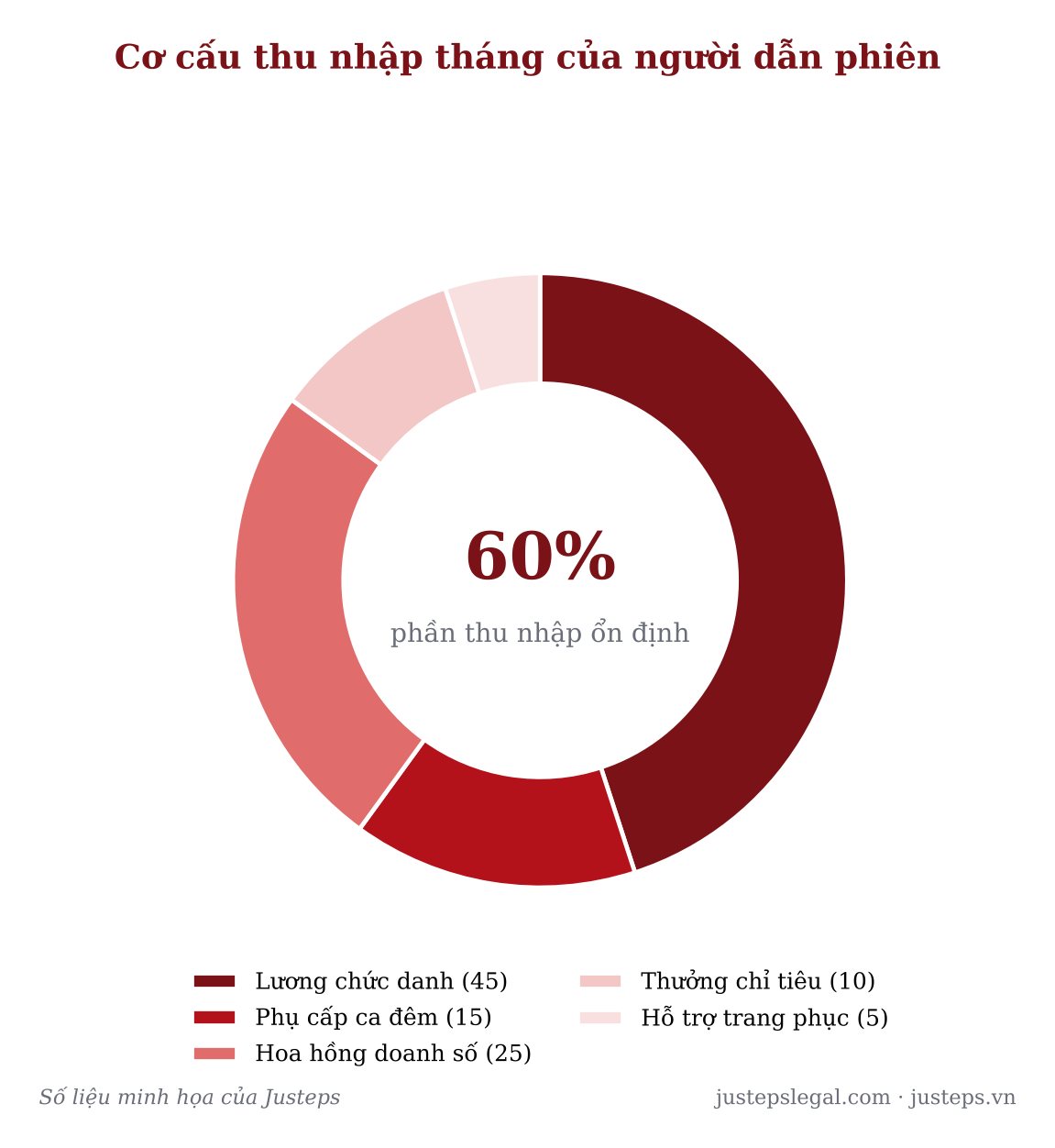
Example monthly income structure of a live-stream host
In this example, the position-based wage and night shift allowance make up around 60% of income and form the stable part usually used as the basis for insurance contributions, while commission and bonuses fluctuate sharply from month to month. This design gives employees a basic income sufficient to live on in slow months, while the business does not have to pay insurance on amounts that arise only during the promotion season. The figures are illustrative only; Justeps proposes appropriate ratios after reviewing the business’s actual sales and payroll.
Young creators and foreign creators
Persons under 15
When employing a person under 15, the business must enter into a written employment contract with that person and his or her legal representative, arrange working hours that do not affect study time, and obtain a health certificate appropriate to the work with periodic health checks at least once every six months[9]. Children aged from 13 to under 15 may only do light work on the prescribed list, while children under 13 may only do artistic, physical training or sports work and require the consent of the provincial labour authority. Persons under 15 may not work more than 4 hours a day or 20 hours a week and may not work overtime or at night[10], so children cannot take part in evening live-stream sessions.
Apart from the employment contract, using a child’s image in advertising content requires the consent of the legal representative and an agreement on remuneration, duration and scope of use[11]. Justeps drafts a dedicated set of documents comprising a three-party contract, a consent to the use of image, a working schedule based on the school year and rules on accompanying adults in the studio.
Foreign creators and live-stream hosts
A foreign national working for a business in Vietnam must have a work permit or a written confirmation of exemption from a work permit, except where the law provides otherwise. Until the end of 4 December 2026, this is governed by Decree No. 219/2025/ND-CP[12]; from 5 December 2026, Decree No. 393/2026/ND-CP dated 20 October 2026 replaces it and applies[13], so a business preparing an application to issue or extend a work permit needs to establish which decree the application will be filed and processed under. A foreign creator who comes to Vietnam only for a few days to film content also needs careful review of the visa and the form of contract, because receiving remuneration for work in Vietnam may give rise to both work permit and tax obligations.
Personal income tax withholding and internal labour rules
As the paying organisation, the business must withhold personal income tax when it pays wages, fees, commission or shares of revenue. For people with employment contracts of three months or more, tax is withheld at progressive rates; for individuals who have not signed an employment contract or have signed one for less than three months, the business withholds 10% where the total income paid is VND 5 million or more at a time[14]. Revenue shares paid to creators need to be characterised as wages, service fees or business income, because creators operating through a household business or their own company issue their own invoices and make their own declarations instead of being subject to withholding.
A business employing 10 or more employees must issue internal labour rules in writing[15] and register them with the provincial labour authority[16]. The internal labour rules of a KOL or KOC business should contain specific provisions on employees using personal social media accounts to sell for the company, the confidentiality of unpublished scripts, customer data and the handover of channel administrator rights on leaving. Violations must be described specifically to provide a basis for disciplinary action, because the business may not discipline an employee for conduct that is not set out in the internal labour rules.
Implementation process, deliverables and fees
A labour, payroll and insurance project for a KOL or KOC business usually takes about eight weeks. In the first two weeks, Justeps consultants review the existing contracts, payroll, shift schedules and insurance records; in week three, the management team and Justeps settle the approach for each group, and the hardest decision is usually converting some freelance collaborators to employment contracts and how to deal with the past period. Justeps then drafts the contracts, pay regulations and pay scales, adjusts the insurance records, prepares the file for registering the internal labour rules if required and follows the first payroll period under the new arrangements together with the business.
At the end of the project, the business receives the set of documents in editable electronic form, together with guidance on application for the HR and accounting departments, comprising the following main documents:
- A report classifying the working relationship of each group, with an estimate of the obligations that may arise and a conversion roadmap.
- A set of template employment contracts, service contracts, creator management contracts and three-party contracts with the representatives of young creators.
- Regulations on wages, bonuses, commission and night shift allowances, and pay scales based on the regional minimum wages applicable from 2027.
- A table determining the insurance contribution wage by position and guidance on tax withholding for each type of income.
- Internal labour rules and the registration file if the business is required to register them.
If the business has not yet separated creators from the administrative chain of command, contract classification should be carried out together with the organisational structure design service for KOL, KOC and multi-channel network businesses. Justeps quotes a fixed fee in writing after the initial meeting, depending on the number of people and relationship groups, the number of contracts to be converted, the complexity of the commission scheme, whether there are young or foreign creators and any need to follow payroll periods after implementation.
How Justeps can help
Alongside labour, payroll and insurance services, KOL, KOC and multi-channel network businesses may combine the following Justeps services:
- Organisational structure design for KOL, KOC and multi-channel network (MCN) businesses. Justeps arranges the organisation so that exclusive creators are managed as partners while shift-based hosts belong to the production division.
- Ongoing legal advisory for KOL, KOC and multi-channel network (MCN) businesses. Justeps answers monthly questions on contracts, shifts, insurance and tax once the new arrangements are in place.
- Building pay scales and salary and bonus regulations. Justeps builds pay scales and commission regulations for hosts and editors in line with the new regional minimum wages.
- Compulsory social insurance advisory. Justeps reviews insurance records, determines the contribution wage and prepares a plan for back contributions when freelance collaborators are converted.
- Internal labour rules and disciplinary handling. Justeps drafts and registers internal labour rules with specific provisions on social media accounts, script confidentiality and customer data.
Frequently asked questions
Must a host who works only a few shifts a week pay social insurance?
If the relationship is an employment contract of one full month or more and the monthly wage is at or above the lowest contribution basis, the person is subject to compulsory social insurance even when working part-time[3]. Justeps reviews the actual number of shifts and wages to reach a conclusion for each person.
Is an exclusive creator an employee?
Not automatically. If the creator controls the content and their own time and receives a share of revenue, the relationship is usually one of cooperation or services. If the creator is scheduled, has attendance recorded and is disciplined like an employee, there is a risk that the relationship will be treated as an employment relationship[1].
How are live-stream sessions after 10 pm paid?
Employees are paid at least an additional 30% of the daytime wage for night working hours; if those hours are also overtime, they receive a further 20% of the daytime wage on top of the overtime rate[7].
May a 12-year-old creator film advertising videos for the business?
Children under 13 may only do artistic, physical training or sports work, and this requires a contract with the representative and the consent of the provincial labour authority[9]. The business needs to assess the specific work carefully, must not let the child work at night and must have the representative’s written consent to the use of the child’s image.
How should a business deal with having used the wrong collaborator contracts for many years?
Justeps assesses the level of risk, calculates the insurance and tax obligations that may arise, and then prepares a roadmap for converting contracts and making back contributions. Remedying the situation proactively is usually less costly than waiting for the authorities to discover it during an inspection or when an employee complains.
How do the 2027 regional minimum wages affect the business?
From 1 January 2027, the regional minimum wage for Region I is VND 5,700,000 per month and the other regions also increase[5]. The lowest level in the pay scale, the wage in the contract and the insurance contribution wage of a person doing the simplest work must not be lower than the new levels.
Related articles
- Managing seasonal workers and freelance collaborators in line with the true nature of the contract and contribution obligations
- Overtime limits, how overtime pay is calculated and the records a business must keep
- Regional minimum wages from 1 January 2027 and reviewing pay scales, contracts and insurance
- Personal data protection in the HR department under the 2025 Law on Personal Data Protection
Notes
[1] Clause 1 of Article 13 of the Labour Code No. 45/2019/QH14 dated 20 November 2019.
[2] Point a of Clause 1 of Article 2 of the Law on Social Insurance No. 41/2024/QH15 dated 29 June 2024, effective from 1 July 2025.
[3] Point l of Clause 1 of Article 2 of the Law on Social Insurance No. 41/2024/QH15 dated 29 June 2024, effective from 1 July 2025.
[4] Clause 1 of Article 31 of the Law on Social Insurance No. 41/2024/QH15 dated 29 June 2024, effective from 1 July 2025.
[5] Government Decree No. 399/2026/ND-CP on the minimum wage for employees working under employment contracts, applicable from 1 January 2027.
[6] Article 106 of the Labour Code No. 45/2019/QH14 dated 20 November 2019.
[7] Article 98 of the Labour Code No. 45/2019/QH14 dated 20 November 2019.
[8] Clause 2 of Article 107 of the Labour Code No. 45/2019/QH14 dated 20 November 2019.
[9] Article 145 of the Labour Code No. 45/2019/QH14 dated 20 November 2019.
[10] Clause 1 of Article 146 of the Labour Code No. 45/2019/QH14 dated 20 November 2019.
[11] Clause 1 of Article 32 of the Civil Code No. 91/2015/QH13 dated 24 November 2015.
[12] Government Decree No. 219/2025/ND-CP on foreign workers working in Vietnam, applicable until the end of 4 December 2026.
[13] Government Decree No. 393/2026/ND-CP dated 20 October 2026 on foreign workers working in Vietnam, effective from 5 December 2026, replacing Decree No. 219/2025/ND-CP.
[14] Clause 2 of Article 50 of Government Decree No. 253/2026/ND-CP dated 30 June 2026 detailing the Law on Personal Income Tax No. 109/2025/QH15.
[15] Clause 1 of Article 118 of the Labour Code No. 45/2019/QH14 dated 20 November 2019.
[16] Clause 1 of Article 119 of the Labour Code No. 45/2019/QH14 dated 20 November 2019.
This article is for reference and reflects the regulations in force at the time of publication. Please consult Justeps for advice tailored to your company’s records and situation.
For further information, please contact:
📩 Email: info@justeps.vn
🌐 Website: https://justepslegal.com · https://justeps.vn
🌐 Page: Justeps
☎️ Hotline (Zalo): 096 172 2607
📍 Thanh Xuan Office: 12th Floor, Licogi 13 Tower, 164 Khuat Duy Tien Street, Thanh Xuan Ward, Hanoi, Vietnam
📍 Ha Dong Office: LK06B, No.10, Dong Dua Area, Ha Dong Ward, Hanoi, Vietnam
📍 Ho Chi Minh City Branch: 528 Le Van Sy, Ho Chi Minh City, Vietnam
📍 Hai Phong Office: Truong Thinh Village, Ha Dong Commune, Hai Phong, Vietnam
📍 Quang Ninh Office: Van Don Special Zone, Quang Ninh Province, Vietnam





