
Key takeaways
- The contract and work schedule of the person in charge of professional pharmacy matters must match the operating hours of the pharmacy or warehouse, as this is the evidence that the business is not borrowing a practising certificate[3].
- Pharmacies open long hours or around the clock must pay additional wages for night work and overtime and comply with the monthly and annual limits on overtime hours[7].
- When goods go missing, the business may only make deductions from wages through the procedure for compensation for damage and within the statutory limits, and may not deduct amounts on its own on the basis of stocktaking minutes[13].
- From 1 January 2027, the regional minimum wage rises to VND 5,700,000 in Region I, so pharmacy chains with outlets in several areas need to review the lowest salary grade at each location[17].
Labour relations in a pharmaceutical business are more closely tied to business conditions than in most other retail sectors. If the person in charge of professional pharmacy matters resigns before a replacement is found, the pharmacy may have to stop selling drugs; if the timesheets show that the person in charge is rarely present, inspectors have grounds to suspect that a practising certificate is being borrowed. At the same time, the business must deal with the familiar issues of the distribution sector, such as night shifts at pharmacies open long hours, medical representatives whose income depends on sales, safety in cold storage and stock shortfalls after stocktaking.
This page introduces Justeps’ labour, payroll and insurance service for pharmacies, pharmacy chains and drug wholesalers and importers. It covers the employment relationship with the person in charge of professional pharmacy matters, shift work, arrangements for medical representatives, liability for stock shortfalls, occupational safety in the warehouse, salary scales, insurance, the implementation process and the deliverables. Organisational design, professional procedures and legal support on products and tenders are presented on three other service pages for the same sector.
The person in charge of professional pharmacy matters in the employment relationship
Contract and working time
The person in charge of professional pharmacy matters at a pharmacy must hold a university degree in pharmacy and have two years of professional practice[1], while a pharmacy chain also needs a person in charge at chain level[2]. The law prohibits hiring or borrowing a pharmacy practising certificate[3], so the employment contract with this person must correctly state the job title, professional duties, working hours and a place of work matching the establishment named on the certificate. A part-time contract is only appropriate when the working time is sufficient to perform the duties and someone holding a valid authorisation covers the remaining time. Timesheets, logs of document approvals and duty rosters must be consistent with the contract, because these are the documents inspectors usually cross-check.
Absence, maternity and resignation
The pharmacist in charge may take annual leave, sick leave or maternity leave or resign like any other employee, and the business must fully honour these entitlements. What the business needs to prepare in advance is a plan for the pharmacy to continue operating lawfully while the person in charge is absent, including a list of qualified persons who may be authorised, a template letter of authorisation and the length of absence beyond which the procedure to change the person in charge must be followed under the decree guiding the Law on Pharmacy[4]. The contract should specify a reasonable notice period and the obligation to hand over professional records on resignation.
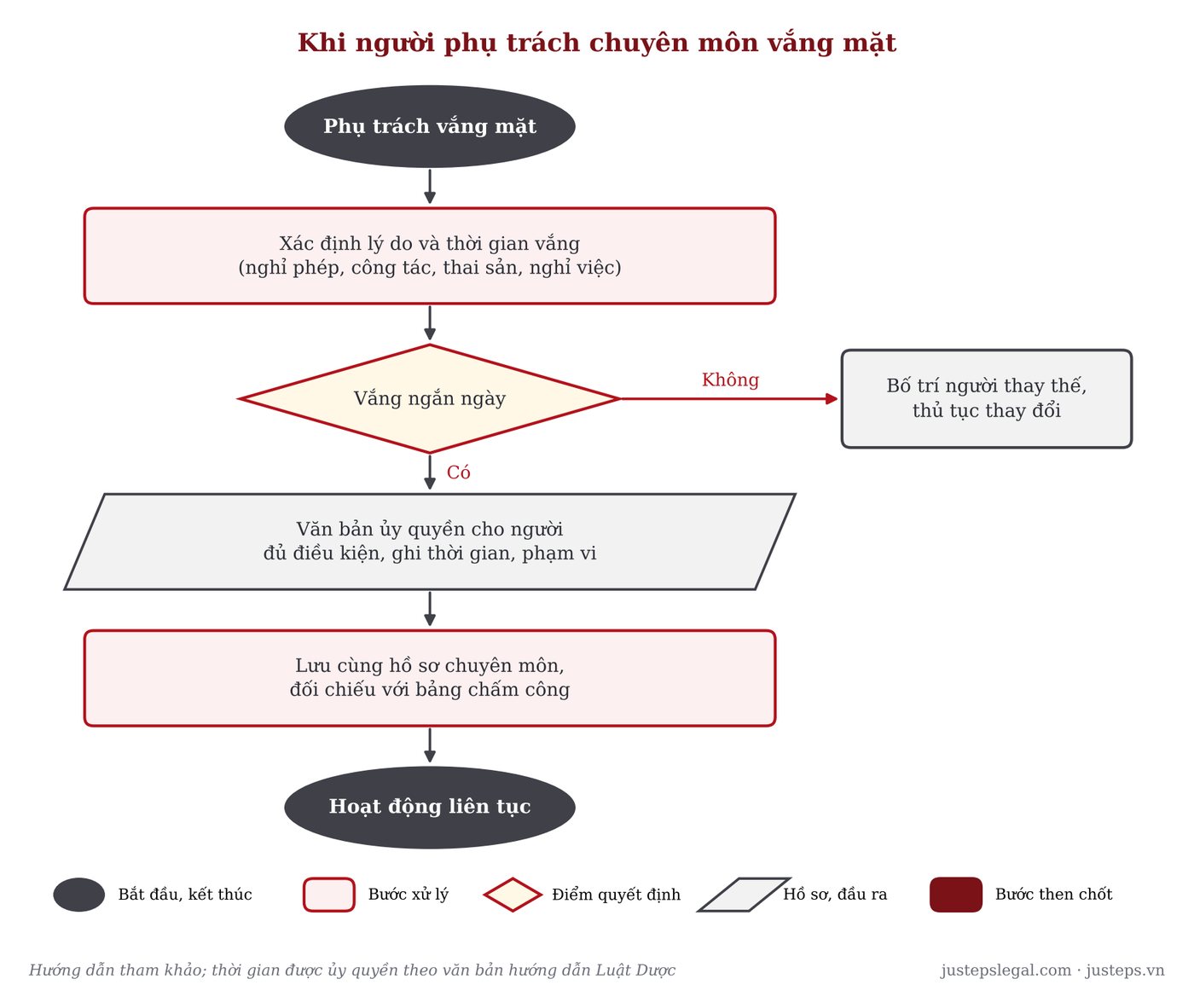
How to handle the absence of the person in charge of professional pharmacy matters at a pharmacy
The flowchart above starts from the question of whether the absence of the person in charge is short or long. For a short absence such as annual leave or a business trip, the business issues a letter of authorisation to a qualified person stating the period and scope, and keeps it with the pharmacy’s professional records. For a long absence such as maternity leave, or when the person in charge resigns, the business must check the rules on how long an authorisation may last, appoint a replacement and complete the change procedure with the pharmaceutical regulator. In all cases, the pharmacy should not sell prescription drugs when nobody with the necessary qualifications is at the counter.
Training and continuing professional education
Pharmacy practitioners must update their professional knowledge periodically, and businesses often pay for courses or send pharmacists on long-term training to prepare successors. When the business pays for training, the two sides may sign a training contract stating the period of service committed to after training and how costs are to be repaid if the employee breaches the commitment[5]. The commitment should be proportionate to the actual, documented cost, so that it is not regarded as an unreasonable restriction on the employee’s right to unilaterally terminate the contract.
Shifts, night work and pharmacies open long hours
Many pharmacies are open from early morning to late at night, some around the clock, and distribution warehouses receive and deliver goods outside office hours. Night work is counted from 22:00 to 06:00 the following morning[6], and employees working at night or overtime are paid additional wages at statutory rates, higher still for overtime on weekly rest days and public holidays[7]. Overtime hours are capped per day, per month and per year, so shift rosters should be designed so as not to rely on regular overtime[8]. The law amending the Labour Code passed by the National Assembly in November 2026 adds public holidays from 1 March 2027, so shift rosters and payroll budgets for 2027 need to account for these days[9].
Justeps usually proposes dividing a pharmacy open long hours into three shifts with breaks between them, with the night shift staffed by someone qualified to sell prescription drugs or with a restricted sales scope. The shift regulation should cover shift swaps, how the night shift allowance is calculated, arrangements for pregnant employees and those raising young children, and recording of actual working hours through a timekeeping system rather than handwritten sheets.
Medical representatives and sales staff
Medical representatives and pharmacy channel sales staff are often paid under a lump-sum arrangement with a low base salary, a large sales bonus and a flat travel allowance requiring no supporting documents. This approach creates three risks at once, namely insurance contributions based on a salary below the value of the work, a flat travel allowance that may be treated as taxable income and not counted as a deductible expense, and undocumented lump sums that are easily used for payments prohibited by pharmaceutical law. The pay and bonus regulation should keep three components separate, namely the salary for the job stated in the contract, performance bonuses under a regulation issued by the business[10] and travel expenses reimbursed against norms and supporting documents.
Bonuses linked to results for each period, with a clear formula and periods in which no bonus arises, are usually not part of the wage subject to social insurance contributions, whereas a fixed monthly payment labelled as a bonus may be regarded as part of the wage[11]. Targets for medical representatives should also not be based solely on sales by individual doctor or department, because this mechanism easily leads to taking advantage of drug prescribing for profit, which the Law on Pharmacy strictly prohibits[12]. Justeps proposes combining sales targets with compliance criteria such as using only approved materials and following the seminar procedure.
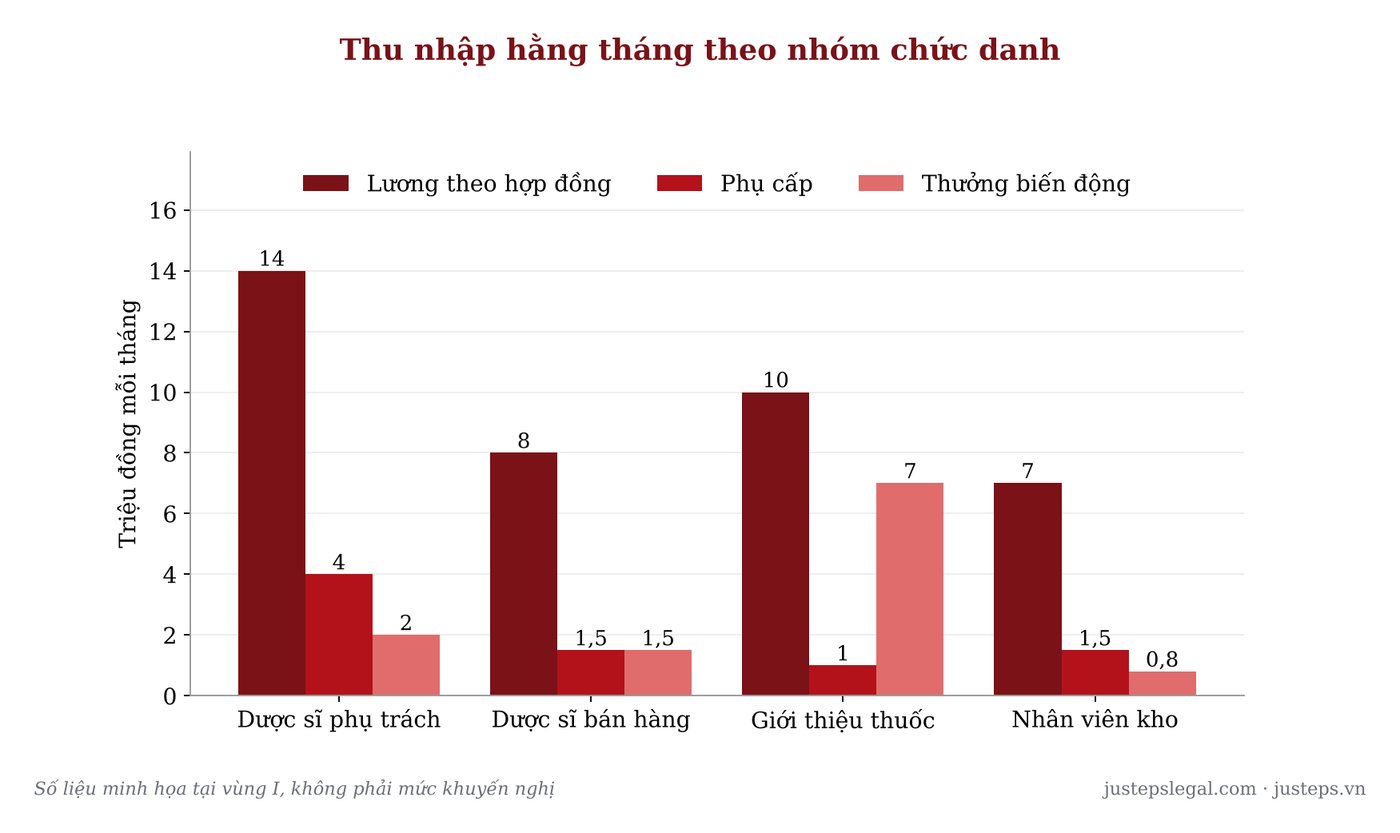
Illustrative income structure of four groups of positions in a pharmaceutical business
The chart above illustrates how monthly income is divided into contractual salary, allowances and variable bonuses. The pharmacist in charge has a stable income with a significant responsibility allowance, and this allowance, paid regularly every month, usually has to be included in the wage subject to insurance contributions. Medical representatives have the largest variable bonus, but their contractual salary must still reflect the true value of the work, while dispensing pharmacists and warehouse staff earn mainly from salary and shift allowances. The figures are only an example for Region I, and actual levels depend on the labour market in each area.
Stock shortfalls and material liability
Drugs are high in value, small in size and frequently counted, so discrepancies after stocktaking occur every month at both pharmacies and warehouses. Many businesses deal with this by dividing the shortfall equally among the staff on the shift and deducting it directly from wages, a practice that is not consistent with labour law. An employee who loses property entrusted to them must compensate at market value or in accordance with the internal labour rules, or under a liability contract if one exists; where the damage is not serious and results from negligence, the amount of compensation is capped[13]. Compensation must follow a procedure for examining the case and determining fault and the amount of damage, and monthly deductions may not exceed the maximum percentage of the wage actually paid[14].
Justeps drafts a material liability regulation linked to the stocktaking procedure, specifying who holds the goods on each shift, how shifts are handed over, how discrepancy minutes are drawn up and how to distinguish losses due to storage or data entry errors from actual loss. For storekeepers and staff holding high-value drugs, the business may sign separate liability contracts so that the level of compensation is clearly agreed from the outset.
Occupational safety in the warehouse, salary scales and insurance
Pharmaceutical warehouses have forklifts, high racking, cold rooms and chemical storage areas, so the business must provide occupational safety and health training, have equipment subject to strict safety requirements inspected, supply personal protective equipment to those working in cold storage and organise periodic health checks under the law on occupational safety and health[15]. Delivery staff are regularly on the road, so rules on routes and recording of working time help to determine correctly whether an incident is an occupational accident.
The business must establish salary scales and pay tables as the basis for recruitment, salary agreements and insurance contributions[16]. From 1 January 2027, the monthly minimum wage is VND 5,700,000 in Region I, VND 5,080,000 in Region II, VND 4,450,000 in Region III and VND 4,040,000 in Region IV[17]. A pharmacy chain with outlets in several areas needs to match each location to the correct region, including probationary wages and the wage subject to insurance contributions. Persons working under an employment contract of one month or more are subject to compulsory social insurance[18], so a business with seasonal staff turnover needs a procedure for reporting increases and decreases in a timely manner.
Implementation process, deliverables and fees
A project to standardise labour and payroll arrangements for a pharmaceutical business usually takes six to eight weeks. In the first two to three weeks, Justeps consultants check the list of persons in charge of professional pharmacy matters against contracts, timesheets and insurance records, read the payroll for the last three to six months, the bonus regulation, stocktaking minutes and warehouse safety records, and then present a risk report and order of priorities. The following weeks are devoted to drafting contracts, regulations and salary scales and organising dialogue with employees before application, and Justeps follows the first payroll cycle closely to check the calculation of night shift pay, overtime and deductions. The deliverables comprise the following main documents:
- A compliance review report on labour, insurance and the relationship with the person in charge of professional pharmacy matters, with priorities for action.
- Template employment contracts for pharmacists in charge, dispensing pharmacists, medical representatives, warehouse staff and delivery staff.
- Salary scales and pay tables by region, a pay and bonus regulation and a travel expense regulation for medical representatives.
- A regulation on shifts, night work and overtime for pharmacies and warehouses.
- A material liability regulation, a template liability contract and template minutes for handling stock shortfalls.
- A contingency plan for the person in charge of professional pharmacy matters, a template letter of authorisation and a template training contract.
Justeps quotes a fixed fee in writing, depending on the number of employees, the number of pharmacies and warehouses, the number of areas where staff work, the number of position groups and how complete the existing records are. If job titles and reporting lines are not yet clear, the business should combine this with the organisational structure design service for pharmacy and pharmaceutical distribution businesses so that the salary scale follows the new organisation. After issue, labour questions arising each month can be handled under the ongoing legal advisory service for pharmacy and pharmaceutical distribution businesses. If a labour dispute has to be resolved in court, Justeps, which does no litigation, prepares the file for the business to pursue itself or to hand over to a practitioner of the business’s own choosing.
How Justeps can help
Alongside labour, payroll and insurance services, pharmacy and pharmaceutical distribution businesses may combine the following Justeps services:
- Organisational structure design for pharmacy and pharmaceutical distribution businesses. Justeps defines job titles, reporting lines and the powers of the person in charge of professional pharmacy matters as the foundation for the salary scale.
- Ongoing legal advisory for pharmacy and pharmaceutical distribution businesses. Justeps answers monthly labour questions together with issues on licences, contracts and tenders.
- Salary scales and pay and bonus regulations. Justeps designs regional salary frameworks and bonus regulations with clear formulas for medical representatives.
- Compulsory social insurance advisory. Justeps reviews the wage subject to insurance contributions when the business pays many allowances and bonuses.
- Internal labour rules and disciplinary procedures. Justeps drafts internal labour rules covering material liability, shift handovers and the handling of stock shortfalls.
Frequently asked questions
Can the pharmacist in charge of professional matters work part-time?
This should only be done when the working time is sufficient to perform the professional duties and someone holding a valid authorisation covers the remaining time. If the pharmacist is hardly ever present, the business risks being regarded as borrowing a practising certificate[3].
Is the responsibility allowance of the pharmacist in charge subject to social insurance contributions?
An allowance paid at a fixed amount, regularly every month with the salary, is usually included in the wage subject to social insurance contributions under the Law on Social Insurance of 2024[11].
How should a 24-hour pharmacy organise its shifts?
It should have at least three shifts with breaks between them, pay additional wages for night hours and staff the night shift with a qualified person or restrict the scope of drug sales during that shift[6].
May wages be deducted when stocktaking reveals a shortfall?
Yes, but only through the procedure for compensation for damage, with fault and the amount of damage determined, and monthly deductions may not exceed the statutory limit[14].
Who bears the cost of pharmacists’ continuing professional education?
The two sides may agree. For training paid for by the business, a training contract may be signed with a commitment on the period of service and how costs are to be repaid in the event of a breach[5].
What safety formalities do pharmaceutical warehouse staff need?
Warehouse staff need occupational safety and health training, must work with inspected equipment such as forklifts, must be provided with protective equipment when entering cold rooms and must have periodic health checks.
How does the 2027 regional minimum wage affect pharmacy chains?
A chain needs to review the lowest salary grade at each outlet according to the correct region, adjust contracts with salaries below the new level and update probationary wages and the wage subject to insurance contributions from January 2027[17].
Related articles
- Pharmacy chain management, pharmacy staff, GPP standards and inventory control
- Monthly labour and payroll compliance checklist for HR departments
- Advisory service on overtime, working shifts and timekeeping
- Advisory service on compulsory social insurance for businesses
Notes
[1] Clause 1, Article 18 of the Law on Pharmacy No. 105/2016/QH13 dated 6 April 2016, as amended and supplemented by Law No. 44/2024/QH15 dated 21 November 2024.
[2] Article 17a of the Law on Pharmacy No. 105/2016/QH13 dated 6 April 2016, as amended and supplemented by Law No. 44/2024/QH15 dated 21 November 2024.
[3] Clause 9, Article 6 of the Law on Pharmacy No. 105/2016/QH13 dated 6 April 2016, as amended and supplemented by Law No. 44/2024/QH15 dated 21 November 2024.
[4] Government Decree No. 163/2025/ND-CP dated 29 June 2025 detailing and guiding the implementation of the Law on Pharmacy.
[5] Article 62 of the Labour Code No. 45/2019/QH14 dated 20 November 2019.
[6] Article 106 of the Labour Code No. 45/2019/QH14 dated 20 November 2019.
[7] Article 98 of the Labour Code No. 45/2019/QH14 dated 20 November 2019.
[8] Article 107 of the Labour Code No. 45/2019/QH14 dated 20 November 2019.
[9] The Law amending and supplementing a number of articles of the Labour Code, passed by the National Assembly on 21 November 2026 and effective from 1 March 2027.
[10] Article 104 of the Labour Code No. 45/2019/QH14 dated 20 November 2019.
[11] Article 31 of the Law on Social Insurance No. 41/2024/QH15 dated 29 June 2024.
[12] Clause 12, Article 6 of the Law on Pharmacy No. 105/2016/QH13 dated 6 April 2016, as amended and supplemented by Law No. 44/2024/QH15 dated 21 November 2024.
[13] Article 129 of the Labour Code No. 45/2019/QH14 dated 20 November 2019.
[14] Clause 3, Article 102 of the Labour Code No. 45/2019/QH14 dated 20 November 2019.
[15] The Law on Occupational Safety and Health No. 84/2015/QH13 dated 25 June 2015.
[16] Article 93 of the Labour Code No. 45/2019/QH14 dated 20 November 2019.
[17] Government Decree No. 399/2026/ND-CP on the minimum wage for employees working under employment contracts, applicable from 1 January 2027.
[18] Point a, Clause 1, Article 2 of the Law on Social Insurance No. 41/2024/QH15 dated 29 June 2024.
This article is for reference and reflects the regulations in force at the time of publication. Please consult Justeps for advice tailored to your company’s records and situation.
For further information, please contact:
📩 Email: info@justeps.vn
🌐 Website: https://justepslegal.com · https://justeps.vn
🌐 Page: Justeps
☎️ Hotline (Zalo): 096 172 2607
📍 Thanh Xuan Office: 12th Floor, Licogi 13 Tower, 164 Khuat Duy Tien Street, Thanh Xuan Ward, Hanoi, Vietnam
📍 Ha Dong Office: LK06B, No.10, Dong Dua Area, Ha Dong Ward, Hanoi, Vietnam
📍 Ho Chi Minh City Branch: 528 Le Van Sy, Ho Chi Minh City, Vietnam
📍 Hai Phong Office: Truong Thinh Village, Ha Dong Commune, Hai Phong, Vietnam
📍 Quang Ninh Office: Van Don Special Zone, Quang Ninh Province, Vietnam





