
Key takeaways
- Commission agreed to be paid regularly and consistently in each pay period risks being counted as part of the salary for social insurance contributions, so contributing on a low basic salary is the largest source of back-payment claims against financial businesses[2].
- A collaborator agreement or service contract is still treated as an employment contract if the business pays wages to, manages, directs and supervises the person doing the work[3].
- People who advise clients or take their orders must hold the appropriate practising certificate, so collaborators without a certificate may only perform tasks outside the scope of securities business[5].
- Recovering bonuses by deducting wages or imposing fines instead of disciplinary measures breaches the Labour Code; a deferred bonus mechanism must be designed from the outset in the bonus regulations[8].
The income structure of people working in the finance sector is very different from that of a manufacturing business. A broker may receive a low basic salary and commission several times larger, a fund manager receives a bonus based on investment results for the whole year, while sales and debt collection staff at a finance company are paid according to the number of loans disbursed or the amount collected. At the same time, employees must meet practising conditions and comply with rules on personal dealing and client confidentiality, and the sales force tends to have high turnover, which readily leads to disputes when people leave.
This page introduces Justeps’ labour, payroll and insurance service for securities companies, securities investment fund management companies and consumer finance companies. It covers the sector-specific risks, common mistakes, what Justeps does, the process, the deliverables and how the work is adapted to each type of business. The main legal bases are the Labour Code No. 45/2019/QH14, the Law on Social Insurance No. 41/2024/QH15, the Law on Employment No. 74/2025/QH15 and Decree No. 399/2026/ND-CP on regional minimum wages applicable from 1 January 2027[1], together with the securities legislation on practitioners.
Three labour risks specific to financial businesses
Back-payment of social insurance on commission
The 2024 Law on Social Insurance provides that the salary on which compulsory social insurance contributions are based comprises the salary for the job or title, salary allowances and other additional amounts agreed to be paid regularly and consistently in each pay period[2]. Many financial businesses contribute only on the basic salary, even though commission is calculated by a fixed formula and paid regularly every month. In an inspection, the social insurance authority may reassess the nature of these payments, and the back-payment plus late payment interest calculated for hundreds of employees over several years can be very large.
Collaborators found to be employees
The Labour Code provides that a contract with a different name but whose content shows paid work, wages and management, direction and supervision by one party is still an employment contract[3]. Collaborator agreements with sales staff at points of service, telesales staff or people introducing clients to open accounts often include targets, shifts, dress codes and discipline, which are all signs of an employment relationship. As a result, the business must pay insurance contributions and severance entitlements and may be penalised for failing to enter into the correct type of employment contract.
Insufficient grounds for disciplinary action
Misconduct by finance sector staff is usually linked to the business itself, such as personal dealing in breach of the rules, disclosure of client information or threatening borrowers during debt collection. The business can only take disciplinary action if the conduct is set out in the internal labour rules, and a business employing ten or more employees must have written internal labour rules registered with the provincial labour authority[4]. Many internal labour rules are drafted from generic templates and do not cover this specific conduct, leaving the business in a weak position when employees challenge disciplinary decisions.
Common mistakes on pay and contracts
The first mistake is using collaborators without practising certificates to give investment advice or take orders for clients. The Law on Securities requires securities companies to ensure that their professional staff hold the appropriate practising certificates[5], and practitioners may work for only one company and may not open accounts at a securities company other than their employer except where the law permits[6]. Collaborators should therefore only introduce clients and help with procedures, and must not touch the regulated business.
The second mistake is recovering bonuses or commission already paid by deducting them from the following month’s salary. The Labour Code only permits deductions from wages to compensate for damage to tools, equipment or property in accordance with the statutory procedure and subject to a cap[7], and it prohibits fines or wage cuts in place of disciplinary measures[8]. If the business wants to hold back part of a bonus to offset risk, it must build a deferred bonus into the bonus regulations from the outset, with clear payment conditions, rather than paying in advance and then trying to claw it back.
The third mistake is failing to protect client lists and investment strategies when employees leave. The Labour Code allows the employer to agree in writing with employees whose work directly involves business secrets on the content and duration of protection of those secrets and on compensation for breach[9]. The final mistake is setting excessively high targets for the number of calls or amounts collected, pushing staff towards prohibited conduct or overtime beyond the statutory limits.
The choice of relationship must be based on how the business actually manages the people working for it, not on the name of the contract. The table below compares the three forms commonly used for the sales force of a financial business.
| Form | When it is appropriate | Main risk |
|---|---|---|
| Employment contract | Brokers, sales staff and debt collectors with targets and shifts who are directly managed. | Insurance must be paid on the correct salary, including commission paid regularly and consistently. |
| Service contract | Independent introducers who control their own time and are not subject to the business’s discipline. | Reclassification as an employment relationship if the business sets targets, assigns shifts and supervises. |
| Agent or partner | A sales or debt collection organisation with legal personality that manages its own staff. | The business still bears client complaints if it does not control the conduct of the partner’s staff. |
What Justeps does for the business
Justeps reviews all relationships with collaborators, point-of-service staff and telesales staff, and proposes converting them to employment contracts or amending the service contracts so that they no longer show signs of management and direction. Justeps designs commission schemes, deferred bonuses and the structure of insurable salary so that they are lawful, transparent and able to withstand inspection, and drafts template employment contracts with conditions on practising certificates, confidentiality agreements and rules on handing over clients when employees leave. Justeps also amends the internal labour rules to add conduct relating to personal dealing, client data confidentiality and debt collection, carries out the registration procedure, and advises on personal income tax on commission, bonuses, bonus shares and foreign employees under the Law on Personal Income Tax No. 109/2025/QH15[10].
The example below shows the income structure of a broker and why the commission element needs careful consideration when determining the salary for insurance contributions.
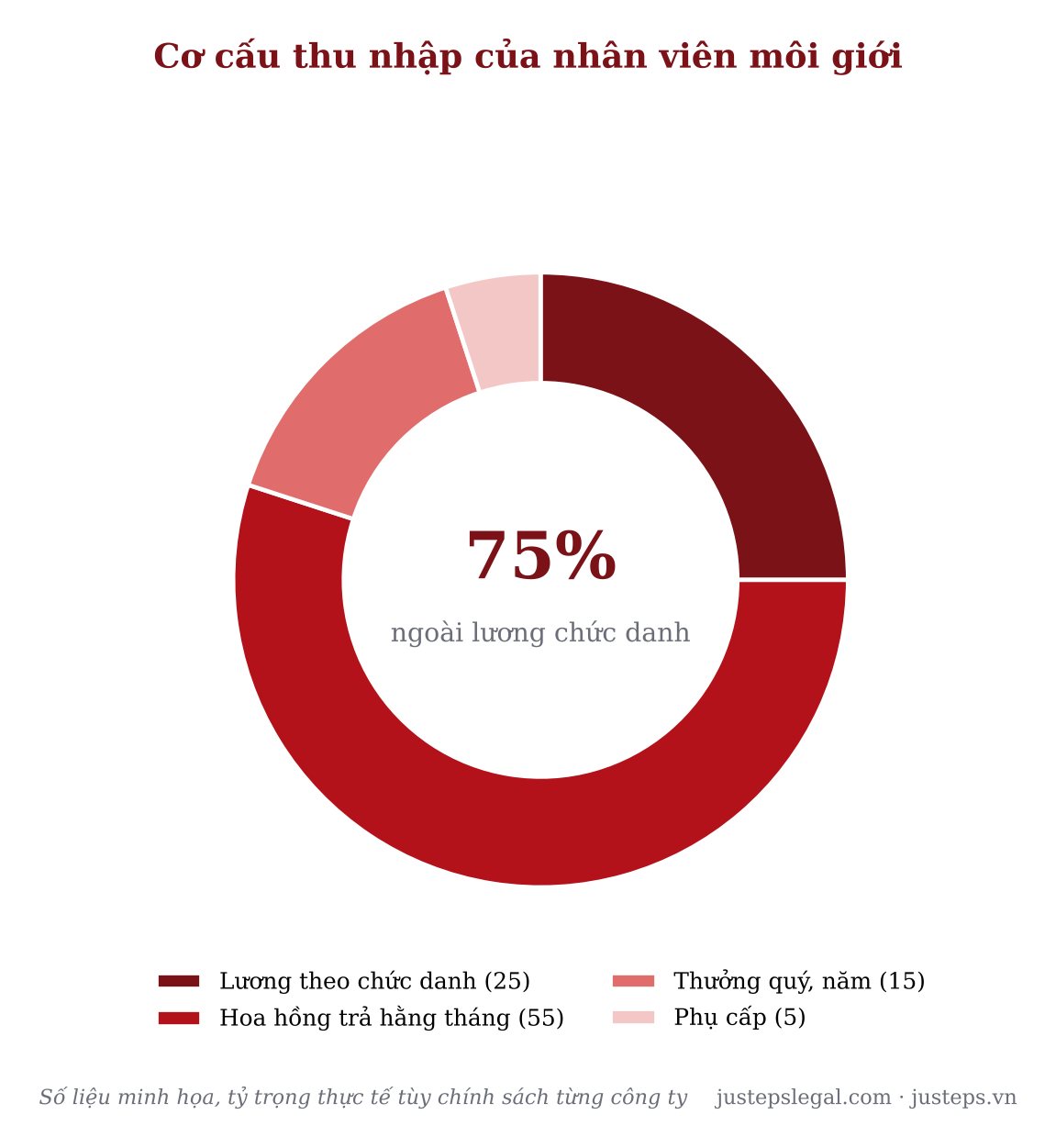
Example of the monthly income structure of a securities broker
In the example, the salary for the title accounts for only about a quarter of total income, with the rest made up of commission based on trading value, bonuses and allowances. If commission is paid every month according to a fixed formula, the business needs to assess the likelihood that it will be treated as an additional amount paid regularly and consistently. By contrast, an annual results-based bonus decided by the employer under the bonus regulations is usually kept separate from salary[11], provided that the regulations are drawn up and published in accordance with the proper procedure.
Delivery process and deliverables
In the first two weeks, Justeps collects contracts of all types, the payroll for the most recent twelve months, the commission and bonus regulations, insurance contribution data and the current internal labour rules. By the third week, Justeps presents a gap report with an estimate of the potential back-payment so that the Executive Board can decide on the scope and roadmap. From the fourth week, Justeps designs the policies and template contracts, amends the internal labour rules and the pay regulations, consults the grassroots employee representative organisation where there is one, and then supports the conversion of contracts and the adjustment of contribution levels according to the agreed roadmap.
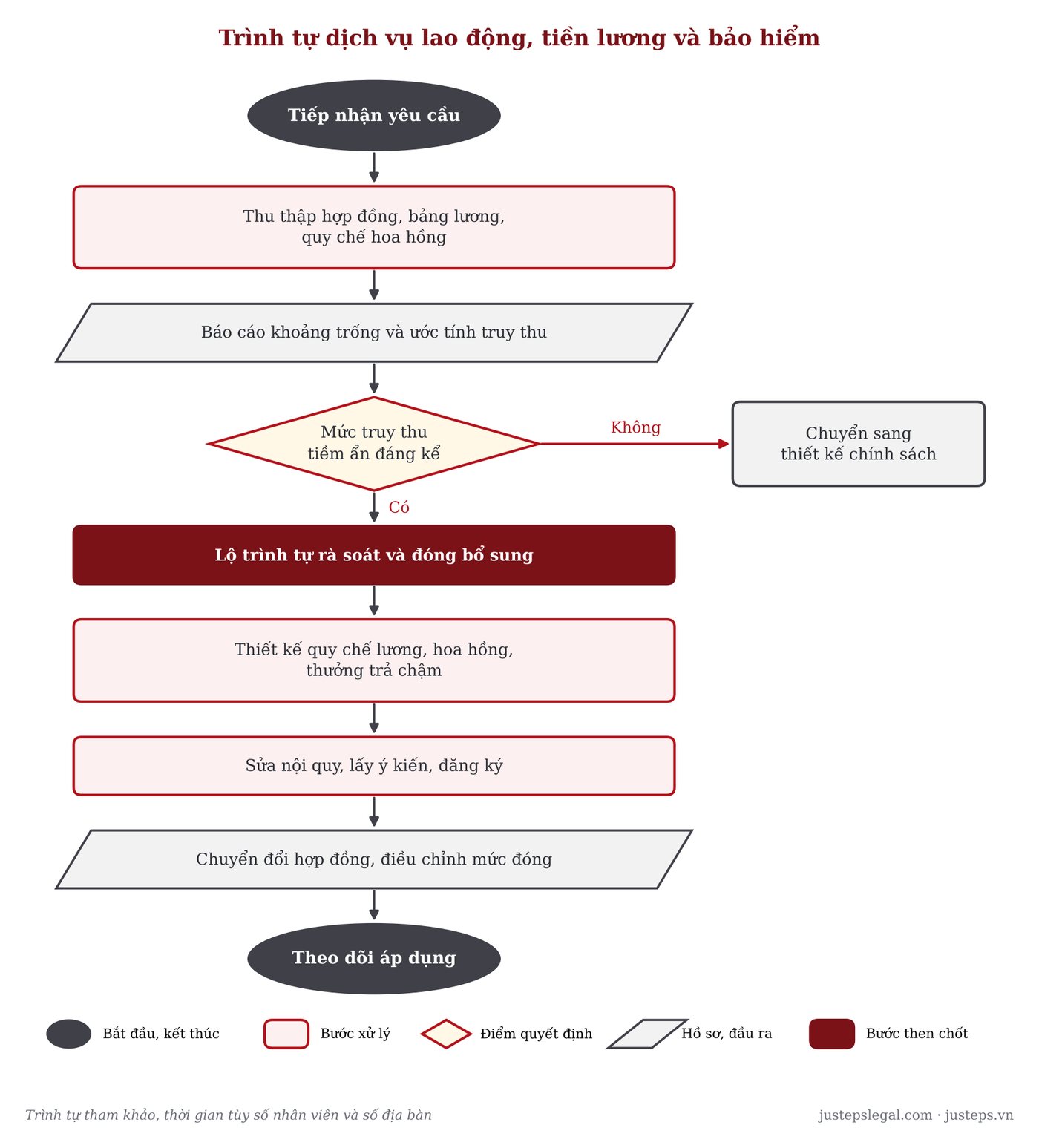
Sequence for delivering labour, payroll and insurance services to a financial business
The decision point in the flowchart is the level of potential back-payment. If it is significant, Justeps proposes a plan for the business to review itself and make additional contributions in phases before the social insurance authority carries out an inspection, because voluntary remediation usually has fewer consequences than being found out. After the project, the business receives a labour and insurance risk assessment report, regulations on pay, commission and deferred bonuses, template employment contracts, service contracts and confidentiality agreements, the amended internal labour rules with the registration file, and a plan for converting contracts and adjusting insurance.
Application by type of business and fees
A fund management company needs to focus on deferred bonuses based on multi-year investment results, protection of investment strategies and personal income tax for its management team. A securities company with many branches needs a single commission policy to avoid each branch paying in its own way, while a consumer finance company with thousands of employees in many provinces needs to apply the correct regional minimum wage, shift rules and a consistent approach to discipline. Where labour issues continue to arise frequently after the project, the business may move on to Justeps’ ongoing legal advisory service for securities, investment fund and consumer finance businesses for a monthly point of contact.
Justeps quotes its fee in writing after the initial meeting, depending on the number of employees, the number of job groups, the complexity of the commission scheme, the number of locations and whether Justeps deals with the social insurance authority and the labour authority on the business’s behalf under a letter of authorisation. Justeps has offices in Hanoi, Hai Phong, Quang Ninh and Ho Chi Minh City and works online with branches in other provinces.
How Justeps can help
Alongside labour, payroll and insurance services, securities, investment fund and consumer finance businesses may combine the following Justeps services:
- Organisational structure design for securities, investment fund and consumer finance businesses. Justeps identifies regulated positions and prohibited combinations of roles so that contracts and job descriptions match the organisation.
- Ongoing legal advisory for securities, investment fund and consumer finance businesses. Justeps answers day-to-day questions on discipline, termination of contracts and employees’ practising certificates.
- Labour disputes and termination of contracts. Justeps assesses the file, drafts documents and supports negotiation and mediation when terminating contracts with brokers and sales staff.
- Labour and payroll compliance management. Justeps sets up a compliance calendar for contracts, insurance, internal labour rules and labour reporting across the whole branch network.
Frequently asked questions
Is social insurance payable on brokers’ commission?
The 2024 Law on Social Insurance includes in the contribution salary additional amounts agreed to be paid regularly and consistently in each pay period[2]. Commission paid monthly under a fixed formula risks falling into this group, so Justeps assesses each specific scheme before the business decides on the contribution level.
May the business use collaborators to expand its network?
Yes, if the collaborators are genuinely independent and only introduce clients and help with procedures. If the business sets targets, assigns shifts and supervises them, the contract may be reclassified as an employment contract[3], and advising clients and taking orders must be done by people holding practising certificates[5].
How should the business deal with an employee whose practising certificate is revoked?
The business must not allow that person to continue work that requires a certificate. Depending on the contract and the internal labour rules, the business may assign other suitable work or consider terminating the contract on statutory grounds, and Justeps recommends setting out this condition in advance in the employment contract.
Can employees be prohibited from leaving to work for a competitor?
The Labour Code only recognises agreements protecting business secrets and technology secrets with people whose work directly involves those secrets[9]. Justeps drafts agreements focused on client lists, investment strategies and handover obligations, rather than a general non-compete clause that is hard to enforce.
Are deferred bonuses lawful?
Bonuses are decided by the employer on the basis of business results and the level of job performance under the bonus regulations[11]. The business may provide for part of a bonus to be paid later and subject to conditions, but the conditions must be clear, published in advance and must not be implemented by deducting wages.
What should a business do if it has under-contributed to insurance for several years?
Justeps estimates the additional contributions and interest payable, proposes a roadmap for adjusting the contribution level and making additional payments in phases, and amends the pay regulations so that the problem does not recur. Voluntary remediation before an inspection usually reduces the consequences for the business significantly.
Related articles
- Late payment and evasion of social insurance contributions under the new law and where the line lies for businesses
- Managing seasonal workers and freelance collaborators in line with the true nature of the contract and contribution obligations
- How to grant shares to key employees so as to retain them without giving rise to disputes
- Internal labour rules, mandatory contents, registration file and effective date
Notes
[1] Decree No. 399/2026/ND-CP on minimum wages for employees working under employment contracts, applicable from 1 January 2027.
[2] Clause 1 of Article 31 of the Law on Social Insurance No. 41/2024/QH15, effective from 1 July 2025.
[3] Clause 1 of Article 13 of the Labour Code No. 45/2019/QH14 dated 20 November 2019.
[4] Articles 118 and 119 of the Labour Code No. 45/2019/QH14 dated 20 November 2019.
[5] Article 89 of the Law on Securities No. 54/2019/QH14 dated 26 November 2019, as amended and supplemented by Law No. 56/2024/QH15 dated 29 November 2024.
[6] Article 98 of the Law on Securities No. 54/2019/QH14 dated 26 November 2019.
[7] Article 102 of the Labour Code No. 45/2019/QH14 dated 20 November 2019.
[8] Clause 2 of Article 127 of the Labour Code No. 45/2019/QH14 dated 20 November 2019.
[9] Clause 2 of Article 21 of the Labour Code No. 45/2019/QH14 dated 20 November 2019.
[10] The Law on Personal Income Tax No. 109/2025/QH15 and its implementing instruments.
[11] Article 104 of the Labour Code No. 45/2019/QH14 dated 20 November 2019.
This article is for reference and reflects the regulations in force at the time of publication. Please consult Justeps for advice tailored to your company’s records and situation.
For further information, please contact:
📩 Email: info@justeps.vn
🌐 Website: https://justepslegal.com · https://justeps.vn
🌐 Page: Justeps
☎️ Hotline (Zalo): 096 172 2607
📍 Thanh Xuan Office: 12th Floor, Licogi 13 Tower, 164 Khuat Duy Tien Street, Thanh Xuan Ward, Hanoi, Vietnam
📍 Ha Dong Office: LK06B, No.10, Dong Dua Area, Ha Dong Ward, Hanoi, Vietnam
📍 Ho Chi Minh City Branch: 528 Le Van Sy, Ho Chi Minh City, Vietnam
📍 Hai Phong Office: Truong Thinh Village, Ha Dong Commune, Hai Phong, Vietnam
📍 Quang Ninh Office: Van Don Special Zone, Quang Ninh Province, Vietnam





