
Key takeaways
- An all-inclusive salary does not remove the right to overtime pay, and overtime may not exceed 40 hours in a month, so peak campaign periods need to be scheduled and recorded[5].
- Where a collaborator works set hours, is directed by the agency and is paid monthly like an employee, the relationship may be found to be an employment relationship, bringing back-payment of social insurance contributions[1].
- Project bonuses and pitch-win bonuses need to be set out in published bonus regulations stating that they are not regular payments, so that they are not mistakenly counted as salary for insurance contributions[9].
- From 1 January 2027, the minimum wage in Region I rises to VND 5,700,000 per month, so agencies need to review the lowest pay grade of assistants, logistics staff and interns with employment contracts[11].
Work at an agency comes in waves. Before a pitch or a launch campaign, the creative team may work late for days on end and the events team may build a stage overnight, followed by weeks with almost nothing urgent. The workforce is also a mix of permanent employees, design and editing collaborators working per deliverable, event crew working in shifts and interns, and each group is paid in a different way.
This page introduces Justeps’ labour, payroll and insurance service for creative agencies, digital advertising agencies, public relations agencies and agencies with an events business. The aim is to keep the flexibility that creative work needs while complying with the rules on contract types, working hours, overtime, wages, social insurance and personal income tax. The arrangement of divisions, the rules for running campaigns and the monthly advisory package for agencies are covered on three sister pages in this sector.
The groups that make up an agency’s workforce
The name of a contract does not determine the nature of the relationship. Where a person is given work by the agency, is paid a wage and is subject to its management and supervision, the relationship is an employment relationship even if the paperwork calls it a collaboration contract[1]. An employment contract must be either of indefinite term or of a fixed term not exceeding 36 months[2], so signing a series of short collaboration contracts with the same person who works regularly does not help the agency avoid its obligations.
| Group | Usually suitable form | Points to note |
|---|---|---|
| Client service, creative | Employment contract. | The contract should describe creative duties clearly so that copyright is established as belonging to the agency. |
| Ad operations on duty | Employment contract with rules on campaign duty shifts. | Evening and weekend duty hours must be recorded so that overtime can be calculated. |
| Design and editing collaborators | Service contract per deliverable. | Suitable only when the person controls his or her own time and tools and delivers per deliverable. |
| Event crew in shifts | Short-term employment contract or service contract depending on how they work. | Safety measures and accident insurance are required for set-up and dismantling work. |
| Interns | Internship agreement or employment contract. | A person given work like an employee and paid monthly needs an employment contract. |
| Foreign staff | Employment contract tied to a work permit. | Check the work permit or the applicable exemption before the start date. |
The table shows only the usual forms, because each collaborator or intern must be classified according to how he or she actually works day to day. Justeps looks at attendance records, work chat groups, meeting schedules and fee spreadsheets, because these are the documents the labour inspectorate or the insurance authority will rely on during an inspection or in a dispute.
All-inclusive salaries and overtime during campaign peaks
Many agencies pay an all-inclusive salary and treat staying late before a pitch as a normal part of the job. Normal working hours may not exceed 08 hours a day and 48 hours a week[3], and work outside these hours at the agency’s request is overtime, paid at no less than 150% on ordinary days and 200% on weekly rest days[4]. An all-inclusive salary agreement covers only normal working hours, unless the contract clearly separates a payment for a fixed number of overtime hours and that payment is not lower than the statutory rate.
Overtime may not exceed 50% of normal working hours in a day, 40 hours in a month or 200 hours in a year, except that certain sectors and jobs may work up to 300 hours[5]. Creative teams in the year-end peak season can easily exceed the monthly limit, even when the annual total is still low. The chart below illustrates the monthly overtime of a creative team when there are no rules on registering and approving overtime.
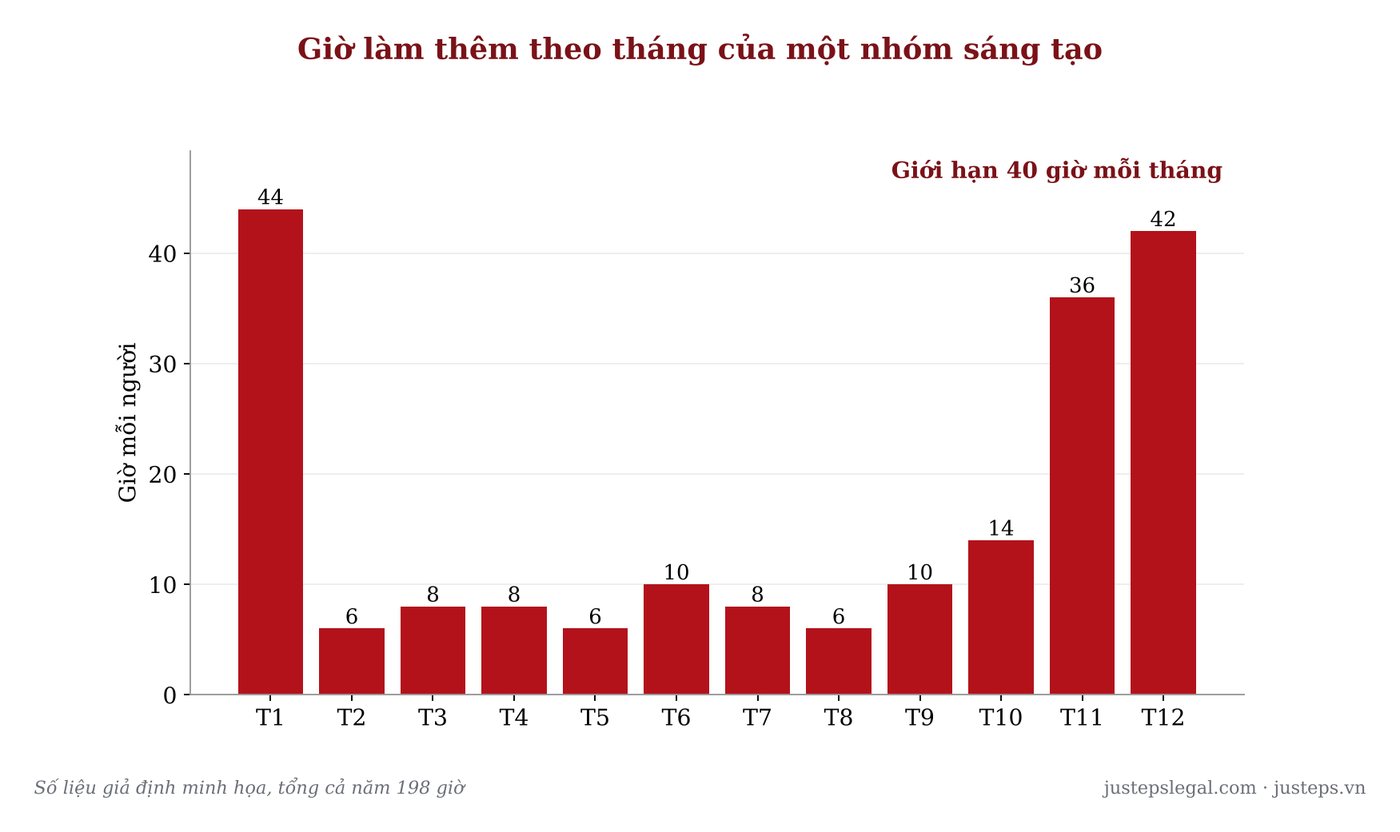
Example of a creative team’s monthly overtime compared with the 40-hour limit
In this example, total overtime for the year is still below 200 hours, but the months before Tet and at the end of the year exceed the 40-hour limit, exactly when the agency takes on the most campaigns. The overtime rules drafted by Justeps require team leaders to register overtime in advance with the employee’s consent, track cumulative hours each month, and arrange time off in lieu or additional staff when a team is approaching the limit. For employees working flexibly or remotely, the rules set out how working hours are recorded, to avoid disputes when an employee leaves and claims overtime pay for several years.
Night work and public holidays when building events
Events are usually built the night before opening, while product launches and brand festivals fall on weekends and public holidays. Night work is from 22:00 to 06:00 the following morning[6]; employees working at night are paid an additional amount of at least 30%, and if they work overtime at night they are also paid an additional 20% of the wage for that day’s work; overtime on public holidays and Tet is paid at no less than 300%, excluding holiday pay[4]. Staff cost estimates for an event must therefore be based on the actual build schedule and cannot use ordinary-day rates.
The law amending and supplementing a number of articles of the Labour Code, passed by the National Assembly on 21 November 2026, adds two fully paid public holidays on 27 July and 24 November, effective from 1 March 2027[7]. Agencies taking on events on these two days from 2027 need to cost them at public holiday overtime rates and inform clients in advance when quoting.
Project bonuses, commissions and pay scales
Income at an agency usually consists of a salary by title, allowances, project bonuses, commission for bringing in new clients and pitch-win bonuses. The agency must develop pay scales and payrolls as the basis for recruitment, agreeing wages and paying insurance, consulting the employee representative organisation if there is one and publishing them before they are applied[8]. Bonuses are decided by the employer on the basis of business results and the employee’s level of performance, but the bonus regulations must also be published at the workplace[9].
The Law on Social Insurance calculates contributions on the salary, allowances and other supplementary amounts paid regularly and consistently in each pay period[10]. Project bonuses arise only when a campaign achieves results and are therefore usually not part of the contribution base, but if the agency pays a fixed monthly amount and calls it a bonus, that amount may be treated as salary. From 1 January 2027, the regional minimum wages are VND 5,700,000, 5,080,000, 4,450,000 and 4,040,000 per month for Regions I to IV respectively[11], so the lowest pay grade and the insurance contribution salary for assistant and logistics positions need to be reviewed before the January 2027 payroll.
Collaborators, seasonal staff, insurance and tax
A person working under an employment contract of one month or more, including a contract with a different name whose content reflects an employment relationship, is subject to compulsory social insurance; a part-time worker is also covered when the monthly wage is at or above the minimum contribution base[12]. When a group of collaborators working like employees is reclassified as employees, the agency must pay back insurance contributions for the past period together with interest, so a planned, proactive conversion is usually less costly.
For genuine collaborators working per deliverable and individuals with contracts of less than three months, the agency withholds 10% personal income tax when the total paid each time is VND 5 million or more, unless the individual gives a written undertaking in the prescribed form that his or her income is below the taxable threshold[13]. The rules on paying fees should specify how payments for the same deliverable are aggregated, when tax is withheld and how withholding certificates are issued, because many agencies split payments into small amounts and are then reassessed by the tax authority at finalisation.
Occupational safety for event build crews
Building stages, rigging lights, installing screens and working on scaffolding are high-risk tasks, usually carried out by seasonal staff or suppliers under the agency’s coordination. The agency needs a safety plan for each programme, safety training for those working at height and checks that suppliers have trained and insured their own people. When an accident causes death or serious injury to two or more people, the employer must immediately report it to the provincial state labour authority[14], so the incident procedure must state clearly who reports and who preserves the scene.
For staff working only a few days who are not covered by compulsory insurance, Justeps proposes buying per-event accident insurance and stating clearly in the contract who bears medical costs in the event of an incident. Agencies whose events business makes up a large share may also consider the labour, payroll and insurance service for event, performing arts and entertainment businesses, where safety and shift-based staffing are covered in more detail.
Client confidentiality, copyright and departures of key staff
The greatest risk for an agency when a client lead leaves is that clients, campaign data and sometimes the whole creative team follow. The agency and the employee may agree in writing on the content and duration of protection of business secrets, the related benefits and compensation in the event of breach[15]. Justeps recommends drafting narrow agreements focused on client lists, campaign data and pitch materials rather than banning work for every competitor for several years, because overly broad clauses are hard to have accepted in a dispute.
Designs, articles and videos produced by employees in the course of assigned duties belong to the agency as economic rights, unless the parties agree otherwise[16]. The employment contracts and job descriptions of designers, writers and video editors should therefore state creative duties clearly, while the leaving procedure requires original files, accounts and administrator rights to be handed over before the agency makes the final payments.
Foreign staff and internal labour regulations
Agencies belonging to international networks often have a foreign creative director or client lead. From 5 December 2026, the employment of foreign workers is governed by a new decree replacing the previous regulations[17], so agencies need to review existing work permit files, their terms and the positions concerned before renewing or recruiting. The tax obligations of foreign staff depend on their residence status, so the pay regulations need to set out how residence is determined and when it is reviewed.
An agency employing 10 or more employees must issue internal labour regulations in writing[18]. An agency’s regulations should contain specific rules on confidentiality of client information, use of personal social media to discuss unpublished campaigns, acceptance of gifts from suppliers and handover of accounts and original files on leaving, because a business can only discipline conduct that has been regulated.
Implementation process, deliverables and fees
Standardising labour, payroll and insurance at an agency usually takes about seven weeks. The sequence begins with a review of data for the last twelve months and ends with a briefing for team leaders, because team leaders are the people who assign overtime and manage collaborators day to day.
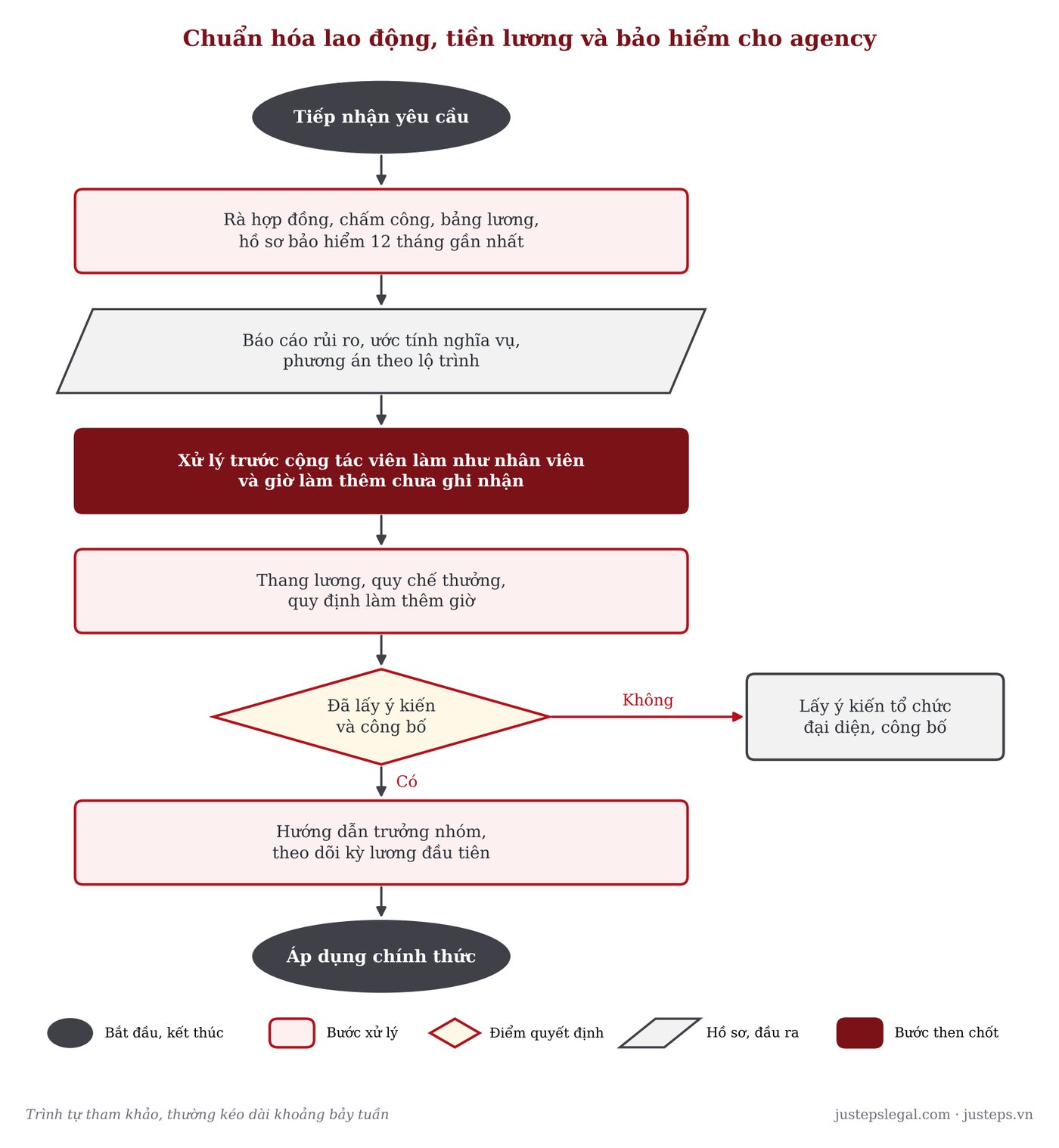
Sequence for standardising labour, payroll and insurance at an agency
After reviewing contracts, attendance records, payrolls and insurance files, Justeps presents a risk report with an estimate of the liabilities arising and a phased remediation plan. The two groups dealt with first are collaborators working like employees and unrecorded overtime; Justeps then finalises the pay scales and bonus regulations, consults the employee representative organisation if there is one and guides the agency in publishing them before they apply. The agency’s human resources and accounting units receive the following documents so that they can continue operating on their own:
- A report reviewing labour, insurance and personal income tax, with risk levels and estimated remediation costs.
- A list classifying each worker and the type of contract proposed for each person.
- A set of template contracts for employees, event crew, collaborators and interns, with confidentiality and copyright annexes.
- Pay scales, pay and bonus regulations, and rules on overtime, flexible working and remote working.
- A template safety plan for events, a template attendance sheet and an overtime registration form.
Justeps quotes its fees in writing, comprising a fixed fee for standardisation and a monthly operating fee if the agency engages Justeps to run payroll, file insurance declarations and withhold tax. The factors affecting the fee are the number of employees, collaborators and event crew each month, the extent of the discrepancies to be remedied, any need for bilingual documents and the number of locations with different regional minimum wages. If job titles and reporting lines are not yet stable, the agency should first use the organisational structure design service for communications, advertising and event agencies so that the pay scales are built on the right system of titles.
How Justeps can help
Alongside labour, payroll and insurance services, communications, advertising and event agencies may combine the following Justeps services:
- Organisational structure design for communications, advertising and event agencies. Justeps arranges divisions and titles so that pay scales and bonus regulations rest on a stable system of titles.
- Ongoing legal advisory for communications, advertising and event agencies. Justeps answers labour questions arising each month together with contract, content and event matters.
- Salary scales and pay and bonus regulations. Justeps builds pay scales by position and bonus regulations for projects and commissions suited to agencies.
- Compulsory social insurance advisory. Justeps reviews insurance contribution salaries and helps handle back-payments when converting collaborators to employment contracts.
Frequently asked questions
Are employees who work on a results basis entitled to overtime pay?
They may be. If the agency requires work outside normal working hours to meet a campaign deadline, that time is overtime and must be paid at the statutory rate[4]. Rules on registering and approving overtime help the agency control this cost.
Must event crew who work only a few days pay social insurance?
A person working under an employment contract of less than one month is not subject to compulsory social insurance[12]. Even so, the agency should still have a written contract, buy accident insurance and provide safety instructions for set-up and dismantling work.
Are project bonuses subject to social insurance contributions?
Bonuses that depend on campaign results and are not paid as a fixed amount each pay period are usually not part of the insurance contribution salary[10]. The bonus regulations should state this clearly and should not use the term bonus for a fixed monthly payment.
Should a client lead sign a non-compete agreement?
The agency should prioritise an agreement protecting business secrets and client information, with a specific duration and scope[15]. A clause banning work for every competitor that is too broad is usually hard to have accepted in a dispute.
Do interns need an employment contract?
An intern training under a school’s curriculum is different from a person given work like an employee and paid monthly. The latter shows signs of an employment relationship[1], so the agency needs to sign an appropriate employment contract.
What should an agency do before the new minimum wage applies?
The agency needs to review the lowest grade in its pay scales, the insurance contribution salaries of assistant and logistics positions and any contract annexes with wages below the new level, and then adjust them before the January 2027 payroll[11].
Related articles
- Overtime limits, how overtime pay is calculated and the records a business must keep
- Managing seasonal workers and freelance collaborators in line with the true nature of the contract and contribution obligations
- A 72-hour playbook for handling a legal and communications crisis
- Labour, payroll and insurance services for event, performing arts and entertainment businesses with a workforce that changes with each show
Notes
[1] Clause 1 of Article 13 of the Labour Code No. 45/2019/QH14 dated 20 November 2019.
[2] Clause 1 of Article 20 of the Labour Code No. 45/2019/QH14 dated 20 November 2019.
[3] Clause 1 of Article 105 of the Labour Code No. 45/2019/QH14 dated 20 November 2019.
[4] Article 98 of the Labour Code No. 45/2019/QH14 dated 20 November 2019.
[5] Clauses 2 and 3 of Article 107 of the Labour Code No. 45/2019/QH14 dated 20 November 2019.
[6] Article 106 of the Labour Code No. 45/2019/QH14 dated 20 November 2019.
[7] The Law amending and supplementing a number of articles of the Labour Code, the Law on Archives, the Law on Gender Equality, the Law on Red Cross Activities and the Law on Employment, passed by the National Assembly on 21 November 2026, effective from 1 March 2027.
[8] Article 93 of the Labour Code No. 45/2019/QH14 dated 20 November 2019.
[9] Article 104 of the Labour Code No. 45/2019/QH14 dated 20 November 2019.
[10] Clause 1 of Article 31 of the Law on Social Insurance No. 41/2024/QH15 dated 29 June 2024, effective from 1 July 2025.
[11] Government Decree No. 399/2026/ND-CP on minimum wages for employees working under employment contracts, applicable from 1 January 2027.
[12] Points a and l of Clause 1 of Article 2 of the Law on Social Insurance No. 41/2024/QH15 dated 29 June 2024, effective from 1 July 2025.
[13] Clause 2 of Article 50 of Government Decree No. 253/2026/ND-CP dated 30 June 2026 detailing the Law on Personal Income Tax No. 109/2025/QH15.
[14] Clause 1 of Article 34 of the Law on Occupational Safety and Health No. 84/2015/QH13 dated 25 June 2015.
[15] Clause 2 of Article 21 of the Labour Code No. 45/2019/QH14 dated 20 November 2019.
[16] Clause 1 of Article 39 of the Law on Intellectual Property No. 50/2005/QH11 dated 29 November 2005, as amended and supplemented in 2009, 2019, 2022 and 2025.
[17] Government Decree No. 393/2026/ND-CP dated 20 October 2026 on foreign workers working in Vietnam, effective from 5 December 2026, replacing Decree No. 219/2025/ND-CP.
[18] Clause 1 of Article 118 of the Labour Code No. 45/2019/QH14 dated 20 November 2019.
This article is for reference and reflects the regulations in force at the time of publication. Please consult Justeps for advice tailored to your company’s records and situation.
For further information, please contact:
📩 Email: info@justeps.vn
🌐 Website: https://justepslegal.com · https://justeps.vn
🌐 Page: Justeps
☎️ Hotline (Zalo): 096 172 2607
📍 Thanh Xuan Office: 12th Floor, Licogi 13 Tower, 164 Khuat Duy Tien Street, Thanh Xuan Ward, Hanoi, Vietnam
📍 Ha Dong Office: LK06B, No.10, Dong Dua Area, Ha Dong Ward, Hanoi, Vietnam
📍 Ho Chi Minh City Branch: 528 Le Van Sy, Ho Chi Minh City, Vietnam
📍 Hai Phong Office: Truong Thinh Village, Ha Dong Commune, Hai Phong, Vietnam
📍 Quang Ninh Office: Van Don Special Zone, Quang Ninh Province, Vietnam





