
Key takeaways
- A foreign national who is required to hold a work permit may only start work once the permit has been issued; a business visa does not replace a work permit[2].
- From 5 December 2026, Decree No. 393/2026/ND-CP replaces Decree No. 219/2025/ND-CP, widening the window for filing renewal applications and extending the validity of confirmations for intra-company transferees[3].
- Salary paid abroad for work performed in Vietnam is still income that must be declared for tax in Vietnam, so net salary contracts need a clear conversion formula.
- New regional minimum wages apply from 1 January 2027, and FDI enterprises should review their salary scales, contracts and insurance contributions before that date[8].
Foreign-invested enterprises (FDI enterprises) usually manage two groups of employees with very different requirements. Foreign experts and managers need work permits, temporary residence cards, net salary after tax, housing and school fee benefits, and tax finalisation based on residence status. Vietnamese employees need labour contracts, salary scales by region, social insurance, trade union arrangements and periodic dialogue. Both groups are governed by the same Labour Code, but the risks arise at different points.
This page introduces the Justeps labour, payroll and insurance service for FDI enterprises and representative offices of foreign traders (representative offices). It covers the procedures for foreign employees, common errors in payroll and insurance, the scope of work, the process, the deliverables and the fees. Organisational structure, internal regulations and ongoing legal advisory are covered on the other service pages in the same group.
Procedures for foreign employees
A foreign national working in Vietnam must meet the conditions on age, legal capacity, qualifications and health and must hold a work permit, unless the person falls within a case exempt from the work permit requirement[1]. A work permit is valid for a maximum of 2 years and may be renewed only once, for a maximum of 2 years[2]. The first step is therefore to identify the correct category for each person, because businesses often assume that an expert transferred from the parent company is an intra-company transferee without checking the conditions on the service sector and the length of prior employment with the group.
Decree No. 393/2026/ND-CP, effective from 5 December 2026, replaces Decree No. 219/2025/ND-CP. According to professional bulletins published so far, the new decree allows renewal applications to be filed between 10 working days and 90 days before the permit expires, extends the validity of the confirmation of exemption from the work permit requirement for intra-company transferees to a maximum of 3 years, and limits this category to managers, executive directors and experts[3]. Permits already issued to technical workers as intra-company transferees remain valid until expiry, but renewal or reissue must be assessed according to the new position. The flowchart below helps businesses determine the procedure for each person before that person starts work.
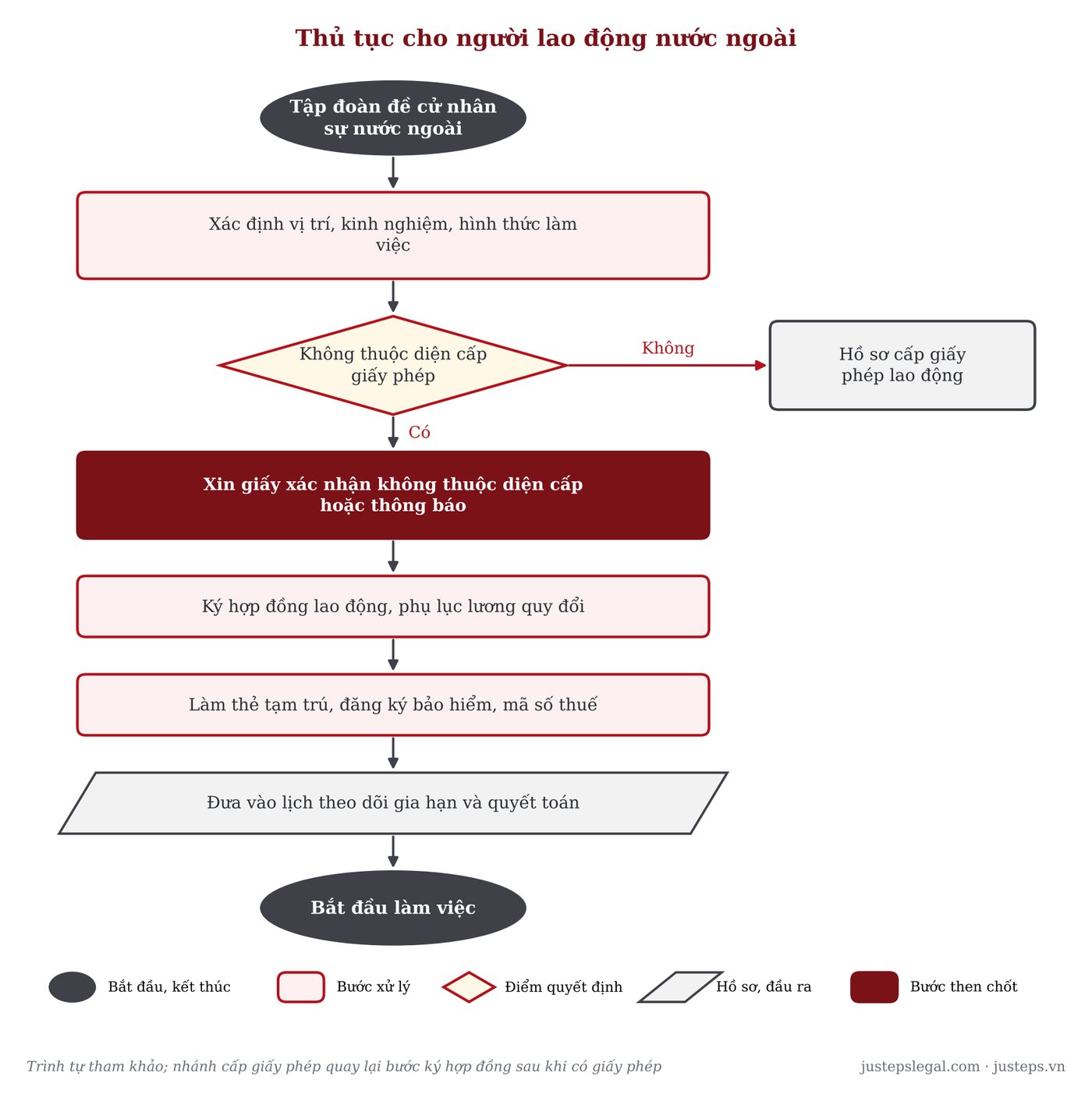
Determining the procedure for a foreign employee before the first working day
The flowchart starts by asking whether the employee falls within a case exempt from the work permit requirement, for example a capital-contributing member whose contribution reaches the statutory threshold, a person entering for short-term work or an eligible intra-company transferee. If so, the business applies for a confirmation of exemption from the work permit requirement, except for certain cases where only a notification is required. If not, the business prepares a work permit application under the position of manager, executive director, expert or technical worker. Only when the permit or confirmation is available does the business sign the labour contract, obtain the temporary residence card and add the employee to the payroll.
Common errors in payroll and insurance
Net salary without a conversion formula
Foreign experts often agree a net salary after tax, with the business bearing all personal income tax and insurance. If the contract does not set out a formula for converting the net amount into a gross salary, the tax paid by the business on the employee's behalf may not be correctly included in taxable income and deductible expenses, and insurance contributions are also likely to be miscalculated. Benefits such as rent, children's school fees and home leave flights also need to be clearly classified as to which items count as taxable income and which count as salary for the purpose of insurance contributions.
Salary paid abroad but not declared in Vietnam
Many groups split an expert's salary into two parts, one paid in Vietnam and one paid abroad. Income from work performed in Vietnam is income arising in Vietnam regardless of where it is paid, so it must still be declared and taxed under the Law on Personal Income Tax, even where a double taxation agreement may apply[4]. The business needs to collect information on the portion paid abroad in order to withhold tax or guide the employee to self-declare and finalise tax on time.
Social insurance for foreign experts
Foreign employees who hold a work permit or an equivalent document and work under a labour contract are subject to compulsory social insurance, except in certain cases such as intra-company transferees, those who have reached retirement age, or where an international treaty provides otherwise[5]. The social insurance and tax authorities increasingly cross-check their data, so differences between the salary used for tax and the salary used for insurance contributions are easily detected. The table below compares the main obligations for the two groups of employees.
| Item | Foreign experts | Vietnamese employees |
|---|---|---|
| Work documents | Work permit or confirmation of exemption, together with a visa or temporary residence card. | No permit needed; only a labour contract and recruitment records. |
| Contract | Fixed-term contract whose term does not exceed the term of the work permit. | Fixed-term or indefinite-term contract as agreed. |
| Social insurance | Compulsory in statutory cases, except for intra-company transferees and certain other exceptions. | Compulsory under the Law on Social Insurance No. 41/2024/QH15. |
| Personal income tax | Determine resident or non-resident status and aggregate any salary paid abroad. | Monthly withholding and annual finalisation under progressive rates. |
| Salary | Usually agreed as net salary, requiring a formula for conversion to gross salary. | Not lower than the regional minimum wage, graded on the salary scale. |
Workforce reduction at the direction of the group
When the group restructures its regional operations, the Vietnamese entity often receives instructions to reduce headcount within a short period. The Labour Code requires a business dismissing a number of employees due to structural or technological change to prepare a labour utilisation plan, consult the employee representative organisation, give prior notice to the labour authority and pay job-loss allowances[6]. If these steps are skipped, the termination may be held unlawful, giving rise to obligations to reinstate the employees and pay compensation. A representative office that ceases operation must likewise pay all salaries and allowances in full, close insurance records and finalise tax for its employees before completing the procedure[7].
Regional minimum wages from 2027
From 1 January 2027, Decree No. 399/2026/ND-CP applies new monthly minimum wages for the four regions[8]. FDI enterprises in industrial parks with many unskilled workers are directly affected, because the lowest level on the salary scale, the minimum insurance contribution and allowances calculated on salary must all be adjusted. Businesses must establish their salary scales and labour norms, consult the employee representative organisation where one exists, and publish them at the workplace before applying them[9].
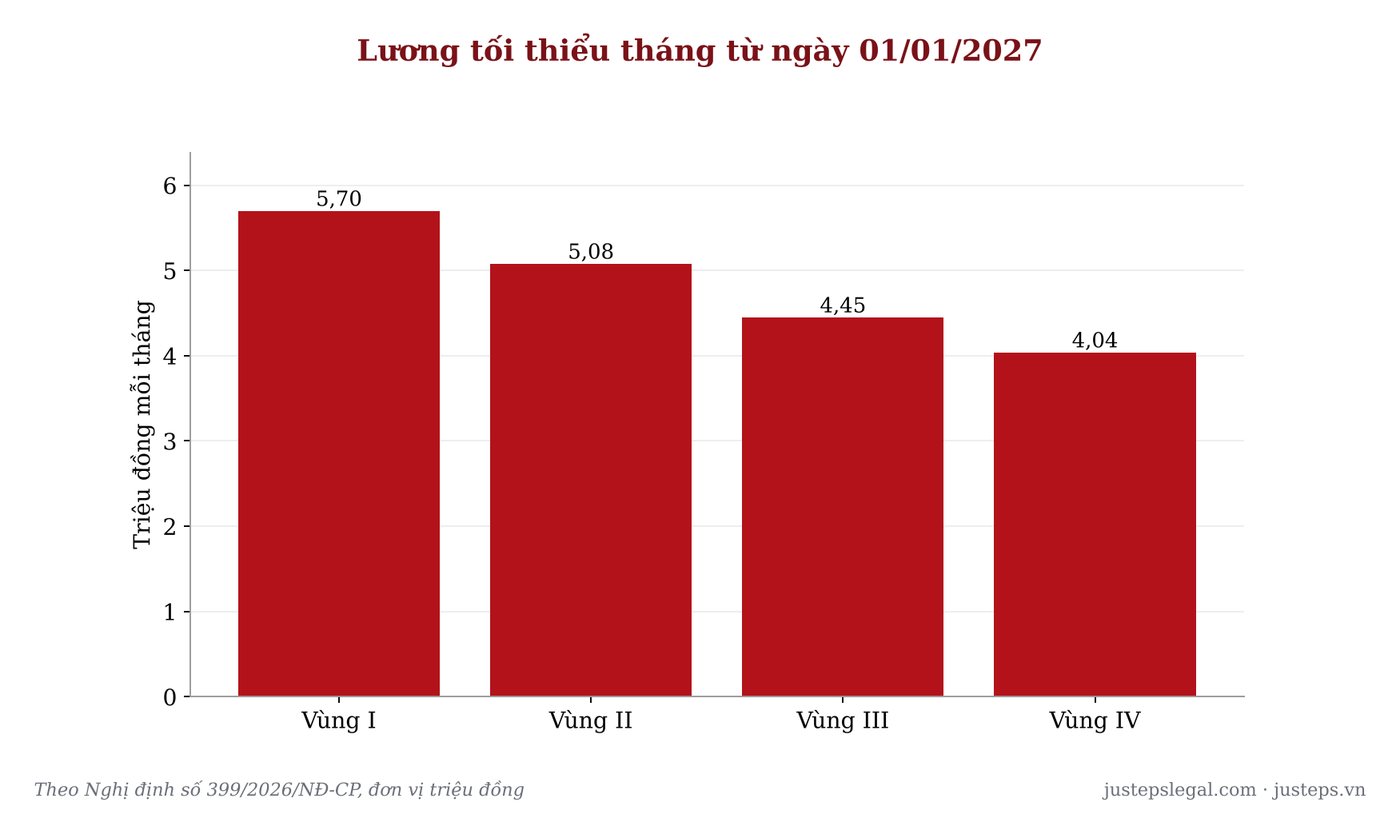
Monthly minimum wages by region applicable from 1 January 2027
The difference between Region I and Region IV is VND 1,660,000 per month, so businesses with factories and offices in several provinces need to determine the region of each location following the reorganisation of administrative units. The minimum wage is only the floor for simple work under normal conditions, and work requiring training should be placed at a higher level on the business's salary scale. Businesses that need to build or update their salary scales may refer to the service for building salary scales and salary and bonus regulations offered by Justeps.
How Justeps supports businesses
The Justeps service starts with a review of existing labour records and then deals with issues according to their level of risk. The main tasks are as follows:
- Justeps identifies the permit category for each foreign national and prepares applications for issuing, renewing or reissuing work permits or confirmations of exemption.
- Justeps drafts bilingual labour contracts, net salary annexes with a conversion formula and, where needed, secondment agreements with the parent company.
- Justeps builds or updates salary scales, salary and bonus regulations and benefit policies for foreign experts.
- Justeps reviews the registration and adjustment of social and health insurance contributions and reconciles them with personal income tax data.
- Justeps advises on determining residence status, withholding and finalising personal income tax for foreign nationals.
- Justeps prepares labour utilisation plans, workplace dialogue records and employee files when a representative office ceases operation.
Process, deliverables and fees
In the first two to three weeks, Justeps reviews the list of foreign employees, permit expiry dates, temporary residence cards, contracts, payroll and insurance records, giving priority to people whose permits are about to expire and experts about to arrive. The following one to two months are devoted to salary scales, salary and bonus regulations and standardising contracts. After that, recurring tasks such as tax withholding, insurance adjustments, permit renewals and year-end finalisation are tracked on a calendar, which can be combined with the ongoing legal advisory service for FDI enterprises and representative offices.
The deliverables include work permits or confirmations, temporary residence card files, a set of bilingual contracts, salary scales and salary conversion tables, insurance records, a summary of labour costs by group, tax finalisation files and, where applicable, dialogue minutes or the labour utilisation plan. Fees are quoted per package or per task and depend on the number of foreign experts, the number of Vietnamese employees, bilingual requirements, whether monthly payroll or only finalisation is included, and the number of operating locations.
How Justeps can help
To manage labour consistently with the organisation and its regulations, FDI enterprises and representative offices can combine this with the following Justeps services:
- Organisational structure design for FDI enterprises and representative offices. Justeps defines the positions, job titles and reporting lines that underpin the work permits and contracts of experts.
- Ongoing legal advisory for FDI enterprises and representative offices. Justeps tracks the expiry of permits and temporary residence cards and flags changes in labour law on a calendar.
- Personal income tax on salaries and wages. Justeps calculates tax on net salary and benefits and handles finalisation for resident and non-resident experts.
- Labour dispute management and contract termination. Justeps prepares labour utilisation plans and termination files when the group restructures.
Frequently asked questions
May a foreign national work while the work permit is pending?
A person who is required to hold a work permit may only start work after the permit has been issued[2]. If the expert needs to arrive early, the business should file the application as soon as the person is identified and assign only work permitted under the visa.
How long is a work permit valid?
A work permit is valid for a maximum of 2 years, in line with the term of the contract, and may be renewed only once, for a maximum of 2 years[2]. After that renewal, the business must apply for a new permit if it continues to employ the person.
With whom do representative office staff sign their labour contracts?
A representative office may hire employees under Vietnamese law, and the chief representative signs labour contracts under a letter of authorisation from the foreign trader[10]. The office must pay insurance contributions and withhold personal income tax for its employees in the same way as a company.
How are employees dealt with when a representative office closes?
The office must pay all salaries, allowances and other amounts owed to employees in full, close their insurance records and finalise tax before completing the procedure for ceasing operation[7]. Justeps prepares a schedule so that these steps do not lag behind the termination file submitted to the licensing authority.
Must an FDI enterprise sign a collective labour agreement?
The law does not require every business to have a collective agreement, but the business must hold periodic dialogue at the workplace and negotiate when a valid request is made[11]. Factories with a large workforce should usually take the initiative to negotiate in order to reduce the risk of collective disputes.
How do the 2027 regional minimum wages affect FDI enterprises?
From 1 January 2027, salary for simple work under normal conditions may not be lower than the new minimum for the region where the employee works[8]. Businesses need to adjust their salary scales, contracts and insurance contributions before that date.
Related articles
- Managing foreign employees, work permits, compulsory social insurance and the records to keep
- Monthly labour and payroll compliance checklist for the HR department
- Lawful procedure and documentation for workforce reduction when a company changes its structure or technology
- Moving from paper to electronic labour contracts, conditions, platforms and storage
Notes
[1] Articles 151 and 154 of the Labour Code No. 45/2019/QH14 dated 20 November 2019.
[2] Article 155 of the Labour Code No. 45/2019/QH14 dated 20 November 2019.
[3] Decree No. 393/2026/ND-CP dated 20 October 2026 on foreign employees working in Vietnam, effective from 5 December 2026, replacing Decree No. 219/2025/ND-CP dated 7 August 2025.
[4] Law on Personal Income Tax No. 109/2025/QH15 on resident and non-resident individuals and income arising in Vietnam.
[5] Clause 2 of Article 2 of the Law on Social Insurance No. 41/2024/QH15 dated 29 June 2024.
[6] Articles 42 and 47 of the Labour Code No. 45/2019/QH14 dated 20 November 2019.
[7] Decree No. 07/2016/ND-CP dated 25 January 2016 detailing the Commercial Law on representative offices and branches of foreign traders in Vietnam.
[8] Decree No. 399/2026/ND-CP on minimum wages for employees working under labour contracts, applicable from 1 January 2027.
[9] Article 93 of the Labour Code No. 45/2019/QH14 dated 20 November 2019.
[10] Article 17 of the Commercial Law No. 36/2005/QH11 dated 14 June 2005.
[11] Articles 63 and 65 of the Labour Code No. 45/2019/QH14 dated 20 November 2019.
This article is for reference and reflects the regulations in force at the time of publication. Please consult Justeps for advice tailored to your company’s records and situation.
For further information, please contact:
📩 Email: info@justeps.vn
🌐 Website: https://justepslegal.com · https://justeps.vn
🌐 Page: Justeps
☎️ Hotline (Zalo): 096 172 2607
📍 Thanh Xuan Office: 12th Floor, Licogi 13 Tower, 164 Khuat Duy Tien Street, Thanh Xuan Ward, Hanoi, Vietnam
📍 Ha Dong Office: LK06B, No.10, Dong Dua Area, Ha Dong Ward, Hanoi, Vietnam
📍 Ho Chi Minh City Branch: 528 Le Van Sy, Ho Chi Minh City, Vietnam
📍 Hai Phong Office: Truong Thinh Village, Ha Dong Commune, Hai Phong, Vietnam
📍 Quang Ninh Office: Van Don Special Zone, Quang Ninh Province, Vietnam





