
Key takeaways
- The name of a collaboration contract does not determine the nature of the relationship; a person who works for pay under the management and direction of the studio is treated as being in an employment relationship[1].
- The 2024 Law on Social Insurance brings contracts with a different name but with the content of an employment contract within compulsory social insurance, so signing collaboration contracts en masse to avoid insurance carries a high risk of back-payment claims[6].
- Studios may pay per shoot, that is by product, but must still ensure that pay is not below the regional minimum wage and must pay overtime when normal working hours are exceeded[2].
- From 1 January 2027 regional minimum wages rise under Decree No. 399/2026/ND-CP, with Region I at VND 5,700,000 per month, so studios need to review their pay scales and insurance contribution levels before next year’s wedding season[9].
A studio crew’s wedding day often starts at four or five in the morning with the make-up artist, followed by the ancestral ceremony, the bride’s procession, the outdoor shoot and ending after the evening reception. That crew may include a photographer on an employment contract, a videographer engaged per shoot, an assistant who is still an apprentice and a driver hired by the day, each paid in a different way. Only when one of them leaves and claims overtime for the whole wedding season, or when the social insurance authority carries out an inspection, does the studio realise that its current labour arrangements lack a proper basis.
This page introduces Justeps’ labour, payroll and insurance service for photo studios, wedding studios and video production companies. It covers the sector’s particular labour issues, how to classify the people who work for the studio, seasonal pay design, insurance, common risks, the implementation process and the deliverables. The main legal basis is the Labour Code No. 45/2019/QH14, the Law on Social Insurance No. 41/2024/QH15 and the decrees on regional minimum wages.
Studio staffing fluctuates with the wedding season
A wedding studio’s staffing needs are uneven across the year. The number of shoots usually rises sharply in the last months of the year and the first months of the next, while the middle months may see only a third as many. The chart below is an example of headcount by quarter at a medium-sized studio, showing that per-shoot collaborators absorb almost all of the increase.
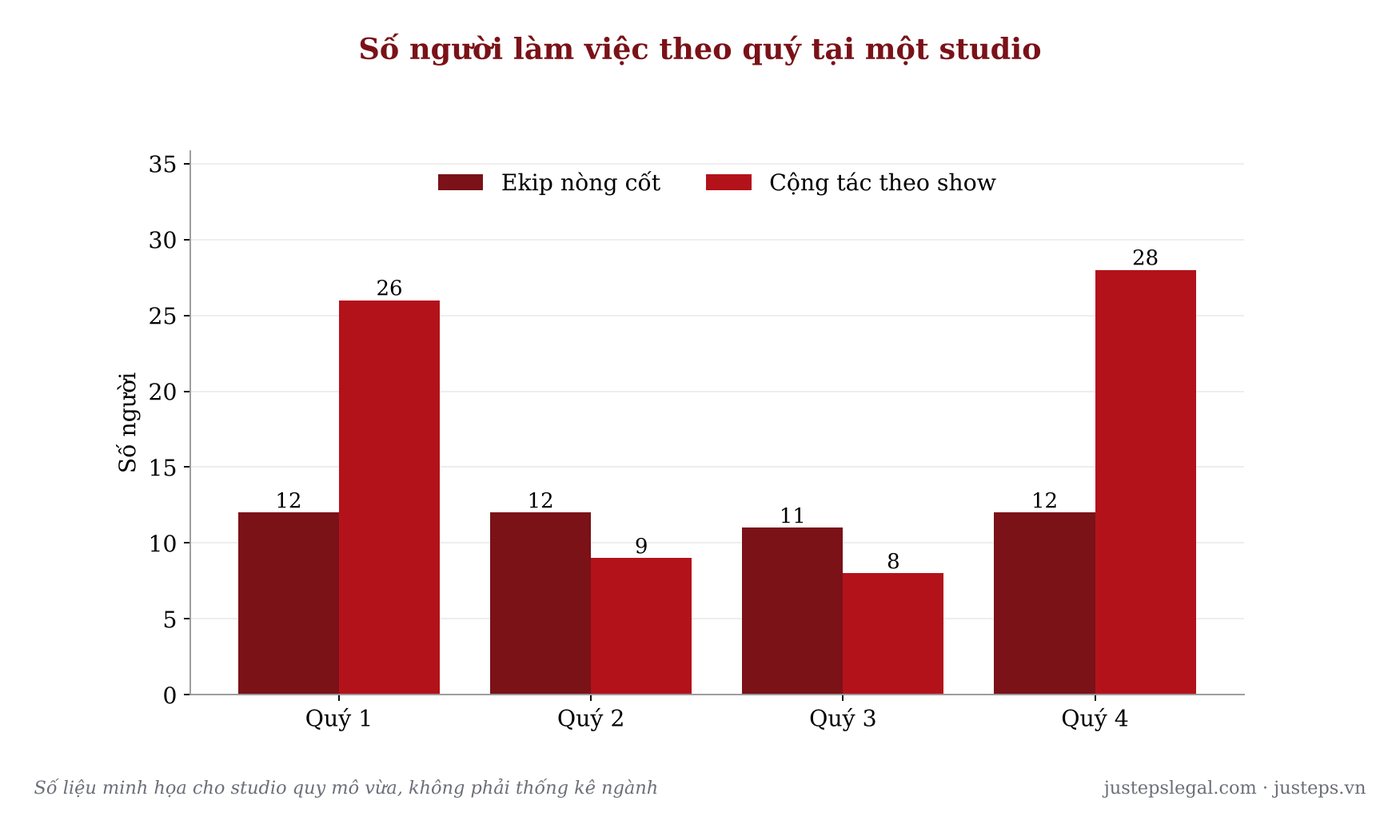
Example headcount by quarter at a medium-sized wedding studio
In this example, the core crew stays almost unchanged across the quarters, while the number of per-shoot collaborators more than doubles in the first and fourth quarters. This arrangement makes sense in cost terms, but it is legally safe only when the studio correctly identifies who is an employee and who is an independent service provider, and signs the corresponding type of contract. Distinguishing core positions from per-shoot positions on the organisation chart is done in the organisational structure design service for studios; this page focuses on contracts, pay and insurance for each group.
Classifying employees and per-shoot collaborators
The Labour Code defines an employment contract as an agreement on paid work, wages, working conditions and the rights and obligations of each party; where the parties use a different name but the content shows paid work under the management, direction and supervision of one party, the agreement is still regarded as an employment contract[1]. The practical question is whether the studio manages that person as an employee, for example by setting a fixed weekly duty roster, requiring daily reports, imposing penalties for lateness, prohibiting shoots for other studios or requiring the use of the studio’s equipment and costumes.
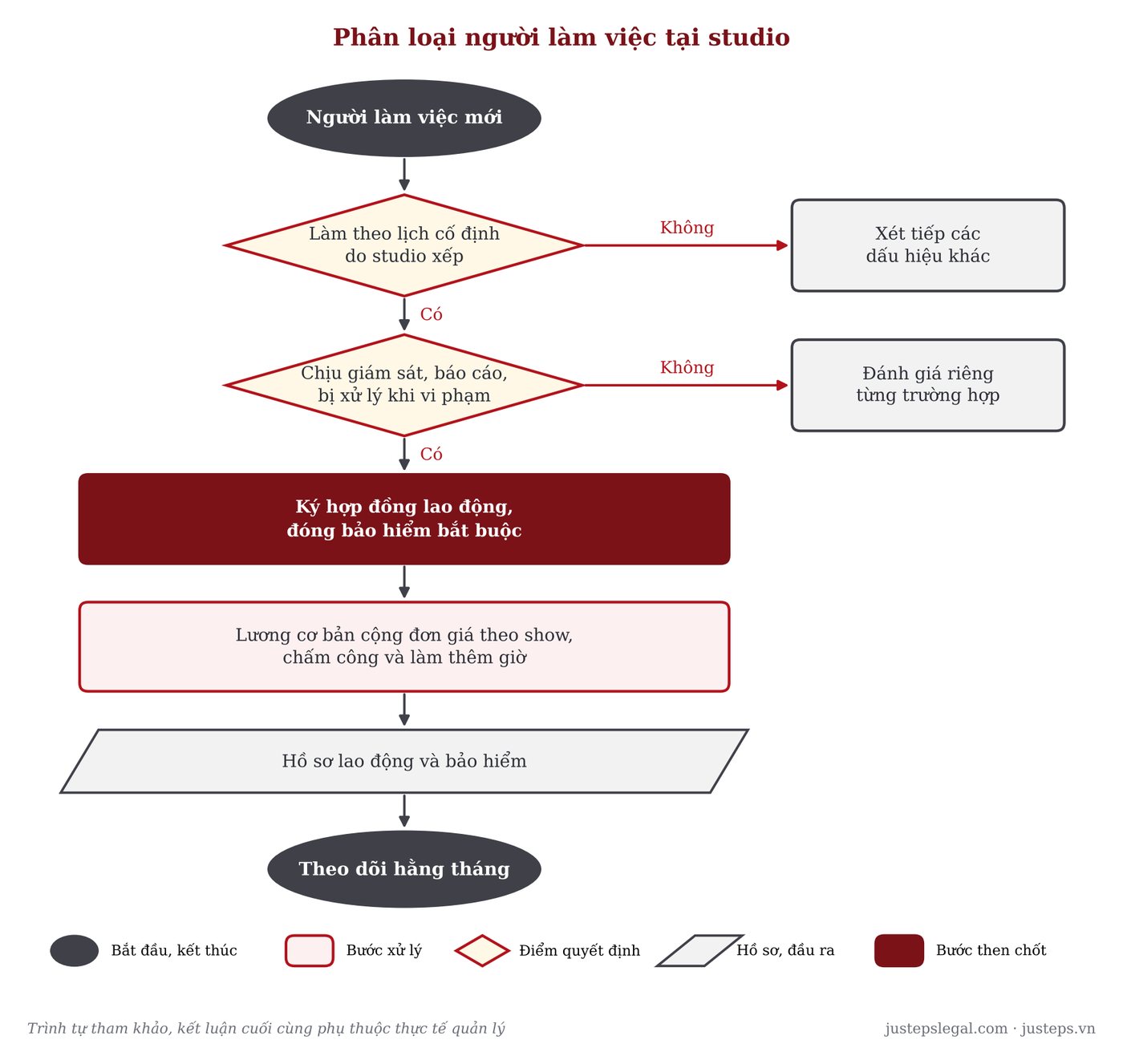
Questions for classifying the people who work for a studio
Under this sequence, a person who takes shoots only when free, decides how to do the work, uses their own equipment and can work for many other studios is usually suited to a service contract per shoot. A person who works regularly on a schedule set by the studio and under its direct supervision should sign an employment contract, even if pay is calculated per shoot. Cases in between need to be assessed individually, and the studio should align its actual management with the type of contract chosen, because the competent authorities look at the facts rather than the title of the document.
Per-shoot pay, overtime and apprenticeships
Piece-rate pay and sales commission on packages
Employers and employees may agree to pay wages by time, by product or as a lump sum[2]. A studio may pay a photographer a basic wage plus a rate per shoot, and pay a consultant a basic wage plus commission on packages signed. What should be avoided is combining every element into an all-in lump-sum wage with no clear breakdown, because the studio then struggles to prove that it has paid overtime in full and to determine which amounts are subject to insurance contributions. The pay regulations should set out the rate for each type of shoot, the allowance for out-of-province work, how commission is calculated and when it is paid.
Overtime, night work and rest days in wedding season
A fourteen-hour wedding day goes far beyond normal working hours. For employees, overtime is capped per day, per month and per year and requires the employee’s consent[3]. Overtime is paid at no less than 150% on ordinary days, 200% on weekly rest days and 300% on public holidays, Tet and paid days off, not counting the pay for night work[4]. Because weddings are concentrated at weekends, the studio should schedule flexible weekly rest days for the crew in the middle of the week and state this in the internal labour rules, so that most weekend hours are normal working hours rather than overtime.
Assistant apprentices and probation
Many studios take on unpaid assistant apprentices for several months. Under the Labour Code, a person recruited for vocational training or apprenticeship to work for the employer does not pay tuition fees, and if during the training period they work directly or take part in making products, they are paid at a rate agreed by the two parties[5]. An assistant who actually operates a second camera, carries equipment and works to the shoot schedule should therefore not be kept as an unpaid apprentice for long periods. If the studio recruits someone for a permanent role, it should sign a probation contract or include probation terms in the employment contract, with the period and pay required by law.
Insurance, equipment and safety when working away from the studio
People working under employment contracts of one month or more are subject to compulsory social insurance, and the 2024 Law on Social Insurance, effective from 1 July 2025, extends this to contracts with a different name but with the content of an employment contract[6]. The wages on which contributions are based include the wage level, wage allowances and other supplementary amounts agreed to be paid regularly and consistently. For sales commission and per-shoot rates, how they are worded in the contract and the pay regulations will determine whether they form part of the contribution base, so they need to be reviewed specifically by Justeps. For collaborators on service contracts, the studio must withhold personal income tax on payment in accordance with the Law on Personal Income Tax and its implementing documents.
The studio’s lenses, cameras and drones are of high value. Where an employee negligently damages property of limited value within the statutory threshold, compensation is capped at three months’ wages and deducted gradually from monthly pay[7]. The studio may not impose fines in place of labour discipline, and deductions must follow the rules on wage deductions. For crews that regularly shoot outdoors, travel to other provinces, work at height or use drones, the studio needs safety provisions in the internal labour rules and a business travel policy, and should consider supplementary accident insurance. Once the studio employs ten or more employees, the internal labour rules must be in writing and registered with the labour authority[8]; this can be done together with the service for internal labour rules and disciplinary procedures.
Implementation process, deliverables and fees
A project usually takes about eight weeks and should be completed before wedding season. In the first two weeks, Justeps’ consultants collect the list of people working for the studio, the contracts in use, the payroll and insurance contribution data for the last twelve months. In week three, Justeps sends a classification and risk report, covering cases at risk of being treated as employment relationships and the amount of insurance contributions that may have to be paid retrospectively. The following weeks are for drafting contracts and pay regulations, adjusting insurance registrations, registering the internal labour rules and guiding the accountant and coordinators on recording attendance per shoot. The deliverables comprise the documents in the table below.
| Document | Main content |
|---|---|
| Classification report | List of people working for the studio by group, the appropriate type of contract and any back-payment risk. |
| Template contracts | Employment contracts for the core crew, per-shoot service contracts and apprenticeship agreements. |
| Pay scale and pay regulations | Rates per shoot, out-of-province allowance, package commission and overtime calculation. |
| Insurance plan | Who must contribute, the contribution wage and a roadmap for dealing with unpaid contributions. |
| Internal labour rules | Flexible rest days, safety on outdoor shoots, equipment management and registration file. |
| Sample calculation sheet | Peak-season monthly payroll with shoots, overtime, tax and insurance deductions. |
Fees are quoted in writing as a fixed package after the initial review and depend on the number of people working for the studio, the number of contract types, whether a new pay scale is needed, the volume of outstanding insurance issues to be resolved and whether monthly payroll support is needed after hand-over. Studios with fewer than ten people usually need only the contract set and a per-shoot payroll sheet, while studios with several showrooms and crews travelling to other provinces need the full pay scale, internal labour rules and travel policy.
How Justeps can help
Together with the labour, payroll and insurance service, photo studios and video production companies can combine the following Justeps services:
- Organisational structure design for photo studios, wedding photography and video production. Justeps identifies core positions, per-shoot positions and the person coordinating crews on the organisation chart.
- Ongoing legal advisory for photo studios, wedding photography and video production. Justeps answers labour questions arising in wedding season and provides updates on the amendments to the Labour Code.
- Salary scales and pay and bonus regulations. Justeps builds pay scales with per-shoot rates and commission in line with the rules on regional minimum wages.
- Internal labour rules and disciplinary procedures. Justeps drafts internal labour rules with specific provisions for crews on outdoor and out-of-province shoots and guides their registration.
Frequently asked questions
Must social insurance be paid for collaborators engaged per shoot?
If the person in substance works for pay under the studio’s management and direction, the relationship may be treated as an employment relationship and fall within compulsory insurance[6]. If the person manages their own work, uses their own equipment and takes shoots freely, a service contract is appropriate.
May a studio pay wages entirely by the number of shoots?
The parties may agree on piece-rate pay[2], but pay for an employee’s normal working hours must not be below the regional minimum wage. In months with few shoots, the studio must still ensure this level if the employee works full normal hours.
Does Sunday work in wedding season have to be paid as overtime?
If Sunday is the weekly rest day under the internal labour rules, work on that day is paid at no less than 200%[4]. The studio may set the weekly rest day on another day of the week to fit the wedding schedule.
Must an employee who damages a lens compensate its full value?
Not necessarily. Where damage is caused by negligence and its value is limited within the statutory threshold, compensation is capped at three months’ wages, deducted gradually from pay[7]. Other cases are considered according to fault, the extent of the damage and the employee’s circumstances.
Is it lawful to take on unpaid assistant apprentices?
A person training to work for the studio does not pay tuition, and when they take part in making products they must be paid at the agreed rate[5]. An assistant who already works like an employee should be given an appropriate contract.
At what headcount must a studio register its internal labour rules?
When the studio employs ten or more employees, the internal labour rules must be in writing and registered with the labour authority[8]. The studio should also follow the Law amending the Labour Code passed on 21 November 2026, effective from 1 March 2027.
Related articles
- Managing seasonal workers and freelance collaborators in line with the true nature of the contract and contribution obligations
- Overtime limits, how overtime pay is calculated and the records businesses must keep
- Organisational structure design for wedding photo studios and video production companies to protect bookings, deposits and client data
- Late payment and evasion of social insurance contributions under the new law and where the line lies for businesses
Notes
[1] Article 13 of the Labour Code No. 45/2019/QH14 dated 20 November 2019.
[2] Article 96 of the Labour Code No. 45/2019/QH14 dated 20 November 2019.
[3] Article 107 of the Labour Code No. 45/2019/QH14 dated 20 November 2019.
[4] Article 98 of the Labour Code No. 45/2019/QH14 dated 20 November 2019.
[5] Article 61 of the Labour Code No. 45/2019/QH14 dated 20 November 2019.
[6] Article 2 of the Law on Social Insurance No. 41/2024/QH15 dated 29 June 2024, effective from 1 July 2025.
[7] Clause 1, Article 129 of the Labour Code No. 45/2019/QH14 dated 20 November 2019.
[8] Articles 118 and 119 of the Labour Code No. 45/2019/QH14 dated 20 November 2019.
[9] Decree No. 293/2025/ND-CP on minimum wages for employees working under employment contracts; Decree No. 399/2026/ND-CP applicable from 1 January 2027.
This article is for reference and reflects the regulations in force at the time of publication. Please consult Justeps for advice tailored to your company’s records and situation.
For further information, please contact:
📩 Email: info@justeps.vn
🌐 Website: https://justepslegal.com · https://justeps.vn
🌐 Page: Justeps
☎️ Hotline (Zalo): 096 172 2607
📍 Thanh Xuan Office: 12th Floor, Licogi 13 Tower, 164 Khuat Duy Tien Street, Thanh Xuan Ward, Hanoi, Vietnam
📍 Ha Dong Office: LK06B, No.10, Dong Dua Area, Ha Dong Ward, Hanoi, Vietnam
📍 Ho Chi Minh City Branch: 528 Le Van Sy, Ho Chi Minh City, Vietnam
📍 Hai Phong Office: Truong Thinh Village, Ha Dong Commune, Hai Phong, Vietnam
📍 Quang Ninh Office: Van Don Special Zone, Quang Ninh Province, Vietnam





