
Key takeaways
- A commission guaranteed as a fixed monthly amount is easily treated as an additional payment made regularly and stably that must be included in the wages on which social insurance is paid[2], so commission rules need to separate the fixed portion clearly from the portion that genuinely depends on orders.
- A business may not fine documentation staff or deduct their wages on its own initiative when they make an incorrect declaration[1], but must proceed through the labour discipline and material liability procedures set out in its internal labour rules.
- Hours spent communicating with customers in other time zones and waiting for vessels at night may be overtime or night work, so they must be recorded and paid as required by law rather than treated as voluntary.
- Work permit applications submitted up to and including 4 December 2026 are processed under Decree No. 219/2025/ND-CP[8], while from 5 December 2026 Decree No. 393/2026/ND-CP applies[9].
Import-export trading businesses usually have few staff relative to their revenue, but each position is linked to transactions of high value. An international salesperson may hold the entire relationship with several major customers, a documentation officer who makes an incorrect declaration may give rise to tax arrears across many declarations, and a foreign specialist working without a permit may expose the business to penalties. The labour, wage and social insurance policies of an import-export business therefore need to be designed around the risks of each group of positions rather than using a single template.
This page introduces Justeps’ labour, wages and social insurance service for import-export businesses, covering employment contracts, commission rules, working hours, confidentiality, overseas business travel, safety for field staff and foreign employees. Staffing and the allocation of authority to each function are handled under the organisational structure design service for import-export trading businesses, while this page deals with the relationship between the business and each employee.
Four groups of staff with four types of risk
When reviewing, Justeps divides the staff of an import-export business into four groups, because each group has different legal risks and pay arrangements. This division spares the business from writing overly general rules for everyone, since each document only answers the questions relevant to that group. The table below summarises the four groups and the policy focus for each.
| Staff group | Main risk | Policy focus |
|---|---|---|
| International sales | Commissions calculated on the wrong social insurance basis, and loss of customers when staff leave. | Clear commission rules, confidentiality agreements and data handover. |
| Documentation and customs | Incorrect declarations giving rise to tax arrears, and disputes over making staff pay compensation. | Internal labour rules on material liability and the disciplinary procedure. |
| Port and warehouse forwarding | Night work following shipping schedules, and occupational accidents during loading and inspection. | Shift rosters, pay for overtime and night work, and safety training. |
| Foreign specialists | Working before a permit is issued, and incorrect insurance contributions and tax withholding. | A work permit timeline, social insurance and personal income tax. |
Commissions, foreign currency and wages for social insurance purposes
International salespeople usually receive a low fixed salary plus sales commission, often calculated on the contract value in US dollars or euros. Under the Labour Code, wages stated in the employment contract and paid to Vietnamese employees are paid in Vietnamese dong[1], so commission may be calculated on the foreign currency value of the order, but the rules must state the conversion rate and the time of conversion. The rules must also answer when commission arises, whether when the buyer has paid or when the goods have been delivered, and how cancelled orders or uncollectable debts are dealt with.
As regards social insurance, the wages on which contributions are based comprise the salary, wage allowances and other additional amounts agreed to be paid regularly and stably in each pay period[2]. Commission that genuinely depends on the result of each order usually falls outside this category, but many businesses guarantee a fixed minimum monthly commission to retain staff, and this amount is easily treated as a stable payment on which contributions are due. The chart below analyses the monthly income of a salesperson in the example.
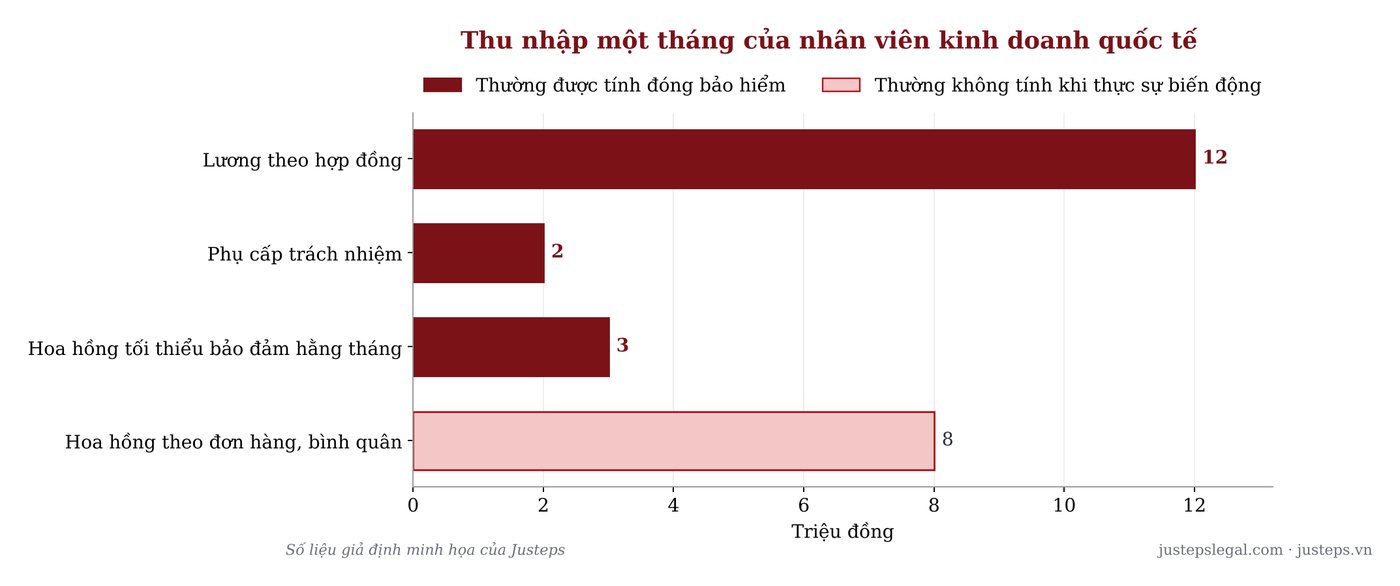
Example breakdown of the monthly income of an international salesperson and the items usually included in the social insurance basis
In the example, the employee receives a contractual salary of VND 12 million, a responsibility allowance of VND 2 million, a guaranteed minimum commission of VND 3 million and order-based commission averaging VND 8 million per month. The business pays social insurance on VND 14 million, comprising salary and allowance, while the VND 3 million minimum commission paid regularly is at risk of being added, raising the contribution basis to VND 17 million. Justeps usually proposes one of two approaches, either moving the guaranteed portion into salary and paying contributions in full, or abolishing the guarantee and replacing it with commission linked entirely to results, with notice to employees following the proper procedure for amending the rules. Salary scales, pay tables and bonus rules can be built in a consistent way through the salary scale, pay table and bonus rules service.
Working hours around customers’ time zones and shipping schedules
Salespeople dealing with customers in Europe and the Americas often have to hold online meetings in the evening, while forwarding staff must be at the port when vessels berth or goods undergo physical inspection, including at night and on rest days. If the business requires this work outside normal working hours, it is overtime and may also be night work; employees are paid at least 150%, 200% or 300% depending on the day on which the overtime is worked, and hours worked between 10 pm and 6 am attract additional pay as required by law[1]. Unpaid amounts may be the subject of complaints and back-pay claims by employees when they leave.
Justeps does not propose ways to avoid these obligations but redesigns working hours to fit. For salespeople, the internal labour rules may provide for flexible working hours, allowing part of the working day to be moved to the evening to match customers’ time zones without exceeding total normal hours. For the forwarding team, Justeps prepares shift rosters and rules on calling in staff for overtime when vessels arrive outside working hours, together with a log of hours worked to calculate pay and to show that the business has not exceeded the overtime limits.
Liability for incorrect declarations and protection of trade secrets
When a documentation officer declares an incorrect tariff code or value, many business owners want to deduct the amount from wages immediately. The Labour Code prohibits the use of fines or wage cuts in place of labour discipline and only permits deductions from wages to compensate for damage in the cases, amounts and procedures provided by law[1]. The internal labour rules therefore need to set out the violations, forms of discipline and material liability, and the business must hold a disciplinary meeting following the proper procedure, with minutes recorded. Justeps drafts this section at the same time as the declaration checking procedure, because an employee is only at fault when the procedure has clearly assigned the checking task to that employee.
For salespeople, the greatest risk is the loss of customers and price lists when they leave and join a competitor. An employment contract may be accompanied by an agreement on the protection of trade secrets and on the employee’s entitlements in case of breach[1], but a non-compete clause that is too broad in duration and scope is unlikely to be upheld. Justeps prefers to protect specific items, namely customer lists, price lists, suppliers and negotiation files, together with rules on handing over mailboxes and data on leaving. Contact details of customers who are individuals are also personal data, so the rules on access rights and data deletion must comply with the Law on Personal Data Protection[3]. A business needing a more comprehensive set of confidentiality policies may refer to the information confidentiality and conflict of interest service.
Overseas business travel and deductible expenses
Sales and purchasing staff of import-export businesses often attend trade fairs, visit suppliers’ factories or meet customers abroad. If the business has no business travel rules, lump-sum allowances paid to staff may be treated as income subject to personal income tax[4], while air fares and hotel costs may not be deductible for corporate income tax purposes if appropriate documents are lacking. Each payment of VND 5 million or more must also be supported by non-cash payment documents to be deductible[5].
The business travel rules Justeps drafts cover the authority to send staff, expense rates by region, payment by company card or reimbursement of advances, settlement documents after the trip and rules for staff authorised to pay on their own account. For staff seconded to work abroad on a long-term basis, for example at the business’s representative office, Justeps also flags obligations under the labour, residence and tax laws of the host country and works with specialists in that country where needed.
Forwarding staff at ports and warehouses
Forwarding and tally staff of a trading business work in an environment with forklifts, containers and stacked goods, so they need occupational safety and health training before starting work and periodic health checks[6]. When the business leases warehouse space from a logistics company, the lease must specify who is responsible for training and providing protective equipment to the business’s staff working in that warehouse.
A business with an office in one area and a warehouse in another must apply the minimum wage of the area where the employee actually works, with a branch applying the rate of the area where the branch is located[7]. From 1 January 2027, the monthly minimum wage is VND 5,700,000 in Region I, VND 5,080,000 in Region II, VND 4,450,000 in Region III and VND 4,040,000 in Region IV[7]. Justeps reviews the pay tables of warehouse and forwarding staff before this date to ensure that the lowest wage and the amounts calculated on the minimum wage are adjusted correctly.
Foreign specialists and managers
Foreign-invested import-export businesses or those trading technical products often have foreign directors, product specialists or salespeople. Applications submitted up to and including 4 December 2026 are processed under Decree No. 219/2025/ND-CP[8], while from 5 December 2026 Decree No. 393/2026/ND-CP applies, with new criteria for experts, executive directors, technical workers and cases not requiring a work permit[9]. A foreign national may only start work once a permit or a written confirmation of exemption from a work permit has been issued, so the application timeline needs to start several weeks before the expected start date.
In addition to the permit, Justeps determines whether the foreign national is subject to compulsory social insurance under the Law on Social Insurance[2], determines residence status for withholding personal income tax at the correct rates[4], and drafts a bilingual employment contract consistent with the content of the permit. For staff seconded by the parent company who still receive part of their salary abroad, Justeps highlights the need to declare all income in full to avoid risks at tax finalisation.
Implementation process, deliverables and fees
A typical project takes about eight weeks, starting with a review of the employment contracts, payroll and social insurance records of each staff group. Justeps presents a risk report and commission options for management to choose from before drafting documents, because this decision directly affects salespeople’s income.
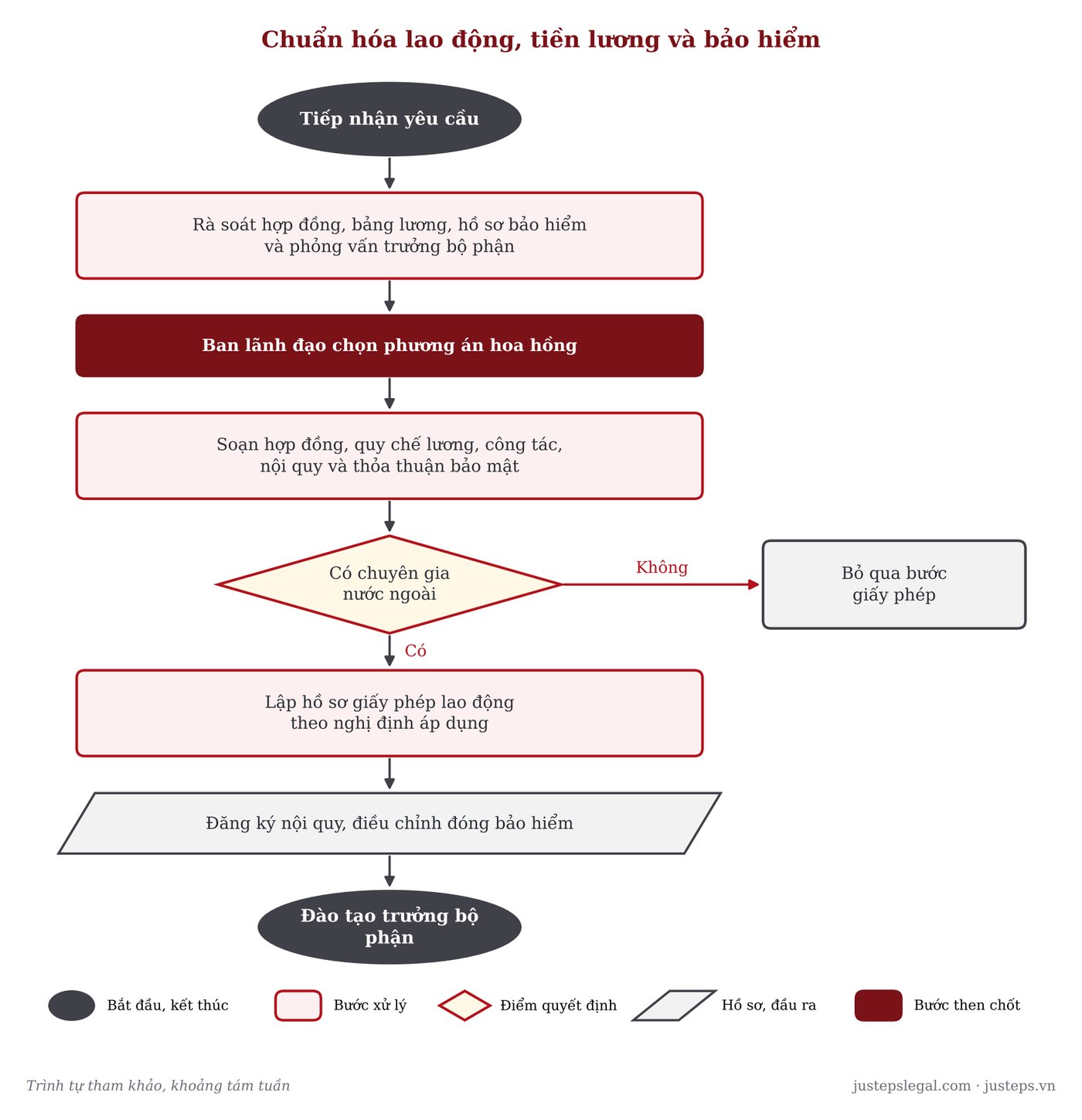
Sequence for standardising labour, wages and social insurance in an import-export business
In the first two weeks, Justeps reviews the records and interviews heads of department, in the third week it presents the report and commission options, and over the following three weeks it drafts contracts, rules and internal labour rules. The seventh week is devoted to consulting the employee representative organisation if there is one, registering the internal labour rules and adjusting the wages on which social insurance is paid, and the final week to training heads of department and completing work permit applications if there are foreign specialists. The deliverables comprise the following documents:
- A labour and social insurance compliance review report, setting out the level of risk and the remedial actions required.
- A set of employment contracts and confidentiality agreements for the four groups of positions.
- Rules on wages, commissions and bonuses, covering foreign currency conversion and the treatment of cancelled orders.
- Domestic and overseas business travel rules with settlement forms.
- Internal labour rules including material liability, flexible working hours and the registration file.
- A classification of income items included in and excluded from the social insurance basis, and a work permit timeline for foreign employees.
Justeps quotes a fixed service fee in writing after the initial meeting. The fee depends on the number of employees and groups of positions, the complexity of the commission scheme, the number of foreign employees, whether back-payment of social insurance needs to be dealt with and the need for bilingual documents. Internal labour rules and disciplinary procedures can be standardised in greater depth through the internal labour rules and disciplinary procedures service.
How Justeps can help
In addition to labour, wages and social insurance services, import-export trading businesses can combine the following Justeps services:
- Organisational structure design for import-export trading businesses. Justeps sets staffing levels and role descriptions as the basis for each position’s employment contract and salary scale.
- Ongoing legal advisory for import-export trading businesses. Justeps answers questions arising on labour, commissions and foreign employees throughout the year.
- Salary scales, pay tables and bonus rules. Justeps builds salary scales, pay tables and bonus rules consistent with the commission rules.
- Internal labour rules and disciplinary procedures. Justeps drafts the internal labour rules and registration file and provides guidance on the disciplinary and material liability procedures.
- Information confidentiality and conflict of interest. Justeps builds policies protecting customer lists, price lists and data when employees leave.
Frequently asked questions
May wages be stated in US dollars for Vietnamese employees?
Wages of Vietnamese employees are stated and paid in Vietnamese dong[1]. Commission may be calculated on the foreign currency value of the order, but the rules must specify the exchange rate and the time of conversion.
Are commissions subject to social insurance contributions?
Commission that genuinely depends on the result of each order is usually excluded, while amounts agreed to be paid regularly and stably in each pay period are included in the contribution basis[2]. Businesses should review any guaranteed or fixed lump-sum commissions.
May we deduct wages when documentation staff make an incorrect declaration?
Wages may not be deducted at will and fines may not be imposed. The business must proceed under the internal labour rules on discipline and material liability, following the procedure and deduction limits set by the Labour Code[1].
Is an agreement not to work for a competitor after leaving enforceable?
Agreements that are too broad in duration, field and territory are often difficult to uphold. Businesses should focus on protecting specific information such as customer lists, price lists and suppliers, with clear rules on handing over data.
Which decree applies to a foreign specialist arriving in December 2026?
It depends on the date the application is submitted. Applications submitted up to and including 4 December 2026 are processed under Decree No. 219/2025/ND-CP[8], and those submitted from 5 December 2026 under Decree No. 393/2026/ND-CP[9].
Which minimum wage applies with an office in Hanoi and a warehouse in Hai Phong?
The minimum wage applies according to the area where the employee actually works, with a branch applying the rate of the area where it is located[7]. Warehouse staff are paid according to the rate for the area where the warehouse is located.
Related articles
- Organisational structure design for import-export trading businesses by order flow and control point
- Ongoing legal advisory for import-export trading businesses on contracts, payments and customs
- Labour, wages and social insurance services for logistics, warehousing and freight transport businesses
- Managing foreign employees, work permits, compulsory social insurance and the records to keep
Notes
[1] The Labour Code and the documents amending and supplementing it.
[2] The Law on Social Insurance No. 41/2024/QH15 and the documents amending and supplementing it.
[3] The Law on Personal Data Protection No. 91/2025/QH15, effective from 1 January 2026.
[4] The Law on Personal Income Tax and the documents amending and supplementing it.
[5] Point c, Clause 1, Article 9 of Government Decree No. 320/2025/ND-CP dated 15 December 2025 detailing the Law on Corporate Income Tax.
[6] The Law on Occupational Safety and Health and the documents amending and supplementing it.
[7] Articles 3 and 4 of Government Decree No. 399/2026/ND-CP dated 2 November 2026 on the minimum wage for employees working under employment contracts, applicable from 1 January 2027.
[8] Government Decree No. 219/2025/ND-CP on foreign workers working in Vietnam, applicable until 4 December 2026 inclusive.
[9] Government Decree No. 393/2026/ND-CP dated 20 October 2026 on foreign workers working in Vietnam, effective from 5 December 2026.
This article is for reference and reflects the regulations in force at the time of publication. Please consult Justeps for advice tailored to your company’s records and situation.
For further information, please contact:
📩 Email: info@justeps.vn
🌐 Website: https://justepslegal.com · https://justeps.vn
🌐 Page: Justeps
☎️ Hotline (Zalo): 096 172 2607
📍 Thanh Xuan Office: 12th Floor, Licogi 13 Tower, 164 Khuat Duy Tien Street, Thanh Xuan Ward, Hanoi, Vietnam
📍 Ha Dong Office: LK06B, No.10, Dong Dua Area, Ha Dong Ward, Hanoi, Vietnam
📍 Ho Chi Minh City Branch: 528 Le Van Sy, Ho Chi Minh City, Vietnam
📍 Hai Phong Office: Truong Thinh Village, Ha Dong Commune, Hai Phong, Vietnam
📍 Quang Ninh Office: Van Don Special Zone, Quang Ninh Province, Vietnam





