
Key takeaways
- The contractual penalty in a commercial contract currently may not exceed 8% of the value of the breached part of the obligation, but damages have no statutory cap, so an agency needs to negotiate a cap on damages when it signs[1].
- A performance programme within an event organised by a business requires written approval, with the application filed at least 07 working days before the performance date, so the procedure must be in the campaign calendar from the start[6].
- The limitation period for bringing a commercial dispute is 02 years from the time the rights were infringed, shorter than many agencies think, so long-outstanding receivables need to be tracked and claimed in writing at the right time[8].
- The National Assembly passed a law amending the Commercial Law in November 2026 under which the chapter on commercial remedies is repealed from 1 January 2028, so long-term framework contracts need their penalty and damages clauses reviewed[3].
A working day at an agency may begin with a request to publish an advertisement for a health supplement urgently before noon, continue with news that an influencer has become embroiled in controversy when the contract has already been half paid, and end with a letter from a stock image library demanding compensation for using an image outside its licence. These matters need an answer within hours and cannot wait for a meeting next week. Most small and medium-sized agencies do not have a legal department, and when they engage specialists case by case, they usually call only after the problem has occurred.
This page introduces Justeps’ ongoing legal advisory service for communications, advertising and event agencies, under which Justeps works as an outsourced legal function on a monthly or annual basis. It covers the typical volume of legal work, the contract clauses to negotiate, the procedural calendar of a campaign with an event, how to respond when an influencer runs into trouble, tracking receivables, the scope of the service and how Justeps works. The agency’s organisation, internal regulations and labour relations are presented on three other service pages in the same sector.
The volume of legal work at an agency each month
Each campaign involves several legal relationships at once, including contracts with the client, with influencers, artists and models, with production, venue and equipment suppliers, and with advertising platforms. An agency running ten to twenty campaigns a month may have to handle hundreds of documents, not counting sales promotion or performance procedures. The chart below shows, as an illustrative example, the types of requests usually sent to an outsourced legal function.
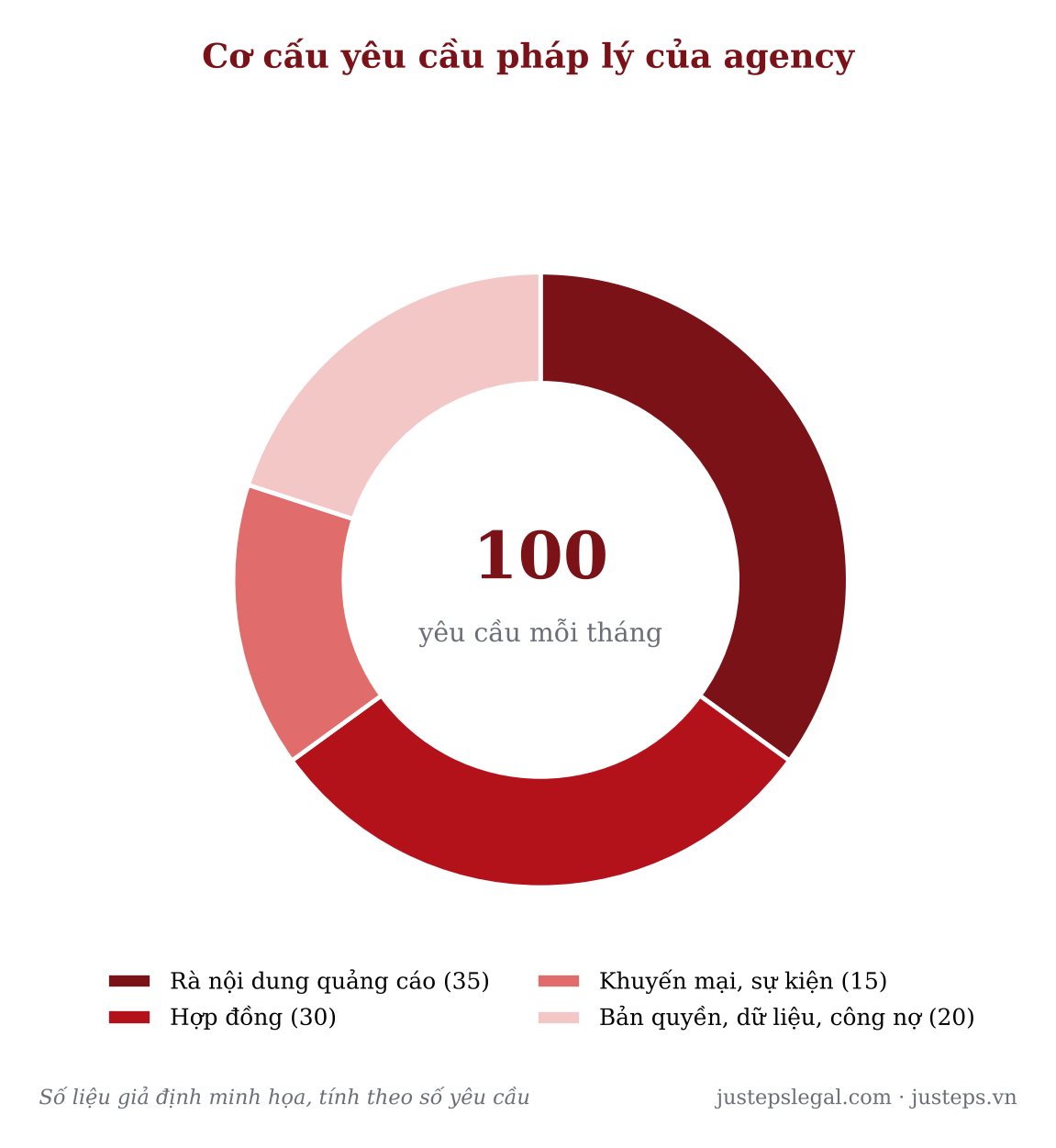
Example breakdown of an agency’s legal requests in one month
Reviewing advertising content and contracts with clients and influencers are the two largest groups, and also the two that require the fastest response because they are tied to publication dates. Sales promotions and events are seasonal, concentrated around holidays, Tet and the end of the year. Copyright, personal data and receivables are fewer in number but often arise after the campaign has ended and involve large amounts in dispute, so Justeps tracks these groups against a list rather than waiting for the agency to ask.
Contracts with clients and the clauses to negotiate
Large clients often require the agency to sign on their own template. These templates tend to place all content risk on the agency, allow daily penalties for delay, transfer intellectual property on delivery even if the client has not paid, and make acceptance depend on the client’s impression. Under the current Commercial Law, the contractual penalty is agreed by the parties but may not exceed 8% of the value of the breached part of the obligation[1], and where a penalty has been agreed, the aggrieved party may still claim damages[2]. For this reason, the clause of most concern to an agency is usually an unlimited damages clause, which may far exceed the service fee for the whole campaign.
| Clause | Risk in the client’s template | Negotiating position Justeps usually proposes |
|---|---|---|
| Responsibility for content | The agency bears all responsibility, including for information supplied by the client. | The party supplying product information is responsible for the accuracy of that information. |
| Damages | No cap, including indirect loss and loss of profit. | Capped at the service fee for the order, with indirect loss excluded. |
| Transfer of rights | Rights pass to the client on delivery. | Rights pass only when the client has paid in full. |
| Acceptance | No time limit, and the client may request unlimited revisions. | A specific response period and deemed acceptance when it expires. |
| Payments on behalf of the client | The client pays only after the campaign ends. | An advance of the amounts to be paid on the client’s behalf before the agency tops up the platform. |
The law amending and supplementing a number of articles of the Commercial Law, passed by the National Assembly on 13 November 2026, repeals the chapter on commercial remedies from 1 January 2028, while contracts concluded before that date continue to be governed by the law in force when they were concluded[3]. For framework contracts running into 2028, Justeps proposes that the agency state the penalty rate, the cap on damages and the method of calculating late payment interest itself rather than relying on statutory provisions, so that its rights do not change when the legal framework changes.
Urgent content review before publication
Under the ongoing advisory package, Justeps and the agency agree a response time for each type of request, for example a few working hours for urgent content and one to two working days for an ordinary contract. For a fast review, the agency sends the product’s legal documents, the script and the internal review form if one exists, because most of the time spent reviewing content goes into finding documents rather than reading the wording. Justeps gives its opinion in writing, stating which sentences need to be changed, why and the replacement wording, so that the agency can keep it with the campaign file as evidence that a check was made.
The product groups that take the most time are health supplements, cosmetics, medical devices, financial services, education and products for children, because each has its own sector-specific rules on what may be said. For these groups, Justeps asks the agency to send requests earlier and helps the agency build a library of approved wording that can be reused in later campaigns, so that review time falls month by month.
The procedural calendar of a campaign with sales promotions and events
Lucky draws, prize draws or prize games linked to purchases or brand promotion may constitute sales promotions and must be notified to or registered with the trade authority before they are carried out[4]. High-value prizes also give rise to an obligation to withhold personal income tax from the winner[5], so the contract between the agency and the client needs to state which party is the trader carrying out the promotion, which party handles the procedures and which party bears the prizes and the tax. If the event includes musical, dance or other performances, the application for approval must be filed with the provincial People’s Committee at least 07 working days before the performance date, together with the script and the list of works[6].
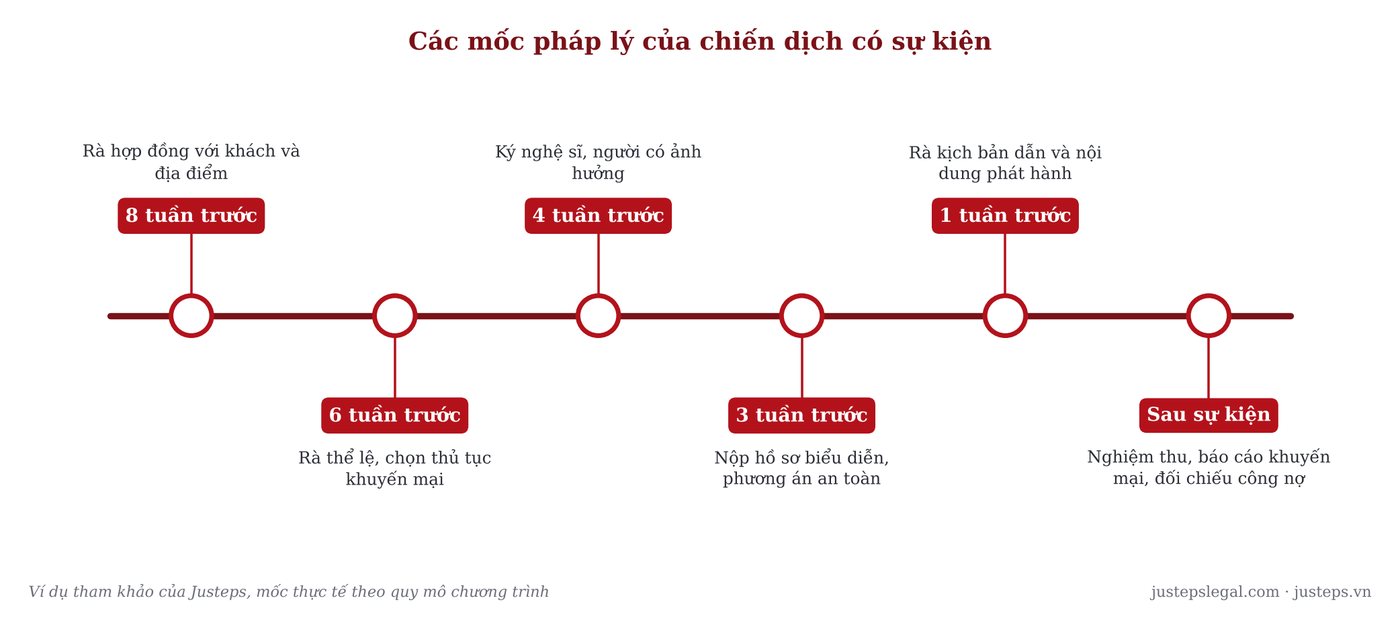
Example of the legal milestones of a product launch campaign with an event
In this example, Justeps starts with the contracts with the client and the venue about eight weeks before the event, then reviews in turn the sales promotion rules, the contracts with artists and influencers, and the performance application together with the fire safety and security plans. The performance application should be filed well ahead of the minimum deadline, because the authority may request additional documents and changing an act close to the date requires further procedures. After the event, the remaining milestones are acceptance with the client, reporting the results of the sales promotion where applicable and reconciling payables with suppliers.
When an influencer runs into trouble or content is the subject of a complaint
When an influencer running a campaign becomes embroiled in controversy, the agency’s first questions are whether it can stop immediately, whether it can recover the money already paid and who bears the cost of reproduction. Justeps reads the contract with the influencer and the contract with the client side by side to determine the right to suspend, the conditions for termination, the obligation to refund and how costs are shared, and then drafts notices to each party. Influencers have their own obligations to verify products and announce that they are advertising[7], so if the problem arises from their failure to apply a label or from going off script, the agency’s review file is the basis for determining fault.
For copyright complaints, for example where the owner of a stock image library or a piece of music demands compensation, Justeps checks the licences the agency holds, the actual scope of use and the amount claimed, and then proposes negotiating or removing the content. For a communications crisis with a legal dimension, Justeps reviews statements, corrections and letters of apology before they are issued, so that the agency does not admit matters that could be used as grounds for a damages claim.
Tracking receivables before the limitation period expires
To preserve relationships, many agencies accept clients paying several months late, while acceptance records are not fully signed and emails confirming additional work are scattered across employees’ inboxes. The limitation period for bringing a commercial dispute is 02 years from the time the rights were infringed[8], shorter than the 03-year period that applies to civil contract disputes in general[9]. Justeps prepares a list of at-risk receivables every quarter, reminds the agency to complete its acceptance records, and drafts demand letters and reconciliation records, because the debtor’s acknowledgement of the obligation or partial payment may also cause the limitation period to start again.
When negotiation fails, Justeps assesses the file, estimates the prospects of recovery and prepares the case file so that the business can bring the claim itself or pass it to a practitioner of the business’s own choosing. Justeps does no litigation: work before the court or arbitral tribunal is agreed separately between the business and that practitioner, while Justeps continues to provide the documents and figures it has compiled when the business asks.
Scope of the service and how Justeps works
In the first month, Justeps reviews the template contracts, the review procedure and the list of contracts in progress to draw up a list of risks to be dealt with first. From the second month, a consultant is assigned to the agency, receives requests by email, Zalo, telephone or the agency’s project management software and replies within the agreed time. The scope usually covers the following work:
- Reviewing advertising content before publication, giving priority to product groups subject to sector-specific rules.
- Reviewing and negotiating contracts with clients, tender documents, framework contracts and campaign orders.
- Drafting and reviewing contracts with influencers, artists, models, collaborators and suppliers.
- Advising on sales promotion, performance, trade fair, exhibition and outdoor advertising procedures according to the campaign calendar.
- Advising on copyright, handling infringement complaints and protecting personal data in targeted advertising and marketing messages[10].
- Drafting demand letters, supporting negotiation and mediation, and preparing the file when the business decides to bring a claim.
Each quarter, Justeps sends a summary report on the matters handled, receivables at risk, changes in the law on advertising, e-commerce and personal data, and recommendations for updating template contracts or the review list. Issues that recur are turned into regulations so that the team can deal with them itself, and this work falls under the service for building internal procedures and regulations for communications, advertising and event agencies.
Application by size, deliverables and fees
A small agency specialising in digital content usually needs the most help with content review, influencer contracts and copyright. An integrated advertising agency working with large clients also needs support with negotiating framework contracts, tender documents and the tax obligations arising from buying advertising on overseas platforms. An agency with an events business needs advice before each programme, while an agency serving international clients needs bilingual contracts and alignment with the compliance policies of the client’s group.
The documents Justeps delivers are filed by campaign and by client, so that a new person taking over the work can look up the opinions previously given. In the course of the engagement, the agency receives the following main documents:
- An initial review report and a list of risks, identifying the contracts and procedures to be fixed first.
- A set of standardised template contracts with clients, influencers, collaborators and suppliers.
- Written advice and content review forms that can be kept with the campaign file.
- Demand letters, meeting records and case files for negotiation or for bringing a claim.
- A quarterly report on matters handled, receivables and relevant changes in the law.
The service fee is charged monthly or annually and is quoted by Justeps in writing after the initial discussion. The deciding factors are the average number of campaigns and contracts each month, the share of urgent content review requests, the number of events requiring procedures, any need for bilingual documents and whether support with negotiating receivables is included.
How Justeps can help
Alongside ongoing legal advisory, communications, advertising and event agencies may combine the following Justeps services:
- Building internal procedures and regulations for communications, advertising and event agencies. Justeps turns recurring issues into a review procedure and rules on advances and digital assets so that the team can handle them itself.
- Labour, payroll and insurance services for communications, advertising and event agencies. Justeps standardises contracts, overtime, project bonuses and insurance for the agency’s employees and collaborators.
- Advertising, promotions and consumer protection. Justeps advises in depth on sales promotion rules and procedures and on consumer rights for large campaigns.
- Intellectual property and trademark protection. Justeps assists with registering trademarks and copyright for the creative assets of the agency and its clients.
Frequently asked questions
Can Justeps review urgent content on the same day?
Yes, within the response time agreed in the package. The agency should send the product’s legal documents and the script so that the review is not delayed by missing documents.
Can an agency be penalised if it advertises exactly according to the documents supplied by the client?
It can, because an advertising service provider is obliged to check the documents relating to advertising conditions itself[11]. The agency should require complete documents, keep a record of its checks and include an indemnity clause in the contract with the client.
What is the maximum contractual penalty?
For commercial contracts concluded before 1 January 2028, the penalty may not exceed 8% of the value of the breached part of the obligation[1]. Damages are a separate remedy, so the agency needs to negotiate a cap on damages and exclude indirect loss.
Does a product launch with a musical performance need a permit?
It usually needs written approval from the provincial People’s Committee where the event takes place, with the application filed at least 07 working days before the performance date[6]. In addition, the programme must meet requirements on security, fire safety and the venue.
How far can Justeps help with recovering receivables?
Justeps reviews acceptance records, drafts demand letters and reconciliation records, and supports negotiation and mediation. If the business decides to bring a claim, Justeps prepares the case file for the business to proceed itself or to pass to a practitioner of the business’s own choosing.
Is the client’s campaign information kept confidential?
Justeps’ service contract contains a confidentiality clause, and consultants access only the information needed for the work. For sensitive clients, the two parties may also sign a separate non-disclosure agreement.
Related articles
- Sales promotion procedures in 2026, when to notify, register and report results
- A 72-hour playbook for handling a legal and communications crisis
- Controlling advertising content within a business and the approval process before publication
- Ongoing legal advisory for event, performing arts and entertainment businesses from artist contracts to show day
Notes
[1] Article 301 of the Commercial Law No. 36/2005/QH11 dated 14 June 2005.
[2] Clause 2 of Article 307 of the Commercial Law No. 36/2005/QH11 dated 14 June 2005.
[3] The Law amending and supplementing a number of articles of the Commercial Law, the Law on Competition, the Law on Foreign Trade Management and the Law on Protection of Consumer Rights, passed by the National Assembly on 13 November 2026, effective from 1 July 2027.
[4] Government Decree No. 81/2018/ND-CP dated 22 May 2018 detailing the Commercial Law on trade promotion activities, as amended and supplemented by Decree No. 239/2026/ND-CP.
[5] The Law on Personal Income Tax No. 109/2025/QH15 and Government Decree No. 253/2026/ND-CP dated 30 June 2026 detailing the Law on Personal Income Tax.
[6] Clauses 2 and 4 of Article 10 of Government Decree No. 144/2020/ND-CP dated 14 December 2020 on performing arts activities, as amended and supplemented by Decree No. 116/2026/ND-CP dated 2 April 2026 and Resolution No. 18/2026/NQ-CP dated 29 April 2026.
[7] Clause 3 of Article 15a of the Law on Advertising No. 16/2012/QH13 dated 21 June 2012, as amended and supplemented by Law No. 75/2025/QH15, effective from 1 January 2026.
[8] Article 319 of the Commercial Law No. 36/2005/QH11 dated 14 June 2005.
[9] Article 429 of the Civil Code No. 91/2015/QH13 dated 24 November 2015.
[10] The Law on Personal Data Protection No. 91/2025/QH15, effective from 1 January 2026.
[11] Point b of Clause 2 of Article 13 of the Law on Advertising No. 16/2012/QH13 dated 21 June 2012, as amended and supplemented by Law No. 75/2025/QH15, effective from 1 January 2026.
This article is for reference and reflects the regulations in force at the time of publication. Please consult Justeps for advice tailored to your company’s records and situation.
For further information, please contact:
📩 Email: info@justeps.vn
🌐 Website: https://justepslegal.com · https://justeps.vn
🌐 Page: Justeps
☎️ Hotline (Zalo): 096 172 2607
📍 Thanh Xuan Office: 12th Floor, Licogi 13 Tower, 164 Khuat Duy Tien Street, Thanh Xuan Ward, Hanoi, Vietnam
📍 Ha Dong Office: LK06B, No.10, Dong Dua Area, Ha Dong Ward, Hanoi, Vietnam
📍 Ho Chi Minh City Branch: 528 Le Van Sy, Ho Chi Minh City, Vietnam
📍 Hai Phong Office: Truong Thinh Village, Ha Dong Commune, Hai Phong, Vietnam
📍 Quang Ninh Office: Van Don Special Zone, Quang Ninh Province, Vietnam





