
Key takeaways
- Most questions from online sellers concern content and must be answered within a few hours before going on air, so an advisory package must commit to response times and not merely to a number of documents drafted.
- When a shop receives a warning or is temporarily locked, an explanation sent to the marketplace on time, supported by evidence and without a hasty admission of fault, determines the chances of reinstatement and the level of sanctions for later breaches.
- Brand owners deal with counterfeits on marketplaces more effectively once they hold a trade mark registration certificate[8], while distributors need a letter of authorisation from the brand owner to avoid infringement reports.
- Commission paid to individual KOCs, advertising spend on foreign platforms and revenue net of marketplace fees all affect tax, so they should be advised on when contracts are signed rather than at the finalisation period[12][10].
At seven in the evening, a livestream host asks whether a moisturising cream may be presented as whitening the skin within seven days, while the session starts at eight. The next morning, the channel manager receives a notice that the best-selling product has been temporarily hidden on suspicion of infringing intellectual property rights, with only a few days to respond. An online seller cannot wait a week for an answer, but nor can it let staff guess, because a wrong statement on air or a hasty explanation both have long-lasting consequences.
This page introduces Justeps’ ongoing legal advisory service for businesses selling on e-commerce marketplaces, social networks, their own websites and through livestreams. Justeps acts as an advisory contact that understands how marketplaces, livestream sessions and conditional product groups work, answers at the business’s own pace and gives advance reminders of what needs to be prepared for major sales campaigns. This page focuses on issues arising day to day, while fixed internal procedures such as script approval or returns are built separately under the internal procedures and regulations service for e-commerce and livestream selling businesses.
What online sellers typically ask during the year
The rules applying to online selling have changed rapidly in the past two years, with the Law on E-commerce taking effect from 1 July 2026[1], amendments to the law on advertising[2], the Law on Personal Data Protection[3] and new rules on tax administration for business conducted on digital platforms[4]. Each marketplace’s policies change even more often than the law and are applied immediately through measures such as score reductions, hidden products or temporary shop locks. The chart below classifies the advisory requests received over one year from a business selling cosmetics and household goods on three marketplaces with an in-house livestream team.
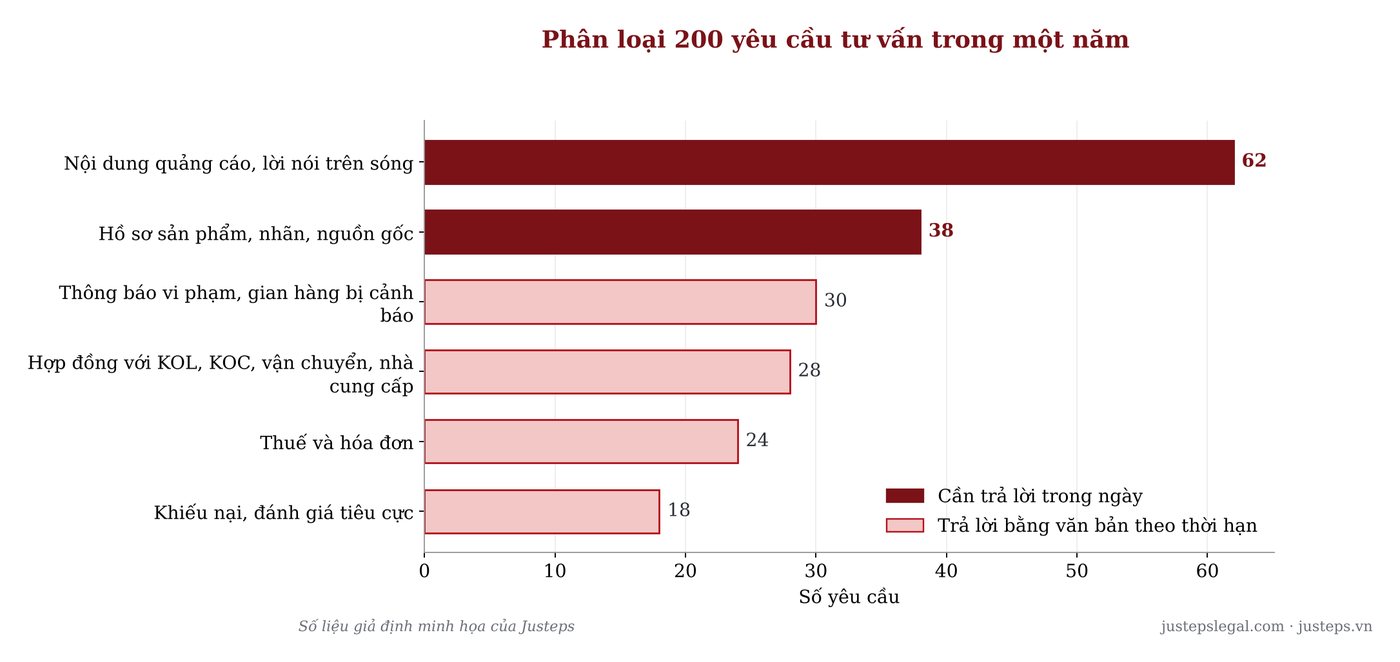
Example classification of 200 advisory requests in one year from a business selling on three marketplaces
In the example, advertising content and on-air statements account for 62 requests, product records, labels and origin for 38, infringement notices and shop warnings for 30, contracts with KOLs, KOCs, carriers and suppliers for 28, tax and invoices for 24, and complaints and negative reviews for 18. The first two groups are questions that need answering the same day, sometimes within a few hours, so Justeps designs the advisory package with a separate response time for questions about on-air content. The remaining groups usually require a review of documents and a written answer within a longer period.
Advertising conditional goods and on-air statements
Cosmetics, health supplements, medical devices and nutritional products for young children are product groups with their own advertising rules, and for some of these groups the advertising content must be certified by the competent authority before advertising[2]. The Law on E-commerce requires livestream sales content to be consistent with the certified advertising content for such goods[1], so hosts cannot freely rephrase product uses in their own words. The questions Justeps receives most often are whether a product may be said to cure, treat or prevent a condition, whether it may be compared with a specific competitor product, and which warnings must be read out on air.
As regards comparisons, the law on advertising and competition restricts comparisons that mislead or damage a competitor’s reputation, so Justeps usually recommends stating only the advantages of the product itself that are supported by documents and not naming other products[5]. Justeps answers each question with reasons and alternative wording, and then compiles the answers into lists of permitted statements by product group for the livestream team to reuse. Businesses needing cosmetic product notification files or advertising content certification files can combine this with the advertising compliance and cosmetic registration service.
Imported goods, labels, trade marks and counterfeits
Imported goods sold on marketplaces must bear a supplementary label in Vietnamese with the mandatory content and have documents proving their origin[6], and sellers must disclose the mandatory label information on the sales page[7]. When a marketplace requests a customs declaration, a purchase invoice or a letter of authorisation from the brand owner, a business that cannot produce the documents within the deadline usually has the product removed, and in a worse case may be penalised for goods of unknown origin. Justeps advises on the list of documents to be kept for each imported shipment, how to draft a letter of authorisation for distribution and how to respond to marketplace requests.
Conversely, brand owners often find other shops using their name, logo or product images to sell counterfeit or imitation goods. The marketplaces’ infringement reporting tools work best when the business already holds a trade mark registration certificate and evidence of copyright in its images[8], so Justeps recommends registering the trade mark before stepping up advertising. Filing the application and monitoring the certificate are handled through the intellectual property and trade mark protection service, while under the ongoing advisory package Justeps prepares infringement reports and cease and desist letters sent to the infringing party.
When a shop receives a warning, has products removed or is temporarily locked
Every day a shop is locked is a day of lost revenue and lost display ranking, so the response in the first few hours often determines the outcome. A common mistake is that an employee immediately sends an apology admitting the breach in the hope of being reopened, while this admission may be taken into account when the marketplace deals with later incidents. Justeps proposes the handling sequence below and works with the business from identifying the error to fixing the root cause.
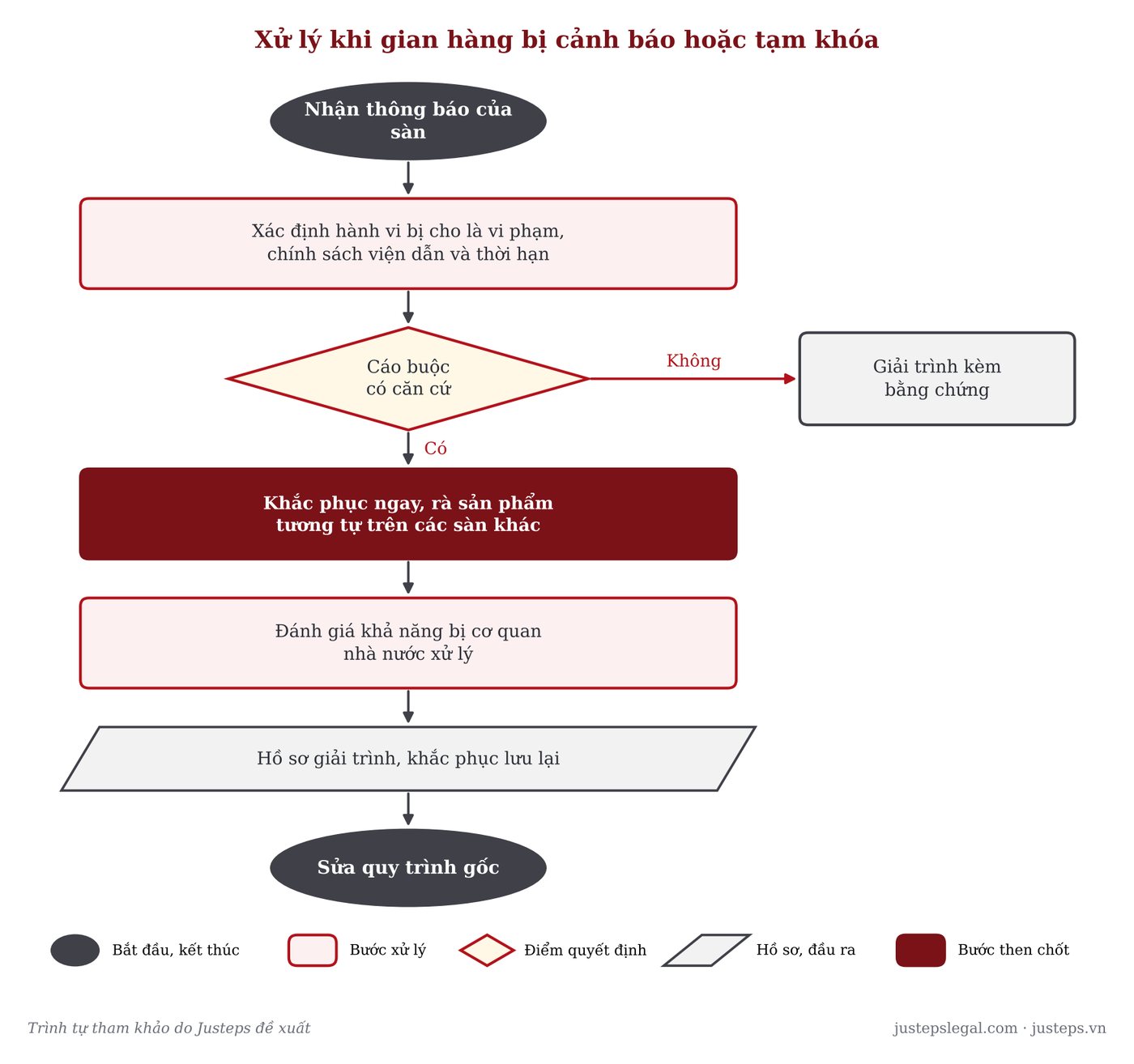
Handling sequence when a shop receives a warning, has products removed or is temporarily locked
The first step is to read the notice carefully to identify the alleged breach, the marketplace policy cited and the response deadline. If the allegation is unfounded, Justeps drafts an explanation with evidence such as product records, the trade mark certificate, import invoices or the livestream recording. If the breach is genuine, the business remedies it at once, reviews similar products on other marketplaces, assesses the risk of action by State authorities and fixes the procedure that let the error through. The chances of reinstating a shop depend on the cause and each marketplace’s policy, so Justeps does not promise an outcome but commits to a complete explanation file submitted on time.
Tax on marketplace revenue, commission and advertising costs
Revenue from sales on marketplaces is recognised at the selling price, while the money transferred by the marketplace is net of fees and refunds, so businesses often ask which amount the invoice should be issued for and how marketplace fees should be accounted for. Transaction data on platforms is provided to the tax authorities under the law on tax administration[4], so differences between declared revenue and marketplace data are easily detected. As regards costs, an expense of five million dong or more per payment must be supported by non-cash payment documents to be deductible for corporate income tax purposes[9], so payments to KOCs, freelance livestream hosts or video production units should be made through a bank and backed by a contract.
Commission and remuneration paid to individuals are usually subject to personal income tax withholding by the business at the time of payment[10], so the contract should state the nature of the payment and whether the amount is inclusive or exclusive of tax. Advertising purchased from foreign platforms also raises questions about invoices, supporting documents and foreign contractor tax obligations, depending on whether the provider has registered to pay tax directly in Vietnam. Justeps answers these questions transaction by transaction, and when the business is subject to a tax inspection or audit it can move to the tax inspection support and tax decision complaint service.
Buyer complaints, false reviews and disputes
Buyers have the right to complain about goods and the information provided in distance transactions[11], and when defective goods are discovered the seller must notify the platform operator and carry out a recall and handling in accordance with the regulations[7]. Justeps advises on how to respond to each complaint that risks spreading, drafts public notices when a product needs to be recalled or its sale suspended, and prepares a response plan when a complaint video appears on social networks. For reviews that are clearly untrue and cause damage, Justeps assesses the evidence, drafts removal requests and reports them through the marketplace’s tools.
Disputes with partners, such as a fulfilment provider losing goods, a KOL not posting as contracted or a supplier delivering defective goods, are supported by Justeps through case assessment, review of evidence, drafting of demand letters and advice on negotiation and mediation. Justeps does no litigation work and its scope ends before any lawsuit is filed, so when the business decides to sue, the entire file is handed over for the business to proceed itself or to pass to a practitioner of the business’s own choosing. Setting this boundary from the outset lets the business know clearly which work falls within the advisory package and which work must be arranged separately.
Working arrangements, deliverables and fees
In the first month Justeps carries out an initial review of account registration, the records of the best-selling product group, the contracts in use, the return policy and the handling of buyer data, and then prepares a prioritised risk register. The second month focuses on remedying the priority points and standardising model contracts. From then on Justeps answers daily questions through a chat group, email or telephone, reviews scripts and promotions before peak periods, sends updates when the law or marketplace policies change, and each quarter sends a work report with an updated risk register. The business receives the following documents:
- An initial review report on accounts, products, contracts and data, with a risk register.
- A set of standardised model contracts with KOLs, KOCs, carriers, fulfilment providers and suppliers.
- Lists of permitted statements by product group, updated from the actual questions received.
- Explanation files submitted to marketplaces, kept for reuse in similar cases.
- Periodic reports and a risk register sent to the board of management.
Justeps quotes advisory fees on a monthly, quarterly or annual basis in writing after the initial meeting. The fee depends on the number of sales channels and product codes, whether there are conditional product groups, the frequency of livestream script reviews, the committed response time, the need for out-of-hours support during peak periods and the scope of documents to be drafted. Small businesses on one or two marketplaces usually choose an hourly package focused on content, product records and explanations, while multi-channel businesses with their own livestream team need a package with short response times. Questions about contracts, wages and insurance for the livestream, warehouse and customer care teams are handled in greater depth under the labour, wages and social insurance service for e-commerce and livestream selling businesses.
How Justeps can help
In addition to ongoing legal advisory, e-commerce and livestream selling businesses can combine the following Justeps services:
- Internal procedures and regulations for e-commerce and livestream selling businesses. Justeps turns recurring answers into procedures for script approval, product listing, promotions and returns.
- Organisational structure design for e-commerce and livestream selling businesses. Justeps identifies the internal contact who works with the advisers and the persons holding account administrator rights.
- Advertising compliance and cosmetic registration. Justeps prepares cosmetic notification files and advertising files for products sold through livestreams.
- Intellectual property and trade mark protection. Justeps registers trade marks so that the business has a basis for reporting counterfeit and imitation goods on marketplaces.
- Tax inspection support and tax decision complaints. Justeps prepares explanation files when the tax authority compares declared revenue with marketplace data.
Frequently asked questions
Does Justeps provide out-of-hours support during major sales campaigns?
Yes, as an optional extension of the advisory package. The business agrees in advance on the time slots and types of questions supported out of hours, usually questions about on-air content and infringement notices.
Can a locked shop be recovered?
This depends on the cause and each marketplace’s policy. An explanation submitted on time, supported by evidence and accompanied by a remedial plan increases the chances of reinstatement.
May a seller compare its product with a competitor’s product during a livestream?
The law restricts comparisons that mislead or damage a competitor’s reputation[5]. The safe approach is to state only the advantages of the product itself that are supported by documents and not to name other products.
Does a distributor need a letter of authorisation from the brand owner?
It should have a letter of authorisation or a distribution contract. This is a document marketplaces usually request when an intellectual property infringement report is filed[8].
Must tax be withheld on commission paid to KOCs?
Payments to individuals are usually subject to personal income tax withholding at the time of payment[10]. The contract should state the nature of the payment and whether the amount is inclusive or exclusive of tax.
Does Justeps file lawsuits on behalf of the business when a dispute arises?
No. Justeps does no litigation work. It assesses the case, reviews evidence, drafts documents and advises on negotiation and mediation, while any lawsuit is pursued by the business itself or entrusted to a practitioner of the business’s own choosing.
What should a business new to online selling prioritise?
It should prioritise registering shops in the name of the business, product records, trade mark registration, a return policy and buyer data protection before stepping up livestreaming.
Related articles
- Organisational structure design for e-commerce and livestream selling businesses based on the order journey
- Internal procedures and regulations for e-commerce and livestream selling businesses
- Labour, wages and social insurance services for e-commerce and livestream selling businesses
- Selling on e-commerce marketplaces in Vietnam and the rules on invoices, tax, returns and complaints
Notes
[1] The Law on E-commerce No. 122/2025/QH15 dated 10 December 2025, effective from 1 July 2026, of which Article 23 sets out the responsibilities of sellers in livestream selling.
[2] The Law on Advertising and the documents amending and supplementing it, together with specialised legislation on cosmetics, food and medical devices.
[3] The Law on Personal Data Protection No. 91/2025/QH15.
[4] The Law on Tax Administration No. 108/2025/QH15 and its implementing documents.
[5] The Law on Advertising, the Law on Competition and the documents amending and supplementing them.
[6] Government Decree No. 43/2017/ND-CP on goods labelling, as amended and supplemented by Decree No. 111/2021/ND-CP.
[7] Article 21 of the Law on E-commerce No. 122/2025/QH15 dated 10 December 2025, effective from 1 July 2026.
[8] The Law on Intellectual Property and the documents amending and supplementing it.
[9] Point c, Clause 1, Article 9 of Government Decree No. 320/2025/ND-CP dated 15 December 2025 detailing the Law on Corporate Income Tax.
[10] The Law on Personal Income Tax No. 109/2025/QH15 and Government Decree No. 253/2026/ND-CP dated 30 June 2026 detailing a number of articles of that Law.
[11] The Law on Protection of Consumers’ Rights and the documents amending and supplementing it.
[12] The Law on Corporate Income Tax No. 67/2025/QH15 and its implementing documents.
This article is for reference and reflects the regulations in force at the time of publication. Please consult Justeps for advice tailored to your company’s records and situation.
For further information, please contact:
📩 Email: info@justeps.vn
🌐 Website: https://justepslegal.com · https://justeps.vn
🌐 Page: Justeps
☎️ Hotline (Zalo): 096 172 2607
📍 Thanh Xuan Office: 12th Floor, Licogi 13 Tower, 164 Khuat Duy Tien Street, Thanh Xuan Ward, Hanoi, Vietnam
📍 Ha Dong Office: LK06B, No.10, Dong Dua Area, Ha Dong Ward, Hanoi, Vietnam
📍 Ho Chi Minh City Branch: 528 Le Van Sy, Ho Chi Minh City, Vietnam
📍 Hai Phong Office: Truong Thinh Village, Ha Dong Commune, Hai Phong, Vietnam
📍 Quang Ninh Office: Van Don Special Zone, Quang Ninh Province, Vietnam





