
Key takeaways
- A foreign business that wishes to provide games to users in Vietnam must establish an enterprise in Vietnam, so the contract between the domestic publisher and the foreign partner is the document that determines most of the risk and must be reviewed carefully, including its technical, data and termination provisions[1].
- A game may be advertised only after a release decision or a confirmation of release notification has been issued, and the advertising must state the game’s name, its age rating and a warning about harmful effects, so the launch promotion schedule must follow the licensing schedule[2].
- Six-monthly periodic reports, licence terms and amendment procedures are obligations that are easily missed when staff change, so an obligations calendar monitored by an outside party means the business does not depend on one individual’s memory[5].
- On discovering a pirate server or an unauthorised copy, the business should preserve evidence before speaking out publicly; Justeps prepares the file and the takedown requests, while any lawsuit is handled by a practitioner of the business’s own choosing[8].
Game businesses work at a very fast pace. In a single month, a publisher may have to negotiate a revenue sharing annex with a foreign partner, approve the promotion plan for a game about to launch, answer a letter from the regulator and deal with a pirate server that is drawing players away. If a separate adviser has to be found and engaged for each matter, the advice often arrives after the decision has already been made, or the business handles the matter itself to keep to schedule and only realises the risk when a dispute arises.
This page introduces Justeps’ ongoing legal advisory service for publishers, developers and digital content businesses. Unlike the two one-off projects of organisational structure design and building regulations, this service is a monthly engagement that handles matters as they arise and tracks periodic obligations throughout the life cycle of each game.
The volume of legal work at a publisher in a month
To choose the right scope of service, Justeps usually asks the business to list the legal requests it has had over the last three to six months. The chart below is an example of the breakdown of requests at a publisher operating three games.
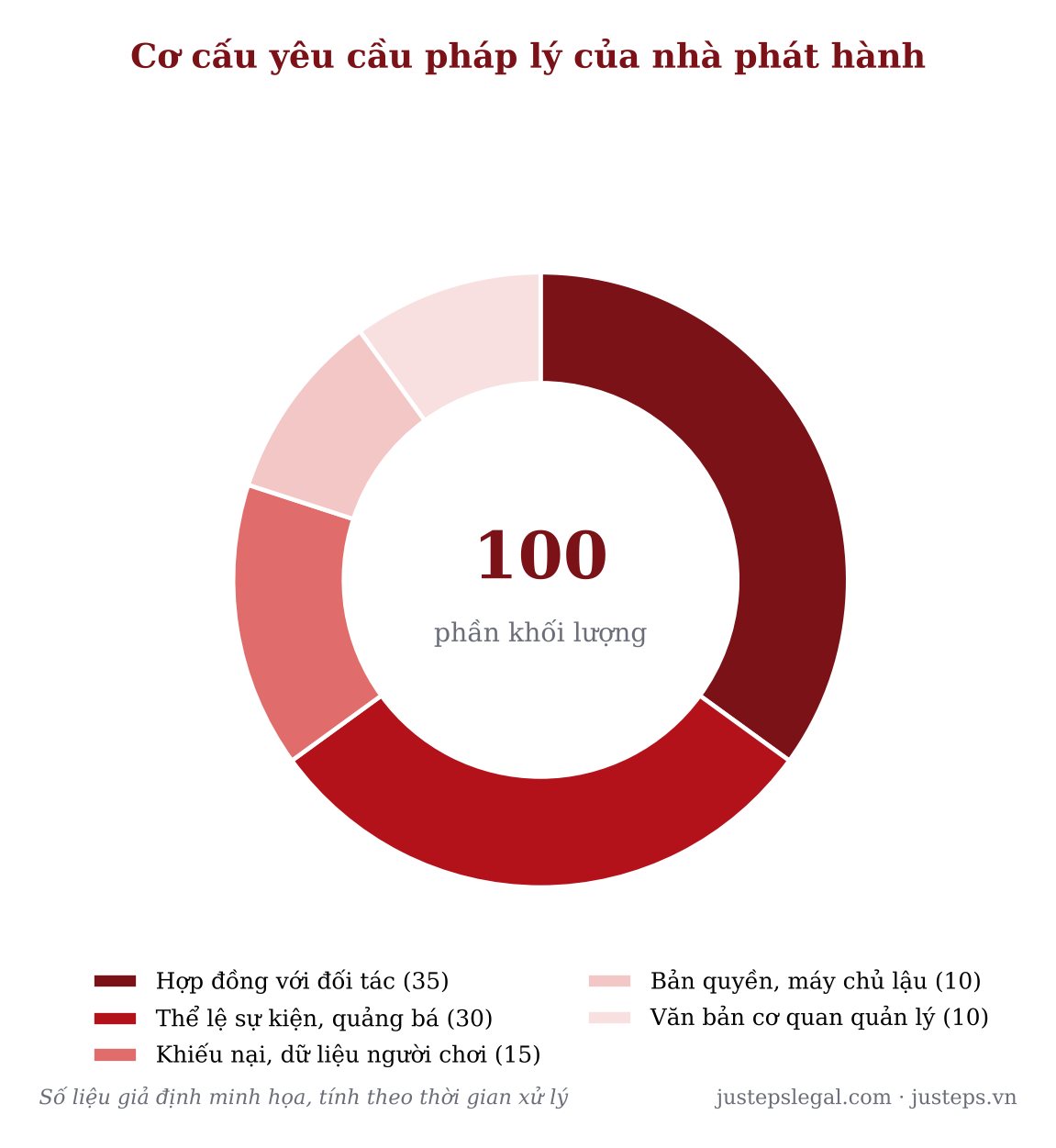
Example breakdown of a publisher’s legal requests in one month
In this example, contracts with partners account for the largest share of the workload because each document is long and has many annexes, while event rules and promotional content are the most frequent group, arising almost every week. Matters concerning copyright, pirate servers or letters from the regulator are fewer in number but usually urgent, directly affect revenue and must be handled on the same day. This breakdown helps the two sides agree a response time for each group and decide which groups are covered by the monthly fee and which are charged separately.
Publishing and licensing contracts with foreign partners
A foreign organisation that provides video game services to users in Vietnam, including on a cross-border basis, must establish an enterprise under Vietnamese law[1]. Most foreign developers therefore choose to license a domestic publisher, and the licensing contract becomes the document that allocates almost every risk between the two parties. A common mistake is that the business reads only the commercial part carefully, such as the revenue sharing ratio and the minimum guarantee, while overlooking the technical annex, the data provisions and the termination provisions.
Revenue, the minimum guarantee and tax
Justeps reviews how the revenue used as the basis for sharing is calculated, namely whether it is the amount players have topped up or the amount remaining after payment channel fees, app store fees and tax. The minimum guarantee should be conditional on the game obtaining a release decision in Vietnam, because if the application is delayed or the content has to be modified, the publisher has no revenue but must still pay. Royalties paid to the foreign party are usually subject to foreign contractor tax, so the contract must state clearly whether the price includes tax and which party bears it, and the possibility of applying a double taxation agreement should also be considered.
Servers, player data and termination
A business that provides games must place at least one server system in Vietnam to serve inspection, storage and complaint resolution[2], whereas foreign partners often want to operate centrally on their own infrastructure. When player data is transferred to a partner abroad, the transferring party must prepare an impact assessment for the cross-border transfer of personal data[3], so the contract needs to state which party prepares the assessment, which data is transferred and for what purpose. The termination provisions must answer the question of who is responsible for players’ virtual unit balances and entitlements if the contract ends early, because the obligations to players remain with the publisher in Vietnam.
For new or high-value contracts, the business can combine this with the commercial contract drafting and review service so that Justeps drafts the counter-proposal and takes part in negotiations. Within the ongoing package, Justeps reviews and comments on annexes as they arise, such as extension annexes, annexes adding publishing territories or changes to the sharing ratio for each stage.
The obligations calendar of a game in operation
A G1 game carries many legal milestones throughout its life cycle, from the term of the service licence of up to ten years[4] to the six-monthly periodic reports sent to the regulator[5]. When a change requires an amendment to the release decision, the licensing authority deals with it within 05 working days of receiving a complete and valid file[6], but the time the business needs to prepare the file is usually much longer. Justeps sets up an obligations calendar for each game in the first month and gives reminders before each milestone, while also recording the person responsible on the business’s side so that the calendar is not broken when someone leaves.
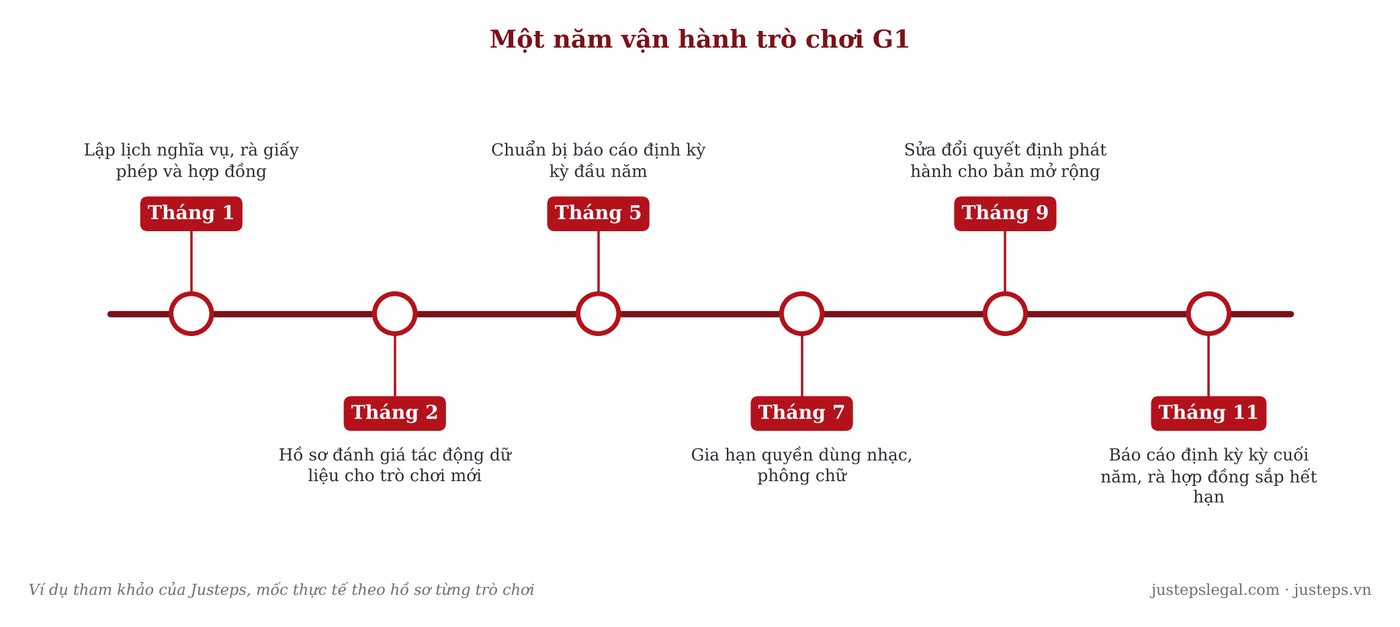
Example of the legal milestones in one year of operating a G1 game
As this example shows, the milestones in a year of operation do not consist only of procedures with the game regulator. A personal data processing impact assessment must be prepared within 60 days from the date on which data processing begins[7], contracts with partners and licences to use music and fonts have their own renewal dates, and a plan to close an old game must allow in advance for the notice periods to players and the licensing authority. Preparing the first application for a G1 licence is a separate project under the licensing service for digital platforms, online games and e-commerce, while the ongoing package tracks the licence once it has been granted.
Reviewing game advertising before it runs
A business may not advertise a game before it has a release decision for a G1 game or a confirmation of release notification for a G2, G3 or G4 game, and all advertising must state the game’s name, its age rating and a warning about possible harm to players’ physical and mental health[2]. Launch pressure leads many marketing teams to run pre-registration campaigns or engage influencers to introduce a game while the application is still being assessed. Justeps reviews the promotion plan against the licensing schedule, identifies which activities may only take place after the decision is issued and reviews the content before publication, usually within one to two working days.
Digital content businesses with many contracts with brands and creators need additional review of sponsored content and contracts with influencers. Where this line makes up most of the work, the ongoing legal advisory service for KOL, KOC and multi-channel network (MCN) businesses has a more suitable scope.
Pirate servers, unauthorised copies and infringement
Pirate servers and unauthorised copies cause the business to lose players and revenue and sometimes lead players to complain mistakenly about transactions that are not the business’s own. The right holder may require the infringer to stop the infringing act, apologise, publish a correction and pay compensation for damage, ask the competent authority to deal with the matter or bring a lawsuit[8]. A common mistake is for the business to issue a public warning on social media naming individuals before there is sufficient evidence, which may both alert the infringer to erase its traces and expose the business to objections that it has infringed another person’s honour and reputation.
Justeps guides the business on preserving evidence with probative value, identifies the infrastructure, domain name, app store and payment channel providers that the infringer is using, and drafts takedown requests to these providers. Where the business needs to ask the authorities to act or decides to bring a lawsuit, Justeps prepares the case file and assesses the evidence and the limitation period, then hands the file over to a practitioner of the business’s own choosing, as Justeps does not handle litigation. In parallel, Justeps can continue to support the business in negotiation and mediation with the infringer or with the partners concerned.
Letters from the regulator and new policies
Video games currently fall within the remit of the Ministry of Culture, Sports and Tourism, and the regulator’s letters often have short response deadlines and require explanations about game content, advertising or compliance with playing time limits. A late or off-target reply may lead to penalties and affect the assessment of later games. Justeps drafts the reply, prepares supporting documents from the business’s records and works with the business to prepare the content for the meeting.
The sector’s legal framework is also changing quickly. The Law on Digital Technology Industry, effective from 2026, places the digital content industry among the sectors eligible for incentives[9], and amendments to the rules on online video games are being proposed with a view to simplifying procedures. Within the ongoing package, Justeps sends summaries of new legislation that affects the business, with proposals on what the business needs to adjust in its regulations, template contracts or incentive files.
Scope of service and ways of working
The first three months are the foundation phase, during which Justeps reviews the licences, release decisions, contracts with partners, terms of use and rules templates to prepare a risk register and an obligations calendar, while also standardising the most frequently used templates. From the fourth month, the two sides work on a monthly cycle with a report on the requests handled and the upcoming milestones, together with a quarterly review with management on recurring risks and new legislation. Each request is classified by urgency on receipt, with short questions answered within the working day and event rules within one to two days, while letters close to their response deadline and data incidents are given immediate priority.
Justeps proposes options together with the level of risk of each option, while the business decision rests with the business. Every request and opinion is entered into a shared tracking log, so that when a similar situation arises, the business can look up the reasoning used and keep a consistent position with partners and with the regulator. Where the organisation has no one to receive advice or the regulations are not yet sufficient, Justeps will propose first carrying out organisational structure design or building internal procedures and regulations for game and digital content businesses.
Application by business model, deliverables and fees
A studio working on contract for foreign partners usually needs advice on development service contracts, rights transfers, confidentiality and tax on income from abroad, with a moderate number of requests. A domestic publisher has the greatest need because it imports games under contract, runs events every week and deals with the regulator. A business that is raising capital or has foreign investors also needs corporate governance support and legal reporting to investors. Justeps serves businesses nationwide through its offices in Hanoi, Hai Phong and Quang Ninh and its branch in Ho Chi Minh City, with most ongoing work handled online.
In the course of the engagement, the business receives documents in a format it can edit and continue to use when the person in charge changes or when it moves to another adviser, including the following documents:
- An initial review report and a risk register for each game and content channel.
- An obligations calendar covering licences, amendments, reports, personal data and contract renewals.
- A standardised set of rules templates, terms of use and contracts.
- A log of requests and advice, together with monthly and quarterly reports.
Justeps quotes its fees for a monthly or annual package in writing after the initial discussion. The fee depends on the number of games and content channels in operation, the expected number of requests each month, the committed response times, any need to work in English with partners and whether direct negotiation or dealings with the regulator are included.
How Justeps can help
Alongside ongoing legal advisory, game and digital content businesses may combine the following Justeps services:
- Licensing for digital platforms, online games and e-commerce. Justeps prepares applications for G1 licences, release decisions and certificates for new games.
- Building internal procedures and regulations for game and digital content businesses. Justeps drafts the regulations on updates, events and player protection so that advice is applied consistently.
- Commercial contract drafting and review. Justeps drafts and takes part in negotiating high-value publishing and licensing contracts with foreign partners.
- Ongoing legal advisory for KOL, KOC and multi-channel network (MCN) businesses. Justeps works every month with digital content businesses that have many contracts with brands and creators.
Frequently asked questions
Does the ongoing package include contract negotiation?
Reviewing and commenting on contracts and annexes is usually included in the package. Drafting new high-value contracts or taking part in direct negotiations is usually charged by the hour or under a separate agreement.
How long does it take to answer a request?
Short questions are answered within the working day, event rules and promotional content within one to two days, and long contracts within the time agreed by the two sides. Letters close to their response deadline and data incidents are given immediate priority.
May a pre-registration campaign run before the game has a release decision?
A business may not advertise a game before it has a release decision or a confirmation of release notification[2]. Justeps reviews the promotion plan against the licensing schedule to identify which activities must wait.
What should the business do first on discovering a pirate server?
The business should preserve evidence and identify the infringer’s infrastructure, domain name and payment channel providers before speaking out publicly. Justeps then drafts the takedown requests and prepares the file if the business wishes to ask the authorities to act or to bring a lawsuit through a practitioner of its own choosing[8].
Is tax payable on royalties paid to a foreign partner?
Royalties paid to a foreign party are usually subject to foreign contractor tax and may be considered under a double taxation agreement. The contract should state clearly whether the price includes tax and which party bears it.
When should a business move from advice on individual matters to an ongoing package?
When the business publishes its own games, operates two or more games or has more than a few legal requests each month. At that level, an ongoing package ensures that advice arrives in time and keeps a continuous record.
Related articles
- Software development contracts, acceptance, warranty and ownership of source code
- A 72-hour playbook for handling a legal and communications crisis
- Controlling advertising content within a business and the approval process before publication
- Ongoing legal advisory for communications, advertising and event agencies
Notes
[1] Clause 4 of Article 37 of Government Decree No. 147/2024/ND-CP dated 9 November 2024 on the management, provision and use of Internet services and online information.
[2] Clause 1, Point a of Clause 3 and Clause 8 of Article 54 of Government Decree No. 147/2024/ND-CP dated 9 November 2024 on the management, provision and use of Internet services and online information.
[3] Article 20 of the Law on Personal Data Protection No. 91/2025/QH15, effective from 1 January 2026.
[4] Clause 2 of Article 39 of Government Decree No. 147/2024/ND-CP dated 9 November 2024 on the management, provision and use of Internet services and online information.
[5] Point a of Clause 2 of Article 61 of Government Decree No. 147/2024/ND-CP dated 9 November 2024 on the management, provision and use of Internet services and online information.
[6] Clause 4 of Article 46 of Government Decree No. 147/2024/ND-CP dated 9 November 2024 on the management, provision and use of Internet services and online information.
[7] Clause 1 of Article 21 of the Law on Personal Data Protection No. 91/2025/QH15, effective from 1 January 2026.
[8] Article 198 of the Law on Intellectual Property No. 50/2005/QH11 dated 29 November 2005, as amended and supplemented several times.
[9] The Law on Digital Technology Industry No. 71/2025/QH15, effective from 1 January 2026.
This article is for reference and reflects the regulations in force at the time of publication. Please consult Justeps for advice tailored to your company’s records and situation.
For further information, please contact:
📩 Email: info@justeps.vn
🌐 Website: https://justepslegal.com · https://justeps.vn
🌐 Page: Justeps
☎️ Hotline (Zalo): 096 172 2607
📍 Thanh Xuan Office: 12th Floor, Licogi 13 Tower, 164 Khuat Duy Tien Street, Thanh Xuan Ward, Hanoi, Vietnam
📍 Ha Dong Office: LK06B, No.10, Dong Dua Area, Ha Dong Ward, Hanoi, Vietnam
📍 Ho Chi Minh City Branch: 528 Le Van Sy, Ho Chi Minh City, Vietnam
📍 Hai Phong Office: Truong Thinh Village, Ha Dong Commune, Hai Phong, Vietnam
📍 Quang Ninh Office: Van Don Special Zone, Quang Ninh Province, Vietnam





