
Key takeaways
- A pharmaceutical business depends on many time-limited documents, so a single tracking calendar for certificates, marketing authorisations, import licences and practising certificates helps avoid sudden stop-sales.
- Every payment linked to the hospital channel should be examined from the perspective of bidding law, pharmaceutical law and criminal law, because taking advantage of drug prescribing for profit is prohibited[5].
- Only drugs on the list of non-prescription drugs may be advertised, and health supplements sold at a pharmacy may not be advertised as if they could cure disease[7].
- On receiving notice that a drug batch is substandard, the stop-sale and quarantine must be carried out on the same day, while any claim for reimbursement from the supplier depends on the terms of the signed contract.
The pharmaceutical sector changes its rules faster than many other sectors. In the past two years alone, the Law on Pharmacy has been amended to recognise pharmacy chains and the sale of drugs through e-commerce, the Government has issued a new guiding decree and the Ministry of Health has replaced its rules on prescribing, while the law on advertising, e-commerce and personal data has also been renewed. Every month, a distributor or a pharmacy chain has to answer dozens of questions arising from these changes, from which drugs may be sold on an app to how a contract with a foreign manufacturer should be signed.
This page introduces Justeps’ ongoing legal advisory service for pharmacies, pharmacy chains, drug wholesalers and importers and foreign-invested pharmaceutical businesses. It covers the groups of issues that arise every month, common mistakes when each matter is handled in isolation, the scope and rhythm of work, the handling of urgent situations, the deliverables and the factors affecting fees. Organisational design, standard operating procedures and labour policies are presented on three other service pages for the same sector.
The legal issues that arise every month
Advisory requests from pharmaceutical businesses usually fall into four main groups, whose shares vary with the tender season, the good practice assessment cycle and waves of legislative change. The chart below illustrates the number of requests by issue group over four quarters for a business that both distributes drugs and runs a pharmacy chain.
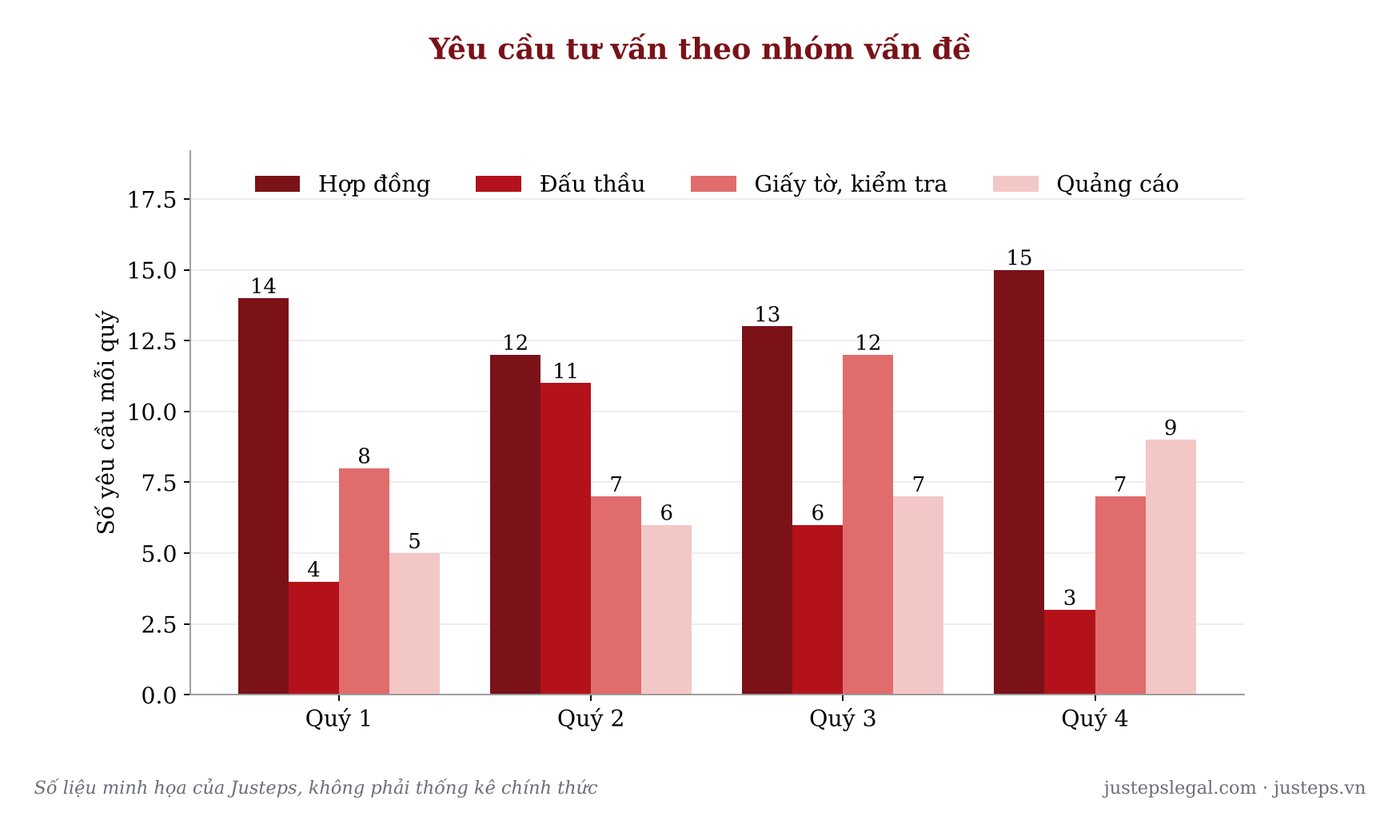
Illustrative number of advisory requests by issue group over four quarters for a pharmaceutical business
Contract questions account for the largest share and are fairly even throughout the year, while tender questions rise sharply in the quarter when hospitals select their suppliers. Questions on licences, inspections and the person in charge of professional pharmacy matters increase when the business opens new outlets or when guiding instruments change. The figures in the chart are illustrative, and the actual distribution differs according to each business’s model.
Time-limited documents and the person in charge of professional pharmacy matters
A pharmaceutical business must simultaneously maintain the certificate of eligibility for pharmaceutical business of each establishment, the practising certificate of the person in charge of professional pharmacy matters, the marketing authorisation or import licence of each drug and the results of periodic assessments of compliance with good practices[1]. Each has its own validity period and procedure, and when a document expires without being renewed in time, the business may have to stop selling a product or stop operating an outlet. The most common case is the sudden resignation of the person in charge of professional pharmacy matters, in which case the business must appoint a qualified replacement and complete the change procedure under the decree guiding the Law on Pharmacy[2]. Justeps keeps a single tracking calendar for all documents and sends reminders ahead of each deadline so that the business can prepare its files.
Contracts with manufacturers, importers and customers
Distribution agreements with foreign manufacturers are usually drafted by the manufacturer, written in English and governed by foreign law with foreign arbitration. The clauses to read carefully include sales targets and the consequences of missing them, termination rights and the treatment of remaining stock, liability when a drug is recalled, reimbursement of marketing costs and the obligation to transfer marketing authorisations on termination. Contracts for sales to pharmacies and clinics must be consistent with the discount regulation and the return terms, while transport contracts must bind the carrier to the storage conditions of Good Distribution Practice[3].
Drug tenders and the hospital channel
Drugs are supplied to public healthcare facilities mainly through tenders under the Law on Bidding and the separate guiding instruments on drug procurement[4]. Common questions concern eligibility to participate, bid security and performance security, what to do when the manufacturer stops supplying after the contract has been awarded and adjustments to prices and quantities under framework agreements. Any support for seminars, sponsorship or discount linked to a hospital should be reviewed in advance, because the Law on Pharmacy prohibits taking advantage of drug prescribing for profit[5] and non-transparent payments may lead to criminal liability for the offence of giving bribes under the Criminal Code[6].
Advertising of drugs, health supplements and social media
Only drugs on the list of non-prescription drugs may be advertised, and the content of drug advertisements must be confirmed by the regulator in advance[7]. Pharmacies also sell health supplements, cosmetics and medical devices, and each product group is subject to a different advertising regime under specialised law and the Law on Advertising as amended in 2025[8]. Risk often comes from posts by pharmacy staff on personal pages, community groups or short videos, in which they present health supplements as if they had a curative effect. On request, Justeps reviews content before it is posted and helps the business issue guidance to staff on posting about products.
Prescription and customer data
Pharmacies keep prescriptions, medication histories and information on customers’ illnesses, which are health data belonging to the group of personal data requiring stricter protection under the Law on Personal Data Protection of 2025[9]. When a pharmacy chain launches a sales app or a loyalty programme or shares data with insurance partners or clinics, questions about the legal basis for processing, consent and data processing agreements arise constantly. The online channel also carries its own obligation under the Law on Pharmacy to keep buyers’ information confidential[10].
Common mistakes when each matter is handled in isolation
Without an ongoing adviser, a pharmaceutical business usually seeks advice only after something has happened, and asks a different person each time. Contracts with manufacturers are signed on the manufacturer’s template because there is no time for review, and only when the manufacturer terminates does the business learn that it must bear the remaining stock itself. Inspection minutes are signed on the spot without recording reservations about inaccurate points, which makes later explanations difficult. Isolated advice also leaves no records, so when the person in charge leaves, the business loses everything that had been answered.
Scope of service and working rhythm
In the first month, Justeps consultants work with the board of management, the person in charge of professional pharmacy matters, the sales focal point and the accountant to carry out a quick review of licences, template contracts and open risks. The two sides agree on communication channels, how urgency is classified and who may submit requests, after which Justeps delivers the review report and the deadline tracking calendar. From the second month, each request is entered in a tracking log with a response deadline and a responsible person, and urgent matters receive a response within the working day. Each quarter, Justeps sends a summary report of matters handled, open risks and legal changes requiring attention.
The scope usually includes answering legal questions in writing or in direct discussion, reviewing contracts and proposing amendments, legally reviewing tender documents, reviewing advertising content and drug information materials, and guiding the business in preparing for and dealing with inspection teams. When the business needs new or amended licences for many products at once, this work is quoted separately under the licensing service for medical devices and pharmaceuticals. When the same question recurs at the same stage, Justeps proposes standardising it into a procedure under the service for building internal procedures and regulations for pharmacy and pharmaceutical distribution businesses.
Handling urgent situations
A typical urgent situation for a pharmaceutical business is receiving notice that a batch of drugs in circulation does not meet quality standards, whether from the regulator, from the manufacturer or from a customer complaint. The flowchart below describes how Justeps and the business handle the first few days.
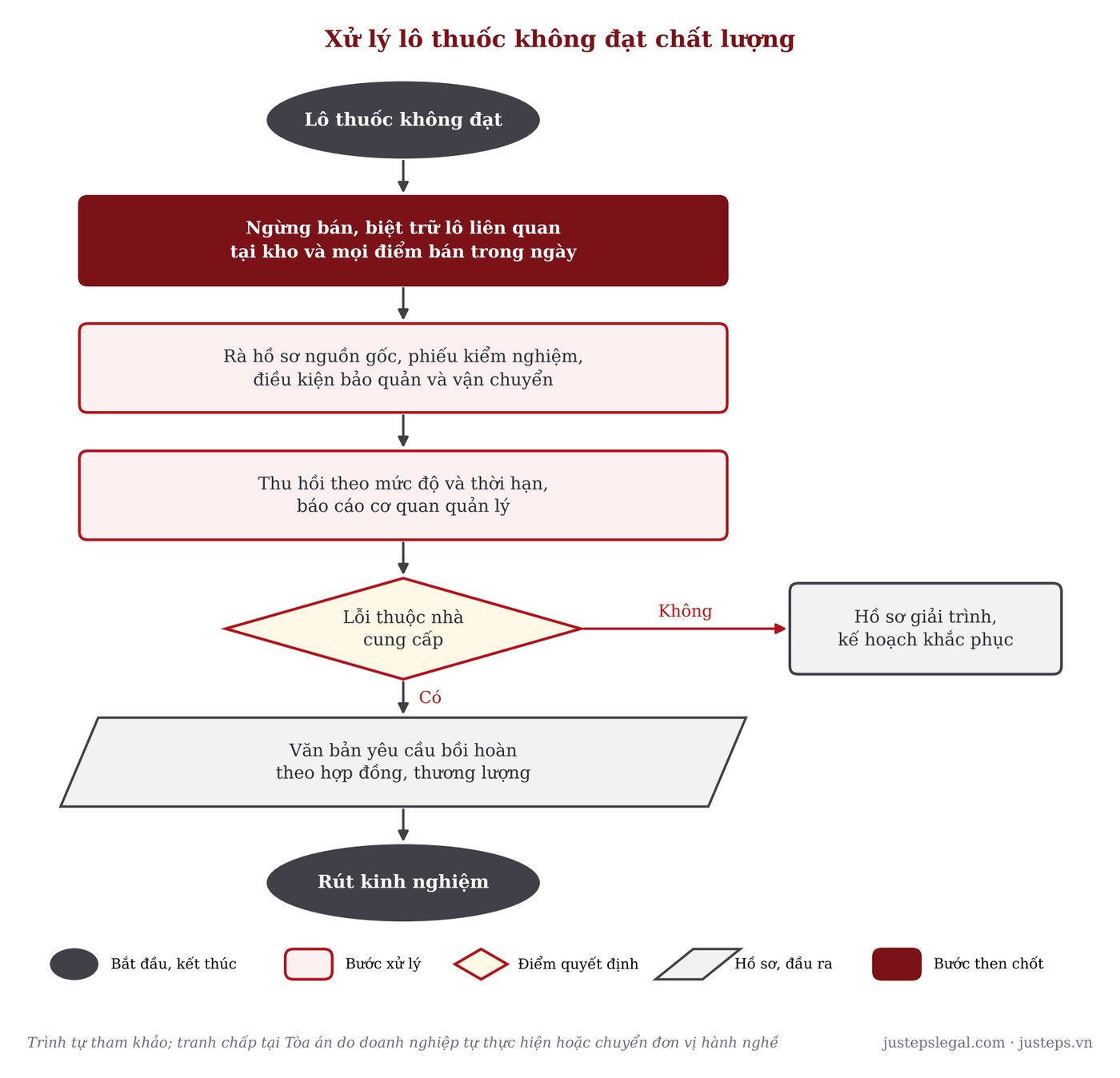
Sequence of steps when a business receives notice that a drug batch is substandard
The first step is always to stop sales and quarantine the batch concerned at the warehouse and every outlet, because this cannot wait for a conclusion. Next, Justeps and the person in charge of professional pharmacy matters review the origin records, test certificates and storage and transport conditions to identify at which stage the cause may lie, and then carry out the recall according to the level and time limit set by the Law on Pharmacy[11]. If the fault lies with the manufacturer or importer, Justeps drafts a letter claiming reimbursement under the contract; if the cause cannot yet be determined, the business prepares an explanatory file for the regulator. If the two sides cannot reach agreement and the matter has to be resolved in court or by arbitration, Justeps prepares the file for the business to pursue itself or to hand over to a practitioner of the business’s own choosing, as Justeps does no litigation.
Deliverables, application by model and fees
At the end of each service period, the business receives the full set of records so that it does not depend on whoever asked the questions, comprising the following main documents:
- An initial legal review report and the remediation status of each risk.
- A request tracking log and the advisory opinions sent, arranged by issue group.
- A set of standardised template contracts with manufacturers, customers and carriers.
- A tracking calendar for the validity of certificates, marketing authorisations, import licences and practising certificates.
- Quarterly reports on open risks and legal changes to be applied.
Independent pharmacies and small chains usually need a package focusing on business conditions, the person in charge of professional pharmacy matters, advertising and inspections. Large pharmacy chains also need support on online sales, premises leases and customer data protection, while distributors focus on contracts with manufacturers, tenders and the hospital channel. Foreign-invested businesses also need advice on their permitted scope of activities, investment reporting and transactions with the parent company[12]. Questions on employment contracts, shifts and insurance for pharmacists and medical representatives can be handled in greater depth under the labour, payroll and insurance service for pharmacy and pharmaceutical distribution businesses.
Justeps quotes a monthly or annual fee in writing after the first meeting. The fee depends on the type of business, the number of outlets and legal entities, the volume of contracts and tender documents to be reviewed, how often advertising content needs to be checked, the committed response time and the need for support during inspections. Large pieces of work such as preparing a complete set of licensing files for many outlets are agreed separately so that the monthly package does not swell.
How Justeps can help
Alongside ongoing legal advisory, pharmacy and pharmaceutical distribution businesses may combine the following Justeps services:
- Building internal procedures and regulations for pharmacy and pharmaceutical distribution businesses. Justeps standardises recurring situations into standard operating procedures and commercial regulations.
- Labour, payroll and insurance services for pharmacy and pharmaceutical distribution businesses. Justeps handles in depth the contracts, shifts, pay, bonuses and insurance of pharmacists and medical representatives.
- Licensing for medical devices and pharmaceuticals. Justeps prepares files for new, renewed and amended marketing documents when the volume exceeds the scope of the monthly package.
- Communications, advertising and digital content advisory. Justeps reviews advertising content for drugs and health supplements and pharmacies’ social media posts.
Frequently asked questions
Does the ongoing advisory package include preparing the file for a certificate of eligibility for pharmaceutical business?
The monthly package includes guidance on and review of the file. Preparing complete files for many outlets at once is usually quoted separately because of the volume of work and the need to work on site.
What should a business do first if its pharmacist in charge resigns suddenly?
The business must immediately appoint a qualified replacement or issue a letter of authorisation in accordance with the rules so that the outlet does not operate without a person in charge, and then complete the change procedure under the decree guiding the Law on Pharmacy[2].
Does Justeps review bilingual contracts with foreign manufacturers?
Yes. Justeps reviews both the Vietnamese and English versions, points out unfavourable clauses on termination, remaining stock, recalls and dispute resolution, and proposes amendments for the business to negotiate.
May a pharmacy advertise health supplements on social media?
Yes, provided the product has been validly declared, the content complies with the law on advertising and food safety, any procedure required by law has been completed with the regulator, and viewers are not led to believe the product is a drug[8].
Are discounts to hospitals lawful?
Transparent trade discounts shown on invoices and consistent with the tender results are lawful. Payments linked to the quantity of drugs prescribed or made to individual prescribers are prohibited[5].
How does Justeps help when the business is inspected?
Justeps helps prepare the files before the inspection, advises on how to deal with the inspection team, reads the draft minutes and records reservations where content is inaccurate, and then drafts an explanation or a remediation plan.
What happens if a dispute with a supplier has to go to court?
Justeps does no litigation and does not appear in court on behalf of the business. Justeps assesses the case, reviews the evidence, drafts documents and supports negotiation, and then prepares the file for the business to pursue itself or to hand over to a practitioner of the business’s own choosing.
Related articles
- How should a business choose an annual retainer for ongoing legal advice, and how can it get the most out of it
- Exclusive distribution agreements, sales targets, territory, termination and unsold stock
- Pharmacy chain management, pharmacy staff, GPP standards and inventory control
- Ongoing legal advisory by business sector, closely tracking the licences, labour rules and specialised contracts of each industry
Notes
[1] Clause 3, Article 33 of the Law on Pharmacy No. 105/2016/QH13 dated 6 April 2016, as amended and supplemented by Law No. 44/2024/QH15 dated 21 November 2024.
[2] Government Decree No. 163/2025/ND-CP dated 29 June 2025 detailing and guiding the implementation of the Law on Pharmacy.
[3] Circular No. 03/2018/TT-BYT dated 9 February 2018 of the Minister of Health on Good Distribution Practice for drugs and drug ingredients, as amended and supplemented.
[4] The Law on Bidding No. 22/2023/QH15 dated 23 June 2023 and the guiding instruments on drug procurement at public healthcare facilities.
[5] Clause 12, Article 6 of the Law on Pharmacy No. 105/2016/QH13 dated 6 April 2016, as amended and supplemented by Law No. 44/2024/QH15 dated 21 November 2024.
[6] The Criminal Code No. 100/2015/QH13, as amended and supplemented.
[7] Article 79 of the Law on Pharmacy No. 105/2016/QH13 dated 6 April 2016, as amended and supplemented by Law No. 44/2024/QH15 dated 21 November 2024.
[8] The Law on Advertising No. 16/2012/QH13, as amended and supplemented by Law No. 75/2025/QH15, effective from 1 January 2026.
[9] The Law on Personal Data Protection No. 91/2025/QH15, effective from 1 January 2026, and Decree No. 363/2026/ND-CP.
[10] Clause 4, Article 42 of the Law on Pharmacy No. 105/2016/QH13 dated 6 April 2016, as amended and supplemented by Law No. 44/2024/QH15 dated 21 November 2024.
[11] Articles 62 to 65 of the Law on Pharmacy No. 105/2016/QH13 dated 6 April 2016, as amended and supplemented by Law No. 44/2024/QH15 dated 21 November 2024.
[12] The Law on Investment No. 143/2025/QH15, effective from 1 March 2026.
This article is for reference and reflects the regulations in force at the time of publication. Please consult Justeps for advice tailored to your company’s records and situation.
For further information, please contact:
📩 Email: info@justeps.vn
🌐 Website: https://justepslegal.com · https://justeps.vn
🌐 Page: Justeps
☎️ Hotline (Zalo): 096 172 2607
📍 Thanh Xuan Office: 12th Floor, Licogi 13 Tower, 164 Khuat Duy Tien Street, Thanh Xuan Ward, Hanoi, Vietnam
📍 Ha Dong Office: LK06B, No.10, Dong Dua Area, Ha Dong Ward, Hanoi, Vietnam
📍 Ho Chi Minh City Branch: 528 Le Van Sy, Ho Chi Minh City, Vietnam
📍 Hai Phong Office: Truong Thinh Village, Ha Dong Commune, Hai Phong, Vietnam
📍 Quang Ninh Office: Van Don Special Zone, Quang Ninh Province, Vietnam





