
Key takeaways
- Financial businesses are under continuous supervision, so most of their legal risk lies in tasks repeated every month, such as reporting, disclosure, signing partner contracts and answering complaints, not only at the moment of applying for a licence.
- The legal framework is changing fast, most recently with Decree No. 245/2025/ND-CP and the amending law to the Law on Securities passed on 13 November 2026, so template contracts, forms and sales scripts need to be reviewed with each round of change[8].
- For complaints about forced selling, loan costs or debt collection conduct, the first step is to preserve evidence such as order logs, call recordings and loan files, and only then to assess liability and draft a response.
- Justeps supports the in-house legal and compliance team rather than replacing it; Justeps does not take on litigation, and matters that require a lawsuit are prepared as a case file for the business to pursue itself or to hand over to a practitioner of its choice.
A securities company or consumer finance company may receive dozens of legal questions every week, from whether a piece of information must be disclosed and whether a clause in a contract with a partner bank is acceptable to how to respond to a client who is posting complaints on social media. Most of these questions need an answer the same day, while the in-house legal team usually has only a few people who also have to handle periodic reporting. Without a stable advisory contact, the business either decides on instinct or lets matters wait until they have become problems.
This page introduces Justeps’ ongoing legal advisory service for securities companies, securities investment fund management companies and finance companies operating in consumer lending. It explains why this group of businesses needs continuous advice, the issues that commonly arise during the year, how Justeps handles complaints and supports the business during inspections, the scope of the service, the working process, the deliverables and the fees. Organisational design, drafting regulations and employment arrangements for staff are covered on separate service pages in the same group.
Why financial businesses need a continuous advisory contact
A financial business does not simply obtain a licence once; it must maintain the licensing conditions throughout its operations[1]. Securities companies and fund management companies report periodically to the State Securities Commission and disclose information in accordance with the guidance of the Ministry of Finance[2], while consumer finance companies are subject to inspection and supervision by the State Bank of Vietnam. Breaches relating to reporting, disclosure or operating conditions may be subject to administrative penalties under Decree No. 156/2020/ND-CP, together with additional sanctions such as suspension of operations for a fixed period[3].
The legal framework for the sector also changes constantly. Law No. 56/2024/QH15 amended the Law on Securities from 1 January 2025, Decree No. 245/2025/ND-CP amending Decree No. 155/2020/ND-CP took effect on 11 September 2025, and the National Assembly has just passed an amending law to the Law on Securities on 13 November 2026, effective from 1 March 2027[4]. In parallel come the 2024 Law on Credit Institutions and the Law on Personal Data Protection, effective from 1 January 2026[5]. Each change entails amending template contracts, forms, procedures and training content, and tracking all of this requires a fixed point of contact.
Legal issues that commonly arise during the year
Reporting, disclosure and shareholder meetings
The second quarter is usually the busiest period, because the business must hold its annual General Meeting of Shareholders within the statutory period after the end of the financial year[6] and must at the same time publish its audited annual financial statements and annual report. Common questions include changes of insiders, who must approve transactions with related persons, and whether opening or closing a branch or transaction office requires prior approval. Justeps reviews meeting documents, draft resolutions and disclosure content before release to avoid having to issue corrections afterwards.
Margin trading, system incidents and investor complaints
When the market falls sharply, complaints about the timing of forced selling, sale prices and notifications rise steeply. Trading system incidents also raise the question of how far the business is liable for orders that were not executed. The outcome of these matters depends mainly on the account opening agreement, the margin regulations and the system logs, so the earlier advice is sought, the better the business can preserve evidence and choose an appropriate course of action.
Consumer lending products and partner contracts
For finance companies, complaints usually concern the actual cost of the loan, the insurance sold with it and the conduct of debt collection staff. The Law on Credit Institutions strictly prohibits tying the sale of non-compulsory insurance products to the provision of banking products and services in any form[7], so every sales script that mentions insurance needs to be reviewed. Contracts with retail partners, electronic client verification providers, credit scoring providers, call centres and outsourced debt collectors need to allocate responsibility towards clients, data confidentiality obligations and the business’s right of inspection.
The chart below illustrates how the volume of advisory requests typically fluctuates during the year at a medium-sized securities company.
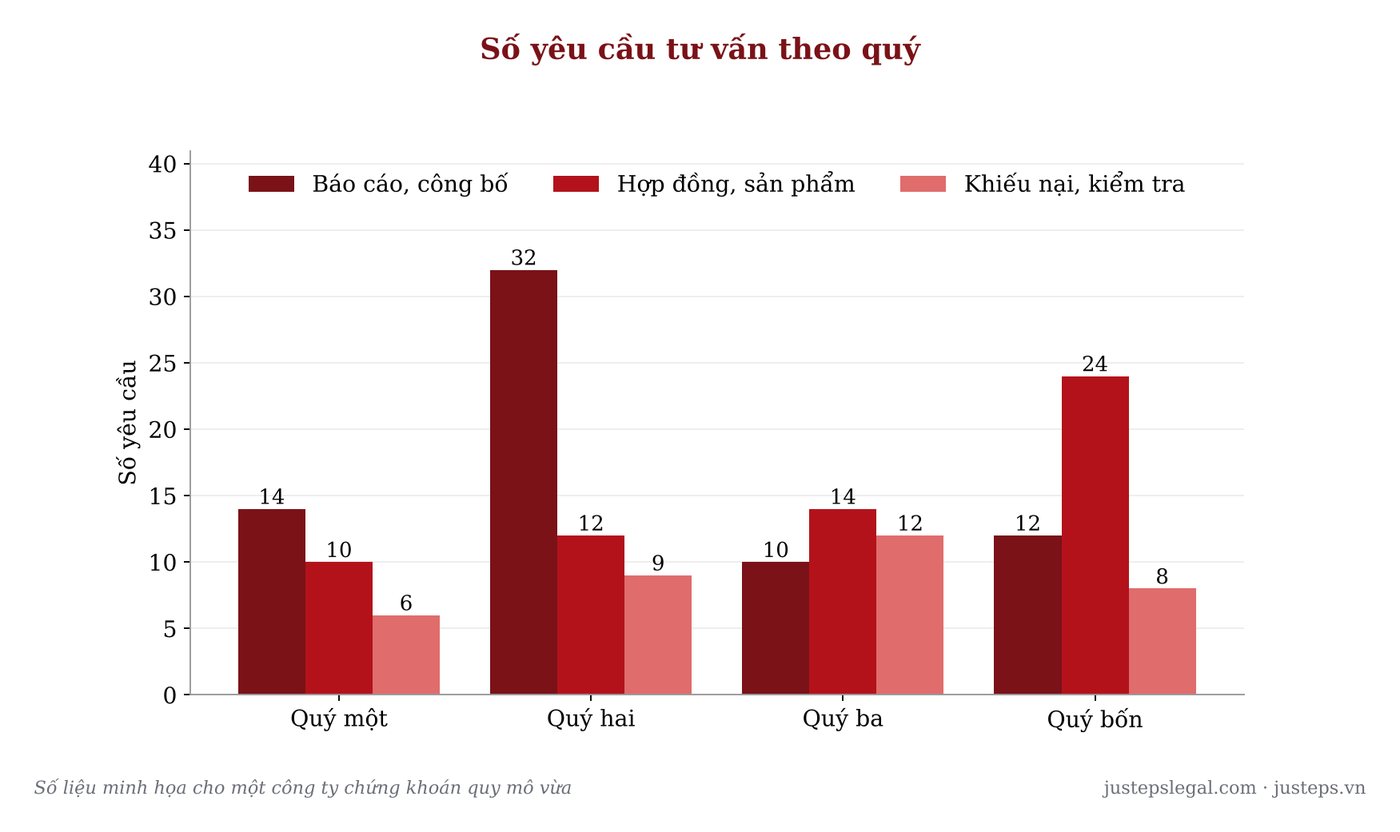
Example of advisory request volumes by quarter at a medium-sized securities company
In the example, the second quarter has the most requests because it coincides with the shareholder meeting season and the publication of annual reports, while the fourth quarter rises again as the business launches new products and signs cooperation contracts for the following year. Client complaints follow market movements rather than the season, so Justeps agrees in advance with the business on a mechanism for increasing resources when the market is volatile. After a year of working together, the business can use its own chart to adjust the service package to its actual needs.
How Justeps handles complaints and supports the business during inspections
For a complaint at risk of escalating, Justeps follows a fixed sequence. First, the business is instructed to preserve evidence, including order logs, call recordings, notification messages and loan files. Justeps then compares the evidence with the contract and the regulations to assess liability, drafts the response to the client, proposes options for negotiation or mediation, and finishes with recommendations to amend the procedure so that the matter does not recur.
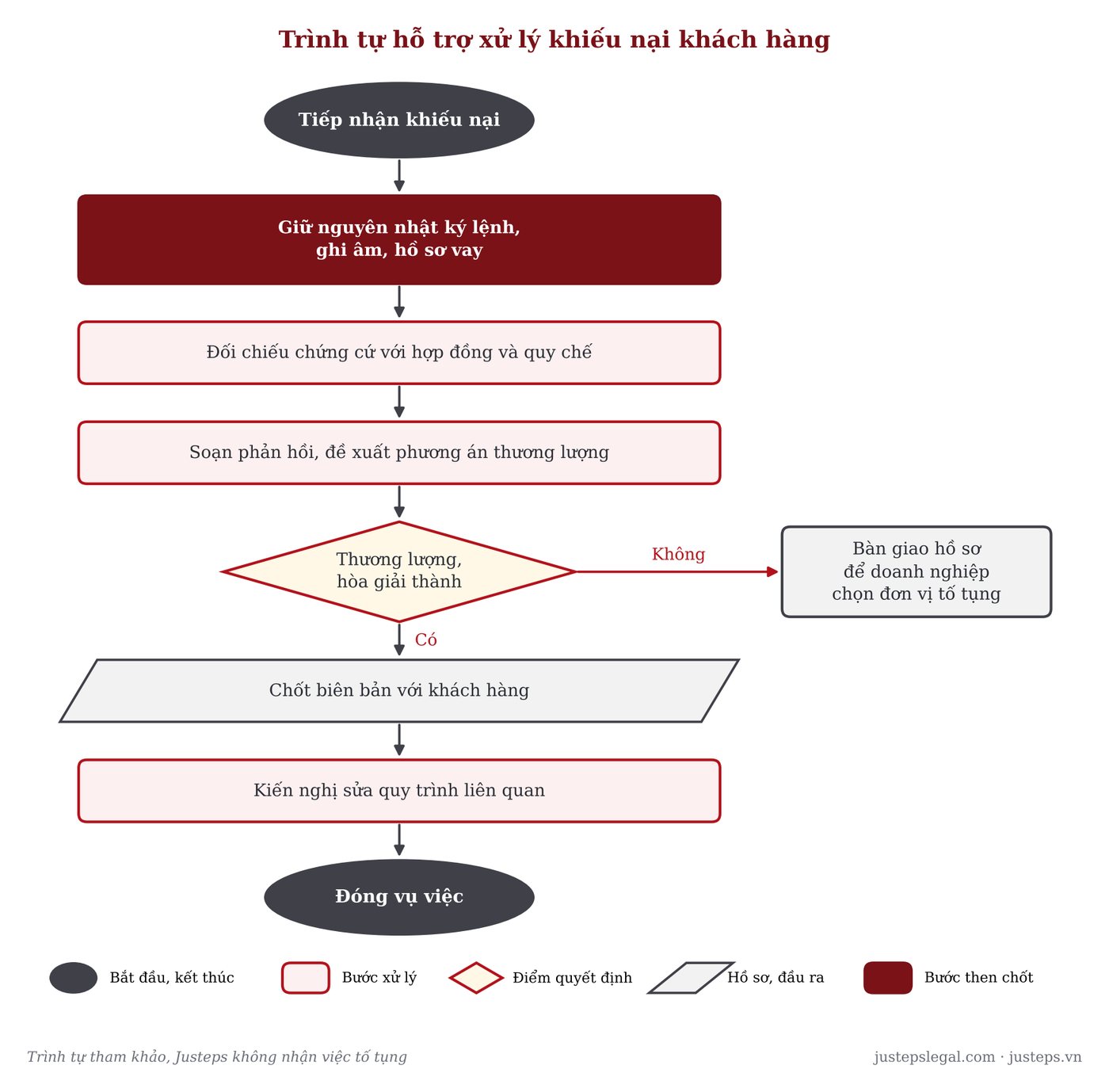
Sequence in which Justeps supports the business in handling a complaint at risk of escalating
The flowchart shows two ways a complaint can end. If negotiation or mediation succeeds, the business signs off the settlement record and Justeps proposes amendments to the relevant procedure. If it fails and the client brings a claim or the business decides to bring one, Justeps hands over the case file, the assessment of evidence and the correspondence exchanged so that the business can pursue the matter itself or pass it to a practitioner of its choice, because Justeps does not take on litigation.
When an inspection team from the State Securities Commission or the State Bank of Vietnam arrives, Justeps helps the business prepare the list of documents, reviews its written explanations, anticipates questions and may attend meetings in its capacity as consultant if the business so requests. Once the findings are issued, Justeps draws up a remediation plan and follows it through until the business reports completion.
Scope of the service and working process
The service covers answering day-to-day legal questions by email, telephone or messaging group, reviewing reports and disclosure content, reviewing documents for meetings of the General Meeting of Shareholders and the Board of Directors, and drafting and reviewing contracts with clients, agents, banks, retail partners and suppliers. Justeps also reviews new products, advertising content, sales scripts and debt collection scripts, assists in responding to complaints and in giving explanations to the regulator, and sends regular legal update bulletins. Response times are agreed according to the urgency of each type of matter, as shown in the table below.
| Urgency | Typical matters | Indicative response time |
|---|---|---|
| Urgent | Information about to fall due for disclosure, a complaint spreading on social media, a summons to a meeting with the regulator. | Within the working day, with direct discussion possible as soon as the request is received. |
| Routine | Review of partner contracts, appendices and meeting documents, and questions on approval procedures. | Two to three working days, depending on the length of the documents. |
| Project | New products, a new set of template contracts, preparation for a periodic inspection. | Under a separate plan agreed for each matter. |
In the first month, Justeps reviews the licences, charter, regulations, template contracts and the most recent inspection and audit findings to prepare a list of priority risks and a calendar of reporting and disclosure obligations. The two sides agree on contact persons, the channel for sending requests, response times and confidentiality rules, including adding Justeps specialists to the list of persons with inside information where necessary. From the second month, every request is recorded in a tracking log and Justeps sends a summary report monthly or quarterly.
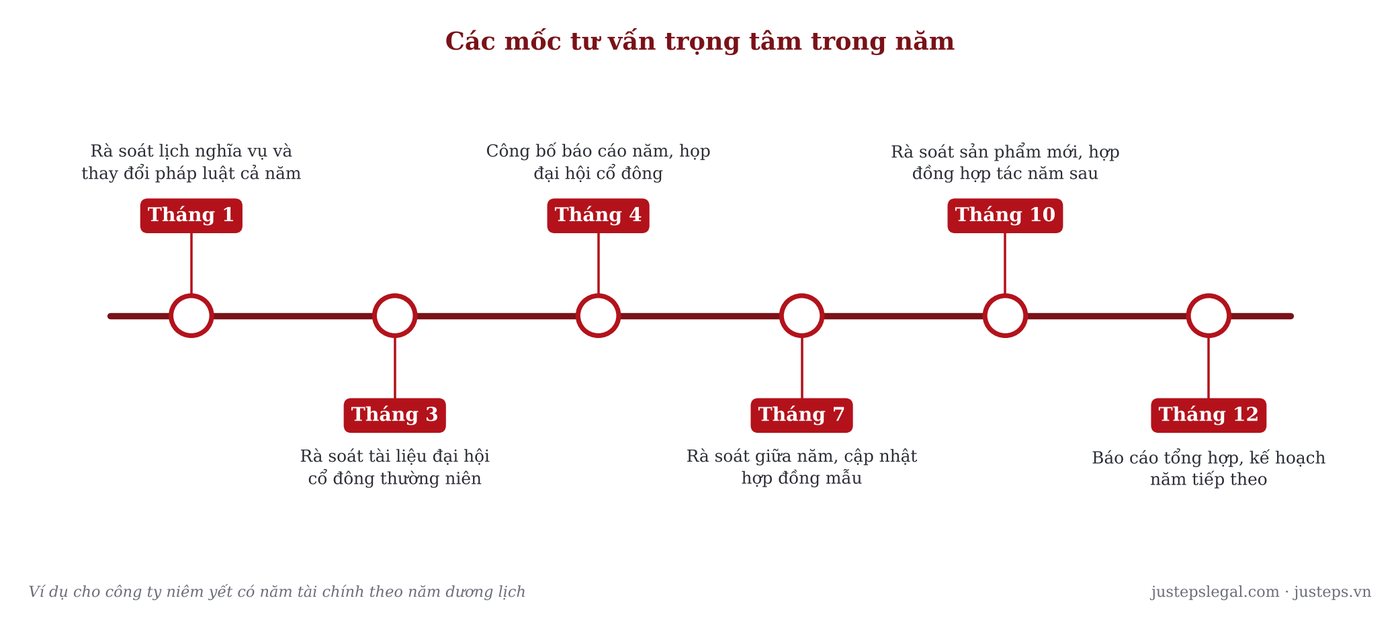
Example of key advisory milestones in a year of cooperation
The milestones above are an example for a listed securities company whose financial year coincides with the calendar year. The actual calendar is drawn up specifically according to the charter, the business plan and legislation about to take effect, such as the 1 March 2027 milestone of the amending law to the Law on Securities. This calendar is also the basis on which Justeps sends reminders before an obligation falls due.
Deliverables, suitable clients and fees
At the end of each period, the business receives the request tracking log with opinions and outcomes, written legal opinions on matters that need to be submitted to the Executive Board or the Board of Directors, the contracts, appendices and product documents reviewed, an updated reporting and disclosure calendar, and a summary report with a legal update section. When an issue recurs several times, Justeps recommends amending the underlying document, and the business may combine this with Justeps’ service for building internal procedures and regulations for securities, investment fund and consumer finance businesses to deal with the root cause.
Small businesses without a legal department often use Justeps as an outsourced legal function alongside their in-house compliance officer. Large businesses use the service to obtain an independent opinion, to carry out new product projects or to add resources in peak periods, while foreign-invested businesses need bilingual advice and explanations of the differences between Vietnamese rules and group policy. Fees are quoted monthly or annually in writing after the initial meeting, depending on the number of business lines and products, the expected volume of requests, the committed response times, the need for bilingual work and the level of support required during inspections or disputes.
How Justeps can help
Alongside ongoing advice, securities, investment fund and consumer finance businesses may combine the following Justeps services:
- Building internal procedures and regulations for securities, investment fund and consumer finance businesses. Justeps amends regulations on margin trading, lending, debt collection and anti-money laundering when ongoing advice reveals recurring gaps.
- Labour, payroll and insurance services for securities, investment fund and consumer finance businesses. Justeps deals with issues relating to practising certificates, personal dealing, discipline and commission schemes for staff.
- Drafting and reviewing commercial contracts. Justeps drafts and negotiates contracts with supervisory banks, retail partners, technology providers and debt collection partners.
- Personal data protection and cybersecurity. Justeps carries out data processing impact assessments for new products, online account opening and data sharing with partners.
Frequently asked questions
Can retaining Justeps for ongoing advice replace the in-house compliance officer?
No. A financial business still needs an in-house compliance lead as required by sector legislation, and the 2026 amending law to the Law on Securities continues to require a compliance officer[4]. Justeps supports this person with expertise, capacity and independent opinions.
How are urgent matters outside working hours handled?
For information about to fall due for disclosure, complaints that are spreading or meetings scheduled with the regulator, Justeps responds within the day and can discuss matters directly outside working hours under the mechanism agreed in the contract.
How does Justeps keep the business’s inside information confidential?
Justeps signs a confidentiality undertaking, limits access to each matter to the people working on it and agrees to have its specialists added to the list of persons with inside information when the business so requests. Documents are stored on a system with access controls and are returned or destroyed when the contract ends.
What support does Justeps provide when an inspection team arrives?
Justeps helps prepare the list of documents, reviews written explanations, anticipates questions, attends meetings in its capacity as consultant if the business so requests, and draws up a remediation plan after the findings are issued. Justeps analyses the penalties that may apply under Decree No. 156/2020/ND-CP[3].
What happens when a dispute with a client has to go to court or arbitration?
Justeps does not take on litigation. Justeps assesses the matter, reviews the evidence, drafts documents and supports negotiation and mediation; if the matter has to be resolved through court or arbitration proceedings, the file is handed over for the business to pursue itself or to pass to a practitioner of its choice.
What should be considered for loan products sold with insurance?
The Law on Credit Institutions prohibits tying the sale of non-compulsory insurance to the provision of banking products and services[7]. Justeps reviews sales scripts, loan files and the way costs are calculated to ensure that clients choose voluntarily and are fully informed.
Related articles
- How should a business choose an annual retainer for ongoing legal advice, and how can it get the most out of it
- Should a business retain ongoing legal advice or hire an in-house legal officer once all costs and benefits are counted
- Preparing for an IPO two to three years before listing by standardising governance, accounting and disclosure
- Legal compliance for fintech companies, electronic identification, data protection and partnerships with banks
Notes
[1] Article 85 of the Law on Securities No. 54/2019/QH14 dated 26 November 2019, as amended and supplemented by Law No. 56/2024/QH15 dated 29 November 2024.
[2] Circular No. 96/2020/TT-BTC dated 16 November 2020 of the Ministry of Finance guiding information disclosure on the securities market, together with its amending and supplementing instruments.
[3] Decree No. 156/2020/ND-CP dated 31 December 2020 on administrative penalties in the field of securities and the securities market, as amended and supplemented by Decree No. 128/2021/ND-CP.
[4] The law amending and supplementing a number of articles of the Law on Securities, passed by the National Assembly on 13 November 2026 and effective from 1 March 2027.
[5] The Law on Personal Data Protection No. 91/2025/QH15 dated 26 June 2025, effective from 1 January 2026.
[6] Clause 2 of Article 139 of the Law on Enterprises No. 59/2020/QH14 dated 17 June 2020, as amended and supplemented by Law No. 03/2022/QH15 and Law No. 76/2025/QH15.
[7] Clause 5 of Article 15 of the Law on Credit Institutions No. 32/2024/QH15 dated 18 January 2024.
[8] Decree No. 245/2025/ND-CP amending and supplementing a number of articles of Decree No. 155/2020/ND-CP detailing the implementation of a number of articles of the Law on Securities, effective from 11 September 2025.
This article is for reference and reflects the regulations in force at the time of publication. Please consult Justeps for advice tailored to your company’s records and situation.
For further information, please contact:
📩 Email: info@justeps.vn
🌐 Website: https://justepslegal.com · https://justeps.vn
🌐 Page: Justeps
☎️ Hotline (Zalo): 096 172 2607
📍 Thanh Xuan Office: 12th Floor, Licogi 13 Tower, 164 Khuat Duy Tien Street, Thanh Xuan Ward, Hanoi, Vietnam
📍 Ha Dong Office: LK06B, No.10, Dong Dua Area, Ha Dong Ward, Hanoi, Vietnam
📍 Ho Chi Minh City Branch: 528 Le Van Sy, Ho Chi Minh City, Vietnam
📍 Hai Phong Office: Truong Thinh Village, Ha Dong Commune, Hai Phong, Vietnam
📍 Quang Ninh Office: Van Don Special Zone, Quang Ninh Province, Vietnam





