
Key takeaways
- The greatest risk for a travel business lies in the gap between the cancellation conditions promised to customers and those that hotels, carriers and foreign partners impose on the business, so both ends of the contract chain must be reviewed together.
- A party that cannot perform its obligations because of a force majeure event is not liable under civil law unless otherwise agreed or provided by law[2], so how force majeure and its notification are defined in contracts decides who bears the costs when tours are cancelled en masse.
- Advertised tour prices must reflect what customers actually pay, and promotional programmes must comply with the commercial legislation just amended in November 2026[6].
- Justeps supports assessment, file preparation, negotiation and conciliation with customers or partners; Justeps does no litigation, and when the business decides to bring a claim, the file is handed to a practitioner of the business’s own choosing.
A travel business has to make decisions with legal consequences almost every day, often within a very short time, such as whether to accept a hotel’s room allotment conditions, how to respond when a storm cancels a whole series of groups, or whether to post an apology when a customer complains on social media. These matters span several fields at once, including tourism law, civil law, consumer protection, advertising, promotions, tax and foreign exchange. Engaging an adviser case by case often comes too late, because by the time the business has found an adviser the contract has been signed or the promise to the customer has already been made.
This page introduces Justeps’ ongoing legal advisory service for domestic travel businesses, businesses receiving international visitors, businesses taking travellers abroad and organisers of programmes for corporate customers. With this service, the business has a team of advisers who understand its products, partners and operating habits and who respond within the time committed under the package. Preparing the initial set of template contracts and regulations is carried out under the internal procedures and regulations service for travel and tour businesses, while this page deals with the situations that arise every day after the set of documents has been issued.
The legal work of a travel business changes with the seasons
Unlike many other sectors, the advisory needs of a travel business rise and fall with the tourist seasons. The chart below illustrates the number of advisory requests per quarter at a medium-sized international travel business, divided into three main groups of work.
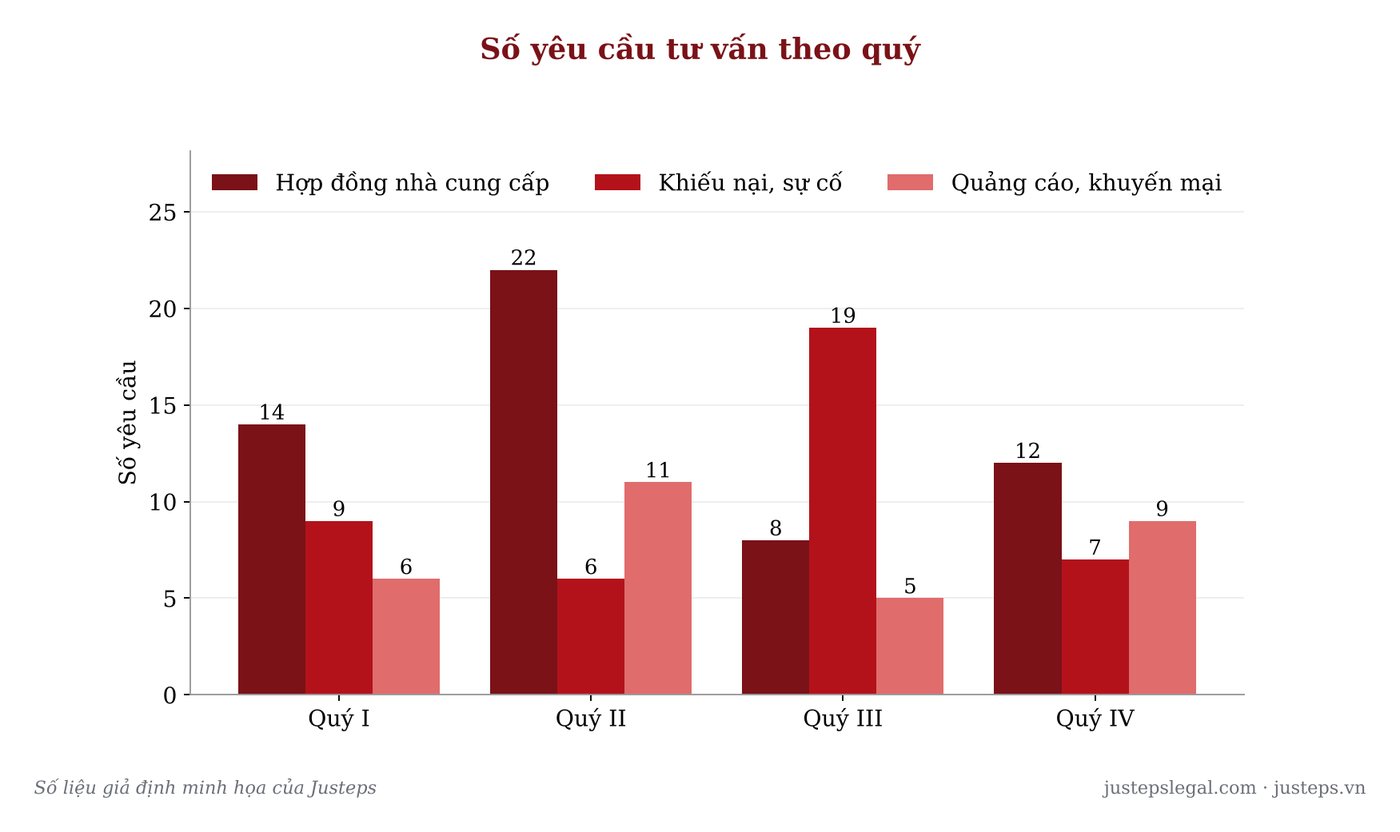
Example of the number of advisory requests per quarter in three groups of work at a travel business
In this example, the second quarter has the most requests on supplier contracts, with 22, because this is when the business signs room allotments and tickets for the summer, and there are also 11 requests on advertising and promotions because early-booking campaigns are running. The third quarter is the peak season, so complaints and incidents rise to 19, while supplier contracts fall to 8. The first quarter has 14 requests on contracts, 9 on complaints and 6 on advertising, while the fourth quarter has 12, 7 and 9 respectively. Justeps uses this rhythm to plan its staffing and to suggest that the business review major contracts before the season, rather than dealing with a rush of matters once groups have departed.
Contracts with hotels, carriers and foreign partners
Travel businesses usually sign standard contracts drafted by hotels, airlines, transport operators or sending partners abroad, with terms on room allotments, release dates for unsold rooms, deposits, penalties for reducing the number of guests and the governing law. When these terms are stricter than the cancellation conditions the business has promised its customers, the business bears the difference every time a customer cancels. Justeps reviews supplier contracts alongside the cancellation fee schedule in the contracts with customers, points out each mismatch and proposes terms to renegotiate, such as extending the release date or reducing the penalty for a lower number of guests.
With foreign partners, the contract also needs to set the payment currency, the timing of deposit transfers, the governing law and the forum for resolving disputes. A clause choosing the courts of the partner’s country may leave the business with no cost-effective way of recovering its deposit. Contracts of high value or complex structure can be drafted and reviewed in more depth through the commercial contract drafting and review service.
Force majeure, mass tour cancellations and refunds
Storms, epidemics, airport closures or unrest at the destination may cancel dozens of groups within a few days. A force majeure event is an event that occurs objectively, cannot be foreseen and cannot be remedied even though all necessary measures within one’s capability have been applied[1], and a party that cannot perform its obligations because of such an event is not liable under civil law unless otherwise agreed or provided by law[2]. Where circumstances change fundamentally but not to the level of force majeure, the affected party has the right to request renegotiation of the contract[3].
In practice the business stands between the two ends. The supplier may refuse a refund because its contract defines force majeure narrowly, while the customer demands a full refund as a consumer right under the contract and the law on protection of consumer rights[4]. Justeps helps the business determine whether the event counts as force majeure under each contract, drafts notices to suppliers and customers within the deadlines, proposes options of changing the departure date, issuing a service voucher of equivalent value or refunding, and calculates the costs the business can recover from suppliers.
Tour price advertising, promotions and online sales
A very low tour price in an advertisement that does not include surcharges, taxes, airport fees or compulsory tips is a common source of complaints and may be regarded as providing untruthful information to consumers. The advertising content of a travel business, including posts by influencers hired to promote it, must comply with the law on advertising, which was amended together with the Law on Tourism at the session of November 2026[5]. Justeps reviews advertisements, the way prices are displayed on the website and the accompanying conditions before the business publishes them.
Programmes such as buy two get one free, group discounts or service vouchers are promotional activities and must comply with the limits and procedures under commercial law. The Law amending and supplementing the Commercial Law, the Law on Competition, the Law on Foreign Trade Management and the Law on Protection of Consumer Rights was passed by the National Assembly on 13 November 2026 and takes effect on 1 July 2027[6], so Justeps monitors the guiding documents in order to update the business in good time. Businesses running many campaigns on digital platforms may combine this with the advertising, promotions and consumer protection service.
Complaints, accidents and compensation for customers
When a customer complains or has an accident, the first reaction of staff is often emotional, such as promising compensation by text message or posting an apology admitting fault on social media. Such wording may become unfavourable evidence when the two sides negotiate the level of compensation or when the business claims under its insurance. Justeps prepares initial response scripts for each type of complaint, reviews the content before it is sent, assesses the liability of the business and of the supplier, and prepares the insurance claim file.
For high-value disputes, Justeps assesses the evidence, drafts documents, supports the business in negotiating or conciliating with the customer and notes that the limitation period for initiating proceedings in a contract dispute is 3 years from the date on which the party with the right knew or should have known that its rights had been infringed[7]. Justeps does no litigation and does not file or pursue claims, so when the business decides to take the matter to court or arbitration, the entire file and analysis are handed over to a practitioner of the business’s own choosing.
Licences, deposits and changes that must be notified
A travel business must maintain a deposit at a bank throughout its period of business, at VND 100 million for domestic travel services, VND 250 million for international travel services receiving visitors to Vietnam and VND 500 million for taking travellers abroad or for both directions[8]. The 80% reduction in deposits under Decree No. 94/2021/ND-CP applied only until 31 December 2023, so a business still holding a deposit certificate at the reduced level must top it up to the current level. Changes such as a new person in charge of travel services, a new legal representative, a new head office address or a new bank holding the deposit all involve procedures with the tourism authority or the business registration authority under the Law on Tourism[9] and the decree on enterprise registration[10]. Omitting these procedures may lead to penalties under the decree on administrative penalties in the field of tourism[11].
Justeps prepares an annual compliance calendar for the business, recording the milestones for licences, deposits, periodic reports, tax and labour, and sends reminders before each milestone. When an inspection team from the tourism, tax or labour authority visits, Justeps helps the business prepare its files, reviews in advance the points likely to be raised and attends the working session if the business requests. The Law on Tourism has just been amended in November 2026, so in the first year Justeps will check each condition currently applied against the new guiding documents once they are issued.
Payments to foreign partners and tax
Businesses taking travellers abroad usually transfer deposits and payments to partners in many countries, while businesses receiving international visitors receive money from sending partners. Each transaction needs a contract, invoice or suitable supporting document so that the bank accepts the transfer under the foreign exchange rules, so that the cost is deductible for tax purposes and so that it can be determined whether foreign contractor tax arises. Justeps reviews how services are described in contracts with partners, identifies cases where foreign contractor tax must be withheld and cases where it need not be because the service is provided and consumed abroad, and agrees with the accountants on the set of documents to keep for each type of transaction.
Working method, response times and fees
In the first month Justeps takes over the files, carries out an overall review of the licences, template contracts and contracts with the main suppliers, and then sends a status report together with an annual compliance calendar. From the second month, the business sends requests through the agreed channel; ordinary requests are answered within the committed time, while requests relating to a group currently on tour are handled as a priority, as shown in the flowchart below.
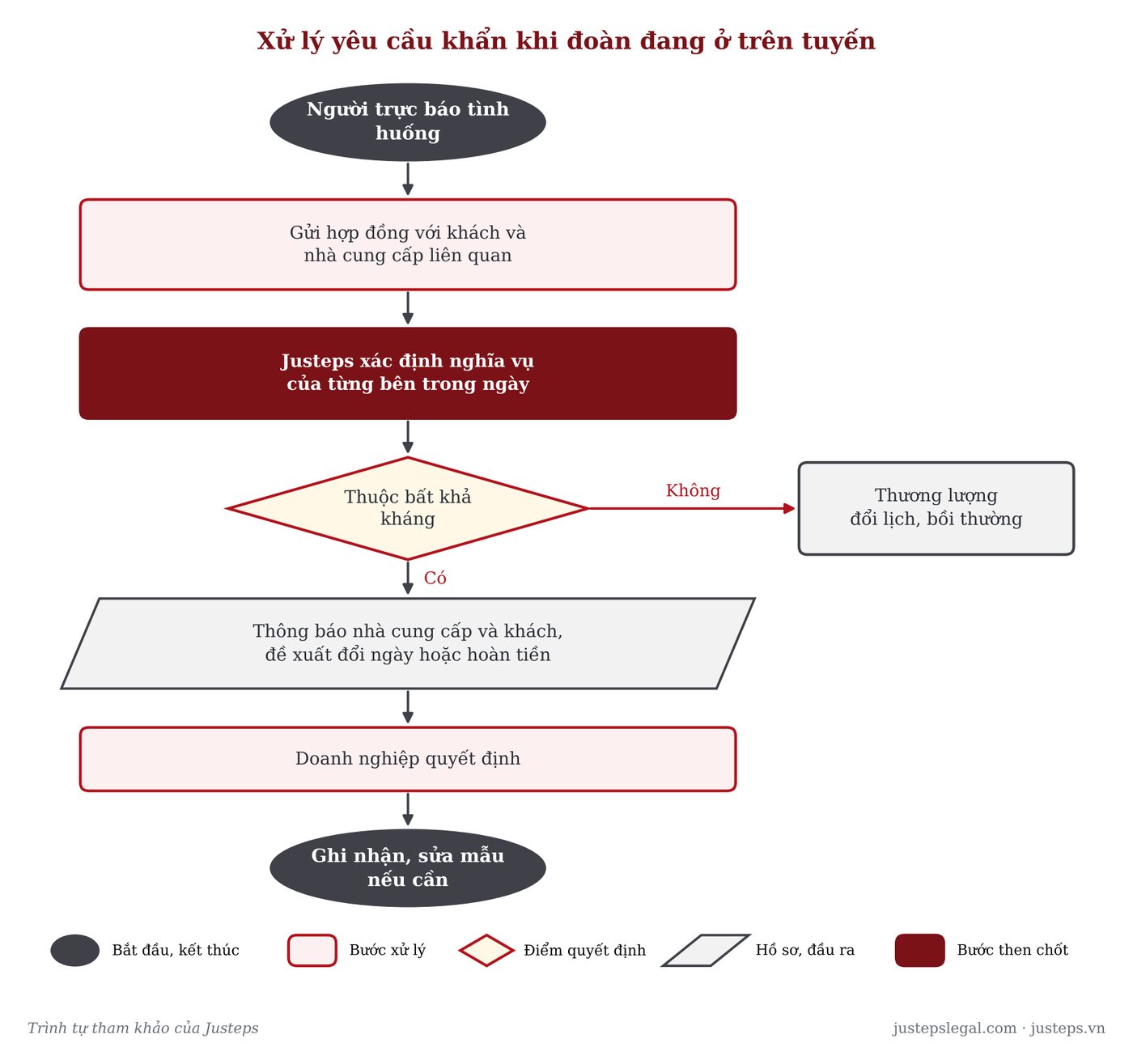
Sequence for handling an urgent advisory request while a group is on tour
The business’s duty officer reports the situation together with the relevant contracts, and within the same day Justeps identifies which obligations belong to the business and which to the supplier and proposes options together with template notices. The final decision always rests with the business, and Justeps provides opinions and documents so that the decision is well founded. Once the incident is closed, Justeps records the lessons learned and proposes amendments to the template contracts or regulations where necessary. The business receives the following documents:
- An initial legal status report setting out the points to be remedied before the peak season.
- An annual compliance calendar covering licences, deposits, tax, labour and periodic reports.
- Advisory opinions and documents drafted or reviewed, filed by matter so that the business can refer back to them.
- Periodic reports on open matters, risks to monitor and relevant changes in the law.
Justeps quotes the fee monthly, quarterly or annually in writing after the initial meeting, depending on the licence scope, the number of contracts and partners, the expected number of hours, the need for bilingual work, participation in negotiations or meetings with state authorities and the response commitment during the peak season. Matters concerning the contracts, working hours and remuneration of tour guides are handled in depth under the labour, wages and social insurance service for travel and tour businesses.
How Justeps can help
Alongside ongoing legal advisory, travel and tour businesses may combine the following Justeps services:
- Internal procedures and regulations for travel and tour businesses. Justeps drafts template contracts with customers, cancellation fee schedules and incident procedures to reduce the number of situations that have to be handled case by case.
- Labour, wages and social insurance services for travel and tour businesses. Justeps standardises the contracts, working hours and remuneration of permanent, seasonal and trip-by-trip tour guides.
- Advertising, promotions and consumer protection. Justeps reviews tour price advertising, promotional programmes and online sales conditions before they are published.
- Commercial contract drafting and review. Justeps drafts and reviews high-value contracts with hotels, carriers and foreign sending partners.
- Outsourced legal department. Justeps assigns staff to handle day-to-day legal work for travel businesses without an in-house legal function.
Frequently asked questions
How does an ongoing advisory package differ from engaging an adviser case by case?
The advisory team already knows the business’s contracts, partners and operations, so it responds faster and more consistently. The business also has an annual compliance calendar and receives reminders before milestones instead of only seeking advice once an incident has occurred.
If a tour is cancelled because of a storm, must the business refund the customer in full?
It depends on the contract with the customer and the contract with the supplier. A party that cannot perform its obligations because of force majeure is not liable under civil law unless otherwise agreed[2], but the business still needs to deal with the money received from the customer under the terms signed and propose a reasonable alternative.
May tour prices be advertised excluding taxes and fees?
The business must state the items not included right next to the advertised price so that customers know the total amount payable. A low price that hides compulsory items is easily regarded as untruthful information and is a common source of complaints.
Does Justeps represent the business when a customer sues?
No. Justeps does no litigation. Justeps assesses the case, reviews the evidence, drafts documents and supports negotiation and conciliation. When the business decides to take the matter to court or arbitration, the file is handed to a practitioner of the business’s own choosing.
Must foreign contractor tax be withheld on payments to hotels abroad?
Services provided and consumed abroad are normally not subject to foreign contractor tax withholding, but the business needs contracts and documents that show this clearly. Items such as booking fees through platforms or services provided in Vietnam need to be considered separately.
Is a procedure required when the person in charge of travel services changes?
Yes. The person in charge is a condition of the licence under the Law on Tourism[9], so when that person is replaced the business must appoint a qualified person and give notice as required. Justeps includes this in the compliance calendar and sends a reminder as soon as the business reports a staff change.
Does a small business need an ongoing advisory package?
A small domestic travel business can use a package with limited hours, focusing on template contracts, complaints and licences. The package is adjusted when the business adds international travel services or online sales.
Related articles
- Conditions for domestic tour operations, licences, deposits, tour contracts and management of tour guides
- Building a customer complaint handling procedure that complies with the law, sets clear authority and leaves an audit trail
- Internal procedures and regulations for travel and tour businesses organised around each stage of the trip
- Labour, wages and social insurance services for travel and tour businesses with seasonal tour guides
Notes
[1] Clause 1 of Article 156 of the Civil Code No. 91/2015/QH13 dated 24 November 2015.
[2] Clause 2 of Article 351 of the Civil Code No. 91/2015/QH13 dated 24 November 2015.
[3] Article 420 of the Civil Code No. 91/2015/QH13 dated 24 November 2015.
[4] The Law on Protection of Consumer Rights No. 19/2023/QH15.
[5] The Law on Advertising No. 16/2012/QH13, as amended and supplemented by Law No. 75/2025/QH15 and by the law passed by the National Assembly on 21 November 2026.
[6] The Law amending and supplementing a number of articles of the Commercial Law, the Law on Competition, the Law on Foreign Trade Management and the Law on Protection of Consumer Rights, passed by the National Assembly on 13 November 2026 and effective from 1 July 2027.
[7] Article 429 of the Civil Code No. 91/2015/QH13 dated 24 November 2015.
[8] Clauses 1 and 2 of Article 14 of Government Decree No. 168/2017/ND-CP dated 31 December 2017 detailing a number of articles of the Law on Tourism; the temporary reduction under Decree No. 94/2021/ND-CP dated 28 October 2021 applied until 31 December 2023.
[9] The Law on Tourism No. 09/2017/QH14 dated 19 June 2017, as amended and supplemented by the law passed by the National Assembly on 21 November 2026.
[10] Government Decree No. 168/2025/ND-CP dated 30 June 2025 on enterprise registration, as amended and supplemented by Decree No. 296/2026/ND-CP.
[11] Government Decree No. 45/2019/ND-CP dated 21 May 2019 on administrative penalties in the field of tourism, as amended and supplemented by Decree No. 129/2021/ND-CP and Decree No. 348/2025/ND-CP.
This article is for reference and reflects the regulations in force at the time of publication. Please consult Justeps for advice tailored to your company’s records and situation.
For further information, please contact:
📩 Email: info@justeps.vn
🌐 Website: https://justepslegal.com · https://justeps.vn
🌐 Page: Justeps
☎️ Hotline (Zalo): 096 172 2607
📍 Thanh Xuan Office: 12th Floor, Licogi 13 Tower, 164 Khuat Duy Tien Street, Thanh Xuan Ward, Hanoi, Vietnam
📍 Ha Dong Office: LK06B, No.10, Dong Dua Area, Ha Dong Ward, Hanoi, Vietnam
📍 Ho Chi Minh City Branch: 528 Le Van Sy, Ho Chi Minh City, Vietnam
📍 Hai Phong Office: Truong Thinh Village, Ha Dong Commune, Hai Phong, Vietnam
📍 Quang Ninh Office: Van Don Special Zone, Quang Ninh Province, Vietnam





