
Key takeaways
- Marketplace shops, livestream channels and payment accounts are assets of the business, so they must be registered in the name of the legal entity that actually sells[1] and assigned for administration by job title rather than to the individual who opened the account.
- The person who approves statements about product benefits, prices and promotions in a livestream should not be someone who earns commission on the sales of that same session.
- The new obligations on identity verification, documents to be provided to livestreamers and buyer data[5][8] should be assigned to a specific position on the organisational chart, even in a small business.
- Warehouse and customer care may need twice as many people during major sales campaigns, so the organisation should consist of a small permanent core plus a pre-agreed plan for additional capacity.
Many online sellers grow from a single shop that the owner opened on a marketplace, photographing the products and going live every evening in person. Two or three years later the same product range is sold on several marketplaces, on the business’s own website and on several livestream channels, with a team of livestream hosts, a warehouse team working in shifts and a customer care team answering messages until midnight. The organisation usually grows on the basis of whoever is free does the job, so some shops are still registered in the name of a former employee, livestream hosts decide for themselves how to describe product benefits, and nobody can say whether marketplace revenue matches the figures declared for tax.
This page introduces Justeps’ service of designing the organisational structure of businesses selling on e-commerce marketplaces, on social networks with sales functions, on their own websites and through livestreams. It focuses on four questions, namely who owns and administers the sales accounts, who controls the content that goes on air, who is responsible for data and revenue reconciliation, and how the organisation expands and contracts in peak season. How staff carry out each daily task, such as approving scripts or handling returns, is set out under the internal procedures and regulations service for e-commerce and livestream selling businesses.
The legal entity, shops and accounts are the starting point
Before drawing the chart, Justeps compiles a register of every account the business uses to sell, including the shop on each marketplace, livestream channels, social media pages, advertising accounts, payment accounts and accounts on order management software. For each account, the register records in whose name it is registered, who holds the highest administrator rights, who currently has access and where the account receives money. The Law on E-commerce requires sellers to provide the platform operator with information for identity verification and their registered business name and address, and on platforms with an online ordering function sellers may only use their own payment accounts[1]. A company shop registered in the name of an individual employee therefore both risks the loss of an asset when that person leaves and misrepresents the seller information disclosed to buyers.
The second situation Justeps often encounters is revenue split across several household businesses or personal accounts of the owner’s relatives. Since transaction data on platforms is provided to the tax authorities under the law on tax administration[2], this arrangement is easily regarded as concealing revenue, and it detaches goods, cash flows and responsibility to buyers from the business that is really behind them. Justeps proposes a plan for bringing the accounts under the operating legal entity in stages, with a list of actions for each marketplace, and where the business has several warehouses or offices in different provinces it considers registering a branch or business location under the Law on Enterprises[3].
Functional units following the journey of an order
The easiest way to divide the organisation is to follow the path of an order, from the moment a viewer joins a livestream to the moment the buyer receives the goods and leaves a review. Each stage corresponds to a functional unit with a clearly identified head, and each handover between two units is a point that requires a document or a confirmation step. A medium-sized multi-channel seller usually needs the following units:
- The sales channel unit manages the product catalogue, listed prices and campaigns on each marketplace, website and social network.
- The content and livestream unit produces images, videos and scripts and runs the live sessions.
- The order operations unit covers the warehouse, packing, handover to carriers and receipt of returned goods.
- The customer care unit answers messages and handles complaints, return requests and negative reviews.
- The compliance and data unit keeps product records, reviews content, manages access rights and handles buyer data.
- The finance and reconciliation unit matches the money transferred by marketplaces with orders, invoices and the accounting books.
Small businesses often omit the last two units because they do not directly generate revenue. However, it is precisely these two units that determine whether a shop is locked, a product is taken down or the business faces tax arrears. At a small scale, one person may handle both compliance and data, provided that person does not also carry sales targets. Invoices for each order are issued under the rules on electronic invoices[4], so the person in charge of reconciliation needs access to order data on every channel rather than merely receiving summary sheets from the sales channel unit.
Content review independent of sales targets
A livestream host paid commission on the sales of a session has an incentive to overstate product benefits, compare the product with competitors’ products or promise promotions outside the official policy. The law places specific responsibilities on both the seller and the livestreamer, under which the seller must provide the livestreamer with documents proving the business conditions and the quality of the goods before going on air, and the sales content must be consistent with the advertising content that has been certified for goods subject to certification[5]. Livestreamers must provide information for the platform to verify their identity and must not give false or misleading information about the uses, origin, quality, price and promotions of goods[6]. The responsibilities of persons who convey advertising products, including influencers on social networks, are also governed separately by the law on advertising[7].
Justeps therefore places the content review function in the compliance and data unit, reporting to the chief executive or the owner, rather than under the head of the livestream team or the sales director. The reviewer has the authority to approve scripts, the list of permitted statements, contracts with influencers and product records before listing, and also has the authority to require a session to stop when a breach is detected. For businesses working with a large network of influencers or running their own creator management unit, this part of the organisation can also draw on the organisational structure design service for KOL, KOC and multi-channel network (MCN) businesses.
Buyer data lead and access rights
An online seller processes thousands of records every day containing buyers’ names, phone numbers, addresses and purchase histories, and shares this data with carriers, order management software, advertising tools and sometimes an outsourced customer care team. The Law on Personal Data Protection requires processing to have a lawful basis, appropriate protection measures and a person responsible within the organisation[8]. If no position on the chart is assigned this task, data will be exported to spreadsheets and sent through messaging apps without anyone controlling the purpose, the retention period or deletion.
Justeps proposes assigning the role of personal data protection lead to the compliance and data unit, with a written appointment decision. The highest administrator rights for each shop and advertising account are held by the legal representative or an authorised executive, while employees are granted operating rights according to their job titles, and those rights are revoked immediately upon a change of job or resignation. Policies, impact assessments and data processing contracts with third parties are prepared in detail through the personal data protection compliance service.
Authority over prices, promotions, refunds and content
When one person both creates discount codes, approves refunds outside the policy and confirms end-of-day revenue, the business is almost unable to detect abused discount codes or fictitious refunds. An authority matrix separates the decisions that affect profit margins from the decisions that may lead to penalties, and assigns each group to a different person. The example below is a matrix Justeps built for a business selling cosmetics and household goods on four channels with an in-house livestream team.
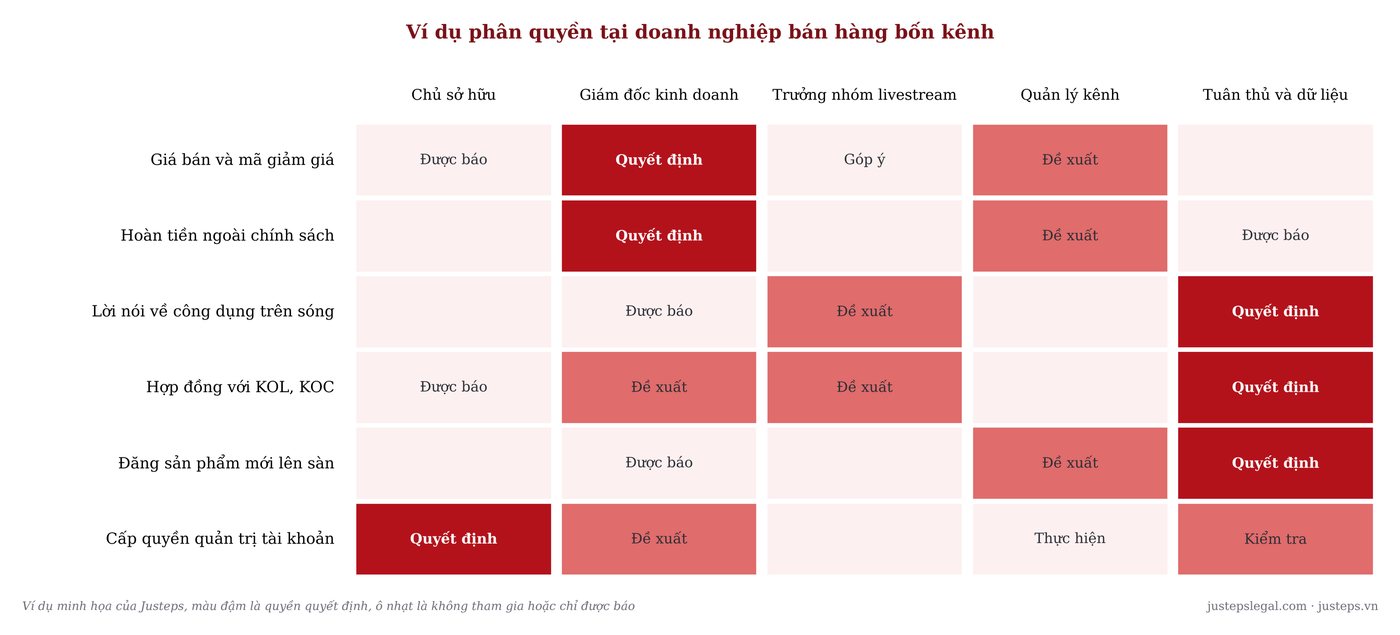
Example of authority allocation at a business selling on four channels with an in-house livestream team
In the example, the sales director decides on selling prices, discount codes and refunds outside the published policy, since these decisions directly affect profit. The compliance function decides which statements about product benefits may be used on air, contracts with KOLs and KOCs, and the listing of a new product on a marketplace, since these are the points that most often lead to product removal or penalties. The owner retains only the right to grant and revoke the highest administrator rights of accounts, while the livestream team leader and the channel manager propose and implement within their assigned scope. Monetary limits for each level, such as the maximum value of a campaign or the maximum refund that does not require approval, are specified through the financial regulations and delegation of authority service.
Staffing in normal months and peak season
Order volumes for marketplace sellers rise sharply around major sales days such as 9.9, 11.11, 12.12 and before Tet. The compliance, finance and sales channel units remain almost unchanged in headcount, but the warehouse and customer care may need twice the workforce for a few weeks. The chart below compares headcount by unit at a business selling around three thousand orders a day in a normal month.
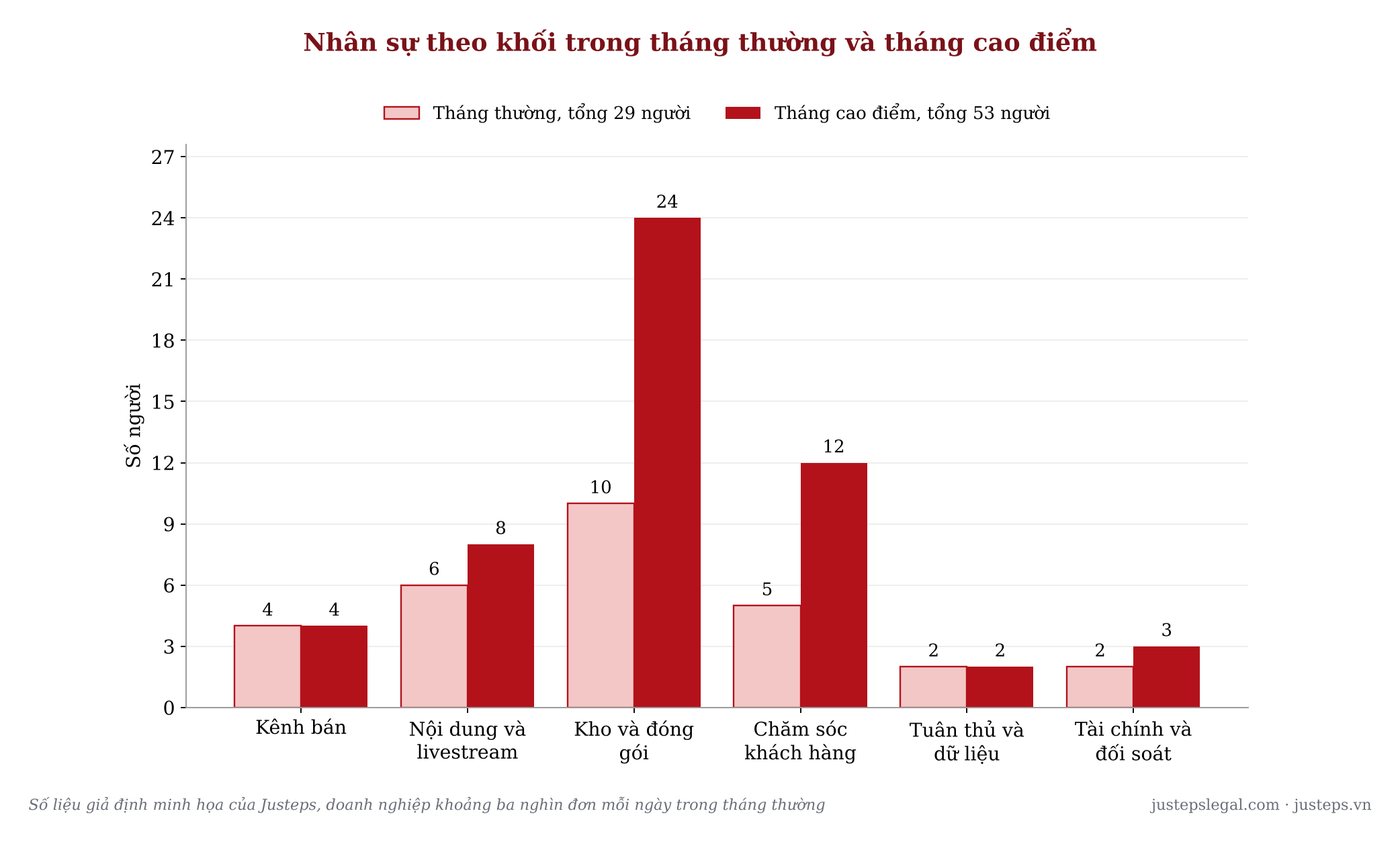
Example of headcount by unit in a normal month and a peak month
In the example, total headcount rises from 29 people in a normal month to 53 people in a peak month. The warehouse and packing unit grows from 10 to 24 people, customer care from 5 to 12, the livestream unit from 6 to 8 and finance and reconciliation by one person, while the sales channel unit stays at 4 and the compliance and data unit at 2. Justeps does not recommend mass hiring followed by redundancies, but designs a permanent core team plus a pre-agreed supplementary plan, which may be seasonal workers, overtime within the statutory limits or a full-service fulfilment contract. When outsourcing, the business remains responsible to buyers, so the contract must clearly set out packing quality, error rates, buyer data protection and compensation. Contracts, wages and insurance for each of these groups of workers are handled under the labour, wages and social insurance service for e-commerce and livestream selling businesses.
Application by size and business model
A small business selling on one or two marketplaces may combine the sales channel and customer care and pack goods at its own warehouse, but it still needs to designate one person to check product records and advertising content. A multi-channel business with its own livestream team should separate the content unit from the sales channel unit, so that the people on air do not set prices or create discount codes themselves. Brand owners, importers or manufacturers selling online directly need an additional function managing product notification records, goods labels and trade marks, since marketplaces usually request these documents when an infringement report is filed.
Businesses selling cosmetics, health supplements or mother and baby products need a stronger compliance unit from the outset, since the advertising conditions for these product groups are stricter and the consequences of a wrong statement on air are usually more serious. Foreign-invested businesses should also check market access conditions for e-commerce and distribution activities before choosing their legal entity model. Questions arising in operations after the new organisation is in place, such as responding to a marketplace when a shop receives a warning, are supported through the ongoing legal advisory service for e-commerce and livestream selling businesses.
Implementation process, deliverables and fees
A project usually takes about seven weeks and is scheduled to avoid the marketplaces’ major sales campaigns. Justeps interviews the head of each unit and observes at least one livestream session and one packing shift in person to understand the actual work, rather than relying only on the existing chart.
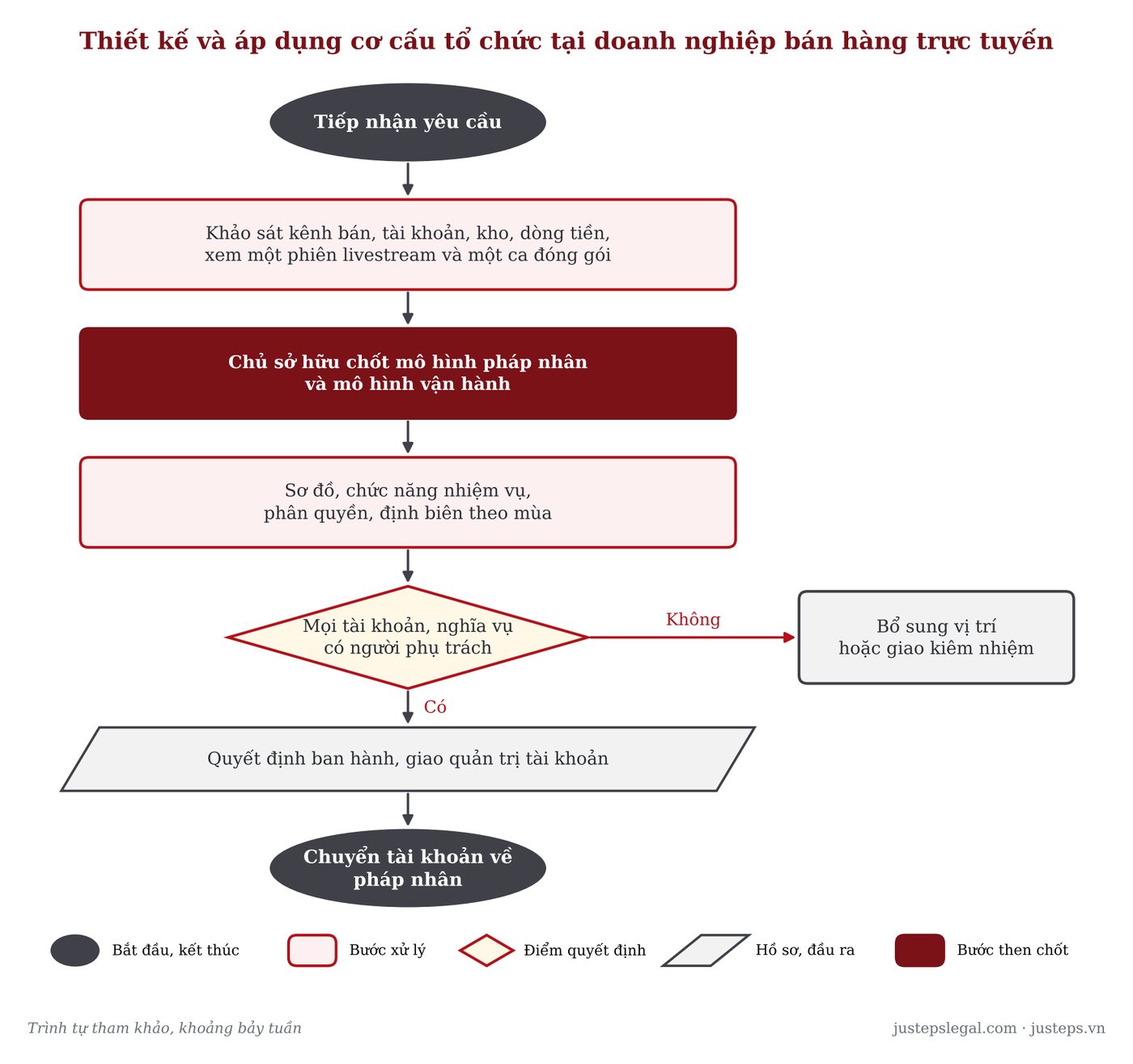
Sequence for designing and applying the organisational structure at an online seller
In the first two weeks Justeps surveys the sales channels, the account register, the warehouse model and the cash flows from marketplaces. In the third week the owner and Justeps settle the legal entity model and the operating model, for example whether to run the warehouse in house or use a fulfilment service, and whether to have an in-house livestream team or work with external influencers. In the following weeks Justeps drafts the chart, functions and duties, the authority matrix and the seasonal staffing table, then checks again whether every account and every obligation has a person in charge before issuance and the transfer of account administrator rights to the legal entity. The deliverables include the following documents:
- A report assessing the legal entity, shop and account model, with a roadmap for bringing accounts under the business.
- An organisational chart and regulations on the functions and duties of each unit and key positions such as channel manager, livestream team leader and compliance officer.
- An authority matrix for prices, promotions, refunds, on-air content, contracts with influencers and account administration.
- An account register with rules on granting, changing and revoking access rights.
- Staffing tables for normal months and peak months and an outsourcing plan for budgeting.
- Draft decisions issuing the organisational structure, assigning account administration and appointing the personal data protection lead.
Justeps quotes a fixed project fee in writing after the initial meeting. The fee depends on the number of sales channels and legal entities, the size of the livestream team, whether the warehouse is run in house or outsourced, whether the product group is subject to strict advertising conditions, the need for bilingual documents, and whether the business needs Justeps’ support in transferring accounts to the legal entity. The authority to approve the organisational structure lies with the owner, the Members’ Council or the Board of Directors depending on the type of enterprise and the charter[9], so Justeps prepares draft documents suited to that competent body.
How Justeps can help
In addition to organisational structure design, e-commerce and livestream selling businesses can combine the following Justeps services:
- Internal procedures and regulations for e-commerce and livestream selling businesses. Justeps writes procedures for script approval, product listing, promotions, returns and reconciliation for the newly designed positions.
- Labour, wages and social insurance services for e-commerce and livestream selling businesses. Justeps turns the staffing table into suitable contracts for livestream hosts, warehouse staff, customer care staff and seasonal workers.
- Financial regulations and delegation of authority. Justeps sets limits on promotions, refunds and advertising spend for each level in the authority matrix.
- Personal data protection compliance. Justeps builds the buyer data protection file for the newly appointed data lead.
- Organisational structure design for KOL, KOC and multi-channel network (MCN) businesses. Justeps designs a dedicated organisation when the business manages its own network of content creators.
Frequently asked questions
Should a marketplace shop be registered in the name of the company or the owner personally?
It should be registered in the name of the company that actually sells, so that revenue, invoices and responsibility to buyers are tied to the same legal entity[1]. This also allows the business to keep the shop when staff change.
Does a small business need its own compliance department?
It need not be a department, but at least one person should be assigned to check product records and advertising content without carrying sales targets. A business selling cosmetics or health supplements should have a dedicated person early on.
Which unit should livestream hosts belong to?
They should belong to the content and livestream unit and coordinate with the sales channel unit on products and prices. Scripts and the list of permitted statements are approved by the compliance function before going on air.
Who owns a social media channel tied to the name of a livestream host?
This depends on the agreement between the two parties. Rights to an individual’s image belong to that individual[10], so the business needs to agree in advance on ownership of the channel, the scope of image use and how matters are handled when the cooperation ends.
Should the entire warehouse and packing operation be outsourced?
Outsourcing allows rapid scaling in peak season, but the business remains responsible to buyers. The contract should set out packing quality, error rates, buyer data protection and compensation, and someone in the organisation must monitor the fulfilment provider.
Who should hold the highest administrator rights for a shop account?
The legal representative or an executive authorised in writing. Employees are only granted operating rights according to their job titles, and these rights are revoked immediately when they leave.
Related articles
- Internal procedures and regulations for e-commerce and livestream selling businesses
- Ongoing legal advisory for e-commerce and livestream selling businesses on content and tax
- Labour, wages and social insurance services for e-commerce and livestream selling businesses
- Selling on e-commerce marketplaces in Vietnam and the rules on invoices, tax, returns and complaints
Notes
[1] Article 21 of the Law on E-commerce No. 122/2025/QH15 dated 10 December 2025, effective from 1 July 2026.
[2] The Law on Tax Administration No. 108/2025/QH15 and its implementing documents.
[3] Article 44 of the Law on Enterprises No. 59/2020/QH14 dated 17 June 2020, as amended and supplemented by Law No. 76/2025/QH15.
[4] Government Decree No. 254/2026/ND-CP dated 30 June 2026 on electronic invoices and electronic documents.
[5] Article 23 of the Law on E-commerce No. 122/2025/QH15 dated 10 December 2025, effective from 1 July 2026.
[6] Article 24 of the Law on E-commerce No. 122/2025/QH15 dated 10 December 2025, effective from 1 July 2026.
[7] The Law on Advertising and the documents amending and supplementing it.
[8] The Law on Personal Data Protection No. 91/2025/QH15 and Government Decree No. 356/2025/ND-CP detailing that Law.
[9] The Law on Enterprises No. 59/2020/QH14 dated 17 June 2020, as amended and supplemented by Law No. 76/2025/QH15.
[10] Clause 1, Article 32 of the Civil Code No. 91/2015/QH13 dated 24 November 2015.
This article is for reference and reflects the regulations in force at the time of publication. Please consult Justeps for advice tailored to your company’s records and situation.
For further information, please contact:
📩 Email: info@justeps.vn
🌐 Website: https://justepslegal.com · https://justeps.vn
🌐 Page: Justeps
☎️ Hotline (Zalo): 096 172 2607
📍 Thanh Xuan Office: 12th Floor, Licogi 13 Tower, 164 Khuat Duy Tien Street, Thanh Xuan Ward, Hanoi, Vietnam
📍 Ha Dong Office: LK06B, No.10, Dong Dua Area, Ha Dong Ward, Hanoi, Vietnam
📍 Ho Chi Minh City Branch: 528 Le Van Sy, Ho Chi Minh City, Vietnam
📍 Hai Phong Office: Truong Thinh Village, Ha Dong Commune, Hai Phong, Vietnam
📍 Quang Ninh Office: Van Don Special Zone, Quang Ninh Province, Vietnam





