
Key takeaways
- The customs authority may carry out a post-clearance audit within five years from the date the declaration is registered[1], so the person who decides tariff codes, customs value and origin must be a fixed position rather than whichever salesperson handles the order.
- The trade compliance function should not report to the person carrying sales targets, because it is the only function with the power to stop a declaration or a contract that does not yet meet the conditions.
- Engaging a customs broker does not transfer the business’s responsibility for what has been declared, so the business still needs someone to receive, check and file the documents before the broker transmits the declaration.
- The international finance function needs the power to refuse risky payment terms and to keep records of payments made through banks, as these protect receivables and are also a condition for exported goods to qualify for the 0% VAT rate[8].
Many import-export trading businesses start as a small team in which each salesperson handles an entire order, from quoting, signing the contract and booking shipping space to sending information to the customs broker and chasing the customer for payment. This approach is fast when the business has only a few customers and products, but as the number of orders grows, each person declares the same product differently, certificates of origin are applied for according to individual understanding, and nobody monitors foreign receivables as a whole. The consequences often only come to light several years later, when the customs authority carries out a post-clearance audit or when a foreign buyer stops paying.
This page introduces Justeps’ service of designing the organisational structure of businesses that import goods for domestic distribution, businesses that export goods sourced in Vietnam, businesses acting under entrustment and foreign-invested enterprises granted export and import rights. It focuses on dividing functions according to the order flow, assigning decision-making power over tariff codes, customs value and origin, allocating signing authority and setting headcount. How each function works day to day with the shipment file is set out separately under the internal procedures and regulations service for import-export trading businesses.
The order flow determines the structure of an import-export business
Justeps does not start from the existing departmental chart but from a specific order, following it from the customer’s request for a quotation until the file is placed in the archive. Along the way, the order needs five types of decision in turn, namely whether to sell or buy and at what price, which supplier or buyer to choose, what to declare to the customs authority, whether the product and the counterparty meet the legal conditions, and whether to accept the payment terms. Each type of decision belongs to one function, and these five functions need not be five separate departments.
| Function | Main tasks | Control point held by this function |
|---|---|---|
| Sales | Finding customers, quoting, negotiating delivery terms and proposing contracts for signature. | Only proposes and does not decide tariff codes, customs value or deferred payment terms. |
| Purchasing | Choosing domestic or foreign suppliers and agreeing purchase prices and delivery schedules. | Collects technical documents and records of the origin of materials from the time of ordering. |
| Documentation and customs | Preparing document sets and working with the customs broker and carriers. | Checks data before the declaration is transmitted and keeps the shipment file. |
| Trade compliance | Deciding tariff codes, customs value, origin, licences and counterparty screening. | Has the power to stop a contract or declaration that does not meet the conditions. |
| International finance | Managing letters of credit, foreign currency, exchange rates and foreign receivables. | Assesses payment terms before the board of directors approves them. |
In a small business, one person may hold two functions, for example the head of documentation also acting as trade compliance officer, or the chief accountant also handling international finance. In every option, Justeps keeps one fixed principle, namely that the sales function must not hold the control point for the very order it proposes, because this is the clearest conflict of interest in the sector.
A single point of responsibility for tariff codes, customs value and origin
The three items of information that determine the tax payable on a shipment are the tariff code, the customs value and the origin. Under the Law on Customs, the customs authority may carry out a post-clearance audit within five years from the date the declaration is registered[1], and the customs declarant must keep the files of cleared goods for the same period[2]. As a result, an incorrect classification repeated across hundreds of declarations may lead to tax arrears being collected for the whole five-year period, together with late payment interest and penalties.
The organisational structure must therefore identify a single position with the power to approve the tariff code, customs value and origin of each product, usually the trade compliance officer or the head of trade compliance. For new products, high-value goods or goods whose code is open to more than one interpretation, this position also requests an advance ruling from the customs authority on the code, origin or value, and the notice of the advance ruling is valid as a basis for the customs authority to carry out procedures[3]. Where the business already has an advance ruling or a classification notice for a product and continues to declare differently, the incorrect declaration may be treated more severely than an ordinary error[4].
This function should not report to the sales director. Justeps usually places trade compliance under the general director or under the chief accountant, with the power to stop the transmission of a declaration, stop the signing of a contract with an unscreened counterparty and reject goods that do not yet have a licence or have not undergone the specialised inspection required by law[5]. The standard tariff code list, the customs value checklist and the screening procedure used by this position are drafted in detail in the internal regulations project.
Customs brokers, signatories of declarations and letters of authorisation
Most trading businesses engage a broker to carry out customs procedures. A customs broker is a business whose agent staff carry out customs declarations[6], but the information the broker declares comes from contracts, invoices and documents provided by the business, so the owner of the goods still bears the tax obligations and the consequences of incorrect information. A common mistake is to treat the broker as an outsourced documentation department, with nobody in the business checking the draft declaration before transmission and the shipment file remaining in the broker’s mailbox.
Justeps designs a point-of-contact position for the broker, usually within the documentation function, responsible for sending data in a uniform template, checking the draft declaration against the approved code and value, and receiving the complete file back after clearance. In parallel, the business needs a clear set of letters of authorisation, because the legal representative is the person who signs contracts and transactions in the name of the business, while other persons may only sign within the scope of their authorisation[7]. The set of letters of authorisation Justeps drafts usually covers signing foreign trade contracts by value threshold, signing and submitting customs documents, and dealing with banks on letters of credit and outward remittances.
International finance has the power to refuse payment terms
In import and export, payment terms are a risk decision rather than a technical detail of the contract. Salespeople eager to close a deal are often willing to accept deferred payment, letters of credit with conditions that are hard to meet or documentary collection with a new buyer, while the risk of losing the goods, losing the money and exchange rate differences is borne by the business. The correct structure gives the international finance function the power to assess any payment terms that differ from the standard template before the board of directors approves them.
This function also holds an important tax obligation. Exported goods qualify for the 0% VAT rate when there is a contract, proof of payment through a bank and a customs declaration as required[8], so a payment made by the buyer through a personal account, an offset that does not meet the conditions or a payment through a third party not previously agreed may all cause this condition to be lost. The person monitoring incoming payments must therefore be able to match each payment to the corresponding contract and declaration, and the limits for each level are further set out through the financial regulations and delegation of authority service.
Allocating authority between the board of directors and the functions
The organisational chart only shows who reports to whom, while the authority matrix shows, for each type of decision, who proposes, who assesses and who decides. For import-export businesses, Justeps focuses on the decisions with the greatest financial or legal consequences. The example below is a matrix Justeps built for a business of about thirty-five people that both imports equipment for distribution and exports processed agricultural products.
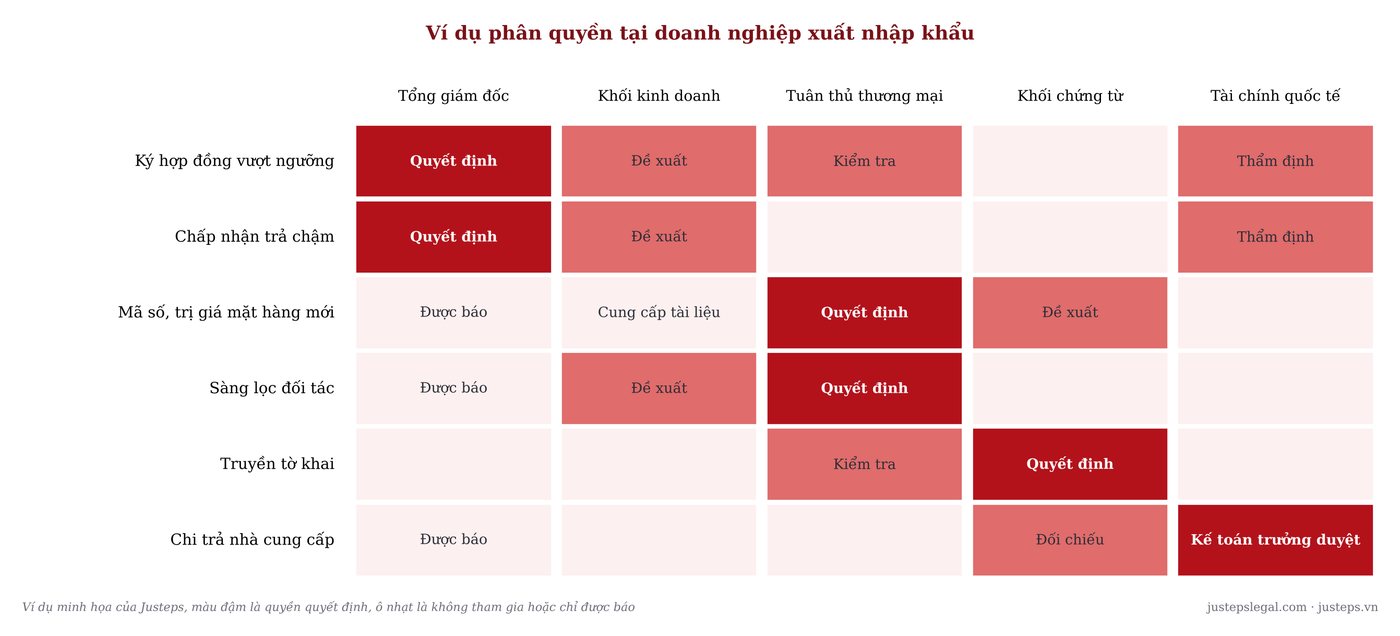
Example allocation of authority between the board of directors and the functions in an import-export business of about thirty-five people
In this example, the general director decides on signing foreign trade contracts above the threshold and accepting deferred payment terms, on the basis of a proposal from sales and an assessment by international finance. Trade compliance decides the tariff code and customs value for new products and the outcome of counterparty screening, while the general director is only informed. The documentation function decides on transmitting the declaration once the draft matches the approved data, and the chief accountant decides on payments to foreign suppliers. Authority to issue the organisational structure and the delegation of authority rules rests with the owner, the Members’ Council or the Board of Directors depending on the type of enterprise and the Charter[9].
Staffing by declaration volume and business model
The number of people needed in each function depends more on the number of declarations per month, the number of markets and the complexity of the products than on revenue. A business importing consumer goods for distribution needs more people for specialised inspection, product labelling and domestic delivery, while an exporting business needs strength in origin, tax refunds and international payments. The chart below compares staffing at three typical sizes that Justeps often encounters.
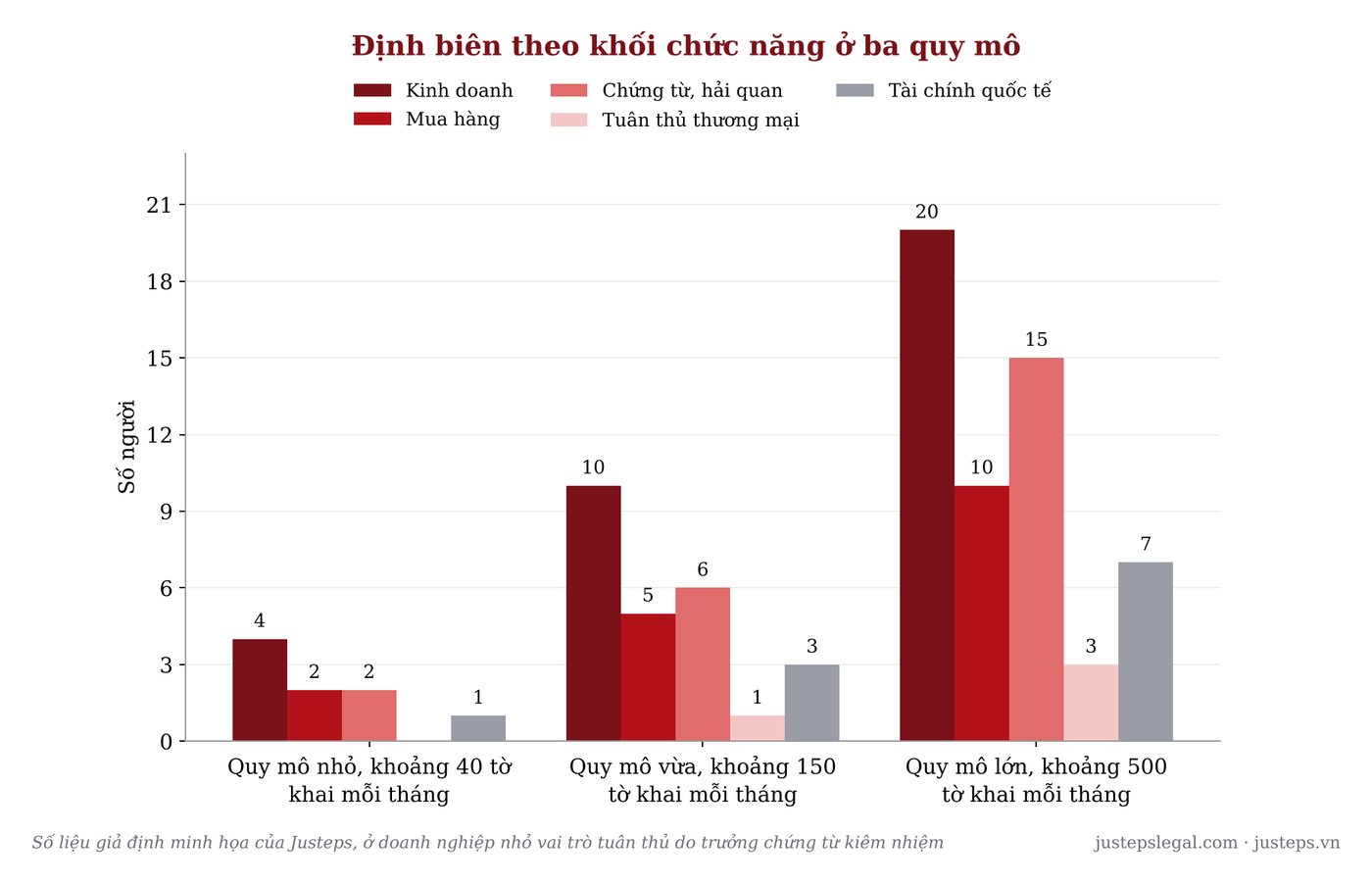
Example staffing by function at three sizes of import-export business
In the example, a small business with about 40 declarations per month needs 9 people, comprising 4 in sales, 2 in purchasing, 2 in documentation and 1 in international finance, with the trade compliance role held concurrently by the head of documentation. A medium-sized business with about 150 declarations per month needs 25 people, including 1 dedicated trade compliance officer. A large business with about 500 declarations per month, or one aiming for priority enterprise status with the customs authority, needs 55 people, with a three-person compliance unit independent of sales. Foreign-invested enterprises must also check the scope of export, import and distribution rights stated in their licences against the functions of each unit before assigning tasks.
Implementation process, deliverables and fees
An organisational structure design project for an import-export business usually takes about seven weeks. Justeps selects a number of typical export and import orders and follows the entire file from quotation to archiving to see who actually decides what, and only then proposes organisational options for management to choose from.
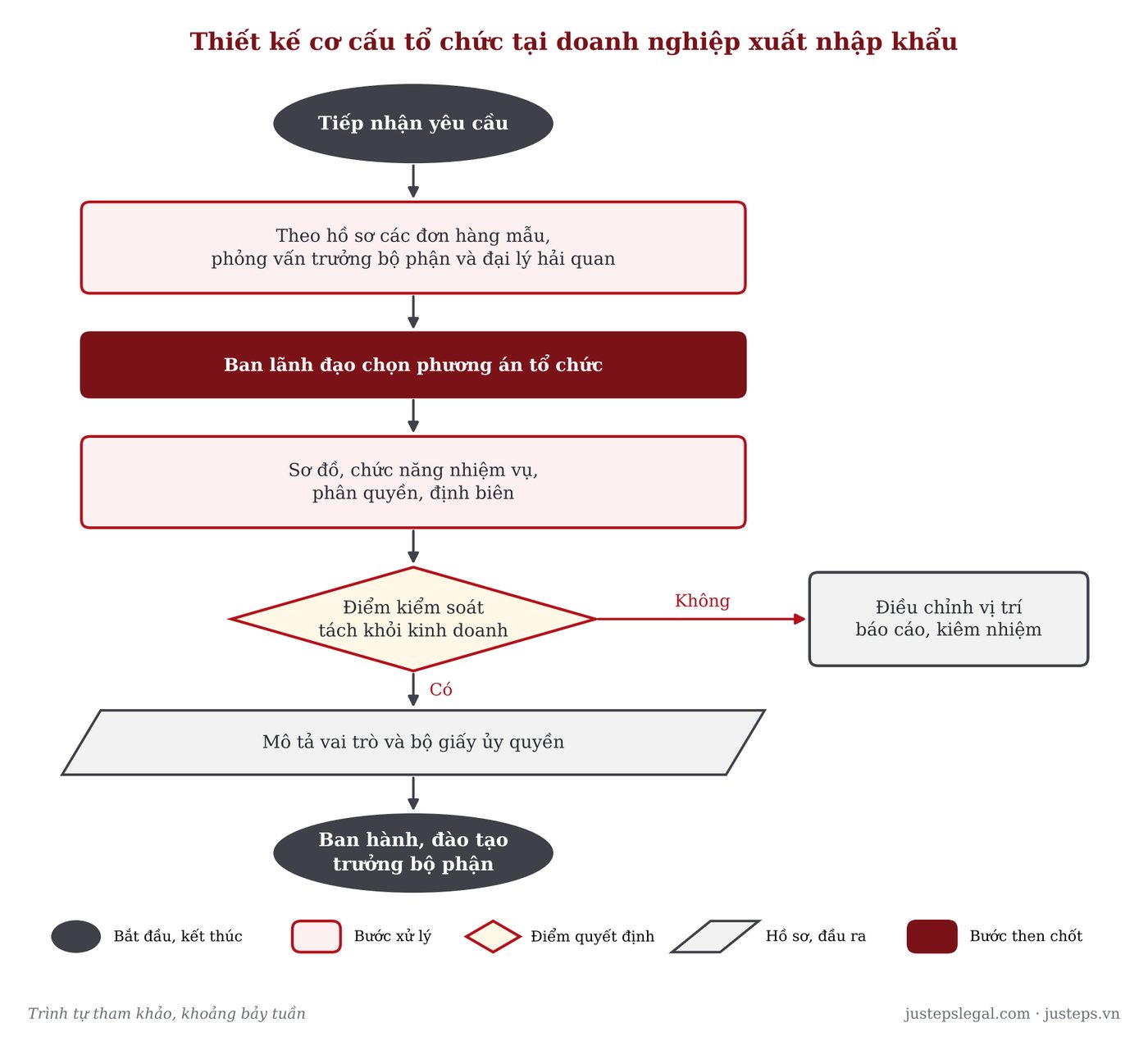
Sequence for designing and applying the organisational structure in an import-export business
In the first two weeks, Justeps reads the contracts, declarations and payment records of the sample orders and interviews the heads of department and the customs broker. In the third week, management chooses an organisational option, after which Justeps drafts the chart, functions and duties, authority matrix and staffing table over two weeks. If any control point still has no holder or remains in the hands of someone carrying sales targets, Justeps makes adjustments before finalising the role descriptions and letters of authorisation. The deliverables comprise the following documents:
- A report assessing the order flow and identifying existing concurrent roles and conflicts of interest.
- An organisational chart with an explanation of the position of trade compliance and international finance.
- Rules on the functions and duties of each unit and descriptions of key roles such as head of documentation, trade compliance officer and international payments officer.
- An authority matrix for signing contracts, approving tariff codes, customs value and origin, payment terms and handling claims.
- A staffing table based on declaration volume and number of markets.
- A set of letters of authorisation for signing contracts, signing customs documents and dealing with banks, and a draft decision issuing the organisational structure.
Justeps quotes a fixed project fee in writing after the initial meeting. The fee depends on the number of products and markets, the annual number of declarations, whether the business has branches, a bonded warehouse or entrustment activities, the need for bilingual documents for an overseas parent company and whether the business needs Justeps to follow the implementation stage closely. A business wishing to link the new structure with its financial control system can combine this with the internal financial control system service.
How Justeps can help
In addition to organisational structure design, import-export trading businesses can combine the following Justeps services:
- Internal procedures and regulations for import-export trading businesses. Justeps writes the rules on tariff codes, customs value, origin, counterparty screening and shipment file retention for the newly designed positions.
- Ongoing legal advisory for import-export trading businesses. Justeps supports the trade compliance function when reviewing foreign trade contracts and letters of credit and when working with the customs authority.
- Financial regulations and delegation of authority. Justeps sets limits for signing contracts, accepting deferred payment and making foreign currency payments for each management level.
- Internal financial control system. Justeps links the authority matrix with the steps for matching contracts, declarations and payment records.
- Tax, customs and international trade. Justeps reviews tariff codes, customs value, origin and tax refund files when the business needs an in-depth opinion on a specific product.
Frequently asked questions
Does a small business need a separate trade compliance department?
It is not mandatory, but the business needs one person clearly given the power and responsibility to approve tariff codes, customs value and origin. This person may be the head of documentation, provided that he or she carries no sales targets and has the power to refuse to transmit a declaration.
If we already use a customs broker, do we still need a documentation function?
Yes, because the broker declares on the basis of documents provided by the business and the owner of the goods still bears the tax obligations[6]. The documentation function checks the draft declaration and keeps the shipment file after clearance.
Who may sign foreign trade contracts?
The legal representative, or a person authorised in writing within the scope of that authorisation[7]. The value thresholds and types of contract each person may sign should be stated in the authority matrix so that counterparties and banks have a basis for checking.
How long must customs files be kept?
Customs files for cleared goods are kept for five years from the date the declaration is registered, unless otherwise provided by law[2]. The organisational structure should assign archiving to a specific position rather than leaving files in individual staff mailboxes.
Can the accountant also handle international payments?
Yes in a small business, if that person understands letters of credit, delivery terms and foreign trade document sets. When the number of deferred payment contracts or markets grows, the business should separate this function so that someone assesses payment terms independently.
When should the organisational structure be reviewed?
Once a year, and immediately when the business opens a new market, trades goods subject to specialised management, opens a bonded warehouse, acts under entrustment or has just received an unfavourable post-clearance audit conclusion.
Related articles
- Internal procedures and regulations for import-export trading businesses from contract to shipment file
- Ongoing legal advisory for import-export trading businesses on contracts, payments and customs
- Labour, wages and social insurance services for import-export trading businesses with commissions and foreign employees
- Organisational structure design for logistics, warehousing and freight transport businesses
Notes
[1] Article 77 of the Law on Customs No. 54/2014/QH13 dated 23 June 2014, as amended and supplemented by subsequent laws, most recently Law No. 11/2026/QH16 effective from 1 March 2027.
[2] Point dd, Clause 2, Article 18 of the Law on Customs No. 54/2014/QH13 dated 23 June 2014, as amended and supplemented by subsequent laws, most recently Law No. 11/2026/QH16 effective from 1 March 2027.
[3] Article 28 of the Law on Customs No. 54/2014/QH13 dated 23 June 2014, as amended and supplemented by subsequent laws, most recently Law No. 11/2026/QH16 effective from 1 March 2027.
[4] Government Decree No. 169/2026/ND-CP dated 15 May 2026 on penalties for administrative violations in the customs sector, effective from 1 July 2026.
[5] The Law on Foreign Trade Management and the documents amending and supplementing it.
[6] Article 20 of the Law on Customs No. 54/2014/QH13 dated 23 June 2014, as amended and supplemented by subsequent laws, most recently Law No. 11/2026/QH16 effective from 1 March 2027.
[7] Article 12 of the Law on Enterprises No. 59/2020/QH14 dated 17 June 2020, as amended and supplemented by Law No. 76/2025/QH15.
[8] Article 9 of the Law on Value-Added Tax No. 48/2024/QH15 and Article 17 of Government Decree No. 181/2025/ND-CP dated 1 July 2025 detailing that Law, together with the documents amending and supplementing them.
[9] The Law on Enterprises No. 59/2020/QH14 dated 17 June 2020, as amended and supplemented by Law No. 76/2025/QH15.
This article is for reference and reflects the regulations in force at the time of publication. Please consult Justeps for advice tailored to your company’s records and situation.
For further information, please contact:
📩 Email: info@justeps.vn
🌐 Website: https://justepslegal.com · https://justeps.vn
🌐 Page: Justeps
☎️ Hotline (Zalo): 096 172 2607
📍 Thanh Xuan Office: 12th Floor, Licogi 13 Tower, 164 Khuat Duy Tien Street, Thanh Xuan Ward, Hanoi, Vietnam
📍 Ha Dong Office: LK06B, No.10, Dong Dua Area, Ha Dong Ward, Hanoi, Vietnam
📍 Ho Chi Minh City Branch: 528 Le Van Sy, Ho Chi Minh City, Vietnam
📍 Hai Phong Office: Truong Thinh Village, Ha Dong Commune, Hai Phong, Vietnam
📍 Quang Ninh Office: Van Don Special Zone, Quang Ninh Province, Vietnam





