
Key takeaways
- Each medical examination and treatment establishment has only one person in charge of professional matters, who represents the establishment in all of its professional activities, so the organisation chart must give that person real authority rather than merely a signature[2].
- A clinic chain cannot be managed like a chain of shops, because each location is a separately licensed establishment with its own list of practitioners and its own professional scope[3].
- A doctor may be registered to practise at several establishments, but the working hours may not overlap, so scheduling doctors between locations is a decision with legal consequences[5].
- The law assigns the prevention of medical incidents to the head of the establishment, so the quality management function needs to stand outside revenue pressure and report directly to the highest level[7].
Most private clinics begin with a doctor of strong professional standing and one or several investors who contribute capital, lease premises and buy equipment. When the clinic opens further locations, adds specialties or grows into a hospital, the line between these two roles becomes blurred, and questions such as who may decide to introduce a new technique, who may assign a doctor to another location and who may halt a service package that is selling well begin to cause disputes. If the answers are not consistent with the operating licence and the registered list of practitioners, the business faces the risk of penalties, suspension of part of its activities or difficulty in proving that it was properly organised when a medical complication occurs.
This page introduces Justeps’ organisational structure design service for businesses owning specialist clinics, general clinics, multi-location clinic chains and private hospitals, including foreign-invested establishments. It moves from the regulations governing the organisation, the four-axis model of authority, common mistakes and the allocation of authority to the implementation sequence, the deliverables and how the approach applies by size. Detailed clinical procedures, monthly legal support and human resources policies for medical staff are presented on three other service pages for the same sector.
The regulations that determine how the organisation is structured
Two layers of responsibility within one business
A business owning a clinic or hospital is still organised under the Law on Enterprises, with a members’ council or board of directors, a director or general director and a legal representative[1]. Alongside that corporate governance layer, the 2023 Law on Medical Examination and Treatment adds a layer of professional responsibility, under which the person in charge of professional matters represents the establishment in all of its professional activities[2]. A good organisation chart must answer which decisions belong to the business powers of the owner and the executive team, and which belong to professional authority in which the executive team may not interfere.
Operating licences attach to each establishment
One of the conditions for an operating licence is that the establishment has sufficient practitioners appropriate to its professional scope and size, and each establishment has only one person in charge of professional matters[3]. When the business wishes to change its scope of professional activities, for example by adding a specialty or a new technique, the establishment must apply to adjust its licence and meet the corresponding conditions before implementation[4]. Organisationally, this means that a decision to expand services cannot pass only through the sales department and the board of management, but must include a confirmation step by the professional division covering staffing, equipment and legal records.
Practitioners working at several places
A practitioner may be registered to practise at several establishments, but the hours of medical examination and treatment at those establishments may not overlap[5]. Within one establishment, a person may simultaneously examine patients under a practising licence, head a professional unit and serve as the person in charge of professional matters, provided that the quality of work in each assigned position is ensured[6]. This rule requires a clinic chain to manage each doctor’s working schedule at company level, rather than letting each location draw up its own roster and discover overlapping hours only during an inspection.
Quality and medical incidents
The 2023 Law on Medical Examination and Treatment makes the prevention of medical incidents the responsibility of the head of the establishment, carried out by identifying, reporting and analysing causes and proposing preventive solutions[7]. When a professional council finds that a practitioner has made an error, the consequence may be suspension of practice or withdrawal of the practising licence, leaving the establishment short of staff for its licensed scope[8]. The organisation therefore needs a quality and patient safety lead with access to every incident report, including incidents involving doctors who are shareholders or founders.
The four-axis model of authority
Justeps does not divide a clinic’s organisation into departments as it would for an ordinary trading company. The organisation is built around four axes of authority, each with its own head, scope of decision-making and reporting line, before moving on to specific departments, units and divisions. The model below is a reference framework, reduced for a single-location specialist clinic and expanded for a hospital or a multi-location chain.
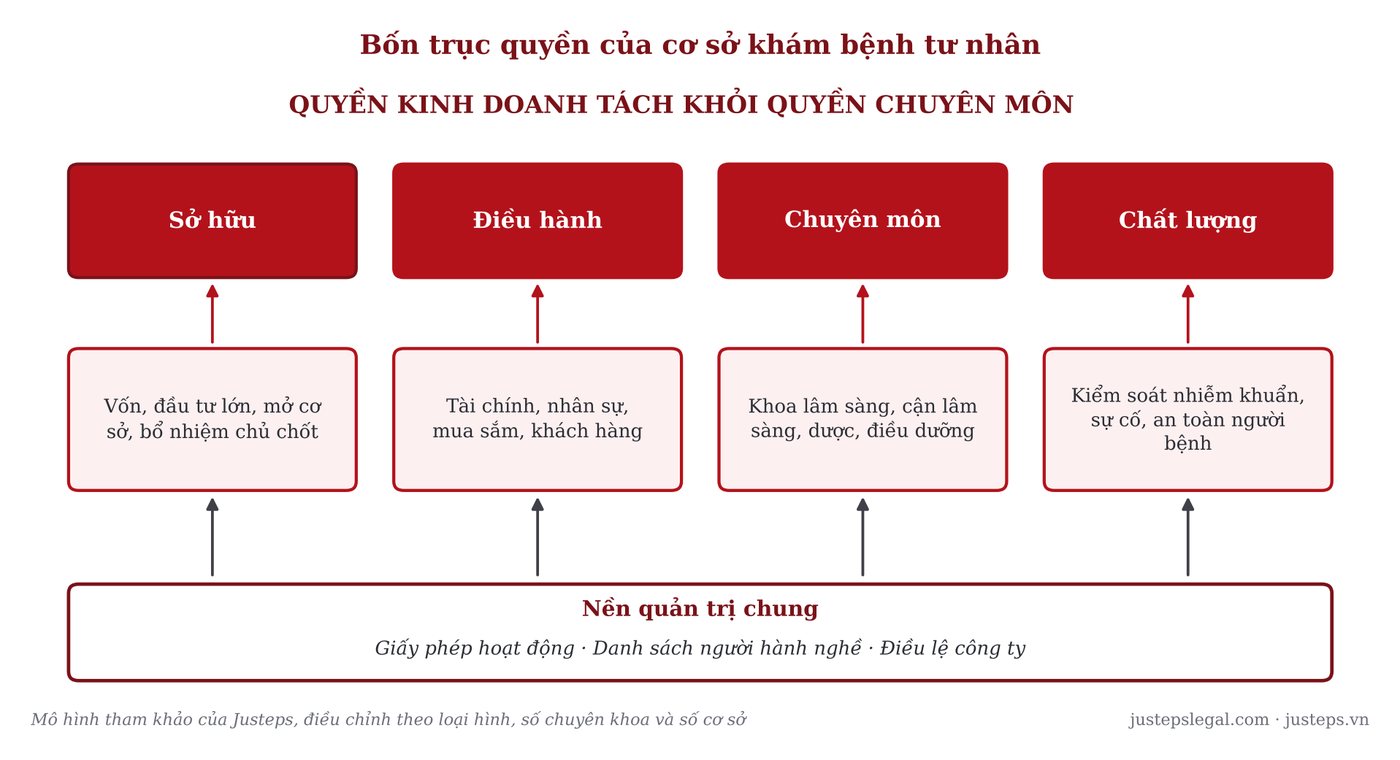
The four axes of authority in a private clinic or hospital business and their common governance base
The ownership axis comprises the owner and the members’ council or board of directors, which decide on capital, major investments, opening new establishments and appointing key positions. The executive axis is headed by the director or general director and covers finance, human resources, procurement, customer care, marketing and the operation of facilities. The professional axis is headed by the person in charge of professional matters and manages the clinical and paraclinical departments, pharmacy and nursing. The quality axis covers quality management, infection control and incident reporting, reports directly to the head of the establishment and has the power to propose halting a technique when a risk is identified. Every change to the chart must be checked against the operating licence, the list of practitioners and the company charter.
Common mistakes in existing organisations
The person in charge of professional matters is a name only
Some establishments invite a senior doctor to be named as the person in charge of professional matters in order to qualify for a licence, while that person is seldom present and takes no part in decisions on techniques, staffing or procedures. When an inspection team arrives or a complication occurs, the establishment struggles to explain who approved the procedure, who assigned the person performing it and who supervised. Justeps proposes clearly describing the powers of this position, the minimum time on site, the arrangement for delegating authority during absences and the obligation to give advance notice before resigning, so that the establishment has time to appoint a qualified replacement.
Pharmacy, laboratory and diagnostic imaging sit under the sales division
At many clinics, the pharmacy, laboratory and diagnostic imaging units are treated as revenue centres and placed under the commercial director. This arrangement readily puts pressure on prescribing and ordering, whereas the law prohibits prescribing medicines, ordering technical services or suggesting patient transfers for improper gain[9]. These units should belong to the professional axis for decisions on ordering and quality, while the executive axis manages only costs, supplies and equipment utilisation.
A clinic chain run like a retail chain
Many clinic chains use a regional manager to oversee locations and move doctors around according to patient volume. Yet each location is an establishment with its own licence, its own person in charge of professional matters and its own list of practitioners, so assigning a doctor to another location without updating the practice registration may be treated as practising at a place other than the one registered. The chain’s chart needs a central professional level to coordinate staffing and standardise procedures, while preserving professional authority at each establishment.
A quality function that exists only on paper
Small clinics often assign infection control and medical waste management to a nurse as an additional duty, without commensurate time or authority. At hospitals, professional councils are fully established but rarely meet and keep no minutes. Justeps specifies the person responsible, the time allocated to the task, the power to require departments to take corrective action and the reporting arrangements, so that the quality function operates in substance.
Allocating authority over sensitive decisions
The organisation chart needs to be accompanied by an authority matrix for decisions that one side may want to make quickly for business reasons while the other must weigh them for patient safety. The principle Justeps applies is that decisions creating financial commitments belong to the ownership or executive axis, decisions on ordering and techniques belong to the professional axis, and decisions to stop an activity in order to prevent risk go to the person closest to the matter. The example below is for a general clinic with two or more locations.
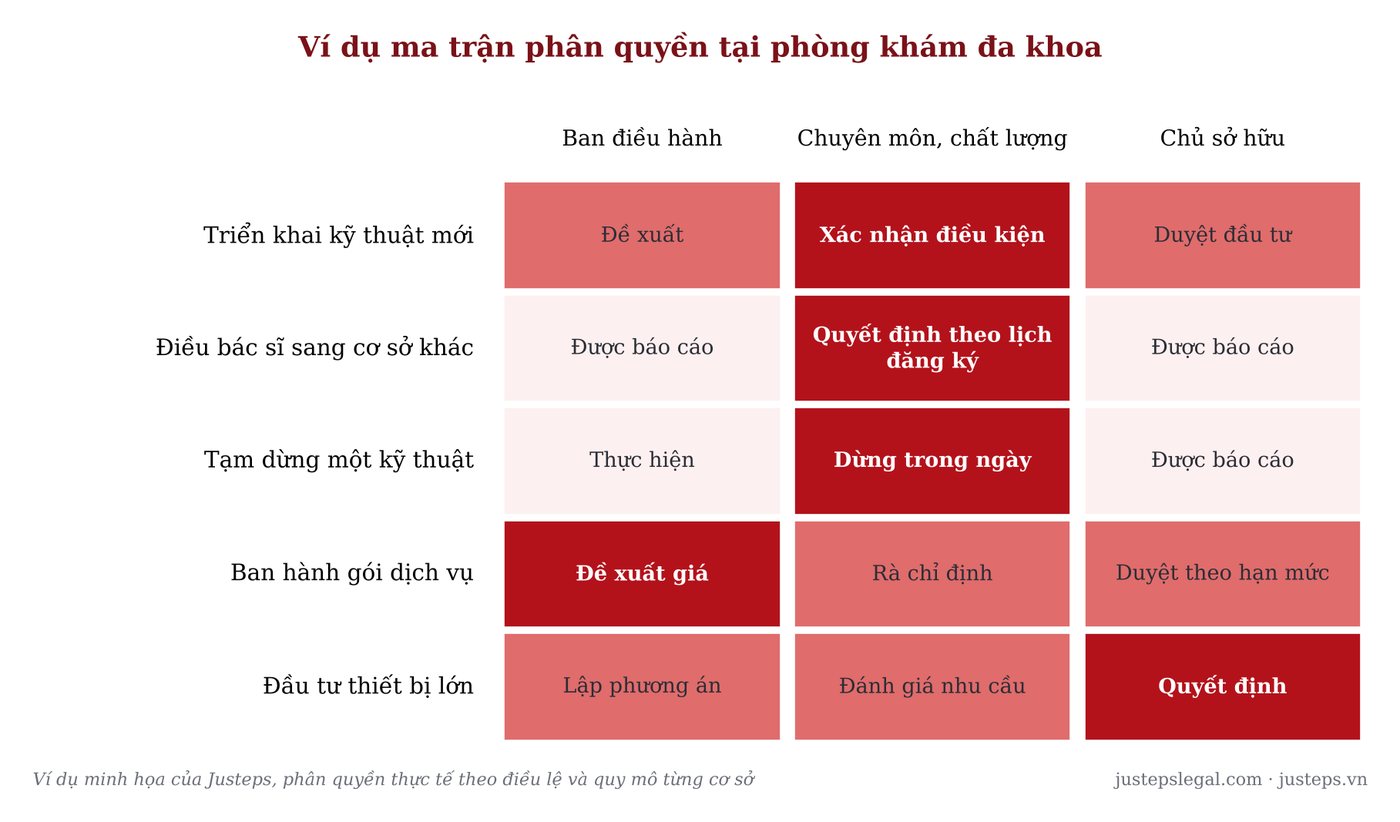
Example allocation of authority for five common decisions at a private general clinic
In this example, the executive team proposes new techniques and service packages, but the person in charge of professional matters confirms that the establishment has sufficient practitioners, equipment and procedures before the owner is asked to approve the investment. Assigning doctors between locations is decided by the central professional unit on the basis of the practice registration schedule, and the executive team is only informed. When signs of risk are found in a technique, the quality unit may propose an immediate suspension and the person in charge of professional matters decides within the day, instead of waiting for the following week’s management meeting. Service prices are proposed by the executive team and approved by the owner within set limits, but the professional division must confirm that a package does not bundle unnecessary orders.
How the service is carried out
An organisational structure design project for a private hospital usually takes about ten weeks, while one for a single-location specialist clinic is usually shorter. What distinguishes this sector from others is that the new chart must be checked against the operating licence and the list of practitioners before it is issued, and may require procedures with the health authority.
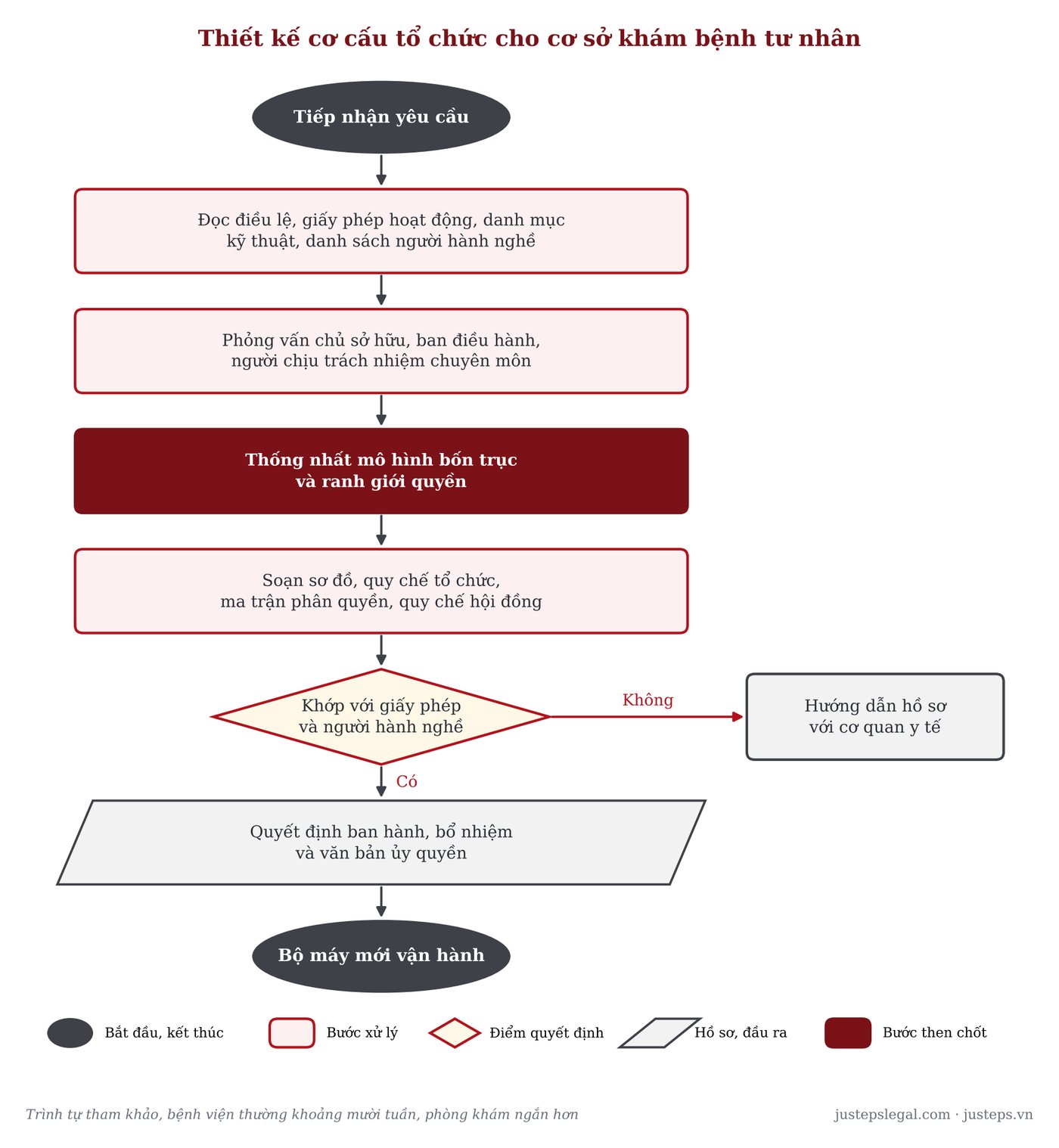
Sequence of organisational structure design including a check against the operating licence
In the first two weeks, Justeps consultants read the charter, licences, list of techniques, list of practitioners and contracts with doctors, and then prepare a table comparing each professional position with the legal conditions. Week three is devoted to interviews with the owner, the executive team, the person in charge of professional matters and the heads of departments. The most important milestone is a joint working session at which the investors and the person in charge of professional matters agree on the four-axis model and the boundaries of authority. After the documents have been drafted, Justeps carries out a final check against the licence; if the chart requires additional practitioners or a change of the person in charge of professional matters, Justeps advises on the filings to be made with the health authority before the decision is issued.
Documents the business receives
The set of documents is delivered in editable electronic form, together with draft instruments for approval by the competent body under the charter, and comprises the following main documents:
- A survey report identifying positions that do not yet meet the conditions on licences, scope of practice, working hours or reporting lines.
- A four-axis organisation chart at company level and detailed charts for each establishment or each division of the hospital.
- Regulations on organisation and operation, together with the functions and duties of each department, unit and division.
- An authority matrix covering the owner, the executive team, the person in charge of professional matters and the quality unit.
- Operating rules for the professional councils of a hospital, or a decision assigning the responsible persons for a clinic.
- Draft appointment decisions, a letter of authorisation for periods of absence and a list of procedures to be completed with the health authority.
Once the organisation has taken shape, each department and unit needs clinical procedures and management regulations so that everyone works to the same standard. Justeps carries out this work under its service for building internal procedures and regulations for private clinic and hospital businesses, which can be contracted at the same time so that both sets of documents share one authority matrix.
Application by size and model
Specialist clinics such as dental, dermatology, ophthalmology or obstetrics and gynaecology clinics have a lean organisation, and the person in charge of professional matters usually also heads the clinical unit. The focus here is the boundary between staff who sell treatment packages and the doctors who order treatment, together with the person responsible for instrument sterilisation and medical waste. General clinics and hospitals need a fuller organisation, with a general planning department, a nursing department, a pharmacy department, an infection control unit, quality management and professional councils. Establishments with a health insurance contract for medical examination and treatment also need an internal claims review lead and payment data management, because rejected claims usually stem from records that are inconsistent between departments[10].
A multi-location clinic chain needs an additional central tier comprising a chain medical director, a procedure standardisation unit and a unit managing the legal records of all establishments, while each establishment retains its own person in charge of professional matters. Foreign-invested establishments often have to balance the parent company’s rights over strategy and budgets with the professional authority of the Vietnamese legal entity, while also checking the practice conditions and language requirements for foreign doctors[11]. Policies on contracts, on-call duty and income for the positions in the new organisation are developed in the labour, payroll and insurance service for private clinic and hospital businesses.
What determines the service fee
Justeps quotes a fixed fee in writing after the initial meeting. The main factors are the type of establishment, the number of specialties and locations, whether there are inpatient beds, the number of professional councils needing operating rules, the gap between the current organisation and the legal requirements, and any need for bilingual documents. Justeps’ proposal sets out the scope, deliverables, timeline and matters outside the scope so that the owner can plan the budget.
How Justeps can help
Alongside organisational structure design, private clinic and hospital businesses may combine the following Justeps services:
- Building internal procedures and regulations for private clinic and hospital businesses. Justeps drafts clinical procedures, consent forms, medical record regulations and pricing regulations so that each department operates under the new organisation.
- Ongoing legal advisory for private clinic and hospital businesses. Justeps monitors licences, contracts and issues arising each month after the new organisation has been issued.
- Financial regulations and delegation of authority. Justeps sets spending limits and rules for approving prices and equipment investment in line with the authority matrix between investors and the executive team.
- Organisational structure, functions and duties, and job descriptions. Justeps drafts job descriptions for the executive and support positions of the medical establishment.
Frequently asked questions
May the company director also be the person in charge of professional matters?
Yes, provided that the person holds a valid practising licence, meets the professional conditions and actually works at the establishment. When one person holds both roles, the regulations should add a cross-check mechanism, for example the quality unit reporting directly to the owner when revenue and professional considerations conflict.
May an investor who is not a doctor own a clinic?
Yes. The law does not require the owner of the business to be a practitioner, but the establishment must have a qualified person in charge of professional matters and sufficient practitioners appropriate to its scope of activities[3]. The charter and regulations should clearly state the professional decisions in which the owner does not interfere.
Does each establishment in a chain need its own person in charge of professional matters?
Yes, because each medical examination and treatment establishment has only one person in charge of professional matters and each establishment is licensed separately[3]. A chain may also have a medical director at company level for coordination, but that position does not replace the person in charge of professional matters at each establishment.
Does a small clinic need to set up professional councils?
Councils such as the drugs and therapeutics council and the infection control council mainly apply to hospitals. A clinic still needs to assign in writing the persons responsible for infection control, medicines management, medical waste and incident reporting, with commensurate time and powers.
What should the business do when the person in charge of professional matters resigns?
The business needs to arrange a qualified replacement and complete the procedures with the health authority as required before the outgoing person leaves, so that the establishment does not fall short of its operating conditions. The contract for this position should provide for a longer notice period and an obligation to hand over professional records.
What should foreign-invested establishments note about their organisation?
The parent company usually wishes to control budgets, branding and global quality standards, while legal responsibility for professional matters in Vietnam rests with the licensed establishment. Justeps prepares a bilingual authority matrix stating which decisions require the parent company’s opinion and which the establishment may take on its own, so that there is no delay in professional situations.
Related articles
- Organisational structure of a private dental clinic with one to three locations
- The authority of the General Director and how to delegate executive powers within the limits of the charter and internal rules
- Restructuring a fast-growing business so that its organisation keeps pace with its new scale
- The minimum set of internal governance rules for businesses with 50 to 200 employees
Notes
[1] The Law on Enterprises No. 59/2020/QH14 dated 17 June 2020, as amended and supplemented by Law No. 03/2022/QH15 and Law No. 76/2025/QH15.
[2] Clause 13 of Article 2 of the Law on Medical Examination and Treatment No. 15/2023/QH15 dated 9 January 2023, as amended and supplemented by Law No. 112/2025/QH15 and Law No. 113/2025/QH15.
[3] Point e of Clause 2 of Article 52 of the Law on Medical Examination and Treatment No. 15/2023/QH15 dated 9 January 2023, as amended and supplemented by Law No. 112/2025/QH15 and Law No. 113/2025/QH15; Government Decree No. 96/2023/ND-CP dated 30 December 2023 detailing a number of articles of the Law on Medical Examination and Treatment.
[4] Article 54 of the Law on Medical Examination and Treatment No. 15/2023/QH15 dated 9 January 2023, as amended and supplemented by Law No. 112/2025/QH15 and Law No. 113/2025/QH15.
[5] Clause 1 of Article 36 of the Law on Medical Examination and Treatment No. 15/2023/QH15 dated 9 January 2023, as amended and supplemented by Law No. 112/2025/QH15 and Law No. 113/2025/QH15.
[6] Clause 2 of Article 36 of the Law on Medical Examination and Treatment No. 15/2023/QH15 dated 9 January 2023, as amended and supplemented by Law No. 112/2025/QH15 and Law No. 113/2025/QH15.
[7] Article 71 of the Law on Medical Examination and Treatment No. 15/2023/QH15 dated 9 January 2023, as amended and supplemented by Law No. 112/2025/QH15 and Law No. 113/2025/QH15.
[8] Point a of Clause 1 of Article 34 and Article 101 of the Law on Medical Examination and Treatment No. 15/2023/QH15 dated 9 January 2023, as amended and supplemented by Law No. 112/2025/QH15 and Law No. 113/2025/QH15.
[9] Clause 9 of Article 7 of the Law on Medical Examination and Treatment No. 15/2023/QH15 dated 9 January 2023, as amended and supplemented by Law No. 112/2025/QH15 and Law No. 113/2025/QH15.
[10] The Law on Health Insurance No. 25/2008/QH12, as amended and supplemented, most recently by Law No. 51/2024/QH15.
[11] The Law on Investment No. 143/2025/QH15, effective from 1 March 2026, and the Law on Medical Examination and Treatment No. 15/2023/QH15 dated 9 January 2023, as amended and supplemented by Law No. 112/2025/QH15 and Law No. 113/2025/QH15.
This article is for reference and reflects the regulations in force at the time of publication. Please consult Justeps for advice tailored to your company’s records and situation.
For further information, please contact:
📩 Email: info@justeps.vn
🌐 Website: https://justepslegal.com · https://justeps.vn
🌐 Page: Justeps
☎️ Hotline (Zalo): 096 172 2607
📍 Thanh Xuan Office: 12th Floor, Licogi 13 Tower, 164 Khuat Duy Tien Street, Thanh Xuan Ward, Hanoi, Vietnam
📍 Ha Dong Office: LK06B, No.10, Dong Dua Area, Ha Dong Ward, Hanoi, Vietnam
📍 Ho Chi Minh City Branch: 528 Le Van Sy, Ho Chi Minh City, Vietnam
📍 Hai Phong Office: Truong Thinh Village, Ha Dong Commune, Hai Phong, Vietnam
📍 Quang Ninh Office: Van Don Special Zone, Quang Ninh Province, Vietnam





