
Key takeaways
- Each outlet is a separate subject of regulation for food safety, fire prevention and invoicing[1], so the organisational chart must show the person responsible at each outlet rather than merely the revenue reporting lines.
- The registered form of an outlet, whether a business location, a branch or a separate company[6], determines where tax is declared, who signs contracts and how labour is managed, so it must be chosen before the organisation is drawn.
- A central kitchen operates as a food production establishment, so it needs a production manager and a quality controller who are independent of the outlets’ sales targets.
- The person who orders, the person who receives goods and the person who approves payment to suppliers should be three different people, even in a small café, because this is the most common point of ingredient loss.
Most restaurant and café chains in Vietnam start from a single outlet where the owner personally cooks, receives goods and holds the cash. When the chain grows to three, five and then ten outlets, the owner can no longer be everywhere, yet decisions still converge on one person, while legal obligations such as food safety certificates, fire prevention records or alcohol sale licences are monitored by nobody. Problems usually only come to light when an inspection team arrives, a customer suspects food poisoning or an investor reviews the chain before investing.
This page introduces Justeps’ service of designing the organisational structure of restaurants, cafés, takeaway drinks outlets, food chains with a central kitchen and franchise systems. It focuses on choosing the legal form of each outlet, assigning each obligation to a specific position, allocating authority between the chain office and the outlets, and setting headcount according to the service model. How staff work day to day at each stage is set out under the internal procedures and regulations service for restaurant, café and F&B chain businesses.
Each outlet is a separate compliance point
Regulators view an F&B chain address by address rather than as one business. An establishment providing food services must meet food safety conditions and, except in exempt cases, hold a certificate of eligibility for food safety for that specific location[1][2]. Similarly, fire prevention records are prepared for each building[3], invoices are issued at the outlet through cash registers or sales software[4], and the sale of alcohol for consumption on the premises is subject to its own restrictions[5].
As a result, each outlet needs a named person with authority and time to keep these records, usually the outlet manager, with a deputy when the outlet manager is on leave. At the chain office, Justeps proposes a position responsible for operational legal matters, which may be held concurrently, to monitor the expiry of all documents at every outlet. The table below shows the allocation Justeps typically uses for chains of five to twenty outlets.
| Obligation | Person responsible at the outlet | Person monitoring at the chain office |
|---|---|---|
| Food safety | The head chef keeps the receiving log, food checks and sample retention; the outlet manager signs off at the end of the day. | The quality control unit carries out spot checks and monitors certificate expiry. |
| Fire prevention | The outlet manager keeps the records, assigns the on-site fire team and checks extinguishers. | The operational legal officer schedules inspections and drills for the whole chain. |
| Invoices and revenue | The cashier issues an invoice for each transaction; the shift leader reconciles at shift close. | The chain accountant reconciles cash register data with money received in the bank account. |
| Sale of alcohol and beer | The shift leader decides to refuse service to under-age or intoxicated customers. | The operational legal officer monitors each outlet’s licence and conditions for selling alcohol. |
| Premises and signage | The outlet manager reports immediately when the landlord or local authority makes a request. | The premises development officer monitors lease expiry dates and signage documents. |
Choosing the legal form of each outlet
Before drawing the chart, the business needs to decide in what form each outlet will be registered. Under the Law on Enterprises, a business location is a place where specific business activities are conducted, while a branch is a dependent unit that may perform all or part of the enterprise’s functions, including authorised representation[6]. Registration and notification of these units follow the decree on enterprise registration[7].
This choice has many consequences for the organisation. If an outlet is registered as a business location, all contracts, including premises leases and employment contracts, are signed by the company’s representative or under authorisation, whereas a branch has a head with broader delegated powers and may have its own seal and bank account. Some chains set up each cluster of outlets as a separate company to spread risk or to bring in investors market by market, which requires an additional governance layer between the parent company and the operating companies. For franchised outlets, the outlet belongs to the franchisee, so the franchisor’s organisation consists only of support and standards monitoring functions and does not manage outlet staff[8].
Justeps prepares an assessment table for each existing and planned outlet, comparing three factors, namely where tax is declared and invoices issued, who signs contracts and manages labour, and the ability to sell or transfer the outlet separately in future. The registration filings can then be handled through the service for opening branches, representative offices and business locations.
A central kitchen needs its own production division
When a chain starts pre-processing ingredients, making stock, baking or preparing drink bases in a central kitchen and then delivering them to outlets, the central kitchen is no longer just a large kitchen but becomes a food production establishment. The requirements on production conditions, labelling of products transferred internally, transport in refrigerated vehicles and batch traceability are all heavier than for an outlet[1]. If the chain also sells packaged products such as roasted coffee, sauces or takeaway cakes to customers, those products must also go through self-declaration or registration of the product declaration as required[2].
Justeps therefore designs the central kitchen as a division with a production manager, a warehouse and delivery team, and a quality control unit that reports directly to the chief executive or the owner rather than to the outlet operations director. This arrangement ensures that the person with authority to hold or discard a batch of ingredients is not influenced by outlet sales pressure. In smaller chains without a central kitchen, the quality control role can be given to an executive chef who carries out cross-checks between outlets.
Separating the buyer, the receiver and the payer
Ingredients are usually a restaurant’s largest cost, and losses at this stage are hard to detect because they occur in small amounts. The situation Justeps encounters most often is that the head chef chooses the supplier, orders the goods, signs for receipt and signs the payment request, so nobody checks quantity, quality or price. The correct structure separates these three tasks among three people, with the chain’s purchasing unit selecting suppliers and agreeing prices, the head chef ordering according to norms, and the receiver at the outlet weighing, counting and recording temperatures before signing.
The chain accountant only pays when three documents match, namely the purchase order, the goods received note and the supplier’s invoice. In a single-outlet café, the owner may personally act as payment approver, but should still assign receiving goods to someone other than the person who orders. Spending, contract signing and discount limits for each level are set out in detail through the financial regulations and delegation of authority service.
Allocating authority between the owner, the chain office and the outlets
Fast-growing chains often face one of two situations, either the owner approves even shift swaps of waiting staff, or the outlet manager signs warehouse leases and runs promotions without the office knowing. An authority matrix resolves both by stating for each type of decision who proposes, who decides and who is merely informed. The example below is a matrix Justeps built for a chain of about twelve outlets with a central kitchen.
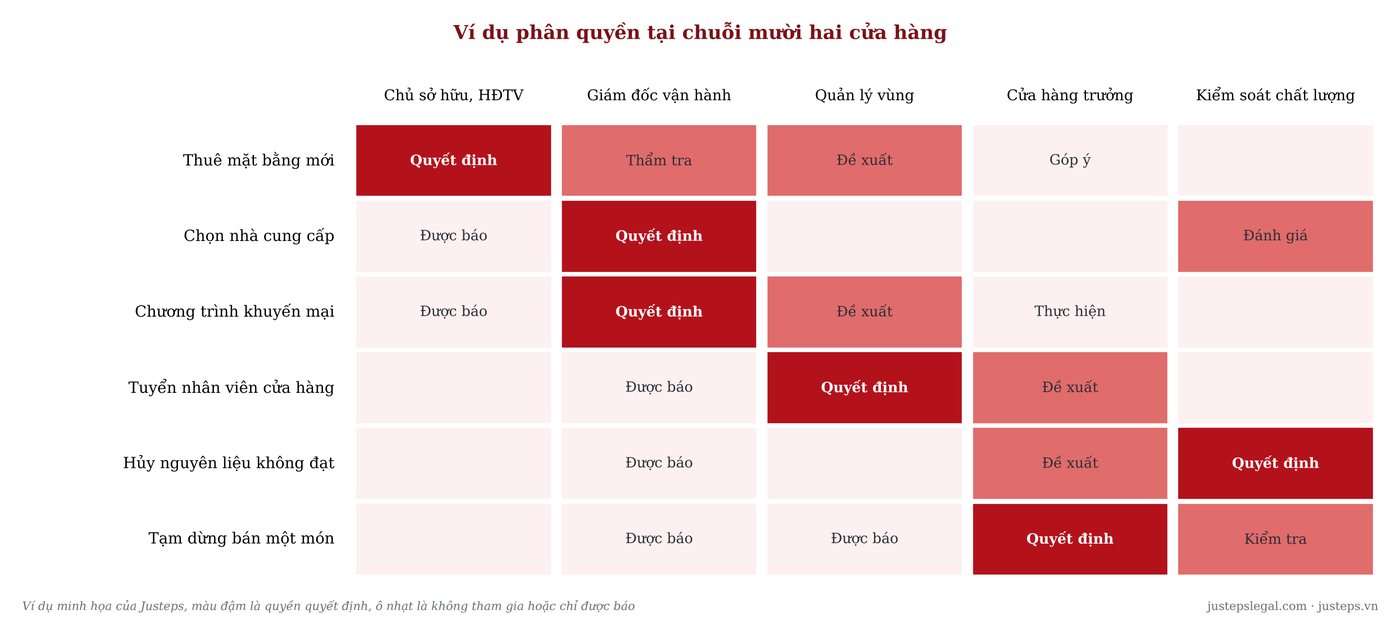
Example allocation of authority between the owner, the chain office and outlets in a twelve-outlet chain
In this example, the owner or Members’ Council retains decision-making power only over premises leases, because these are the chain’s longest-term financial commitments. The operations director decides on suppliers and promotional programmes, the area manager decides on hiring outlet staff, and the outlet manager may suspend sales of a dish immediately on signs of an incident without waiting for approval. The quality control unit decides on discarding non-compliant ingredients, and no operational level may override this power. Authority to issue the organisational structure rests with the owner, the Members’ Council or the Board of Directors depending on the type of enterprise and the Charter[9].
Staffing by service model and time slot
The number of staff an outlet needs depends more on the service model than on floor area. A takeaway drinks outlet needs few people but must cover long opening hours, a dine-in restaurant needs many people at the lunch and dinner peaks, and a central kitchen works to a production schedule ahead of outlet opening times. The chart below compares the number of permanent staff per day for three typical models.
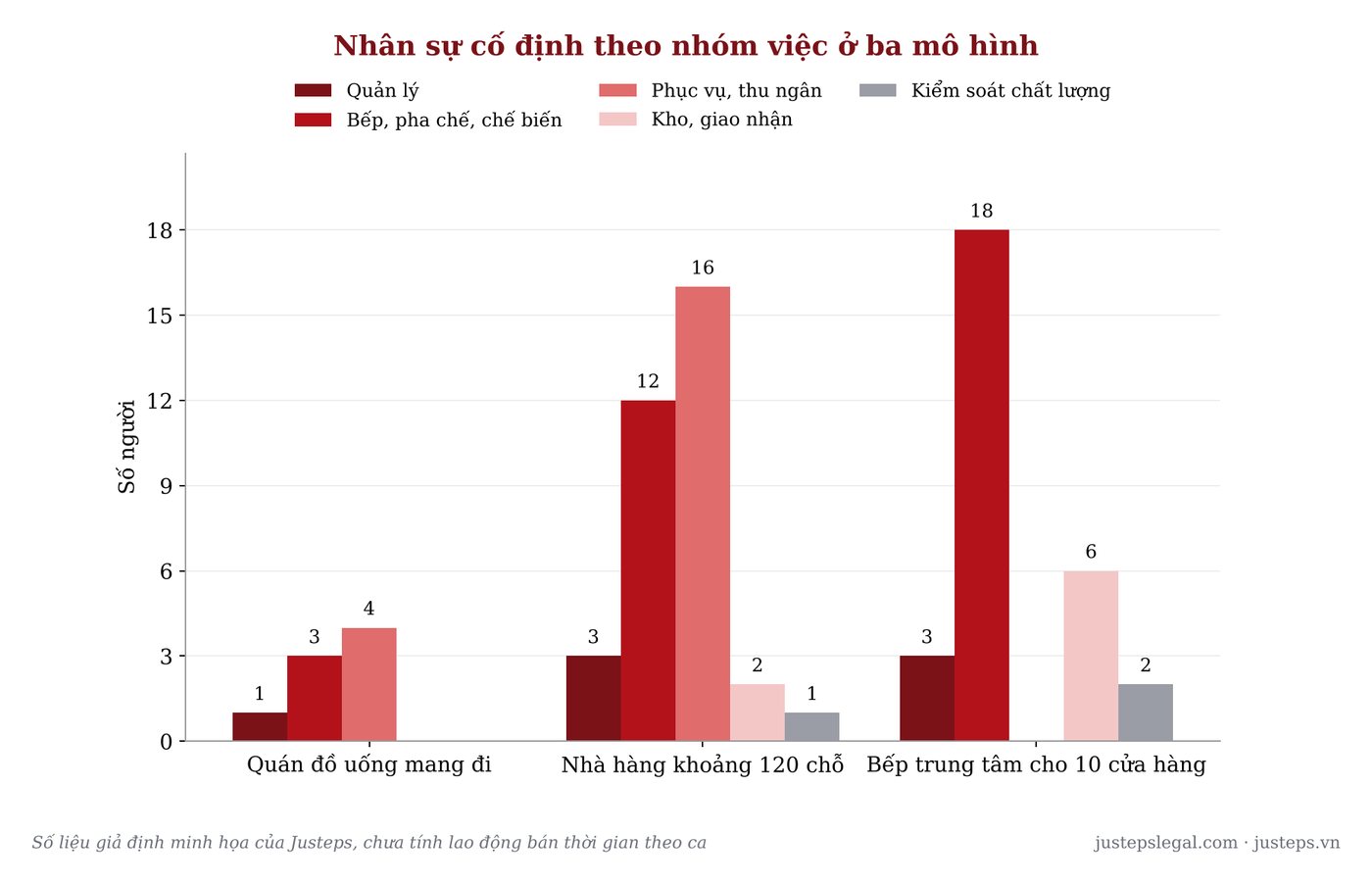
Example permanent staff by work group for three outlet models
In the example, a takeaway drinks outlet needs 8 people, comprising 1 manager, 3 baristas and 4 service and cashier staff. A restaurant of about 120 seats needs 34 people, including 12 in the kitchen, 16 in service and cashiering, 3 managers, 2 storekeepers and 1 quality controller. A central kitchen serving ten outlets needs 29 people, mainly 18 in food preparation and 6 in warehousing and delivery. In addition to permanent staff, restaurants usually add part-time workers for peak hours and weekends, so Justeps’ staffing table shows permanent workers and shift workers separately. Contracts, hourly pay calculation and insurance for this group are handled under the labour, wages and social insurance service for restaurant, café and F&B chain businesses.
Implementation process, deliverables and fees
For a chain of fewer than ten outlets, an organisational structure design project usually takes about eight weeks. Justeps works at a number of representative outlets, attending at least one peak shift and one early-morning delivery to see the actual work rather than relying only on the existing chart.
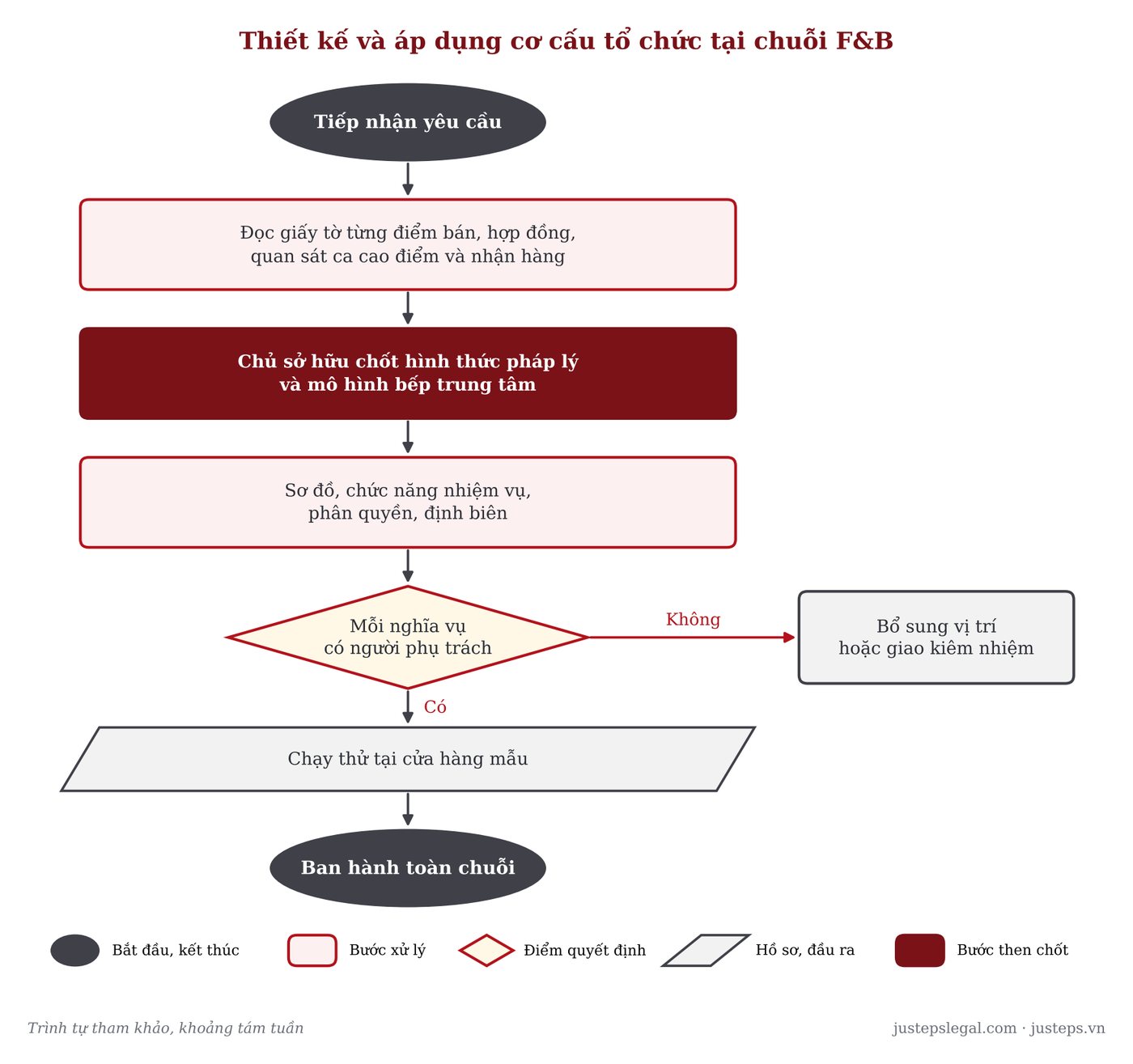
Sequence for designing and applying the organisational structure in a restaurant and café chain
In the first two weeks, Justeps reviews the legal documents of each outlet, leases and franchise agreements if any, and interviews the owner, outlet managers and head chefs. In the third week, the owner settles the legal form of the outlets and the central kitchen model, after which Justeps drafts the chart, functions and duties, authority matrix and staffing table. If any obligation still has no one in charge, Justeps adds a position or assigns it concurrently before a pilot at a model outlet in the final two weeks. The deliverables comprise the following documents:
- An assessment of the legal form of each existing and planned outlet, with recommendations.
- The organisational chart of the whole chain, a standard outlet chart and a central kitchen chart where applicable.
- Rules on the functions and duties of the chain office, outlets, central kitchen and quality control unit.
- An operational authority matrix between the owner, operations director, area managers and outlet managers.
- A staffing table for each outlet model, separating permanent and shift workers.
- Draft decisions issuing the organisational structure and appointing the persons responsible for food safety and fire prevention at each outlet.
Justeps quotes a fixed project fee in writing after the initial meeting. The fee depends on the number of outlets and legal entities, whether there is a central kitchen or franchise system, the need for bilingual documents for foreign investors, and whether the business needs Justeps to follow the pilot at the model outlet closely. A chain preparing to expand through franchising can combine this with the retail chain and franchise set-up service to design the franchisee support function from the start.
How Justeps can help
In addition to organisational structure design, restaurant, café and F&B chain businesses can combine the following Justeps services:
- Internal procedures and regulations for restaurant, café and F&B chain businesses. Justeps writes procedures for receiving goods, food checks, shift close and incident handling for each newly designed position.
- Labour, wages and social insurance services for restaurant, café and F&B chain businesses. Justeps turns the staffing table into contracts, shift rosters, hourly pay calculations and insurance records.
- Opening branches, representative offices and business locations. Justeps carries out the registration procedures for each outlet in the chosen legal form.
- Financial regulations and delegation of authority. Justeps sets spending, contract signing and discount limits for the owner, the chain office and outlet managers.
- Retail chain and franchise set-up. Justeps designs the franchisee support and monitoring function when the chain moves to a franchise model.
Frequently asked questions
Does a single-outlet café need an organisational chart?
Yes, but one page is enough. The chart shows who receives goods, who holds the cash, who keeps the food safety and fire prevention records, and who decides on the owner’s behalf when the owner is absent.
Should an outlet be registered as a branch or a business location?
A business location involves simpler procedures and suits a centrally managed company, while a branch suits cases where the head of the outlet needs broader signing authority[6]. Justeps compares the two options in terms of tax declaration, invoicing and each chain’s expansion plans.
Who is responsible when a customer suffers food poisoning at an outlet?
The business in whose name the establishment is registered is responsible to the customer and the State authorities[1]. Internally, the organisational structure must identify who keeps that outlet’s receiving, food check and sample retention records to show that the establishment acted correctly.
To whom should the quality control unit report?
It should report to the chief executive or the owner, not to the person carrying the outlets’ sales targets. Decisions to discard ingredients or suspend a dish are then not driven by revenue pressure.
Does a franchise chain need to manage the staff of franchised outlets?
No. Staff of franchised outlets belong to the franchisee, while the franchisor monitors compliance with standards under the franchise agreement[8]. The franchisor’s organisation therefore focuses on training, inspection and support.
How often should the organisational structure be reviewed?
Once a year, and immediately when the chain opens a central kitchen, adds a new outlet model, moves to franchising or brings in an investor. These changes usually require reallocating obligations at each outlet and amending the authority matrix.
Related articles
- Internal procedures and regulations for restaurant, café and F&B chain businesses, from goods receipt to shift close
- Ongoing legal advisory for restaurant, café and F&B chain businesses on premises, trade marks and partners
- Labour, wages and social insurance services for restaurant, café and F&B chain businesses with part-time workers and split shifts
- Building restaurant operating procedures from the organisational structure to every service shift
Notes
[1] The Law on Food Safety No. 55/2010/QH12 dated 17 June 2010.
[2] Government Decree No. 15/2018/ND-CP dated 2 February 2018 detailing a number of articles of the Law on Food Safety, applied during the period in which Decree No. 46/2026/ND-CP is suspended under Government Resolution No. 15/2026/NQ-CP.
[3] The Law on Fire Prevention, Fire Fighting, Rescue and Salvage and the documents amending and supplementing it.
[4] Government Decree No. 254/2026/ND-CP dated 30 June 2026 on electronic invoices and electronic documents.
[5] The Law on Prevention and Control of Harmful Effects of Alcoholic Beverages No. 44/2019/QH14 and Government Decree No. 105/2017/ND-CP on alcohol trading, together with the documents amending and supplementing them.
[6] Article 44 of the Law on Enterprises No. 59/2020/QH14 dated 17 June 2020, as amended and supplemented by Law No. 76/2025/QH15.
[7] Government Decree No. 168/2025/ND-CP dated 30 June 2025 on enterprise registration, as amended and supplemented by Decree No. 296/2026/ND-CP dated 23 July 2026.
[8] The Commercial Law and the documents amending and supplementing it, and Government Decree No. 35/2006/ND-CP detailing the Commercial Law on franchising activities, together with the documents amending and supplementing it.
[9] The Law on Enterprises No. 59/2020/QH14 dated 17 June 2020, as amended and supplemented by Law No. 76/2025/QH15.
This article is for reference and reflects the regulations in force at the time of publication. Please consult Justeps for advice tailored to your company’s records and situation.
For further information, please contact:
📩 Email: info@justeps.vn
🌐 Website: https://justepslegal.com · https://justeps.vn
🌐 Page: Justeps
☎️ Hotline (Zalo): 096 172 2607
📍 Thanh Xuan Office: 12th Floor, Licogi 13 Tower, 164 Khuat Duy Tien Street, Thanh Xuan Ward, Hanoi, Vietnam
📍 Ha Dong Office: LK06B, No.10, Dong Dua Area, Ha Dong Ward, Hanoi, Vietnam
📍 Ho Chi Minh City Branch: 528 Le Van Sy, Ho Chi Minh City, Vietnam
📍 Hai Phong Office: Truong Thinh Village, Ha Dong Commune, Hai Phong, Vietnam
📍 Quang Ninh Office: Van Don Special Zone, Quang Ninh Province, Vietnam





