
Key takeaways
- A security service business may only operate once it holds a certificate of satisfaction of security and order conditions, and the person responsible for security and order must meet specific standards, so every appointment or replacement of the head of the business should be checked against those conditions before it is signed[1].
- A control centre staffed around the clock, sitting between site team leaders and the board of directors, ensures that night-time incidents are recorded, classified and reported in the same sequence instead of depending on whoever can be reached by phone.
- Businesses providing security services are among the entities permitted to be equipped with support tools, so the tools should be managed centrally by a unit at head office and issued only to staff who have been trained[6].
- Staffing must be calculated from the total duty hours of each site divided by the number of hours one person may lawfully work, not from the number of posts; otherwise the organisation only functions by relying on overtime beyond the statutory limits.
A security service business with five hundred staff may have its workforce spread across seventy or eighty guarded sites in several provinces, from factory gates, building lobbies and residential car parks to warehouses and weekend events. Most staff work at clients’ sites, rarely see their direct manager and have to deal with situations on their own during night shifts. When the organisation consists only of a board of directors, an administration department and self-managing team leaders, every incident ends up on the director’s phone, and the questions of who keeps the support tools, who checks the shifts and who is eligible to be named on the certificate are only asked when the police carry out an inspection.
This page introduces Justeps’ organisational structure design service for businesses providing site security, event security, bodyguard services and security monitoring using technical equipment. The main legal basis is Decree No. 96/2016/ND-CP on security and order conditions for certain conditional business lines, which has been amended several times, most recently in 2026, together with the 2024 Law on Management and Use of Weapons, Explosives and Support Tools.
Operational features that call for a dedicated structure in security businesses
The security workforce is dispersed and works continuously. A post staffed around the clock needs someone present 24 hours a day, including public holidays and Tet, while managers only visit periodically, so the organisation must have a point that receives reports and makes decisions independently of office hours. Business conditions are also tied to specific individuals, from the person responsible for security and order to every member of staff, who must hold a security guard professional certificate[1], and these conditions are easily broken when the business changes its director, opens a branch or hires in a hurry for a new contract.
The conduct of a single member of staff at a site can also turn into a criminal case or a compensation claim against the business. Holding a suspected thief for longer than necessary, using support tools in the wrong circumstances or leaving a post when property goes missing all stem from shifts that are not supervised, so the structure must include an inspection line that is independent of the direct commander.
Legal conditions attached to each position in the organisation
The person responsible for security and order
Under Decree No. 96/2016/ND-CP, security services may only be provided in the form of an enterprise, and the person responsible for security and order must hold at least a college degree and meet the background standards set by law[2]. Information about this person is recorded in the application file for the certificate, so when the person is replaced, the business must apply to the competent police authority to have the certificate reissued, rather than only registering the change with the business registration authority. From 2026, certificates for businesses with foreign elements or businesses permitted to train security staff fall within the competence of the administrative management police authority of the Ministry of Public Security, while certificates for other businesses are issued by the provincial police[3].
Security staff and the training unit
A business may only use security staff who meet the selection standards, have been trained and granted a security guard professional certificate and have an employment contract, and it must issue badges and uniforms bearing the logo registered with the police[4]. Under the 2026 amendments, the security guard professional certificate is valid for 05 years from the date of issue[3], so in a business with several hundred staff, certificates will fall due almost every month. Tracking certificate expiry dates, organising retraining and issuing uniforms should belong to an operations and training unit at head office rather than being left to individual team leaders.
A business that wishes to train its own security staff must meet separate conditions on facilities, length of operation, size of workforce and trainers, and may only provide training after its curriculum and programme have been approved[5]. Setting up an internal training centre or sending staff to external training is therefore a structural choice, which brings with it trainers, training grounds and even a different authority issuing the certificate.
Support tools
The 2024 Law on Management and Use of Weapons, Explosives and Support Tools places in-house security forces of agencies, organisations and enterprises and businesses providing security services among the entities that may be equipped with support tools[6]. A person assigned to use them must have received training, be in good health and have full civil legal capacity, and is responsible for keeping them properly and not losing or damaging them[7]. A single point of contact is therefore needed to keep the issue register, the storage location, the list of trained staff and the return records, instead of leaving tools scattered across the posts.
Common mistakes in existing structures
When reviewing medium-sized security businesses, Justeps often encounters the same group of organisational mistakes. The table below summarises each mistake, its consequences and the adjustment made in the new structure.
| Mistake | Consequence | Adjustment |
|---|---|---|
| Appointments based on seniority | The person appointed as branch director does not meet the standards, and the certificate has to be reissued urgently or the business is penalised. | Draw up a list of conditions for each position and a mandatory check before submission for signature. |
| No control centre | Night-time incidents go straight to the director, there is no log, and clients receive reports late. | Set up a centre staffed around the clock with authority to deploy reserve staff. |
| Team leaders keep the support tools themselves | The business cannot show who was assigned the tools, whether they were trained or when the tools were last used. | Make the operations unit responsible for central management, with signed issue records and periodic stocktakes. |
| Commanders inspecting themselves | Sleeping on duty, leaving posts and recording false duty hours go undetected until property is lost. | Separate internal inspection, reporting directly to the board of directors. |
| Staffing based on the number of posts | Each post has only two or three people, who work overtime beyond the limits and lack rest days. | Calculate staffing from total duty hours and lawful working time. |
The organisational model Justeps proposes
The model Justeps usually proposes for businesses with around twenty sites or more consists of five functional blocks at head office, built on the person responsible for security and order and a set of documents allocating authority. The figure below shows these blocks.
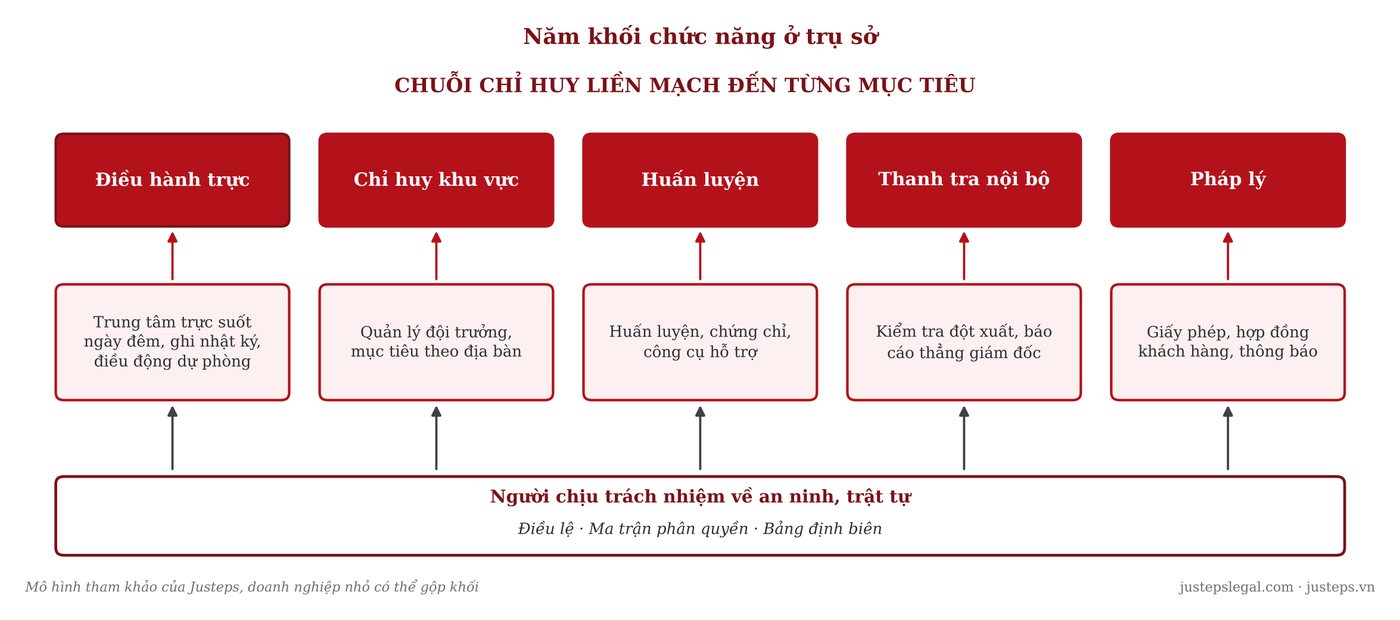
Five functional blocks at the head office of a security service business
The control centre and the area commanders form the day-to-day command line, with site team leaders reporting to the area commander and reporting incidents immediately to the centre. Internal inspection sits outside the command line so that inspection results cannot be adjusted by the very people being inspected, while the administration and legal block handles the certificate, client contracts and notifications to the police.
The control centre
Justeps designs this centre with three clear tasks: receiving and logging every call and report from the sites; classifying incidents by severity to decide who must be informed and how quickly; and deploying reserve staff when a post is short of people. The centre’s shift supervisor is authorised to make decisions within a defined scope, and beyond that scope must report to the area commander or the duty manager according to the issued list.
Independent internal inspection
Internal inspection carries out unannounced checks at sites, compares shift logs and patrol data with the actual situation and reports directly to the director or the person responsible for security and order. Inspection should not sit under the area commander, because the inspection results would then reflect the management performance of the very person who assigned the work to the inspector. In a small business, one person holding the role concurrently is sufficient, provided that person does not command the sites being inspected.
The area level and branches
When deploying staff to sites in a province or city other than where the head office is located, the business must notify the commune-level police where the site is located within 05 days, enclosing a copy of the certificate, the list of staff and the quantity and types of support tools[4]. If the number of sites in a province is large enough, the business may consider establishing a branch or business location under the Law on Enterprises[8], in which case the head of the branch must also meet the security and order conditions.
Staffing by duty hours
A post staffed around the clock needs 8,760 hours of presence a year. If each member of staff may only work within the limits on normal working hours and overtime under the Labour Code[9], the number of people per post is always greater than the three or four that many businesses currently assign, before taking into account annual leave, public holidays and Tet, sick leave and reserve staff. Justeps therefore calculates staffing from the bottom up, starting with the total duty hours of each site and only then moving on to the number of team leaders, area commanders and head office staff.
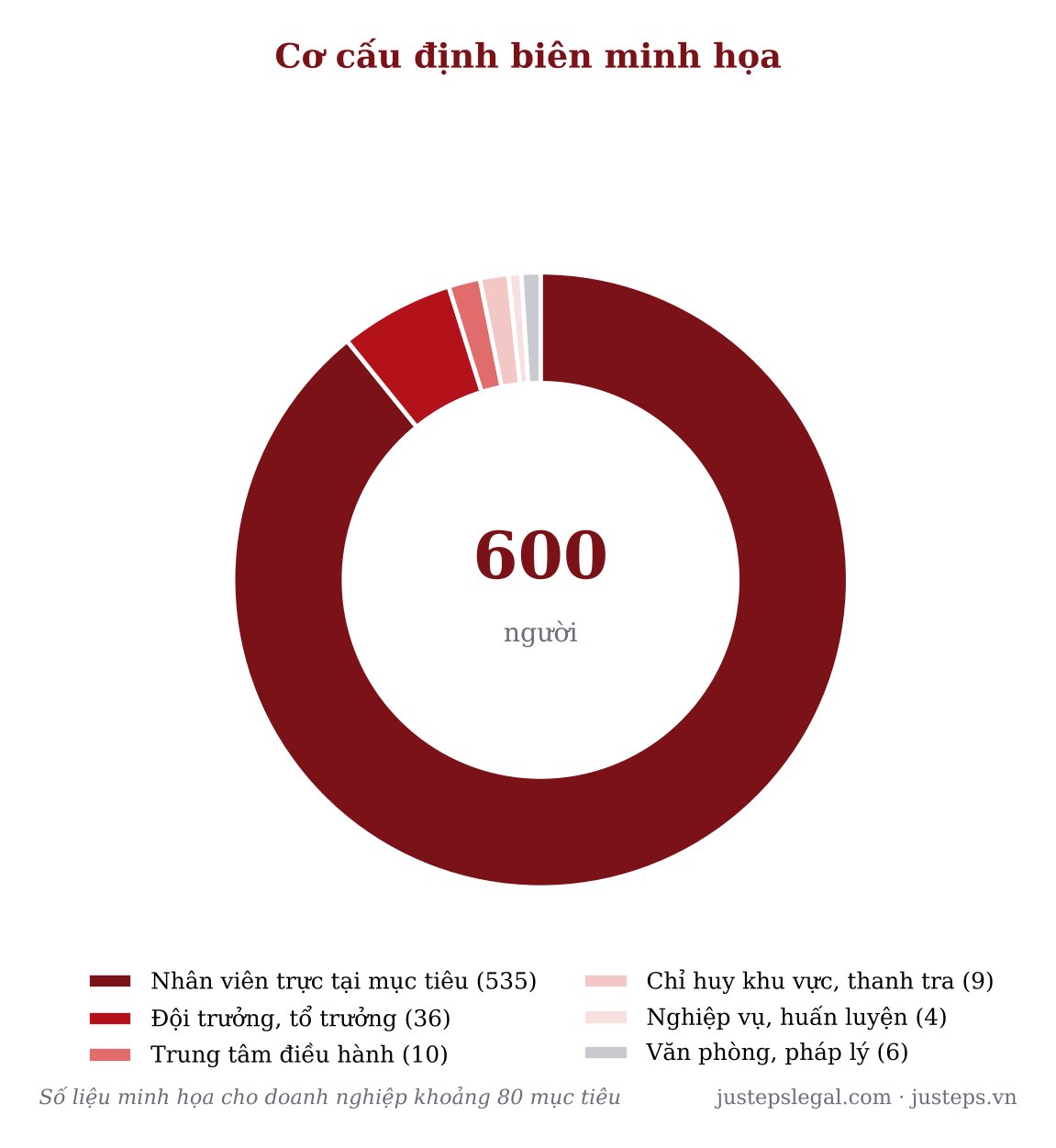
Example staffing structure of a security business with around 600 people
In this example, staff on duty at the sites make up most of the workforce, team leaders and group leaders account for around one fifteenth, while the control centre, area commanders, inspection, training and the office together make up only around five per cent. Organising shifts and calculating pay for each shift model is dealt with in detail by Justeps in the labour, payroll and insurance service for security service businesses.
Implementation process and deliverables
An organisational structure design project for a security business usually takes around nine weeks. The key turning point is the result of checking the conditions of the people proposed for appointment, because if they do not qualify, another person must be chosen or the arrangement changed before the structure is issued. The flowchart below shows the sequence.
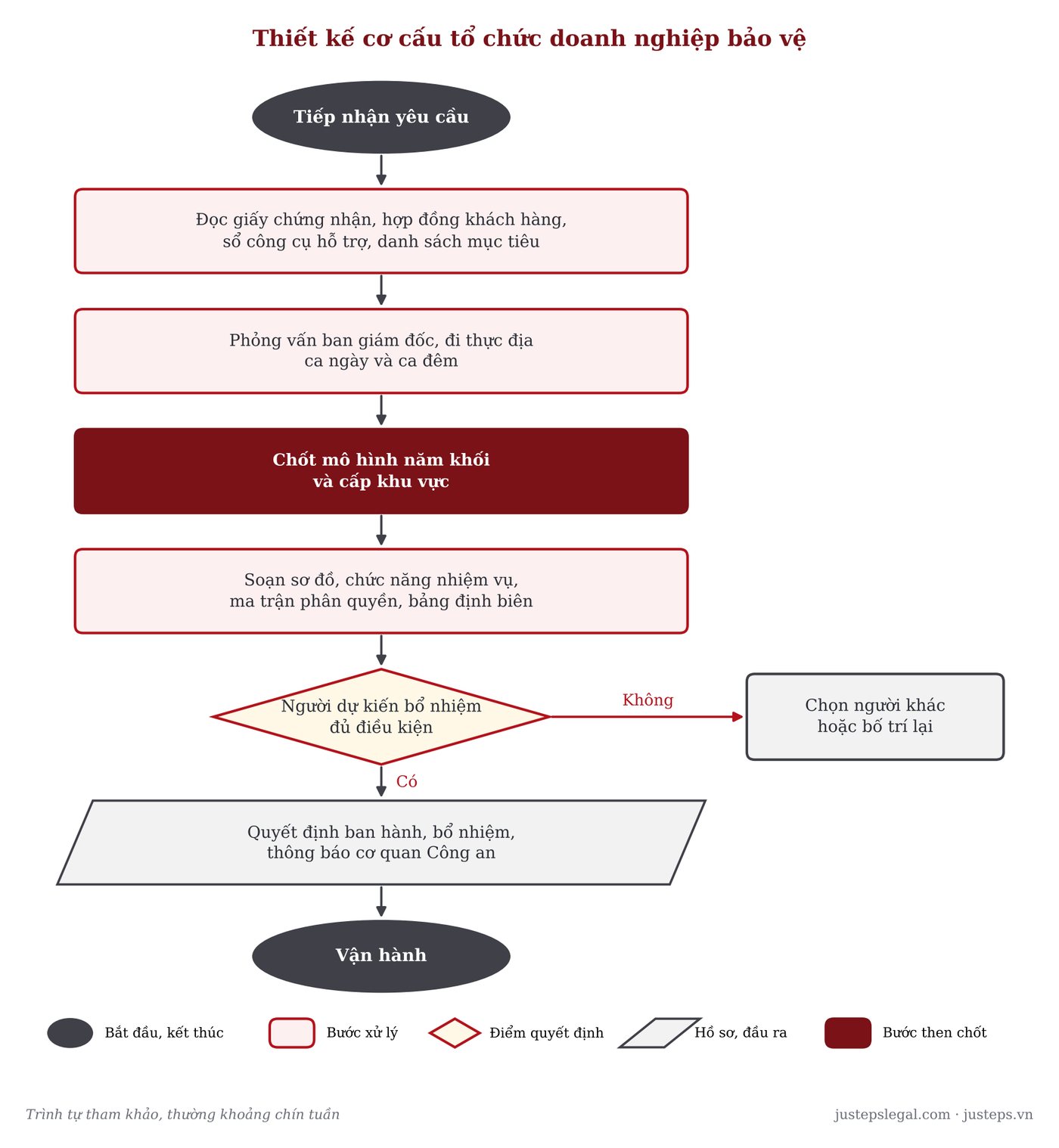
Sequence of organisational structure design for a security service business
In the first two weeks, Justeps consultants read the certificate of satisfaction of security and order conditions, the list of sites, client contracts and the support tools issue register, interview the board of directors and visit several sites during both day and night shifts. In week three the model is settled with the board of directors, and the following weeks are spent drafting documents and checking the conditions for each position. The deliverables comprise the following documents:
- An organisation chart for head office, the area level, branches and the team model at sites, with an explanation of the reasons for the choices made.
- Statements of the functions and duties of the control centre, the operations and training block, internal inspection and the administration and legal block.
- A table checking the conditions of the person responsible for security and order, branch heads and key positions.
- An authority matrix for deploying staff, issuing support tools, taking on new sites, temporarily withdrawing from a site and reporting incidents.
- A staffing table by duty hours for each type of site, which can be updated when new contracts are signed.
- A draft decision issuing the structure, appointment decisions and a list of notifications to be sent to the police and the business registration authority.
Once the organisation has been issued, the new positions need shift procedures, support tools regulations and incident handling procedures in order to work to the same standard. This work falls under the service for building internal procedures and regulations for security service businesses, which is usually carried out immediately afterwards to make use of the survey results.
Application by size and type of business, and fees
A business with fewer than twenty sites usually does not yet need an area level; the director acting as overall commander, one person on duty in the control role for each shift and one person concurrently responsible for inspection are sufficient, provided support tools are still managed centrally. A business with hundreds of sites across several provinces needs all five blocks, an area level organised by territory and clear rules on the relationship between head office and branches. Bodyguard services need a separate team with their own selection and training standards, while event security needs a mobile team and a point of contact for coordination with the competent authorities.
A business with foreign investment or with a foreign national in a key management position is classified as an establishment with foreign elements and is subject to separate conditions on capital contribution, equipment and the authority issuing the certificate[3], so the list of business lines and market access conditions under the Law on Investment should be reviewed before negotiations[10]. The service fee is quoted as a fixed fee in writing after the initial meeting, depending on the number of sites, the number of staff, the number of provinces in which the business has a workforce, whether it has branches, the scope of services it currently provides and whether it needs support preparing the file to have the certificate reissued.
How Justeps can help
Alongside organisational structure design, security service businesses may combine the following Justeps services:
- Building internal procedures and regulations for security service businesses. Justeps drafts shift procedures, support tools regulations and incident handling procedures so that every position in the new organisation knows its own tasks.
- Labour, payroll and insurance services for security service businesses. Justeps designs shift models, pay scales by command level and the calculation of overtime and night work in line with the staffing table.
- Organisational structure, functions and duties and job descriptions. Justeps drafts job descriptions for control centre shift supervisors, area commanders, internal inspectors and site team leaders.
- Opening branches, representative offices and business locations. Justeps selects the form of registration for the workforce in other provinces and prepares the accompanying files alongside the security and order procedures.
Frequently asked questions
Does changing the director of a security company require a procedure with the police?
Yes, if the new person is the person responsible for security and order recorded in the certificate file. In addition to registering the change with the business registration authority, the business must apply to have the certificate reissued and should check the new person’s conditions before the appointment[2].
Is a security business required to set up a control centre?
The law does not prescribe a mandatory name for this unit. However, a business with many sites guarded at night needs a point that continuously receives reports and deploys staff, and large clients often require this in their tenders.
Who should keep the business’s support tools?
The operations unit at head office should manage them centrally, issuing them against a signature to trained staff and taking them back when the assignment ends. A person assigned to use them must meet the training conditions and is responsible for keeping them as required by law[7].
Does deploying staff to another province require a branch to be established immediately?
Not necessarily, but the business must notify the commune-level police where the site is located within 05 days of deployment[4]. When the number of sites in that province grows and contracts need to be signed locally, establishing a branch is usually considered.
How many staff does a post guarded around the clock need?
The figure depends on the shift model, rest entitlements and the reserve ratio, but it is usually more than four people if the limits on working hours and overtime are respected[9]. Justeps draws up a staffing table for each type of site instead of using one general figure.
Related articles
- Building internal procedures and regulations for security service businesses so that staff know the limits of their actions
- Ongoing legal advisory for security service businesses from client contracts to incidents at guarded sites
- Labour, payroll and insurance services for security service businesses with lawful 12-hour shifts
- How to choose an organisation chart model that fits the size of a business and the way it generates revenue
Notes
[1] Government Decree No. 96/2016/ND-CP dated 1 July 2016 on security and order conditions for certain conditional business lines, as amended and supplemented by Decree No. 56/2023/ND-CP, Decree No. 58/2026/ND-CP and Decree No. 392/2026/ND-CP.
[2] Article 11 of Government Decree No. 96/2016/ND-CP dated 1 July 2016 on security and order conditions for certain conditional business lines, as amended and supplemented by Decree No. 56/2023/ND-CP, Decree No. 58/2026/ND-CP and Decree No. 392/2026/ND-CP.
[3] Government Decree No. 58/2026/ND-CP dated 13 February 2026 amending and supplementing a number of articles of decrees on security and order conditions, including Articles 4, 12 and 24 of Decree No. 96/2016/ND-CP.
[4] Article 32 of Government Decree No. 96/2016/ND-CP dated 1 July 2016 on security and order conditions for certain conditional business lines, as amended and supplemented by Decree No. 56/2023/ND-CP, Decree No. 58/2026/ND-CP and Decree No. 392/2026/ND-CP.
[5] Article 12 of Government Decree No. 96/2016/ND-CP dated 1 July 2016 on security and order conditions for certain conditional business lines, as amended and supplemented by Decree No. 56/2023/ND-CP, Decree No. 58/2026/ND-CP and Decree No. 392/2026/ND-CP.
[6] Point m, Clause 1, Article 52 of the Law on Management and Use of Weapons, Explosives and Support Tools No. 42/2024/QH15 dated 29 June 2024, effective from 1 January 2025.
[7] Article 6 of the Law on Management and Use of Weapons, Explosives and Support Tools No. 42/2024/QH15 dated 29 June 2024, effective from 1 January 2025.
[8] Articles 44 and 45 of the Law on Enterprises No. 59/2020/QH14 dated 17 June 2020, as amended and supplemented by Law No. 03/2022/QH15 and Law No. 76/2025/QH15.
[9] Articles 105, 107 and 111 of the Labour Code No. 45/2019/QH14 dated 20 November 2019.
[10] The Law on Investment No. 143/2025/QH15, effective from 1 March 2026, and its guiding documents on conditional business lines and market access conditions for foreign investors.
This article is for reference and reflects the regulations in force at the time of publication. Please consult Justeps for advice tailored to your company’s records and situation.
For further information, please contact:
📩 Email: info@justeps.vn
🌐 Website: https://justepslegal.com · https://justeps.vn
🌐 Page: Justeps
☎️ Hotline (Zalo): 096 172 2607
📍 Thanh Xuan Office: 12th Floor, Licogi 13 Tower, 164 Khuat Duy Tien Street, Thanh Xuan Ward, Hanoi, Vietnam
📍 Ha Dong Office: LK06B, No.10, Dong Dua Area, Ha Dong Ward, Hanoi, Vietnam
📍 Ho Chi Minh City Branch: 528 Le Van Sy, Ho Chi Minh City, Vietnam
📍 Hai Phong Office: Truong Thinh Village, Ha Dong Commune, Hai Phong, Vietnam
📍 Quang Ninh Office: Van Don Special Zone, Quang Ninh Province, Vietnam





